Tag Archives: Scenery

Day 4 – To the woods! To the woods!!

18th September – The tour buses came for us at 0830 and transported us to the start point of today’s walk. I was, as ever, grateful that they did the work to give us some altitude, as this meant I didn’t have to. As Željko had explained the day before, there would be a down side later, in the form of much walking down, but his view was that walking up 800 metres from Bol and then simply turning round and walking back down again was less interesting, particularly since that would be in full sunshine (and 30° heat) all the way. So instead we were dropped at somewhere in the middle of nowhere notionally called Gažul, which left us just a couple of hundred metres to climb before we had to make our way back down to our hotel in Bol.

Gažul was a slightly spooky place, practically a ghost village – a handful of derelict-looking buildings miles from anywhere. There were signs of returning population: the local rain-collecting cistern had been repaired and one or two buildings were showing signs of being brought back to a liveable state. Željko explained that the inhabitants would basically have abandoned the village and migrated to the coast to support the booming tourist industry. Now there was the possibility to repair the buildings, but most likely to rent to visitors rather than to live in.

The uphill part of the walk led, unusually, through woodland – and therefore shade!
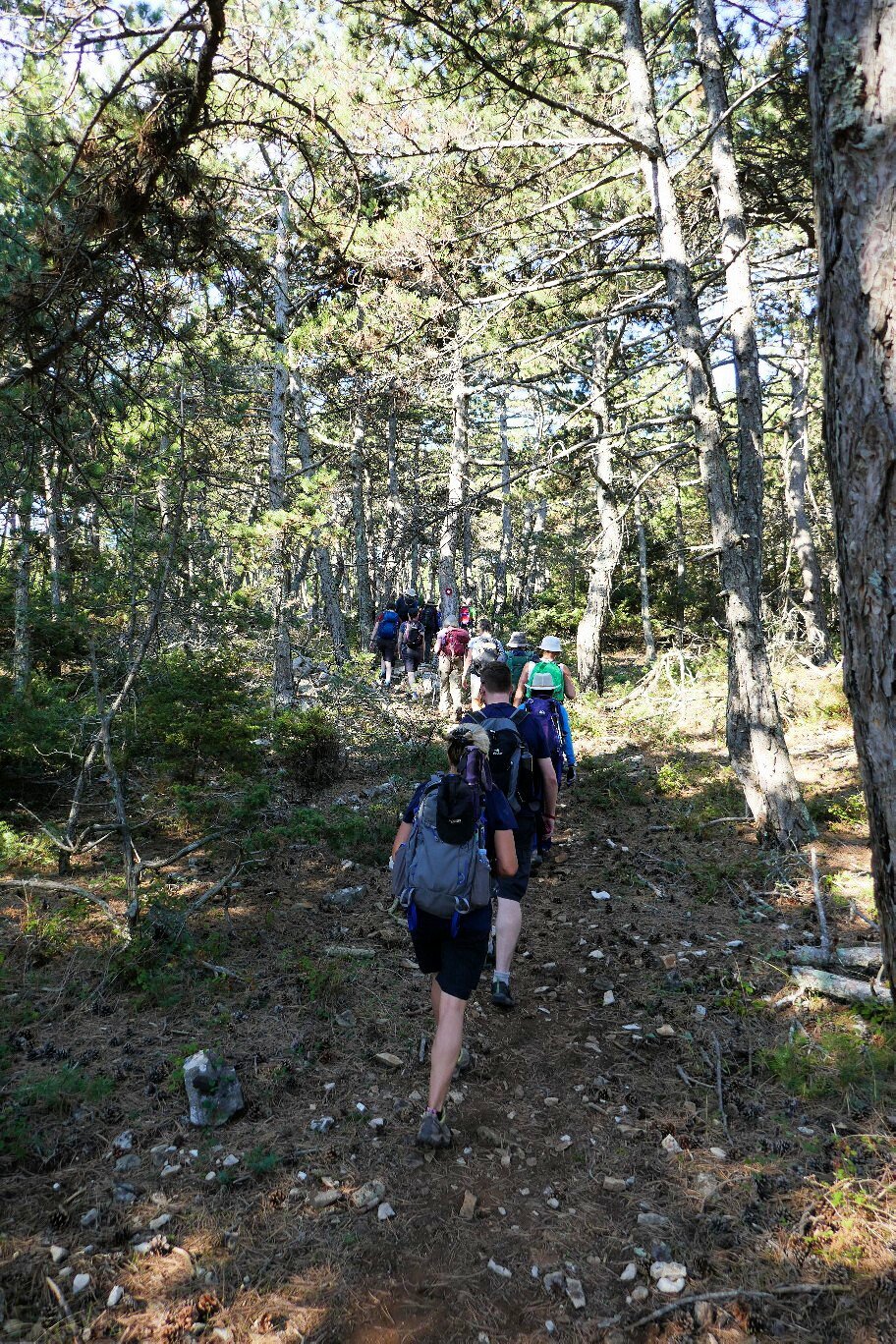
Željko had described it as “basically flat”, and, after a little bit of climbing, it led gently up to Vidova Gora, the highest point on the island. A helpful sign set our expectations as to how long it would take to get there
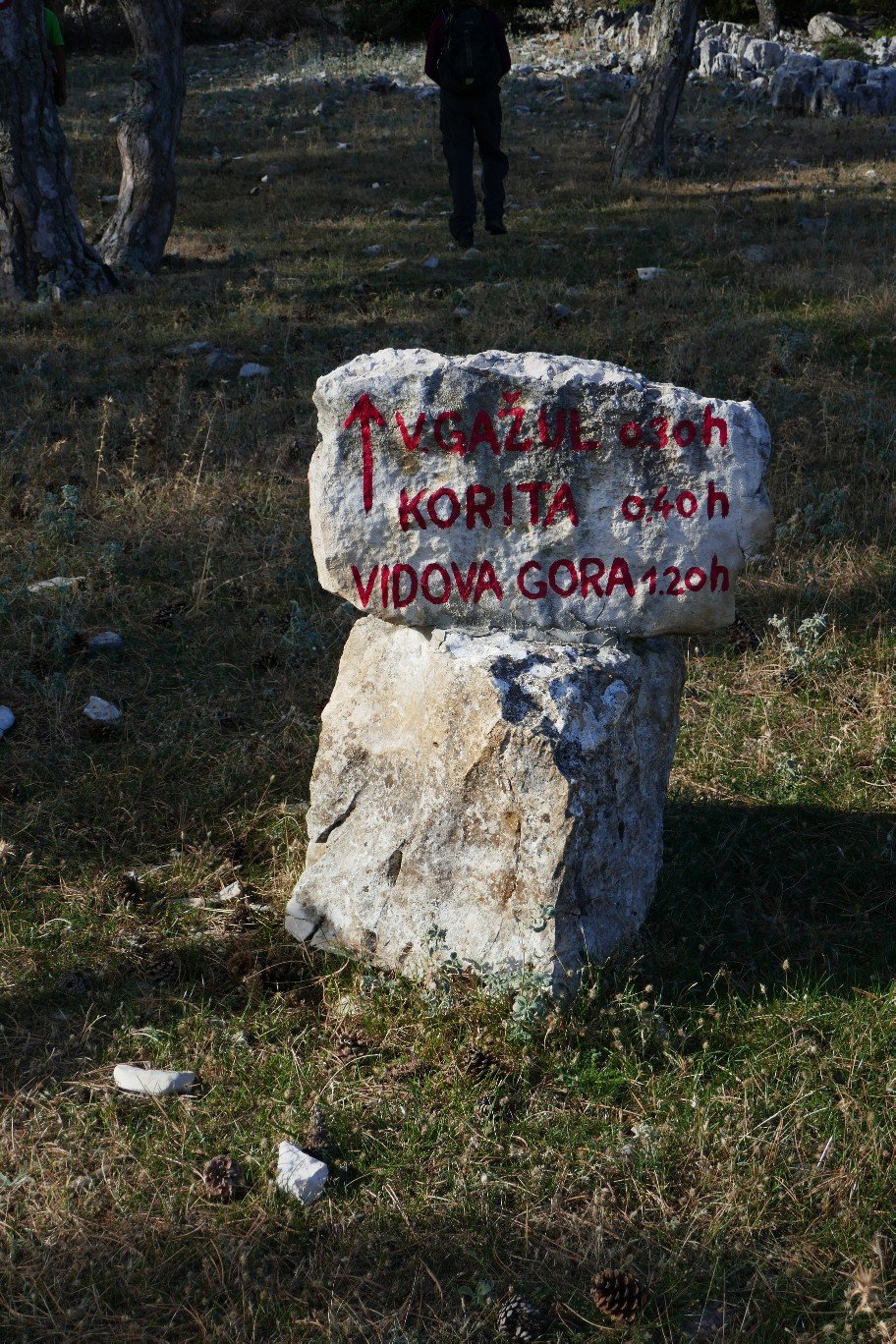
and the route was, like all of the tracks we had followed in Croatia, very well-marked with waymarks in the trees and on the rocks.

Accordingly, after about an hour and twenty minutes, we arrived at the top. There used to be a restaurant here

but it was now closed (no beer for me, then!) and, in any case, Željko explained, despite it selling good, if simple, fare, the proprietor had been an eccentric veteran soldier with a short fuse and a shotgun. Probably best to press on to the penk itself, then:

where the view back towards Bol was spectacular, if somewhat hazy.

On the right-hand side of the photo, you can see the “famous” Zlatni Rat beach of Bol, with its little tip which sometimes points one way, sometimes the other. Vidova Gora has a sharp and steep drop over the edge – suitable for parasailing; we saw one chap turn up with a parachute and the sort of expression on his face that said he was going to use it – and various wags had decorated the preciptious edge with little rock cairns.

These serve no purpose other than to encourage other people to erect their own, apparently.

After a short break for lunch in the shade of a couple of trees it was time to head down to Bol – a long and rocky path which zigzagged its way down the side of the slope.

It was a long, hot and sweaty descent, tough, as the day before’s had been, on knees, ankles and feet (incredibly there was someone trying to negotiate this downslope on a bicycle!). But there were a couple of diverting moments on the way down, as the more eagle-eyed in our group spotted things worth stopping to look at, such as this praying mantis

and even a chance to see a cicada, which is a pretty rare thing (unlike hearing them, which is unavoidable).

When we finally got down to Bol, a process which took a couple of hours, Željjo pointed out a superb example of a 1960s Croation car called a Zastava, which had a back-end very similar to an old Fiat 500

although the front was different.

The company that made these was eventually taken over and made cars under the name Yugo, which people of my generation will recall as being alongside the old Škoda and Lada makers in terms of quality and reputation.

After the luxury of a well-earned shower, Jane and I set out on a mission to find pizza, which we found at an agreeable place called Skalinada. After that we went for a walk around Bol, which is small but beautifully formed.
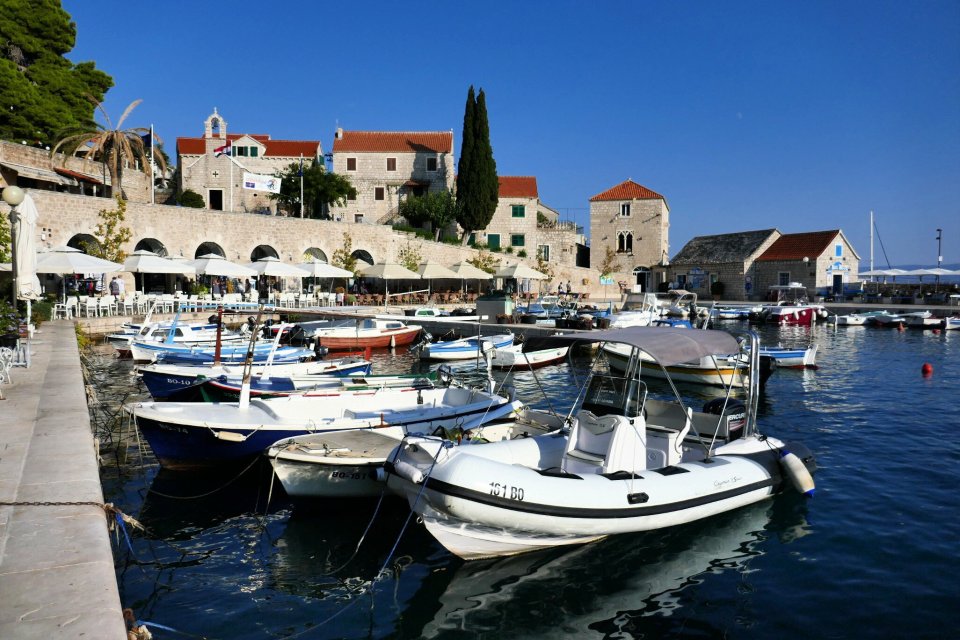
and which has a small market

some strange mural work

and at least one unintentionally hilarious shop name.

There is a delightful promenade leading from the town to Zlatni Rat beach, pleasant and shady. We walked a little way along it until my need to get back to the hotel for a lie down imposed its imperative. A certain amount of drinking of gin and updating of blogs concluded the day’s activities, and we had to get to bed early because of a really early start the next day. You’ll have to read on to find out about that. My goodness, how the excitement mounts!

Trains (well, train)….

18th April 2018

[Short read but lots of pictures alert]

All too soon our day of leisure in Cusco was over and the relentless tourism resumed with an 0500 alarm set for the next day, all so we could go and catch a train. Not just any old train, though – we would have got up later for that – but the Titicaca train, operated, as is the Machu Picchu service we travelled, by PeruRail, and thus sharing many of the same characteristics – friendly staff, drinks and food on board and a fashion show to try to extract a few extra tourist dollars. However, the journey we were undertaking was a significant one – over 10 hours to cover the 384 kilometres from Cusco across the mountains to Puno, on the shores of Lake, you guessed it, Titicaca. (Starting altitude 3,354m above sea level, finishing at 3,828m and, in the middle, getting up as high as 4,319m – over 14,000 feet, and within a very short spit of 2.7 miles high. By way of comparison, the cabin pressure you experience on a typical jet flight is equivalent to an altitude of 2,000 – 2,500m).

If one has to spend 10 hours on a train going over very significant mountainous terrain, it’s reassuring to know that a full meal (and bar) service is provided, as is an observation car.

Prompt at 0710 we started the journey and it was immediately clear that we were in for some great scenery.

It was also nice to see the locals waving a friendly greeting as the train went by.

as well as some who were simply getting on with the daily grind of, for example, subsistence farming of quinoa,

or llamas

which may well have this as their home.

After a short while, the entertainment started in the bar.

and it became clear that the repertoire of traditional Peruvian music stopped at around El Condor Paso (yes, the tune immortalised by Simon and Garfunkel) and tunes such as Hotel California and Sweet Child of Mine were pressed into service – all with some skill and great verve. There was also a dancer

who had at least one costume change and who also got passengers involved in the fun.

And then it was time for the fashion show.

before we had a stop at the highest point, La Raya, where – goodness me! – there was a retail as well as a photo opportunity. My, what a surprise!

Then lunch was served and we could all settle in to a nice siesta.

The scenery continued, of course

(the power of prayer clearly being insufficient to hold this church together)

and then we noticed a bit of a change in the landscape, from the absolutely ubiquitous terracing (e.g. above) to stone-walled corrals

perhaps indicative of a move out of the Inca influence and towards the Titicaca tribes, who it is thought were the first to people the land in Peru, Ecuador and Bolivia. But this was only temporary, and before too long we were back to terracing, so who knows?

As time moved on, the landscape flattened out and we passed all sorts of rural scenes: evidence of oat farming on quite a big scale;

as well as subsistence farming (this is quinoa)

and we’re not sure what this chap was carrying.

Adobe is a common building material

and we even saw a couple of flamingoes, something I had never expected.

And then….we hit the outskirts of the major town of the area, Juliaca (whence we shall fly en route home in a couple of days). It was, frankly, dispiriting, with a very scruffy industrial area outside the town

which gave way to an extraordinary scene – a market of sorts, bordering the railway, for what seemed like several kilometres into the town.

with stalls literally within centimetres of the train as it went by – and even….

…on the track itself! I’ve called it dispiriting, but I guess it’s just how life goes here, and people were calling out cheerily to the train as we went by; they didn’t seem dispirited.

From Juliaca to Puno is flat and uneventful, although you do start to see the incursion of Lake Titicaca as you go along.

From a brief conversation with a guide, I believe we’ll find out much more about this when we go out on the lake tomorrow. You’ll have to stay tuned to find out, won’t you?

Breathless in Cusco

16th April 2018

After the toils and travails of walking up to Machu Picchu, I was looking forward to some less relentless tourism – a visit to Cusco, the city that was the centre of the Inca empire in its glory days.

The journey from Machu Picchu involved once again catching the train to Ollantaytambo, where we had a chat with a couple from Bristol who were nearer the start of their South American adventure than the end. Remarkably, the train staff, having served drinks and snacks, then staged a fashion show with a view to selling us some fine examples of Andean costumery. I bet no-one told them about this sort of thing during careers guidance at school.

The train journey was followed by two hours of purgatory in a taxi. The driver seemed to be a devotee of a particularly tedious variant of traditional Peruvian music which he started playing to us, unasked. It involved a low-quality synthesised guitar/harp/keyboard background to a couple of guys who mainly shouted things like “Ariba!”, “chicos!”, “Cusco!”, “senoritas”, “cerveza!” and so on, and who very rarely actually sang anything recognisable as a tune. At every change of track, I prayed for some variety, but no – tempo, key and harmonic structure, involving just two chords, carried on unabated. I hope the driver enjoyed the music, otherwise there were three of us in the car who hated the music.

Since Cusco’s altitude, at 3,400m above sea level, is somewhat higher than anything I’d experienced before, I was expecting perforce to have to take things gently. In the event, I didn’t suffer from altitude sickness – but I did suffer from altitude. The visit’s prospect of a full day at leisure, something that we’d come to realise is important to factor in to long holidays such as ours, was thus very alluring.

However, we still had to be ready at 0830 to be taken on a guided tour of the city and its environs – who says tourism is relaxing, eh? We were reunited with Camila, our Sacred Valley guide, and she started off by taking us up to Cristo Blanco – the white statue of Jesus Christ which oversees the city. The site offers an excellent view over Cusco.

After this, we went to the nearby Inca site of Saqsaywaman. This was a citadel, with sections originally built by the Killke people, with the Incas adding to it from the 13th century. It’s a large site, with two temples either side of a huge plaza, large enough to hold several thousand people for ceremonial occasions. This is a panorama across the huge main Temple of the Sun, taken from the other temple on the site.

(Note: I had to walk up about 30 largish Inca-style steps to bring you this photo, at the top of which I had to sit down for a couple of minutes, since this site is at 3,700m altitude. So, thank you. Thank you for appreciating the effort I’ve had to make to bring you this educational piece.)

As you can see, the main temple is very substantial (indeed, the whole site occupies some 3,000 hectares). The wall is some 400 metres long, and the estimated volume of stone in the temple is 6,000 cubic metres. The stones in the bottom layers of that wall are vast, with the largest estimated to weigh 125 tonnes.

and yet, you can clearly see the precision with which the stones have been fitted together, with no mortar, and no room even to slide a piece of paper between the stones. The precision of construction and the intricacy of interlocking design are thought to have been the reasons that the site has survived Cusco’s various devastating earthquakes.

To remind visitors that there was doubtless a ceremonial aspect to the site involving the sacrifice of llamas, there are camelids on the site, in this case alpacas, both long- and short-haired varieties; we were particularly taken with this cute little one which can only have been days old.

After the visit to Saqsaywaman, it was time to head back into Cusco proper, where Camila took us to a well-known market called San Pedro (in the square outside St. Peter’s Church).

Before going in, she warned us to take only essential items, as the risk of pickpockets was high.

The San Pedro market was similar in concept to the San Francisco market we’d visited in Quito – organised in sections and with a food court – but much larger and more crowded (hence better turf for pickpockets, I suppose – at any rate we escaped unscathed in that respect). Like all such markets it’s very interesting, varied and colourful.

There are plenty of stalls offering fabrics and clothes; and if they don’t have your size, they can easily make adjustments for you there and then.

As well as the official stallholders, there are people selling from ad hoc locations just sitting on the floor (they need the relevant stallholder’s permission to do this). This one, for example, was selling cuy (guinea pig), and you could take your pick – raw or cooked!

After the bustle of the market, it was time to make things more thoughtful and spiritual, with a visit to a major temple site in Cusco, called Qorichanka. This was the most important temple in the Inca empire (of which Cusco was the capital, as you’ll know, because you’ve been keeping up).

Since this can roughly be translated as “the place with gold”, you’ll not be surprised to learn that it was pillaged by the Spanish when they arrived. Indeed, having stolen the gold, they destroyed much of what was left in building the Church of San Domingo which stands there now. However, some of the original Inca stonework survives, and, indeed supports parts of the church.

There were three temples on the original site – the Temple of the Sun, the Temple of the Moon and the Temple of Venus and the Stars. The type of stonework was the most sophisticated and labour-intensive sort, called ashlar masonry, involving cuboid blocks of similar size, fashioned to the most exacting standards in order to fit together with complete precision.

Here you can see the precision involved; even though the lines of the stone are not necessarily completely straight, the fit is as snug as a very snug thing indeed.

and the precision of alignment of the various components very high.

This was why the Inca remains have survived Cusco’s devastating earthquakes, whereas the church has had to be rebuilt. Hah!

Camila pointed out one other feature which underlined how clever the Incas were. As I say, the stonework was made to great precision (indeed, modern “experts” have failed to disassemble the remnants of the temple stonework without damage, trying to understand how the ashlar masonry worked, and have been unable to reassemble it with the original precision).

The protuberance top left is actually part of a sundial, very carefully calibrated to allow the Incas to understand the time and the seasons. Clever chaps, the Incas.

We were allowed to photograph as much of the Inca work as we liked, but prohibited from photographing the colonial/catholic religious parts of the site. In theory this is out of respect (cameras can be noisy in use; and there is nothing in the world of photography more dispiriting than seeing someone waving a selfie stick around in a place of worship) and possibly because camera flash light can be damaging, and there are (too many) people in this world who don’t even realise that their camera is using flash, far less understand how to stop it doing so. In practice, I actually believe it’s so they can sell you postcards.

The next place we visited, and the final one on our tour, was the cathedral, on the (handsome) main square of Cusco.

No, they don’t let you take photos inside there, either, so this is all you get. However, we were amused by the stories that Camila told us of the rivalry between the cathedral (left, above) and the Franciscan church (the other slab of masonry in the photo). There was political point scoring on every side, with the cathedral having to add elaborate decoration on the front and a dome on top to match the (very ritzy) façade and dome of the Franciscan church; to add two other chapels to make it larger than the Franciscan church; and to forbid the Franciscans from using a part of the building for religious purposes to limit the size of the Franciscan church so that the cathedral was actually larger.

Despite not being able to do anything without sitting down and taking a rest every few minutes, despite the occasionally ridiculous and noisy traffic and despite the difficulty sleeping because of the resonant quality of the hotel plumbing and/or the barking dogs, I liked Cusco a lot. It felt safer, it was more compact, and it had more history to be explored than other South American cities and it has been a pleasure to be here.

A train, a boat and planes lie between us and going home, so stay tuned. But for now it’s time for lunch. (Time For The Bar happened about halfway through the above.)