Tag Archives: Surrey

Eclipses, Ratholes and Frustrations

Thursday 13 August 2026 – Yesterday saw the most significant solar eclipse visible in the UK since 1999. Between then and now there have been a few partial eclipses, but either the weather has got in the way of being able to see anything or its pith and moment in Surrey was negligible.

1999 was the first time I made any kind of effort to view an eclipse.  I didn’t have a digital camera at that stage, and the film camera I did have wouldn’t have made any sense of what was going on, so we viewed it, along with our neighbours and a glass of something cold, via some kind of pinhole-projection setup.

I can’t remember the exact setup, but this was the sort of image we got.

This gave me something of an incentive to Do Better Next Time, although many years elapsed before I was able to have another go. During that time I made the shift to digital photography (Digital Ixus in 2000) and then to Serious Digital Photography (Nikon D70 in 2005 – I even done a course, innit!) and this passage of the years saw, of course, the first photography rathole that I disappeared down. Many photographers are closely acquainted with GAS – Gear Acquisition Syndrome – and I am of their number. I made my way up the Nikon DSLR ladder, acquiring ever more sophisticated bodies and lenses, with purchases supported somewhat by doing paid photo work. I even bought a specialist eclipse filter, from Thousand Oaks Optical, for a Big Lens I’d decided I needed in order to do another project – wildlife photography. But significant eclipses, UK locations and decent weather stubbornly failed to coincide.

Until last year, actually. March 2025 saw a 40% eclipse in the south of England and the weather was decent. At last! An opportunity!

Annoyingly, the filter I’d bought those years ago was made to fit a Big Lens I no longer had, having moved from DSLR to mirrorless with a concomitant change of lenses. But, as a colleague of mine used to say, nil desperandum: I also had a sheet of Thousand Oaks’s black polymer film, so jerryrigged something or other with a square cut out of the film and pointed my new Big Lens at the sun. This was the result.

It’s satisfactory in its way – correctly exposed and in focus – but, frankly, is creatively a bit lacking. It’s just this photo of a not very interesting eclipse, you know? So when I read that there was to be a significant eclipse in 2026, I sought out an eclipse filter properly sized to fit my current Big Lens (Nikon Z 100-400) so I had it ready for August 12 – a 90% eclipse towards sunset over the south of England, with (hooray!) the prospect of a clear sky.

In the run up to this, I fell down another rathole, which was the result of considering how to make something more of what promised to be a spectacular event. After all, I’d proved that I could get an in-focus photo of the sun, so how could I leaven the experience with a bit of creativity? There were, as far as I could work out, no easily-accessible locations where I could factor the eclipse into a landscape or a cityscape to make it spectacular, like this, for example.

Credit: Luke Miller

All I have near me is the leafy Surrey countryside, somewhat devoid of points of interest. Since the maximum point of the eclipse was due to be near sunset, I also needed to be on a hill somewhere, and the only one I could think of was Oystershell Hill, on Chobham Common – a short drive and a 10-minute walk away. I’d used it before for a lunar eclipse series so was fairly confident I could get some kind of a result from there. I’d also seen some time-series photos of eclipses and so I thought I’d have a go at one of them, as well as getting a decent photo of the eclipse at its max.

Here, then, was the next rathole – how to achieve the time series? I wondered about using a multiple exposure setup on the Nikon; set it up, point it in the general direction of the sunset and take several exposures into a single image. If I did that, though, I lost my best chance of getting a top quality image of the eclipse at maximum. I have a very good camera in my phone: could I that in some way?  Was it even possible to use it to get  a decent image of the sun without it being over-exposed? Could I use it to do a hyperlapse? The answer in both cases is no; particularly in the second case, I would end up frying the sensor in the phone, which would be stupid.

In the end, I decided that I could probably use my little Sony RX100 vii, but I would need to jerryrig a filter. So I dug out my ThousandOaks film and discovered there the segment I’d cut out as part of the 2005 jerryrig.   I used it to create something I could position over the lens.

To hold it in place, I decided to use a Wimberley Plamp, a photo accessory I’d purchased some years before for….erm, well, I can’t really remember why I bought it, apart from that it looked like it could come in handy. I hoped it would do the job and I’d get to actually use it, rather than have it simply hanging around in my accessory cupboard.

Previous experience, and the several failed experiments that have bedevilled my time as a photographer, told me that I should have a practice, just to make sure that I had the right stuff with me when the time came and hadn’t forgotten anything. So, 24 hours before, I duly drove over to Chobham Common and trudged up to the top of Oystershell Hill, carrying three tripods and a backpack containing two cameras, lenses, filters, water and snacks. I discovered that I’d rather misjudged the terrain.  I remember there being a flat spot at the top of the hill where I envisaged setting up. Trouble was, I found, it wasn’t suitable for a view of the sun, what with trees being in the way and that.  There was a westerly viewpoint, but it was among long grass off to the side of the path – long grass and, it became clear, junior gorse bushes, against which my shorts-and-sandals attire were woefully defenceless.

Cursing rather less than gently, I set up two of my tripods, and put the Sony on one of them behind the filter. And then discovered a plan-reality disconnect.  I had envisaged setting the Sony up to take multiple pictures as the sun crossed its field of view, with the horizon just at the bottom of each frame.  It was actually exceedingly difficult to put this into practice. I had simultaneously to work out an exposure for the sun through the filter, an exposure for the treeline that formed the horizon and the correct focus distance so that both sun and horizon would be sharp. This had to be done without being able to see the screen of the camera, because the image on it wasn’t bright enough and it was reflecting my shirt. Fortunately, the Sony has an electronic viewfinder so all was not entirely lost, but trying to work out whether the sun was actually in the picture at all was the main challenge. My original plan had been to run a practice sequence of photos, but I abandoned this impossibly idealistic goal, realising that luck and guesswork, as well as long trousers and stout shoes, were going to be the order of the morrow. So I didn’t learn much from my practice session, although I did establish that taking photos with the Nikon handheld was over-ambitious. I had expected it to be a rather dull practice session, with not much to do after my original setting up. In reality it was anything but – frustrating, sweaty and ultimately of limited value.

And so Wednesday 12 August dawned and, come 1730, I started the drive to Chobham common. En route, it occurred to me that there might be another suitable location, on Staple Hill, a different part of Chobham Common – but one with a more convenient car park and possibly a more pleasant (i.e. les gorse-ridden) area in which to set up. So I turned off to get there, and entering the car park, saw that lots of other people had had the same idea. The car park was rammed – I got the last space – and people were beginning to park on the road in the area. It was quite the gathering, with many people clearly having prepared quite comprehensively.

There were a few tripods already set up, and some people were clearly taking things even more seriously than I was.

There was a smattering of eclipse specs and cereal-box pinhole cameras to go with the tripods and serious setups – everyone had come prepared in their own way.

I got myself set up as best I could, but it really was difficult to understand what focal length to set the Sony at – if it were short enough to capture the sun as it entered the eclipse, I couldn’t see whether it would appear so tiny that one couldn’t make out the disk of the moon in front of it. Even with half an hour to set up, I was still dithering about this as the disc of the moon made first contact (as shown on this Nikon image)

so I did some final guesswork for focal length, direction, focus distance and exposure, prayed, and set the Sony going, taking a photo every minute.

The next couple of hours unfolded gently, from 1820 to 2010, with the Sony taking photos automatically, and me taking occasional photos manually with the Nikon. Maximum eclipse was at 1913

but it hadn’t gone very dark;

we couldn’t tell whether the birds had fallen quiet, as we were just by the M3 and traffic was speeding by in complete ignorance of the unfolding spectacle. A contact posted on Instagram that the parrots in the park he was visiting went quiet, but soon started up again as the moon cleared the sun.

People started drifting away soon after the maximum had been reached, but I stayed on for another hour. I was among the last to leave, having recorded photos of the sun as it headed towards the horizon. Eventually I packed up and headed home.

That was when the hard work started, really, because I arrived home with 160 photos and only the vaguest idea of (a) whether they were any good and (b) what to do with them. Completing the processing of them and transforming them into what the Instagram Generation would call “content” took the next 24 hours.

Because the Nikon picture of the eclipse at maximum was, well, not boring, exactly, but certainly had nothing remarkable about it that thousands of others hadn’t already captured, I decided the first thing was to get a time series sorted out. My first target being social media, I needed to do it quickly, so I took a quick look at my available content from the Sony.

I had taken photos every minute, and I elected to check out very fourth photo to see how the sun had moved. The first two pictures I had through the filter with the sun in it were these.

which show the movement, but of course the strength of the filter means that everything else in the scene is blacked out. For a backdrop, I’d taken a photo of the general scene without the filter.

The scenery is too dark and the sky too bright, but this is the sort of thing that can relatively easily be fixed, using my favourite RAW editor, DxO Photolab.


So: I had 20 images of the sun on a black background and a general scene to place them in.  For this, I had to use a different editor; my general image editor of choice, for historical reasons, going back decades, is Corel Paintshop Pro.  To create an image I “simply” had to load the backdrop image and the 20 sun images and then layer the suns over the backdrop – another rathole to spend some time in. So I ground my way through a repetitive process of adding image layers, and this was the final result – cropped in a bit to avoid a couple of defects in the backdrop.

Despite its defects, I have to say I was pretty pleased with it, bearing in mind the amount of guesswork that went into it. For social media purposes, I thought it should make pretty much the impact I was after, so I posted it, and it seemed to get a pretty good response from those that its algorithms bothered to showed it to.

The Nikon photos were all lovely and sharp, but individually didn’t tell much of a story. I wondered whether it might be possible to make a video from them, simply centring each frame on the sun and fading between them.

It’s one way of looking at it, I guess, but not all that inspiring. I wondered if I could animate the time series somehow, which led me to revisit a previous rathole. Looking at the individual Sony images revealed some red fringes around each of the suns. So I had to re-edit all the pictures to remove those, and also spent quite a lot of time trying to to improve the backdrop by making the top a little darker.  But I emerged from the rathole with this.

There are notable defects in al of this content, but all in all I’m not dissatisfied with it as a day’s work.  It’ll certainly stand me in good stead for the next one in the UK, which is in….oh, wait….2090.

Bugger.

Never mind. Maybe I can find another eclipse somewhere else. Watch this space.


Day 13 – Camintosh: wet weather gear needed!

Cami-flage Day 13Wednesday 23rd September 2020

And so to the final day of our Cami-flage walks. From the weather perspective Menorca has the last laugh; our expectations were set low by the Met Office weather app – correctly so, as it turns out.

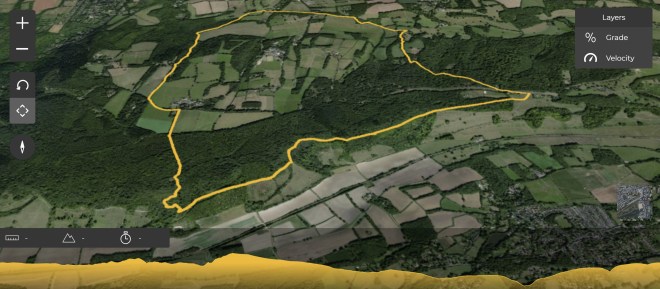
Our final walk was a round trip from Denbies Hillside and up round Ranmore Common; a shorter walk of about 8 miles.

(Dorking is just off to the right in the image.)

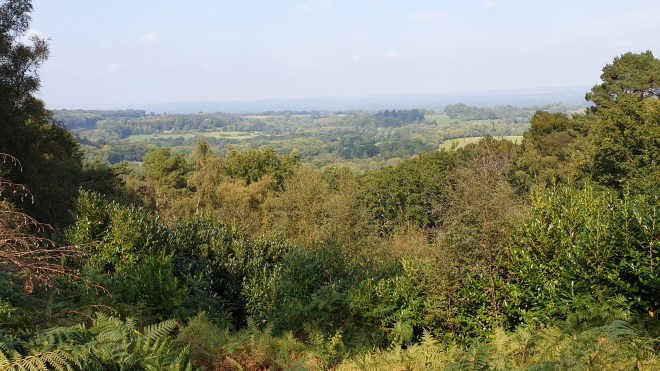
The walk started with a great view over the North Downs

(I have a confession to make – I have titivated some of these photos to make them a little less dull and more colourful; the above is an example. So one or two are not exactly as they came from the phone.)

We soon joined the North Downs Way, which at this point is a long, long straight path.

That’s a magnified view along it, Here’s what it really looked like.

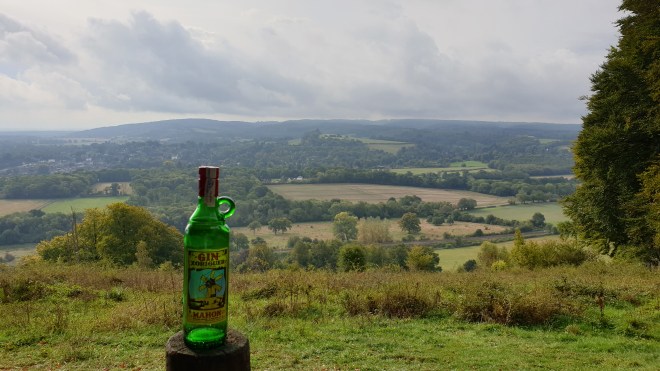
Long and straight. It passes several great views such as these

which are, of course, enhanced by having a gin bottle in them.

If you have better eyesight than mine, you can even see Leith Hill tower on the horizon.

It’s a very enjoyable trail to stomp along. It reminds me of a story about a lady who used to keep herself fit by going for an exhilarating tramp in the woods every day. She died unexpectedly, and her family were really cross with her when they discovered she had left all her money to the exhilarating tramp.

As we walked along, we could hear some very loud crashing, bashing and gnashing. We eventually came across a very industrial strength bit of forestry kit in use beside the path,

although it rather looked like it was Forest 1 – Human 0, as the driver was seen getting some huge spanners out in order to do something arcane to the crashing-bashing-gnashing appendage on the front.

This is a very splendid forest trail, with some great groves of beech and yew trees along it

and a precipitous drop to the left in places.

It is part of the North Downs Way, which is some 153 miles long.

We passed a wartime pillbox or two

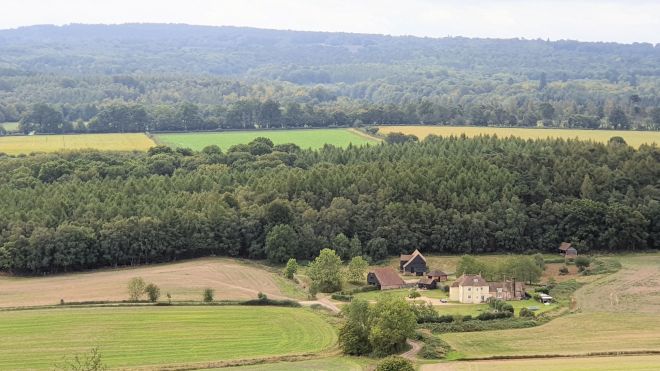
and some spectacular views

before turning off it and heading up to a major forestry trail

alongside which was evidence of some pretty major forestry having taken place. After a while, we emerged at a house called, for some bizarre reason, Red Gables.

before heading back into woodland. The path was not always clear.

but we found ways round and debouched on to Effingham Golf Course (I wonder if if it’s called that because of all the Effingham Blinding that goes on when a golfer hits a bad shot?).

We passed a “Neo-Tudor” pile called Robinswood

which seemed an obvious place to stage another gin bottle shot.

As we crossed fields on the edge of Ranmore Common, we could sort of make out London in the distance.

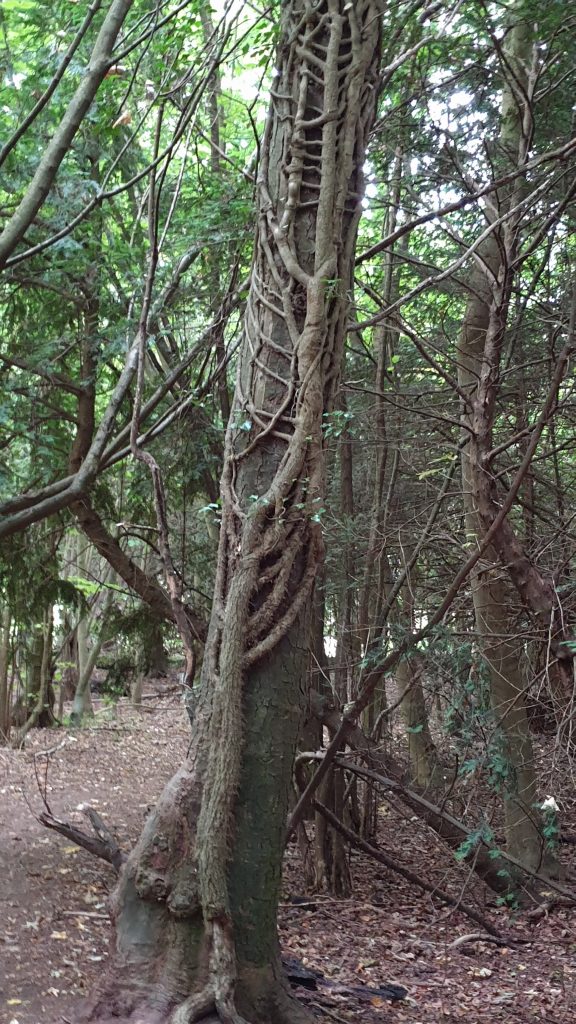
A short dive into woodland revealed the merciless nature of ivy’s grip once it gets established.

And as we emerged, blinking, into open countryside once again, it started raining, albeit not too heavily.

We passed a viewpoint over Polesden Lacey House

which seemed a good place for our final gin bottle shot of the not-holiday.

The final stretch took us into forest, which offered some protection from the rain: first beech;

then oak. It really was quite dark in the looming weather.

A final dash along Ranmore Common Road got us to the car before we became too bedraggled so that we could take ourselves off to Denbies Wine Estate for a Nice Lunch in the Gallery Restaurant. After today’s 7.93 miles we had something, after all, to celebrate.

13 walks in 13 days; 121.12 miles covered (6 miles more than would have been needed in Menorca); 3,623 metres of elevation gained (943 more than the Menorca total); and no injuries – we both feel that we could just carry on.

One reason not to carry on is actually the amount of time it takes up – not just the walking, but also the writing of the blog posts. I’ve hugely enjoyed all aspects of the last 13 days – yes, even the uphill bits – and writing about them has been wonderful, as I haven’t had an excuse to update this blog for ages. But we’ve acquired a bit of a backlog of Real Life Things that needs to be dealt with, so a few days of not walking will ease the pressure. But there’s a nice 18-mile walk that looks tempting for early next week; 9 miles along the canal to Weybridge, a Nice Lunch and then 9 miles back again, trying not to fall in.

I will add a couple of posts to the blog over the next days: a general wrap-up of our impressions of the fortnight; and a specific exposition of my thoughts on having used nothing but a mobile phone camera for the photography (OK, a drone, twice, but you get my thrust, here). So I hope to see you back here in some days. In the meantime, thanks for joining us on these walks and see you soon!

Day 12 – Cami towards the end; Day 12 of 13

Cami-flage Day 12 Tuesday 22nd September 2020

Today is the penultimate day of our substitute walking holiday, where (sorry, this is like a Channel 4 programme after an ad break where they have to remind you what’s going on) we decided to recreate a pandemic-cancelled holiday walking round the outside of Menorca on the Cami de Cavalls by doing equivalent distances in England. Over the previous 11 days, we have walked over 102 miles in lovely late Summer/early Autumn English weather, instead of sweating our way up and down foreign hills in nasty 30-degree heat. Today would appear to be the last day for which this is true.

The outlook for our walk today is sunny, but clouding over (as opposed to the risk of rain in Menorca, nah, nah-ni, nah nah). However, our luck may run out tomorrow.

Anyway, today our walk takes us to the other end of the Surrey Hills from yesterday – Haslemere.

(We start at bottom left and walk the loop counter-clockwise.) Haslemere seems to sit at the junction between the Surrey Hills and the South Downs, if the sign outside the station is to be believed.

We decided to park the car by the station, despite the station car park’s very confusing signage about it being only appropriate for season ticket holders, or something like that.  Whatever, it didn’t look as if we would have trouble finding a space.

We walked along Lower Street, which was radically different from the previous time we saw it when we did this walk last, which was in July this year, not quite three months ago.  Today, it looked like this.

But when we came before, it was a radically different proposition for traffic and pedestrians alike.

Haslemere is a handsome town with some lovely buildings.  I think there must have been a tile factory nearby, or a really good tile salesman, since hanging tiles are a frequently chosen decorative option.  The High Street is a good example of its handsomeness.

The eponymous Church of St. Bartholomew

has a positively baronial vicarage!

We soon cleared the town into some open countryside

where a barn showed, once again, the approach of Autumn in the colours in the creepers across the roof.

We reckon that it won’t be long before the Russian Vine and Virginia Creeper play a degree of havoc with some of the wiring.

One thing that becomes very clear very quickly is that Haslemere backs on to some substantial hills.  Our path wound upwards quite abruptly, and rather steeply.

The path we followed is part of the Greensand Way, a long-distance path that covers Kent and Surrey.  The Long Distance Walkers’ Association (no relation) describe it as “challenging”

and, frankly, if you’d tried to get any kind of vehicle up that path, you’d certainly have faced some challenges.

Once up, there’s a short stretch of open country

before going down again. There are some very fine views to behold

before going, you guessed it, up again, on the final pull up to the Devil’s Punchbowl, where one finds the eponymous Hotel.

This is a fine building, which contains a pub, but we courageously walked past it and merely decided it would be a good backdrop for the first gin bottle shot of the day.

It’s right on the old A3, for those who, like me, remember the days before the Hindhead Tunnel. The Devil’s Punchbowl itself is a geological feature, a massive fold in the landscape with a visitor centre, walking trails and that. There’s a great view

(and a café, from which we gratefully purchased tea and cake).

Moving on took us past more lovely views; this is my attempt at an arty shot of hillsides receding into the haze.

There’s heathland

which gives opportunities for gin bottle shots

and we shortly arrived at the highest point of the walk, the top of Gibbet Hill, the second-highest point in Surrey (the highest being Leith Hill – but you knew that because you were paying attention to my earlier posts, weren’t you?) which provides more spectacular views

and opportunities for gin bottle shots.

There’s a Celtic Cross there

which was erected to attempt to dispel fears of the ghosts of the people who were hanged there on the gibbet which charmingly gave its name to the place.

Thence, the path goes, unsurprisingly, down

eventually passing the site of the Temple of the Four Winds, marked now by just its platform,

by which are some more great views

and a further gin bottle shot opportunity.  Well, it would be rude not to, wouldn’t it?

Continuing down, the path goes past a wonderful grove of beech trees with roots exposed

and thence to a place where there’s clearly been some pretty extreme forestry – really quite an extraordinary scene.

After that, we passed Halcyon House, which, I guess, is in Kingfisher colours (today I learned that Halcyon is the genus of the Kingfisher)

and which has a lovely garden with a duckpond. But we didn’t see any kingfishers.

We greeted the lady of the house cheerily as we walked by, but she rather grumpily ignored us, presumably fed up with Bloody Tourists; but, then again, why buy a place like that with a path going through it, eh? Eh? Answer me that, then.

Continuing down took us by some newish-but-nicely-done cottages

into Grayswood, a very pleasant village on the fringes of Haslemere.  It has a handsome church,

village green,

eccentrically-decorated tree

and some lovely villagey houses, including this arty one.

The route we took, which is part of the Explore Surrey section on Alltrails.com, then takes another final loop out into the country.  We passed a Hammer Pond, so-called because it’s so deep that if you drop a hammer into it, you’ll never get it back.

(Actually, I made that bit up; a hammer pond is merely a body of water that was used to drive a waterwheel which powered a furnace hammer.) In the case of this pond, the furnace was at Imbham Farm, which we walked past.  As we did so, we noted (a) the nice rolling countryside and (b) the incoming clouds, telling us that the long streak of wonderful weather we’d been fortunate to experience for these walks was coming to an end.

The route goes by and through the fields of Swan Barn Farm. a National Trust location, where long-term volunteers live in a specially designed eco-house built with locally sourced, sustainable wood from the Black Down Estate. It also features the Hunter Basecamp, where people on working holidays (in the days when these are available) stay while helping with the work.  The streams between the fields are crossed by some charming paths and bridges

and the farm has a tractor

which in and of itself is hardly an item worthy of mention; but the facial expression of this one is striking.

I think it reminds me of The Hound in Fahrenheit 451, or some such sci-fi film.

We exited the lane by Swan Barn Farm back into the middle of Haslemere, and, screwing our courage to the sticking point, decided to go home rather than have a pizza.  It was a nice walk, quite strenuous in places – a total ascent of over 1200 feet – and 10.71 miles in length. The comparison with Menorca is complicated, so pay attention, now.

We have swapped the two final UK walks over, so today’s UK walk should be compared with tomorrow’s Menorca walk and vice versa.  The reason for this is to do with Lunch.  Originally, we had the Denbies walk (tomorrow’s, keep up) set for today, and today’s set for tomorrow.  But today’s walk, although being of an appropriate length compared to the Menorca schedule, offered nowhere for a Nice Lunch, so if we’d done it tomorrow, we would have had nowhere, on our last day, to celebrate our achievement. This would be a shame.  However, the Denbies walk, originally planned for today but now happening tomorrow (are you still with me?) offers the prospect of a Nice Lunch at the Wine Estate’s Gallery Restaurant. So we decided to do it tomorrow, so we could seal the while Menorca Walk deal in an appropriate way. That’s why we swapped the two over.

So, today’s walk was about a quarter of a mile shorter than tomorrow’s Menorca equivalent.  Tomorrow, we expect to walk about half a mile further than today’s Menorca equivalent.

OK? Clear?

We’ve now walked over 113 miles in total and have just one more day to do to complete our virtual walk round the outside of Menorca. Tomorrow, as I say, we wind up the endeavour with the Denbies walk in the Surrey Hills. With luck, we may complete it without being rained on, but you’ll have to come back and Read All About It to find out, won’t you?