Tag Archives: Scenery

Cami de Cavalls day 3 – First day of walking; our Favàritx Thing

Wednesday September 15, 2021 – Well, This Is It.  Today, we started walking the first stage of 20 over 13 days which will take us round the island – if we survive, of course.  It is one year and two days since we started our Camiflage walks, the exercise of trying to recreate in Surrey the walks we couldn’t do in Menorca due to the pandemic.

If, by the way, you can’t bear the idea of reading through the following screed about what we did and saw today, and if you’re prepared to spend 3 minutes watching a video, then the tl;dr can be viewed on Relive. You’ll see the route and some photos, but you’ll get more information by staying with me here.

To sum up: we had to walk 20.37 km between Mahón and Favàritx, over hill and dale with a vertical gain of some 450m – and we had to get to the end by 3.30pm, as this was the time we’d agreed to be picked up by the Cami360 folk to take us to our accommodation for the next stage.  The hotel breakfast started at 8am so we took as early a breakfast as we could and then Got on With It.

The start, as I mentioned before, was at the Three Horses statue by the convent, and we’d researched the first few metres of the route, making sure we were aware of signposts and such.

The route took us past a view of the industrial end of Mahón harbour

past caper bushes embedded in stone walls

and out on the road north of the town.  The first several kilometres of the route were on paved roads, which was a but dull, but the views were OK.  For example, we got a good sight of Mahón from the north side of the harbour

and a look at the back end of Golden Farm.

We wound our way along the road, occasionally spying mysterious things in the distance

before arriving in Sa Mesquida, which is a town with a popular beach, but also some nice residences.

Some convenient benches

gave us a chance to look over the place

and we eventually discovered the mysterious object.

We couldn’t get close to it, but it looks like it was once a watch tower, similar to those found all over the island.

Mesquida has a popular beach,

and also marks the point where the trail leaves paved roads.  From this point, the marking is done via posts.

and the surface becomes a lot rougher.

(The posts are very well-placed.  Above you can see one in the foreground and if you look carefully, you can see the next one.  It actually takes no little skill to get lost because the trail is so well-marked.)

The trail winds up and down

(occasionally very steeply up – see later) and can be very rocky.  The purity of the air is attested to by the existence of some very colourful lichen on the rocks.

As I said, the trail is very clearly marked, occasionally passing through traditional-style bentwood gates.

I don’t want to bore you, but actually some of this trail was really quite steep

(20% according to the booklet) and overall the going was somewhat tougher than I’d expected.  In theory, we’d covered pretty much exactly this mileage and ascent in one day in Surrey a year ago; but here, on rocks and tree roots, in 30 degree heat, it just seemed rather a  lot harder going.  So it was with considerable relief that we reached the mid-point of the day’s trekking.

The Cami goes left at this point, but we headed straight on into a town called Es Grau in search of beer and lunch.  I’m glad to report that we were successful, and, much refreshed but feeling we had to get on with it to make our 1530 deadline, we headed back to the track to get on with the next bit – officially Stage 2 of the Cami, from Es Grau to Favàritx.

The first part was on a very different surface – almost like a forest trail

leading past a lagoon.

into some weird woodland

and eventually offering a nice view back over Es Grau.

We got our first sight of our finishing point for the day

which was the lighthouse at Favàritx (you can see another watch tower in the foreground). From here, the track wended up over headlands and down into coves and beaches.

through some rather blasted scenery

past some actual cavalls (whose copious product could be found, piled up on the path by some unknown force)

past tantalising glimpses of our lighthouse destination – closer, ever closer –

through more weird woodland

past mysterious government-sponsored things hanging off trees (moth traps?)

to the end (phew!) of today’s part of the trail.

All we had to do was to walk to the lighthouse (which began to seem a long way away at this point, although it was probably only one kilometre on a paved road) but eventually we reached it

and got to our pickup point

with about five minutes to spare before our official pickup time, which is either brilliant planning or a source of considerable relief, depending on your view point.  Anyway Juan Gabriel (“Juanga”) from Cami360 turned up bang on time and drove us to our overnight accommodation. En route we asked him whether they were very busy, and he said that they really were: they had to manage 40 groups of people doing the trail in various places.  That’s a lot of co-ordination; let’s hope they carry on as well as they’ve started.

Our accommodation was actually back in Mahón – a fairly basic hostel, Hostal La Isla. It describes itself as being “family run”, and the practical upshot is that a single person runs the reception and the bar – he whole place, in fact.  It is not at all fancy, but at least it has a lift to get us and our bags to the second floor, even if the timer switch on the corridor gives out before you can get from lift to room, leaving you in utter darkness. Once inside, you discover that the room is almost entirely taken up by bed; but it was at least spotlessly clean and the cramped space was quite well-organised.  And since we were fair knackered by this stage it didn’t really matter.   To validate our tiredness. let me bore you with some stats.

  • Garmin Connect says we walked 15.6 miles, or 25km. OutdoorActive says 14.2 miles, or just under 23km. The Cami 360 book says 20.37km and we did a few detours. Whatever, it was quite long enough, thank you.
  • Garmin says we ascended 449 metres, much more than OutdoorActive’s 1000 feet. The official datum is 475 metres. Whatever it was, it felt tough.

We showered and rested a bit and then pottered out for some tapas before an early night, because we have agreed to be on the road again early tomorrow; the Cami 360 guys will take us back to Favàritx so we can carry on our trek round the island.  So, please come back to the blog so you can see how we got on.  See you then!

Day 14 – We stood the time of test

Monday 12th July 2021. When we originally made the holiday arrangements with Dagur, we added an extra day into the schedule so that we could potter around Reykjavik. I’m immensely glad we did, in the light of the hoops one has to jump through in order to travel internationally in these pandemic times. UK requirements were that we had to be able to show a negative Covid test taken no more than 72 hours before departure, and the exceedingly well-organised Iceland authorities made this a very straightforward process – we booked the test online for the morning of our free day, and the leisurely 24 hours we’d added into the schedule on spec would give us a cushion in case the tests took the full 24 hours to come through. All in all, another example of the remarkable good fortune we’d experienced on this holiday.

That good fortune didn’t entirely hold. We had to get to a testing centre which was a couple of miles from our hotel and we decided to walk it. In the event, the walk there was into the teeth of the driving drizzle that, as I’ve said before, there is probably a special Icelandic word for, almost certainly containing some strange vowels and consonants. Also, my fond belief that we would turn up to a largely deserted testing centre and sweep effortlessly through looked a little optimistic when we saw the queue.

In fact, the queue moved swiftly and the process inside the building ran with an efficiency that could have been described as ruthless were it not discharged so courteously. The chap who thrust a cotton bud so far up my nasal passage that I feared it would come out of the top of my head was very polite and helpful whilst going about his business; it took seconds and there was a steady flow of people, which made me wonder how much he is enjoying his days at the moment.

The walk back to the hotel was much more pleasant, with the wind behind us; and having got back to the hotel to change into Being A Tourist clothes, we went out to look around Reykjavik in a little more detail than we had on our arrival day.

The first thing we did was go up to that “Space Shuttle” church (you remember – this one)

and took a look inside. It’s a Lutheran church, so the sort of ritzy decoration that typically adorns Catholic churches (often at the expense of the peons they purport to serve) is absent, leaving a clean, calm environment – somewhat reminiscent of the Sagrada Familia in Barcelona.

The church features a very impressive organ. Stop sniggering at the back.

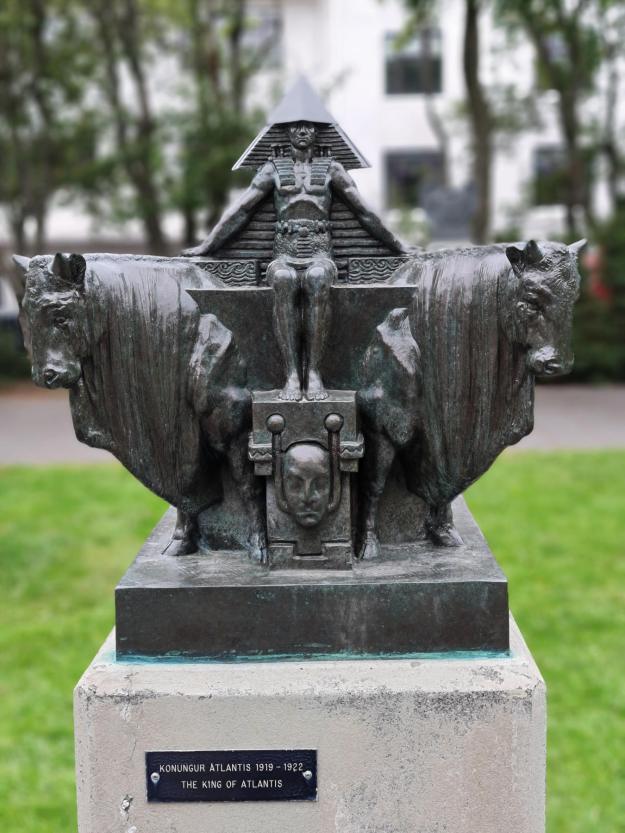
One can go up the tower, at a cost, but we decided not to, instead opting to follow a suggestion from Dagur to cross the road and look into the sculpture garden of the Einar Jonsson museum opposite the church.

He lived from 1874 to 1954, and the sculpture garden has some lovely examples of his work.

(Obvs I have many more photos, but I wouldn’t want to bore you, not really.)

We went back to our hotel and about 5 hours after we had undergone the test, again with no fanfare or choir of angels but rather via a text, I received the following:

“Sóttvarnalæknir og Almannavarnir: Stephen. Skimun sýnir að þú ert ekki með COVID-19 sjúkdóminn.”

Thank goodness for Google Translate, I say; this helped me establish that it was a negative result. To be fair to the authorities, they also e-mailed certificates to us. In English.

After that we wandered round the area close to our hotel, marvelling at the time and trouble taken to make the buildings interesting.

There are many more interesting and quirky architectural sights that we saw, but, again, there’s a limit to your patience with my photos, so I’ll spare you for now. If you come back tomorrow, you’ll see some more, I can promise you that.

We had made an arrangement to meet Chris Foster, you remember – the folk singer and artist contact from Jane’s dim and distant [slap! ouch!] for drinks in the evening. We thought that it would be a good idea to have a bite to eat beforehand as ballast, but equally thought it would be nice to get away from the arctic char/lamb/beef options that so often figured in our diet over the last fortnight. So we went for a Thai meal and I can now vouch that the beef salad in Krua Thai in Reykjavik is a belter.

After that, we met Chris and his wife, Bára Grímsdóttir, who is a legendary force in Icelandic folk music and song, for “a couple of drinks”, which actually resulted in us getting chucked out of one bar as it closed and then still knocking further drinks back as the hotel bar closed; it was a good evening meeting a couple of really interesting people, in my case for the first time.

And so, rather blearily, to bed. We still have a morning in Reykjavik before we have to go to the airport and bid farewell to this remarkable country, and so we might well go out and see a few more of the sights. Come back and find out if this was the case, why don’t you?

Day 13 – Water goes up…must fall down

Sunday 11th July 2021. The plan for today was Golden Circle day. This is basically the route that tourists who are based in Reykjavik can use to see The Sights, the main ones of which are Geysir (water goes up), Gullfoss (water falls down) and Þingvellir National Park (water stays where it’s put). We expected to tick those boxes in pretty short order before retiring to the bar in our Reykjavik hotel for a G&T before some kind of extravagant dinner. We ticked the boxes all right, but the day didn’t quite work out like that… in a good way.

Our extreme good fortune with the weather didn’t hold, and we had a grey, windy and occasionally wet day, with the sort of driving drizzle whose ubiquity has probably earned it a special Icelandic name. It didn’t interfere with our enjoyment, but it’s not the weather that a photographer would normally choose.

Before we got to the major part of the box-ticking exercise, Dagur took us to the cathedral, just down the road in Skálholt.

Skálholt has a major place in Iceland’s history. It was an episcopal See, a school, a seat of learning and administration for more than 700 years and a place of pilgrimage in medieval times. The present Cathedral was consecrated in 1963 and is the 10th church standing on exactly the same site. In it is a list of all the Bishops stretching from the current (female) one right back to the first one, who took office back before Willam the Conqueror decided he fancied a bit of English rule. It was, unlike most of the Interesting Churches we’ve seen this last fortnight, open, so we went in. It’s a lovely interior.

The stained glass is very striking, as is the mosaic above the altar. There’s an escape tunnel to the outside, used both for exit and entry in emergency, e.g. attack by a band of marauding riffs.

and in the grounds is a replica of the type of house that once also stood on the land.

Our next stop was also something that’s not on your normal Golden Circle tour – an amazing place called Friðheimar. To say baldly that they grow tomatoes there is technically accurate but utterly misses the point of how they go about it and the scale of the undertaking . The creators, Knútur Rafn Ármann and his wife Helena Hermundardóttir, have created an environment in which they can be grown year round.

Geothermally heated greenhouses and a carefully controlled growing process ensure that light, nutrients, water and heat get to the plants

and they keep bees to pollinate them.

They also, by the way, grow cucumbers and lettuce – over a ton of produce every day of the year – and have even put a restaurant in place so you can eat a meal in the surroundings. It’s rather surreal – a lush, green, warm oasis amid Iceland’s rather more hostile environment.

After this – at last! – we got on to the first of the major Golden Circle attractions – Geysir.

Well, actually – not. The original Geysir, whose name is now used worldwide to refer to such phenomena, has not erupted, with maybe a couple of days’ exceptions, for decades.

Here’s a picture of the dormant Geysir, taken by a dozy old geezer.

However, on the same site is its little brother, Strokkur, which is active. As might be expected, there’s a crowd of people waiting for the next eruption

which, although not as high as Geysir was, is quite impressive when it happens.

View this post on Instagram

A post shared by Steve Walker (@spwalker2016)


We then moved smoothly on to the next box to be ticked – Gullfoss, the Golden Waterfall, billed as Iceland’s version of Niagara. I’ve never seen Niagara, so I can’t comment on that (come back to this blog in October next year for my thoughts on it, if plans go according to, erm, plan). It’s pretty substantial.

So substantial, in fact, that it’s quite difficult to convey in still photography. There’s a high viewpoint which enables a video panorama, which I hope helps you a bit more with its scale.

View this post on Instagram

A post shared by Steve Walker (@spwalker2016)


Our next stop was at the rather unusual home of “The Cave People“.

The idea here is to re-create the sort of environment that Icelandic people, typically shepherds, lived in long ago; and about a century ago, this house was used by Icelandic couples. There are a few mod cons visible – solar PV and a small wind turbine – but otherwise the Caves have been rebuilt to look exactly like they did when the last Cave People in Iceland lived there only a century ago. You can take a tour if you like, but we didn’t because the next box to be ticked was calling – Þingvellir National Park (pronounced “Thingvellir” by the way).

Þingvellir is the National Park where the Althing, an open-air assembly representing the whole of Iceland, was established, way back in the year 930 and continued to meet until 1798. Over two weeks a year, the assembly set laws – seen as a covenant between free men – and settled disputes. It’s held to be the world’s first Parliament. There’s a pole erected to mark its place.

Behind the pole, you can see the wall of rock which marks the start of the American Tectonic Plate.

This “wall” is visible from some distance away as a line across the landscape. Anything this side of it is therefore in Europe.

From a viewpoint on top of the wall, you can see people walking between it and the European Tectonic Plate. The two plates are moving apart at some 2cm per year, but I still assert that it takes some courage to walk between them, just in case the middle bit collapses.

There is an Interesting Church across the river

and a very nice, calm lake

(in this windy country, you rarely get lovely calm reflections like this).

So that was the Golden Circle well and truly ticked off. But Dagur had a couple of “extras” for us, some less expected than others.

The first was a visit to The Volcano – the recent eruption near Fagradalsfjall. Bearing in mind that the actual eruptingness of the volcano was no longer visible to pedestrians (and any available helicopter for miles around was fully booked to fly over the site), and all that could be seen was lava, I frankly had low expectations for something that took us two hours out of the way between me and a refreshing gin and tonic, particularly since the weather was looking rather grim – after all, we’d seen quite a lot of lava over the last couple of weeks.


When we reached the site, it was evident, though, that it was still a popular day out

and as we walked towards the lava flow there was a constant flow of people coming back from it, with a huge variety of languages among them, and none of them, even the ones carrying expensive-looking camera equipment, looked dejected. And, in the end, after a 20-minute hike along a defined path but across somewhat broken ground, we reached the start (or, to be more accurate, the end) of the lava flow.

It was actually a very interesting experience, despite poor visibility. You might be able to make out the lava field receding into the distance and splitting round a hill; we walked about half a mile along the left hand side before it became clear that you could walk for a further hour or two and see still more lava. To give you a better idea, here is a photo that Dagur sent us some days before our trip started.

You can see where the lava flow has split around a hill; our half-mile walk took us just short of the “blob” of lava on the left, somewhat before the split – so you can see that it’s a very, very large lava flow.

As we approached the lava flow, the first thing that struck me was the smell. It was a singed kind of smell, but not, as it were, “natural”. As Jane said, it was the sort of burnt plasticky, rubbery smell that a photocopier makes as it goes seriously on the blink.

And the second thing was the heat. It wasn’t very hot, but there was a sense of a vast amount of powerful warmth emanating from the lava – and the very real understanding that setting foot on it would be a foolish thing to do, the sort of total fuckwittery that only Instagram selfie addicts might try and which will hopefully lead to the Darwinian extinction of that vapid species.

The lava gave rise to some interesting abstract image possibilities.

All in all, I’m glad that Jane insisted we do the trip to the site; even though there were no eruptive fireworks to marvel at, we came away with a sense of the enormous power that lay beneath, despite it being (for the moment) quiet.

Then Dagur sprang his last two surprises on us. One was a visit to a major tourist site – the Blue Lagoon. Although it’s quite close to the eruption site, we hadn’t expected to see it, so it was a nice little fillip for the end of the tour. Again, it’s one of those places where the basic description – a lagoon of black rock containing blue water – doesn’t cut it to convey what the place is really like.

There’s a hotel and spa there, where guests can frolic in the water (which frankly looks toxic to me)

and they can even buy beauty face masks if they’re completely unselfconscious.

But you can also walk around the lake proper, and it is a weird and wonderful sight.

By this stage, it was getting quite late, and we thought that these two diversions had eaten rather heavily into Dagur’s time and goodwill; but he sprang one more surprise on us…..

Dried Fish.

This might not sound much, but….

there’s a site outside Reykjavik which is so little talked about that even the locals don’t have a formal name for it. It’s a site where fish are hung for up to three months to dry them before they can be used for some local products (e.g. in cat food) and also for export – apparently the eyes are a delicacy in Nigeria…

It’s an extraordinary sight -rack after rack after rack of – fish, being hung out to dry.

And thus ended our second week in Iceland and the touring aspect of our holiday here. We’d covered 2,000 kilometres, taken 2,000 photographs and presented nearly 400 of them on this blog (oh, I’m not done yet, though!) It has been fascinating, educational and often awe-inspiring. I’m absolutely delighted to have documented it through these pages, because there is no way I could have remembered a tenth of what we’ve been told and what we’ve seen otherwise; and we were both utterly knackered and quite glad to get back to Reykjavik, check in to our final hotel, hotfoot it out for burger and stellar chips once again at Reykjavik Chips (see the “Cry Freedom” blog), and – relax. Our brains are full. Full of the sights, sounds and smells of an extraordinary country which it has been our pleasure to travel round and our privilege to see in largely beautiful weather. As a way of breaking out of UK’s Lockdown it simply couldn’t have been bettered.

As I say, I’m not done with you yet; we have a day at leisure in Reykjavik (and the rain, if the forecast is anything to go by), and we have to do some Covid-type admin before we leave. I’ll report how the day went in the next post, and hope you come and join me there.