Tag Archives: Mosaics

Day 3 – It’s the fort that counts

Sunday 10 May 2026 – A sunny start to the day: so out on to the hotel restaurant’s veranda to take in the view.

Then our group congregated and, as yesterday, trooped down the road to be collected by Mostafa in his bus, and we set off towards the southern coastal side of Istanbul for our first visit of the day, which was to Yedikule Fortress. As you might infer from the name, this is part of  Constantinople’s formidable fortifications. Built in 1458 by Ottoman Sultan Mehmed II after he conquered the city, the seven-tower complex was created by adding three new towers and fully enclosing a section of the ancient walls of Constantinople. Those walls were built in the 5th century AD during the reign of Roman Emperor Theodosius II. At this point I have to confess that I knew nothing of these walls, so much of the day was spent raising my consciousness about them.

First, though, the fortress.  It is the subject of a substantial restoration project whose banner gives a good overview of its shape.

The bottom three circles are the three extra towers; the run of the wall is across the top of the diagram and the two square blocks represent a triumphal entry gate, called the Golden Gate, which was built in the 6th century. This is what the Gate looks like from inside the courtyard of the fortress.

You can clearly see that at one stage there was a massive central arch through which one would triumphally arrive. Over the years it has been successively bricked up to be smaller and smaller, but it must have been hugely imposing in its day. Over the arch are flagstones with holes in them.

and these holes were a puzzle until someone figured out that they were mounting blocks for metal letters. Some further clever thinking deduced what these letters probably were

and thus reconstructed what the text was – “HAEC LOCA THEODOSIUS DECORAT POST FATA TYRANNI”, “Theodosius decorated these places after the downfall of the tyrant.” 

From the other side, the Golden Gate looks like this.

You can see the outline of the original triumphal arch in the centre, and the successively smaller portals inside it. Behind you as you look at the gate from this side is the Little Golden Gate.

This presumably gave extra pith and moment to any processional entry, and, more importantly, was part of a second wall built in support of the main walls into which the Yedikule fortress was incorporated. More on the walls later.

Yedikule became a place of imprisonment and execution. In front of the Little Gate, for example, is a well, down which the bodies would be thrown to be washed away into the Sea of Marmara. There is another well, used for the same purpose, inside one of the towers, which was also used for imprisonment.  

You can see joists and the holes for them which indicate that there were several floors off which were cells in which prisoners could be kept. If they died or were to be executed, the central well was for disposal of the bodies.

Looking carefully round the fortress, one can see a few subversive Christian relics which presumably escaped Ottoman notice:

Even a Roman eagle survived.

We climbed up inside the Golden Gate and were presented with a great view over the courtyard of the fortress

and, incidentally, an oversight of the huge queue of shipping waiting to be allowed up the Bosphorus. 

The viewpoint at the top of the gate allowed us to get some idea of how the walls were designed.

To the left you can see the main walls. From there, a terrace leads to a second wall, then another terrace and then a ditch, which was the moat, itself defended by a crenelated wall. It’s interesting to see that the locals use the moat these days as market gardens or allotments.

This very daunting double-walled construction was built during the reign of Theodosius II, and hence it’s called the Theodosian Walls. They ran some 4 miles, north from the Sea of Marmara up to the Golden Horn inlet, thus forming a massive land wall which, together with the existing sea walls, formed a protective cordon around the city  that successfully defended the whole of the Constantinople peninsula from incursion by land or sea for over a thousand years. Eventually, in the 15th century, the Ottomans found a weak point where a river ran through the Theodosian Walls and used it as one of the tactics to be able to invade the city

The walls, therefore, were critical to the enduring success of Constantinople as the centre of power for the region. The Land Walls was (were?) a huge construction project.  The main walls were 4.5 – 6m thick and 12m high. Their construction included bands of bricks, a technique  which strengthens the construction and, importantly for this region, makes it more resistant to earthquakes. The technique was also used in constructions in Britain, such as the Roman walls of Colchester, London and St. Albans.

Not that swallows care a jot for this architectural feat – they just use the wall for nests, and we could see and hear them whizzing about shouting at each other and catching insects – a joyful phenomenon.

96 towers were included along the length of the wall. We could see some of them from our viewpoint at the top of the Golden Gate,

and indeed, after we left the Yedikule fortress and travelled northwards beside the walls, we could see the amazing extent of these walls.  Some sections were in disrepair, some have had some repair and/or restoration work done and some have been almost excessively reconstructed.

Our wallside drive took us almost to the northernmost extent of the walls, within a kilometre or so of the Golden Horn. In order to get near our next destination, we had a traffic interaction which is pretty typical of Istanbul. First, Mostafa had to squeeze us past a crane

and then

he did a splendid job of (a) navigating the bus along an extremely narrow road without damaging bus, cars or buildings, and (b) facing down any drivers who had the temerity to want to come in the opposite direction.  Whilst all this was going on, a chap by the roadside was calmly filleting and selling fish from a makeshift stall.

Once Mostafa had found a place where we could safely debus, we walked a little way to visit the Tekfur Sarayı museum, which is housed behind the remaining façade of a 13th-century palace built for the son of a Byzantine Emperor. The place had fallen into extreme disrepair, and reconstruction work enabled it to be opened as a museum as late as 2021. It’s a handsome façade.

If you look the place up on Google Maps, it labels it in English as the “Palace of the Porphyrogenitus”. Some sources translate Porphyrogenitus as merely “Sovereign”, but it literally means “Born to the Purple”, indicating a child born to a reigning emperor. 

The place served as a palace in the final years of the Byzantine Empire, but suffered severe damage due its proximity to the walls during the Ottoman conquest in the 15th century. In subsequent times it served multiple purposes: housing for the Sultan’s menagerie; a brothel; and, in the early 18th century, a pottery workshop producing ceramic tiles in a style similar to that of İznik tiles, but influenced by European designs and colours. The museum has exhibits on a couple of floors and one floor is given over to this tiling work, with some striking and colourful displays.

There are some decent views of parts of the city – or would have been had the visibility not suffered from Istanbul’s rather typical haziness – and we also had fun watching a pigeon market, where roller pigeons were being bought and sold.

On the ground floor of the museum is a marvellous model of the Theodosian Walls, as viewed from the south, the Sea of Marmara end.

You can see the Yedikule fortress here in the context of the walls, and the model is a faithful recreation of their extent.

After the museum visit, it was time for lunch, so we walked back up to a road where Mostafa was able to pick us up more easily, and headed to the Fatih neighbourhood of Istanbul.

The restaurant was a bit of a distance from where Mostafa could get the bus, and so we walked through the neighbourhood, which, like so many in Istanbul, has a very colourful and diverse array of shops. 

The lunch was at a Maltese restaurant called Esnaf Lokantasi, very much a family-run locals’ eatery.  The main courses were served from pots at the counter

and very delicious and filling they were, too, with offerings such as stuffed peppers, moussaka, meatballs and so on. For those of us who wanted a bathroom break, Seçkin gently suggested that the toilets by the local mosque would be more gemütlich, and so some of us went back down the street to the Fatih Mosque

beside which were some decent loos. This mosque is culturally quite significant, something which I think Jim and Seçkin missed a trick in not explaining it to us at the time. It’s known as the Conqueror’s Mosque, named after the Ottoman sultan Mehmed the Conqueror (known in Turkish as Fatih Sultan Mehmed), the conqueror of Constantinople in 1453. A mosque was symbolically constructed here, because it was the site of the Church of the Holy Apostles, which Mehmed demolished, symbolising the ousting of Christianity by Islam. The original mosque was seriously damaged in the 1766 earthquake and rebuilt in 1771 to a different design, which one sees today. 

Our last stop of the day was a visit to Kariye Mosque, or the Chora Church. Once again we had a bit of a walk to get from bus to mosque, and it was lovely to see a chap leading his donkey towards the mosque ahead of us.

The mosque itself

was a Byzantine church and has been converted to a mosque. Twice, actually. Much of the fabric of the church dates from the 11th century, and it has suffered earthquake damage followed by rebuilding work, completed in the 14th century.  In the 16th century, during the Ottoman era, it was converted into a mosque; it became a museum in 1945, and was turned back into a mosque in 2020 by President Recep Tayyip Erdoğan.

The sad bit starts with this: the church was endowed with some very fine frescoes and mosaics. When it was converted into a mosque, these were covered by a layer of plaster, as Islam prohibits iconic images. The uplifting bit is this: when the mosque was secularised and turned into a museum, restoration work was able to uncover many of the frescoes and mosaics, and these are visible in the building today. They are in a sort of church section; deeper inside is the mosque section (what was the naos – nave – of the church), where, of course, these are not allowed to be visible.

What’s there is quite impressive. It’s actually quite small inside and gets easily crowded, so getting photos wasn’t perfectly straightforward

but here are a few of the ones I took.

The mosque section is, unsurprisingly, much plainer,

although there is one surprise. If you stand in this area and turn round to look behind you, you see, on the wall above the entrance, this:

this is the mosaic of a scene known as “The Dormition of the Virgin”, and the surprising thing is that it’s visible at all, given the Islam proscription of This Kind Of Thing. It’s a lovely mosaic, and wonderful that it is complete and has been allowed to stay visible. 

The mosaics in the church part are in many cases incomplete.

so it’s uplifting to see the results of the restoration work, but sad to reflect on the destruction of so much beautiful work. Our visit to the painted monasteries of Romania had shown us how magnificent these works can be, and so our pleasure at seeing the frescoes was mixed with sadness about the damage that had been inflicted.

The music of Stravinsky should be playing in the background here. He wrote his Dumbarton Oaks Concerto (sort of his take on Bach’s Brandenburg Concertos) for the wealthy patrons who created Dumbarton Oaks as a centre for Byzantine studies affiliated with Harvard University, and Dumbarton Oaks played a major role in the launching of the restoration programme for the Chora Church.

And that was it for the day. We were free to find our own dinner, but actually just retired to rest and drink Earl Grey in our room and ponder on what we’d seen for the day. There was one diversion, for an attempt at a specific photographic project, but it failed dramatically. I’ll tell you all about it in the next post, so you’ll just have to contain your souls in patience, won’t you?


Day 3 – We hit peak Mosaic

Tuesday 17 May 2022 – We had an early start today; once again, the only times we have to get up early is when we’re “relaxing” on holiday.  Anyway, come 8am, we were on the road that would lead us eventually to Petra, but which had several stops on the way.  Almost all of these stops seemed to involve mosaics, so I hope you like mosaics.

The first stop was in the town of Madaba, the “City of Mosaics”, to visit St. George’s, a Greek Orthodox church. The reason that so many people visit it is that it is the home of a very famous mosaic, the oldest surviving original cartographic depiction of the Holy Land, dating from the 6th century AD. The mosaic was rediscovered in 1884, during the construction of a new Greek Orthodox church, St. George’s, on the site of its ancient predecessor. Outside (and replicated on cards in the on-site retail opportunity) is a large display explaining what the remaining areas of the mosaic are.

The map mosaic itself is very difficult to convey photographically, because it is so large.  I took a couple of snaps, of course I did, but I also tried to give an idea via video.

It is amazing that there are still areas of the mosaic that are still hiding under tiling work that has been laid on top of it, for some bizarre reason.

As well as this historic ancient mosaic, the church has an incredible array of modern mosaics, made in the Madaba School of Mosaics (these days called the Madaba Institute for Mosaic Art and Restoration), which can be found on every available display surface.

They are very intricate and beautifully made.

On searching for the etymology of the word “mosaic”, I learned that it has its roots in the Latin for the Muses.  It’s also true that Mosaic (capital M) means “pertaining to Moses”, which is relevant for our next stop, which was at Mount Nebo, the site from which Moses was allowed to see the Promised Land, and where he then died. It is obviously a site of great historical and religious significance, but the Moses Memorial church there (originally built in the 4th century AD and restored by the Franciscans in 1932 to working monastery status) is quite a plain building, and not ornate at all.

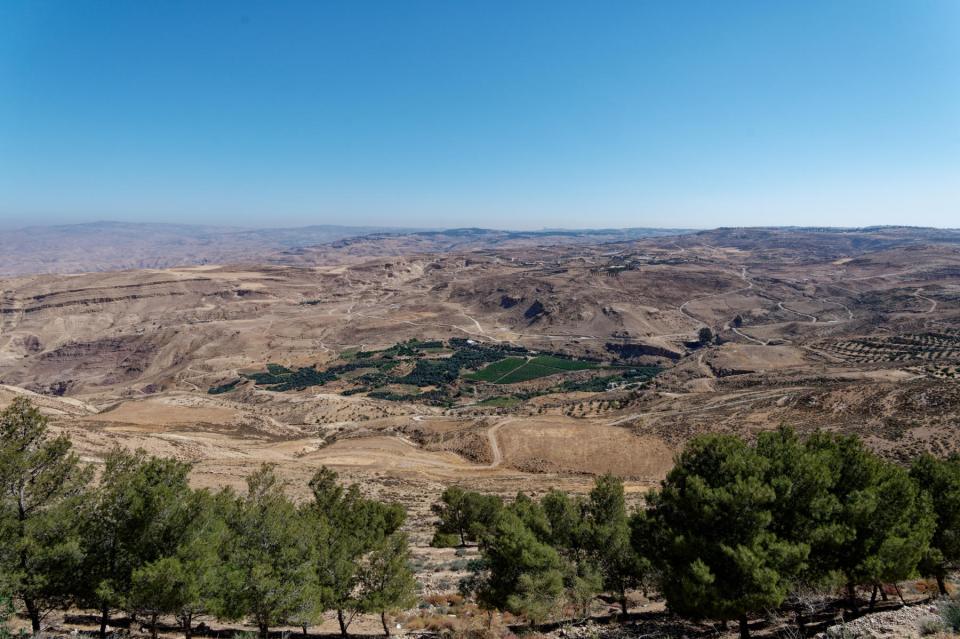
Since this is where Moses could see the Holy Land, you might expect there to be a decent view.  You’d be right.

It’s a popular spot for people to look from, and marked by a representation of Moses’ staff.

On display outside the church are a couple of the mosaics from the original building

but it’s inside the church where the real action is, mosaic-wise.  The most impressive is a 6th Century mosaic in the Diakonikon Baptistry in the church, pictured as captured on a non-Diako Nikon camera.

There are many, many, wonderful and intricate mosaics there.  Some have the shapes often found in stained glass, and there is also some real stained glass cunningly shaped to look like a mosaic.

I’d love to go into more detail, but honestly there is so much there it would become dull if I were to share all the photos I took.

We went back into Madaba and visited the Madaba Arts and Handicraft Centre.  We got a very interesting insight from a chap there who explained about how both old and modern mosaics were made.  There were several people at work creating mosaics – the centre is a co-operative which provides training to budding mosaicists, many of whom have special needs.

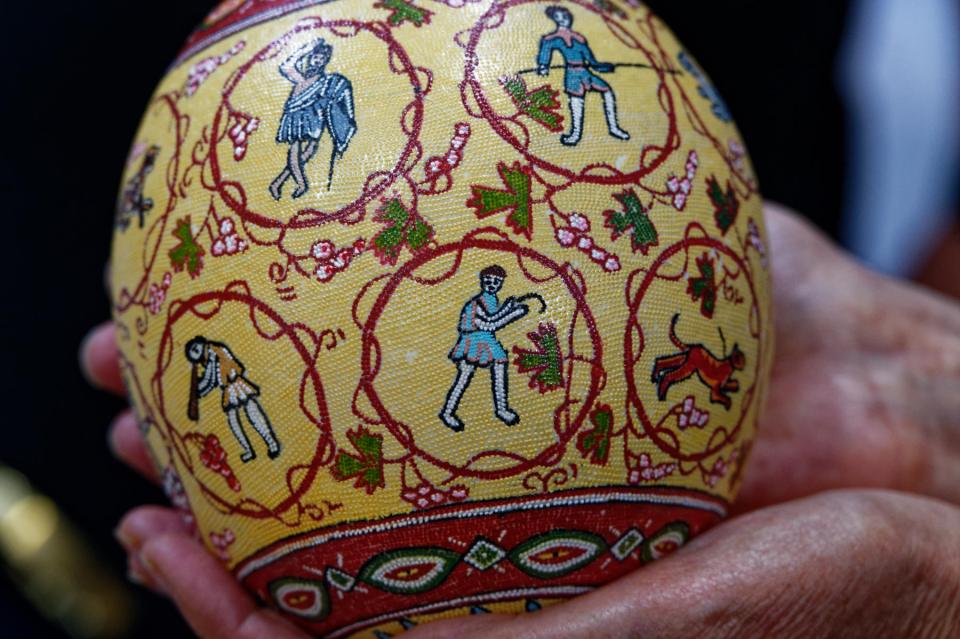
As well as what anyone would understand to be mosaic work (with pieces of stone down to about 2mm in size), the centre also has work that is “micromosaic” – creating art with pieces of stone so tiny that they can only be worked through a magnifying glass; or indeed with dots of powdered stone “paint” – pointillisme in stone.  The resultant work is remarkable.

Ostrich eggs are common bases for this kind of artwork, and the chap was such a good salesman that Jane failed to escape without buying an example.  The co-operative does good work in supporting disadvantaged people, mainly women, and has the financial support of Queen Noor of Jordan, so we’re pleased that the money is going to support a good cause.  No, really.

So that was peak mosaic, and we left to continue our journey towards Petra.  En route, we passed an unusual roundabout decoration.

We have been unable to understand why this choice of decor has been made but we’ve seen more than one example.

Saeed drove us along the King’s Highway*, a scenic and historic route so-called because it once linked the realms of three kings – Ammonite, Moabite and Edomite.  It’s preferable to the Desert Highway, which is straighter, faster and has fewer speed bumps, but is dull.

By contrast, the route that Saeed took us had some wonderful scenery,

an unusual new marketing look to a fast-rising supermarket chain,

some more fantastic views,

a remarkable, if ramshackle, tea stop-cum-retail-opportunity run by yet another welcoming Jordanian (pictured below with Saeed),

and stopping for a visit to Kerak (or Karak) Castle, a 12th-century Crusader castle which also had a significant strategic role up to the Ottoman period in the 19th century.  It was badly damaged in a siege and has really only partially been restored.  It has a looming presence over the surrounding countryside.

It looks impressive from the outside and is huge and rambling on the inside, but lacks information boards and other things to help understand its story.  You can understand its strategic importance, given that rule 1 of such a place is to have a commanding view over the countryside so you can spot any unwanted marauding going on by your enemies.

but the site itself, while it has several impressively castle-y lumps of masonry

didn’t have a story to tell, or at least not one that came over to us.

The town of Kerak would actually be a wonderful photo site – all tiny narrow streets, chaotic traffic and colourful shops.  We didn’t get a chance to see it beyond one rather optimistic piece of marketing.

Shortly after this we stopped for lunch at an unusual restaurant-cum-retail-opportunity called Midway Castle

where we had a taste of the National Dish of Jordan – mansaf (slow-cooked lamb with rice, flatbread and a special yoghurt sauce).  Yes, I have a picture of it.  No, I’m not going to share it with you.  Then we pressed on, again largely avoiding the Desert Highway, which meant we saw camels

sheep and goats,

more impressive scenery

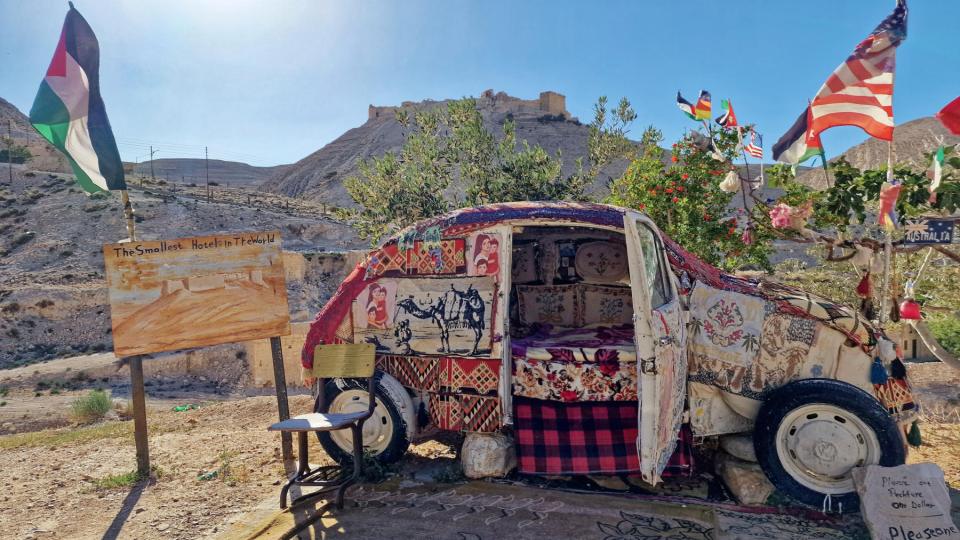
and the “Smallest Hotel in the World”.

We also passed by Shobak Castle

but didn’t go in, as we didn’t need a loo break.  Our final stop, as we hit the outskirts of Wadi Musa (the “Valley of Moses”, where Petra can be found) was at the spring that is the source of the water running through the valley, and may be the place where Moses struck the rock with his staff and water came forth for his thirsty Israelites:

It’s remarkably low key for something that bears the name of Moses.  People can stop by and fill their containers with water

underneath the writing taken from the Koran that says  something along the lines of “From water, all life begins.”

And so our journey ended at the Mövenpick, Petra. We immediately had a meeting with Ali, a representative of the organisation that provides tourist guides for Petra, because we had decisions to make.  Unfortunately, The Powers That Be have decided to close a hiking route that we had planned to take (from Little Petra to Petra Monastery) in a couple of days’ time, so we had to work out what our alternative was going to be.  Oddly enough, “sitting in the bar and drinking gin” didn’t seem to be the right thing for me to suggest, so we’ve got two hikes set up for tomorrow and Thursday, both of which involve quite a lot of walking and climbing of stuff.  And because we want to beat (a) the tourist hordes and (b) the heat of the day, we have to get under way at 0630 tomorrow.  O, the joys of being a tourist!

But, assuming we survive, the coming days should be absolutely wonderful, despite a 5am alarm call.  So do please stay tuned to see how things turned out.


*  “Along the King’s Great Highway, he drives his merry load /  at 90 miles per hour in the middle of the road.”  With thanks to Flanders and Swann