

Friday 26 August 2022 – After two days of full-on encounters with wildlife (apart from the boring waiting around bits, that is), we were (a) sad to be leaving Farewell Harbour Lodge and (b) quietly pleased that we elected to have a morning sitting around in the lodge and catching our breath, rather than taking on any of the excursions that Tim had made available (a First Nation village visit, Sea Kayaking or a local hike on Berry Island, where the lodge is located).
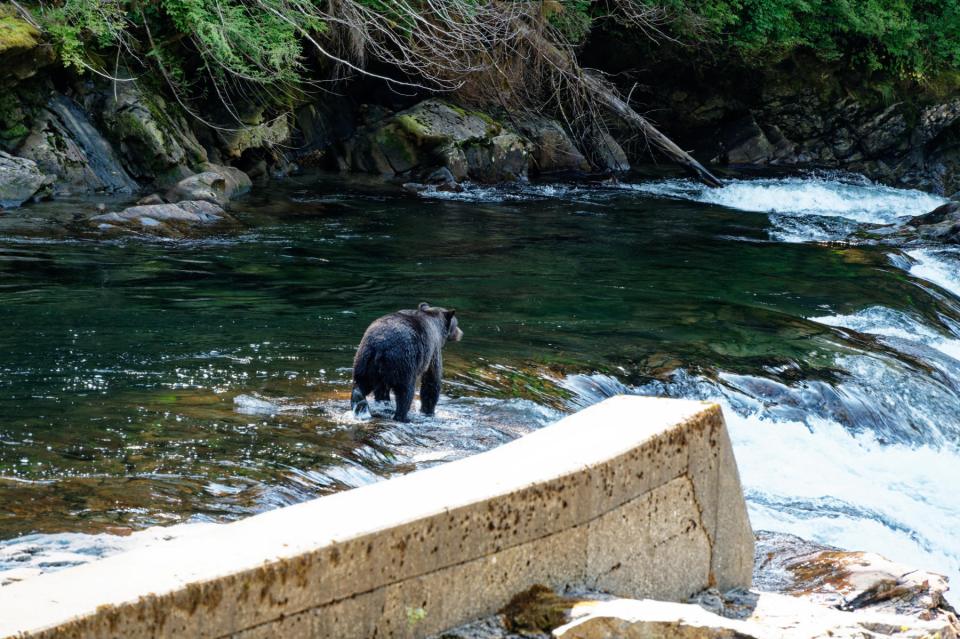
There we were, having a leisurely breakfast, when another ripple of excitement ran through the room. A bear was wandering around on the island! Everyone immediately shot outside, and – quietly – watched as a black bear wandered around helping herself to berries from the bushes by the shore.
The bear was Evie, and was the same bear that we’d seen the previous evening; she had swum across from the neighbouring island. Her quest for the berries brought her closer to the lodge than anyone had seen before.

The lodge’s internet connection stabilised enough for me to upload some videos and therefore to write up the breathless excitement of yesterday’s encounter with the fishing bear. Whilst I was doing this, Jane was filling in the (inevitable, these days) feedback form. We don’t always bother with this, but it was so clear that Tim and his team cared what people thought of their offerings that we took the time to fill it in. Not that it took much time, since the quality of everything – accommodation, food, arrangements, service, excursions, gin – was absolutely faultless. Tim has built up a superb environment and it was a real pleasure to have experienced what he and his team had to offer.
Whilst we were doing this, Bill, one of the group of eight Brits who had been on substantially the same itinerary at the lodge, went out kayaking

as it was a calm, clear morning.

(He ended up kayaking right round Berry Island, encountered Evie again on the far side and came back with a smile on his face and a severely numb bum.)
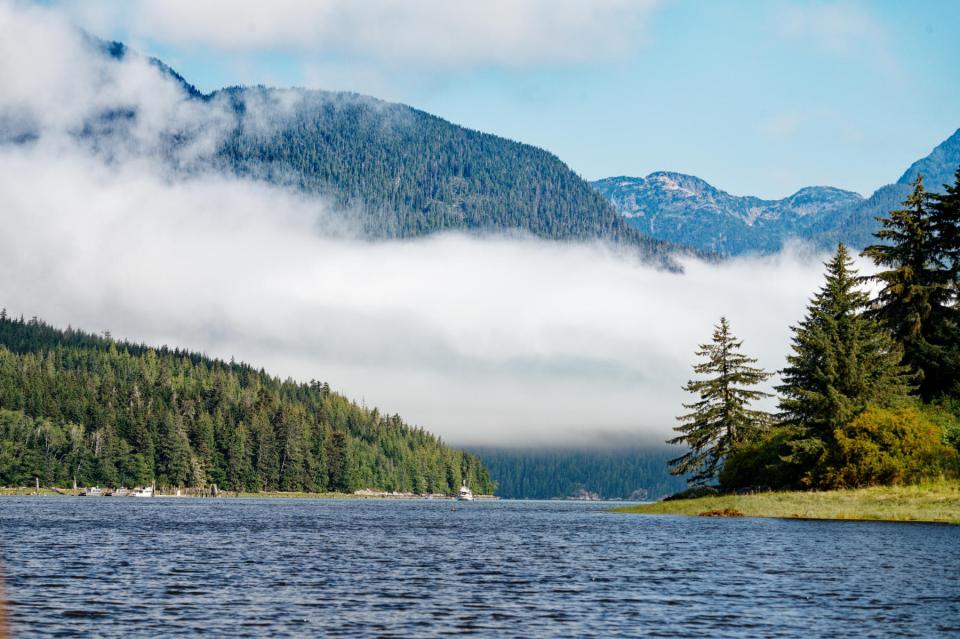
Too soon, though (because I’d only just finalised the blog posting and it was a bit of a scramble getting the brag about it up on to Facebook), it was time to leave the lodge and be ferried over to Alder Bay. We were about half way over when, just as I thought that perhaps we could get from A to B without having to stop and admire some wildlife, one of our group, Eileen, exclaimed that she’d seen the spouting of an Orca. Our driver, AJ (a genial, larger-than-life Canadian with a deeper and larger-than-life voice) soon also spotted them and we slowed down to take a look. Sure enough, there were five of them; it seemed they were resting, rather than actually going somewhere.
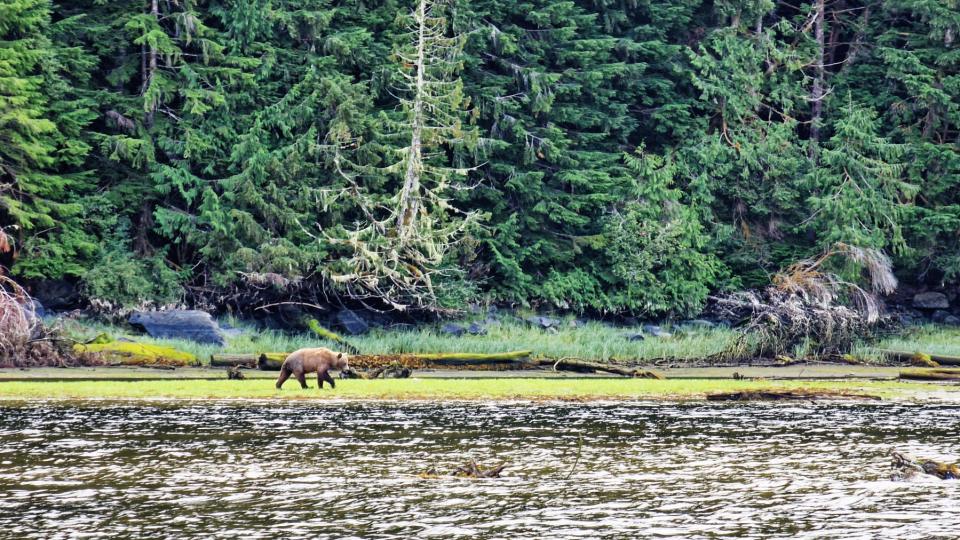
And so it was that right up to the point where we left the inlet, the wildlife were queuing up for us to see them, again and again. We really had been amazingly lucky with what we’d been able to see, and it’s a tribute to the skill and passion of the staff at the lodge that they’d got us into the positions where we could take full advantage of what the environment had to offer.
At Alder Bay, we bade goodbye to two of the members of the group we’d spent time with over the previous two days, Paula and Sandrine.
We had one final wildlife encounter of sorts still in store for us. The remaining six in the group – Eileen and Dave, Berni and Bill and Jane and I – were to be ferried to Port Hardy for our flight towards our next adventure by a young lad called Chris (who had also brought a batch of new punters to Alder Bay to be ferried back to the lodge). Tim had arranged for us to be able to visit a wild salmon hatchery (very different from a salmon farm). It is called the Quatse River Hatchery; because we arrived a few minutes early, Chris led us to a gazebo where we could eat the sandwiches that the lodge had thoughtfully provided.
As we were eating our sandwiches, a vagrant drifted past and shambled down to the river, coming back muttering that it was worse than he’d seen it in 15 years. This turned out to be Patrick, our tour guide, who then took us on a tour.
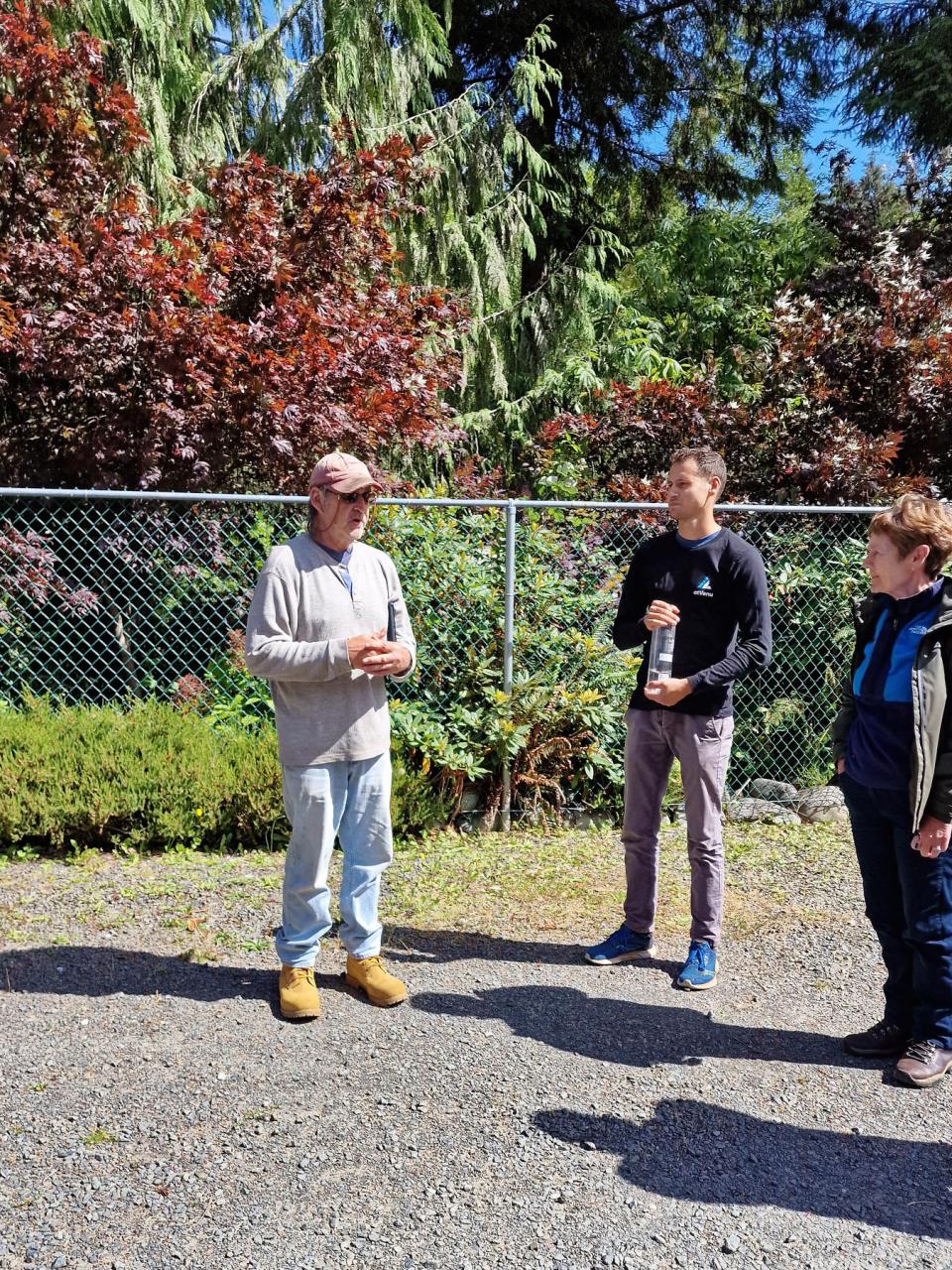
(Patrick on the left, with Chris; Eileen also in the picture.)
He actually started by taking us to see the river, which, indeed, was barely a trickle in places.


Not only was it too low for fish to navigate up, it was also too warm. Salmon thrive in temperatures up to about 13°C, and the river was up to about 17°C. Patrick showed us the fish counter

(very different from the one you’d find at any decent supermarket) which should be under water, so fish can swim over it and be seen and counted by the cameras above it. This was a further stark demonstration that the whole area is in desperate need of heavy rain, and soon.
The hatchery also has an interpretation centre, set up to educate visitors about the role of the hatchery and the critical importance of salmon to the environment generally, as they provide food when alive and nutrients for the waterways when dead. In the wild, as I’ve said elsewhere, a female salmon’s clutch of around 2500 eggs might give rise to two adult salmon – the hatchery has a neat demonstration of the difficulties faced by salmon in the form of a “wheel of fortune”, which you can spin to understand the odds of survival, rather than being eaten or dying from disease.

We were then treated to a short video about the development of the salmon and the methods the hatchery uses to fertilise the eggs and process the fry to the point where they can be released into the river or downstream lake, being very careful to keep different species separate and to mark all they produce by clipping the adipose fin (the one to the rear of their backs, between the dorsal fin and the tail – this has been shown not to disadvantage the fish). The segregation serves to prevent interbreeding between species; and the fin clipping not only allows data to be gathered on relative numbers of wild vs hatchery salmon making it back to spawn; it also enables the control of what the fishing industry gets up to; there’s a complicated set of rules as to how many hatchery versus how many wild salmon the fishing boats are allowed to keep, and the fishery inspectors apparently police this quite rigorously.
The hatchery has a room where all the eggs harvested from salmon are carefully vetted as well as nurtured. They sit in racks, washed with cold water, and every diseased egg is removed before it can develop into a danger to the others.

Finally, Patrick showed us a couple of the tanks in which the growing fry (in this case coho salmon) are nurtured.

Different sizes of fish are kept in different sizes of tanks and nurtured differently (the hatchery only processes pink, chum and coho breeds of salmon); pink salmon can look after themselves but the other species need feeding as part of ensuring their survival.
Patrick himself is an interesting case; he has a degree in political science and in one of his previous lives has lived in the UK (he is a West Ham supporter, bless him). Although not a biological scientist, he clearly had a good knowledge of the practicalities of the hatchery process and clearly had a passion for his role.
Chris then took us to the Port Hardy airport, where the six of us joined the single queue for the single check-in desk (it’s not a huge airport; it doesn’t even have a café). As we stood there, a nice staff member came over to explain to us that The Powers That Be had changed the aeroplane on them and it was by no means clear that they’d be able to get all the bags on to the (now smaller) plane. In front of us in the queue were some people with enormous bags, and one guy even had three large cardboard boxes marked “Canada Fish Produce”; since we needed to pick up our bags at Vancouver and transfer to an Air North flight to Whitehorse, this didn’t lessen the stress levels in that check-in queue, I can tell you.
In the end, there appeared to be room for all the big bags in the plane, which was a 30-seat propeller jobbie, and we breathed a sigh of relief as we noted our bags being hurled into the furthest recesses of what passes for a hold in that sort of aeroplane. A lot of passengers had fairly substantial hand luggage, some of which (mine included) wouldn’t fit into the overhead or under-seat spaces. The nice steward, a very helpful and friendly chap called Matthew, offered to put mine in a space at the front, which was kind; I heard him mutter “God, that’s heavy!” as he heaved it around.
We were a few minutes behind schedule after everyone had boarded and Matthew had sorted the bags (and told the captain about the resultant weight distribution). However, we sat on a full plane with the doors still open and the captain came on to explain that because of Vancouver air traffic controls, we wouldn’t be able to take of for a little while. All of a sudden, therefore, the stress levels rocketed up again. Our schedule allowed us an hour and a quarter to transfer between flights. Since, in the end, we were going to land 45 minutes late, it seemed that we would miss our onward flight. Jane and Matthew chatted about this a little and he was very helpful with information, such as the fact that we would be arriving in Vancouver’s South Terminal which was a shuttle bus ride from the main terminal whence our Whitehorse flight would depart. He suggested that a cab might be quicker than the shuttle and cost only 15 or 20 dollars…..
In the end, we simply accepted the fact that we would miss our flight and hoped that we would get on a later flight. And that’s what happened. We shot off the plane but had to wait a few minutes to pick up our bags. The shuttle bus departed very soon after we got on, and we went for a mystery bus tour, almost, it seemed, to downtown Vancouver, on the way to the main terminal. As we entered the terminal, I noted that our flight was marked “Final Call”.
We eventually found the two Air North desks among the myriad Air Canada and Westjet desks, and a very helpful lady got us transferred on to a later flight. In the end it was a better flight, as it was direct, while the one we’d originally been booked on went from Vancouver to Whitehorse via Victoria, which is a long way round. We passed the time until our flight taking some dinner. There were two eateries in the departures area, both takeaway joints; a charbroiled burger bar (huge queue) and a salad bar (no queue). We had a blameless falafel salad with Earl Grey tea and then it was time to go for our flight. As are most of these things it was entirely crash-free, though there were a couple of bumpy passages, and we arrived at Whitehorse at 11.30pm. only 1 hour behind our original schedule. The baggage carousel provided some amusement whilst we awaited our bags

which arrived in due course, and we headed out, expecting to have to take a cab to our hotel. As it happens, the hotel we were staying in (Best Western Goldrush Inn) had a shuttle bus waiting and so we were reasonably swiftly taken there. The last people to board the bus were a group of four hunters who had, as well as vast amounts of luggage which I helped to unload at the hotel, their own gun cases, each of which was as tall and almost as wide as they were, and which were loaded on at the front of the bus. The driver asked their leader what they were going to hunt, and he said, counter-intuitively, “sheep”. Apparently it’s a thing; we learned later that the specific sheep to be hunted are mountain sheep which have to be targeted from above. So it’s not just a question of “you just stand there looking cute / and if something moves, you shoot”*; it’s bloody hard work, it seems.
Anyway, that was about it for the evening; the hotel were thankfully expecting us and the organisers of the package that brought us here had provided information for us. It informed us that we had to be ready for a City Tour at 10am and our other planned activity at 1030pm. Unless you’ve already guessed or I’ve accidentally spilled the beans, you’ll have to come back and find out what that activity is.
* © Tom Lehrer, 1953.








 (Darryl is in the ln light green top; Ria is on the right.)


