Tag Archives: Travel

Day 10 – Caught in the wind, darling, and the reindeer

Thursday 8th July 2021. The Fosshotel Austfirðir continued to not particularly impress over breakfast. Slow replenishment of items on the buffet, and staff not seeming to be particularly keen on keeping the selection refreshed. I think this hotel is definitely suffering from the pandemic-induced shortage of trained staff in the hospitality industry – just like the UK, really. I’m sure things will improve in time (just like the UK, really); but it’s interesting that the Fosshotel in Myvatn managed to provide a decent service (despite clearly being short-staffed) whereas this one, well, didn’t. Anyway, nobody died and we got a decent breakfast, so we were well set up for the day.

Oh, I nearly forgot to provide the utterly essential comment on the weather outlook for the day. It was good. Sunny and warm. Better than at home, so yah boo.

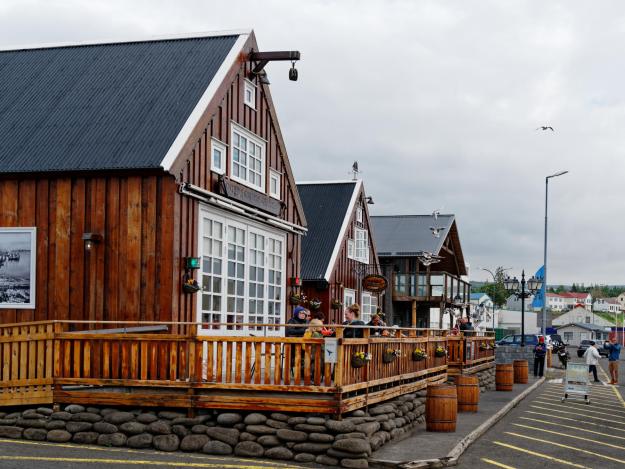
Before we set off on the day’s travels, Jane and I decided to have a walk around Fáskrúðsfjörður, which is a small town, but not unattractive. The hotel itself is photogenic.

We came across an extraordinary hanging basket of flowers.

The pot was originally used a century ago to melt liver in the the local whale factory, and then for salting fish, just so you know.

Also intriguing were the street signs, which were all in both Icelandic and French.

Apparently the town was a centre for French sailors and fishermen, back in the Good Ol’ Herring Days, so this street-naming is a tribute to their history, and the hotel itself combines historic buildings previously made for French fishermen in the years between 1898-1907: the French hospital, the Doctor’s house, and the Chapel.

The town has a nice little church

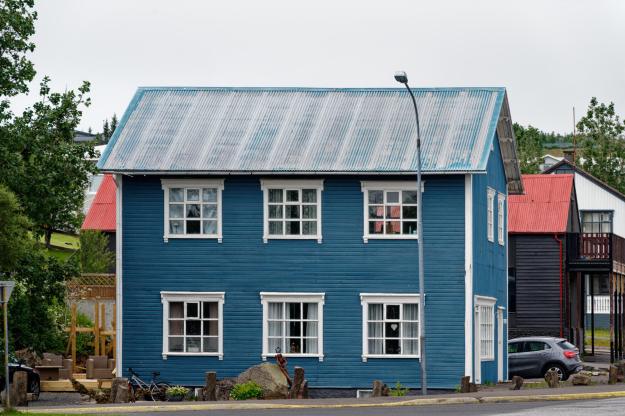
and several other interestingly decorated buildings.

and I was able to get a decent reflection photo at the small harbour.

As with yesterday, churches would figure quite large in the day. The first town we passed through, Stöðvarfjörður, provided not one but two Interesting Churches for our collection. One is the old church, Kirkjubaer, now used as a guest house.

and from which you can see the new church,

which is quite a striking building.

Another feature of the town is “Petra’s Stone Collection“, which is a good example of how far short a name can fall in describing something. Petra Sveinsdottir collected stones and kept them in her house. You can go and see them. This is true, but doesn’t prepare you for the impact of the place.

There are literally tons of stone samples, from all over Iceland, which Petra personally collected over the many years of her life and which are now on display in the house – and the garden.

All of the outdoor stones have to be cleaned every year, which looks like it’s a massive task. As well, there are quirky items on show, such as this animal made from various odds and sods
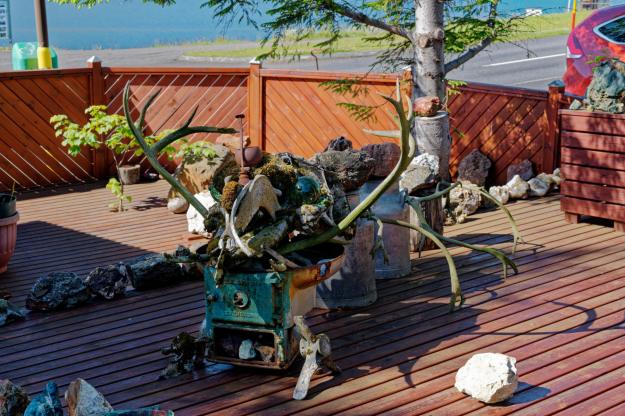
It’s a magnificent tribute to a magnificent obsession – I commend her story to you. There are some very lovely things on display; Jane was very taken, for example, with this small but perfect piece.

Stone actually was a key factor at and en route to our next stop, just along the coast. Iceland provided some typically dramatic rocky scenery as we went.

We stopped along the side of Berufjörður to look at an unusual geological sight – “Green Rock” (the Google Maps description, not mine; I would have sought something a little less literal and a little more, well, intriguing).

Whatever the key mineral was – we never found out – there was plenty lying around on the beach.

The next stop was a waterfall. Well, it’s a while since I showed you a waterfall photo, so here you go:

This waterfall is set on the river Fossá, and is one of several along the river. I suppose that’s why the river is basically called “waterfall”. Anyway, it’s a nice sight, worth a few minutes to set up the long-exposure shot.

By this stage, the idea of lunch was beginning to appeal, so we stopped in Djúpivogur. Before we could eat, though, there was another Interesting Church to add to our collection.

as well as a very striking artwork along the edge of the harbour called “Eggin í Gleðivík” (“The Eggs of Merry Bay”).

This is an artwork by the popular Icelandic visual artist, Sigurður Guðmundsson. There are 34 eggs, each representing a local bird.

We had a nice lunch in Hotel Framtid (“Hotel Future”), in the dining room which seemed more like someone’s living room from the past – very homely and comforting.

The rest of the afternoon was spent staggering about in whistling gales around a kind of “East and West” matched pair of mountains, Eystrahorn

and Vestrahorn.

We spent a lot of time scrambling around and trying to keep our balance in the windy conditions to take several different views of Vestrahorn, but actually the first one I took, above, with the lupins, is the one I like most. Note the “Batman” rocks to the right of the picture:

Also on offer to the unwary tourist at Vestrahorn is a visit to a “Viking Village”. This was actually a film set for a film about Vikings to be directed by one Baltasar Kormákur, who is a recognised Hollywood director and was briefly related to our guide Dagur until his (allegedly frequent) philandering caused a marital split. Anyway, we trudged over towards it

only to find that the years of neglect (we don’t think it was ever used) have taken their toll and it’s rather dilapidated.

There’s evidence of the nice touches that were used, for example the authentic-looking carving around the doors.

so I guess it was worth the visit, but only just; it could really do with a lot of maintenance if they wish to charge the entry fee they do.

As we exited the Vestrahorn site, Jane suddenly asked Dagur, urgently, to stop. Her sharp eyes had spotted something that’s quite rare in Iceland these days – wild reindeer.

It was good to see these creatures just pottering about without being spooked by anyone and it was a nice end to the day’s relentless tourism. All that was left was to get to a nearby town called Höfn and check into our hotel, imaginatively called the Hotel Höfn. We had an agreeable evening meal, with good service from a waiter called Philip, from Prague, whom we learnt has spent the last five summers working in Iceland whilst he studies for his degree in International Relations. Whatever that entails (other than talking to foreigners…)

We are now in South-eastern Iceland, officially in the southern region, and distinguishing features of the area are mountains and glaciers. Tomorrow we are promised a ride on a Zodiac RIB and a glacial lake, which is either going to be fascinating and fun or freezing cold and wet. Tune in tomorrow to find out how it worked out, eh?

Day 8 – Making a great deal more foss

Tuesday 6th July 2021. Yes, I know that obsessing about the weather is terribly British, but it simply has to be pointed out that today was the first day that the weather outlook for us here

was better than at home.

Hah!

In reality, the weather here today really was pretty good – even, at times, a little too warm.  So, we’ve been lucky so far.

Our first stop was actually to the “supermarket” just along the road so we could buy something that would serve as lunch.  It wasn’t what we’d think of as a supermarket and the selection was a little sparse, but we found some pizza-ish sort of things that would probably do, and – mirabile dictu – a couple of apples.  To be honest, whilst the food we’ve eaten in the hotels and restaurants here has been very well-cooked, well-presented and tasty, we’ve discovered that They Don’t Do Fruit And Veg Much here, so the quest for dietary fibre is often, erm, fruitless. That’ll be me showing my age, then.

So: a morning of waterfalls beckoned.  Firstly, the most powerful waterfall in Europe – Dettifoss.


View this post on Instagram


A post shared by Steve Walker (@spwalker2016)


As I hope you can hear from the sound on the video, this is an awesome thing. It must be said, though, that we preferred those from yesterday.  Dettifoss, because it’s carrying such a volume of glacial rock fragments, actually looks a bit muddy.  I know it’s pathetic to expect pristine white water, but there you go: we’re tourists – what do we know?  Dettifoss is one of several waterfalls along a canyon, and there was an insight into the impact of the glacial sediment on the water flow via a view of whatever the geologists would call the side street of a canyon.

You can see the clarity of the water which is out of the mainstream.

The second waterfall of the day is visited on the same hike which took us to Dettifoss. It’s called Selfoss, and it’s also pretty impressive.

You can see photographers on the far side of the canyon. These are the keen beans who have risked the tyres and suspension of their vehicles and a possible broken ankle or two to get to the Dedicated Photographer side of the canyon. Ok, the view of Selfoss would have been better from that side, and you can also get a Classic Shot of Dettifoss from over there; but our schedule, and my not-preparedness to lug a tripod over rocky terrain and spend much time setting up long-exposure shots, conspired against my achieving anything other than the standard Tourist Pics (which I’m very happy with). Dagur did his Pro Photographer bit as best he could at Selfoss, given that his clients were too pathetic to go the extra mile.

But the two falls were anyway impressive to see.

And that wasn’t the end of the foss we had to make this morning, as there was a third waterfall to visit, Hafragilsfoss, down another rocky track.

It wasn’t possible to get really close to this one because the track, even under normal circumstances a somewhat tricky descent, was impassable because of rockfall.  Such a shame. No, really.

It was getting towards lunchtime by this stage, and we were understandably anxious to get at our pizza-ish goodies, and Dagur suggested that we could hike to lunch at Katlar, which was along, you guessed it, a rocky track a little further downstream in the canyon. So we loaded up with lunch goodies and set off. We hit a decision point and, through a process that I don’t quite understand but am very grateful for, took a side track. This was actually a revelation, as it led through a landscape that we simply hadn’t come across before in Iceland, involving, as it did –  trees!

and wild flowers!

It really was a gorgeous walk, beside a river which of course gave rise to more photo opportunities.

After a while, we wound our way back towards Katlar, which is a gorgeous gorge

but decided in the end, and mainly because of the increasing numbers and importunateness of the flies, to head back to the car, where we ate our lunch in air-conditioned comfort but with no view.

At the next stop, we agreed between us that it wasn’t worth spending time heading toward the lava cave that Dagur had originally in mind (we’d already passed a couple, maybe not so grand, earlier in our walk).  However, the car park for that trek was interesting as it illustrated the difference between how serious Icelanders go on serious camping holidays

and how the Germans do it in Iceland.

After this, we went to an oasis of calm called Ásbyrgi Canyon.  This is a huge horseshoe-shaped wall of rock with a lake at its foot (Icelandic legend has it that this was a hoofprint of Odin’s 8-legged horse, Sleipnir. I couldn’t possibly comment on the veracity of that.)

And yes, a rocky trail leads down to the lake and at first blush it didn’t look as if it was going to be all that calm

but fortunately the bus load of Americans left shortly after we arrived and it settled down a bit. From the lakeside, you can’t capture the scale of the place in a photograph. You have to climb up to a viewing platform to do that.

But I did try a little snippet of video (creative director again was the distaff side) to give some idea of what it’s like on the lakeside.


We then headed back to the hotel, via a small town called Husvik, the Whale Watching capital of Iceland, where Dagur took the Land Rover off to clean it whilst we pottered around. The town is typical of our experience so far here, in that there are some attractive buildings

but much of the town is basically workmanlike rather than pretty.  It does, however, feature an unusual church, which we of course added to our collection of same.

After Husvik, we headed back to the hotel but Dagur took us by an alternative route which enabled us to get some insight into the reason for the lupins in Iceland.  You  can see them dotted about in the laval soil here.

Dagur told us that he remembered being driven along this road by his father when he was quite young, and it was just black sand. And this sand had been a major problem, particularly as it blew in the wind; soil erosion was one issue, and damage to cars’ paintwork was another. So the lupins were planted to combat soil erosion and they work – but it’s still ongoing and will be a task that carries on for generations to come.  The authorities are trying to leaven the mix with grass planting as well as lupins and this seems to be working overall; the problem is really to decide exactly where to cover with the programme, as a huge area is affected by this issue.

And thus ended another varied and interesting day, apart from the bit where Jane educated the hotel bar staff about Boulevardier cocktails. We have another V&I day in prospect tomorrow, with – who knows? – perhaps even more puffins! But much of the schedule will be decided on the hoof and so you’ll simply have to come back here and find out what we got up to, won’t you?


Day 7 – Fossicking

Monday 5th July 2021. We had the luxury of a slightly late start in that we were leaving the hotel as late as 10.30. This gave us the opportunity to have a wander around Akureyri.  We’d been past the botanical garden en route to the hotel yesterday, and thought this might be a decent starting point. And There Was A Church….

Akureyri is the capital town for the region and, like the UK’s capital, has charm in sporadic doses among other, less appealing, aspects.  But there is quirkiness, such as the pavement outside the art museum

and the steps that lead to the college.

There are also fine edifices, such as the college’s main building

and other residences.

The botanical garden, one of the most northerly in the world at only 50km south of the Arctic Circle, was created in 1912 and has extended over the years to form a pleasant oasis, free to enter and walk around.

Worth a visit for all floraphiles, but I won’t bore you with too many photos.  It’s only flowers, after all…

On the way down, we passed the church, which shows some art deco influences

and featured ravens on its spires.

The town has some pleasing buildings among the workmanlike ones.

As we left, Dagur was upbeat about the weather prospects for the day.  Akureyri, however, was pretty much blanketed by fog.

But, as we emerged, blinking, from a tunnel shortly after we hit the road, the weather on the exit side of the hill was completely different

and stayed pretty good for most of the day.

The first two ports of call were waterfalls. (The Icelandic for waterfall, by the way, is “foss”, just in case you were wondering about the title of this post.)

Dagur decided on the hoof to visit the first one, which is called Aldeyjarfoss.  There’s a slightly precarious walk down to it, but it was definitely worth the diversion.


View this post on Instagram


A post shared by Steve Walker (@spwalker2016)

The second styles itself, rather immodestly, as “The Waterfall of the Gods” or Goðafoss. It is an impressive sight, one has to admit.


View this post on Instagram


A post shared by Steve Walker (@spwalker2016)

Since the sun was out, rainbows were on offer in the spray.

There was a restaurant by these falls, at which we bought some (sadly not particularly appetising) lunch. But at least they also had beer and Earl Grey tea, so all was not lost.

After lunch we headed for our overnight destination, beside Lake Myvatn. The landscape changed as we approached, from the rolling, farmy sort of countryside to a more austere, rocky appearance, which signified that we were in an area of geothermal activity – hot springs, in other words.  The water can come out of the ground at 100°C (as they discovered the hard way when excavating the tunnel that led us through from Akureyri), and so has obvious uses for heating, such as the Myvatn Nature Baths nearby.

What I couldn’t show in photos was the seething, steaming cauldron nearby with “Danger – 100°C” warning signs on it.

The rest of the day was spent exploring this new, extraordinary – and active – landscape. We stopped first at the Námafjall Geothermal Area. which features smoking fumaroles and boiling mud pots, surrounded by sulphur crystals of many different colours. This sulphur gives the area an overwhelming smell of eggs, and ones that have not been treated well, at that.

It really is an extraordinary landscape

but then almost everything in this area is.  There’s a geothermal energy plant

a volcanic mountain, Kafla, with its very own crater lake

and a huge area called Leirhnjúkur, which is basically a field of lava from eruptions over a period during the 1970s and 1980s.  A walking trail leads across it to the crater of Hófur, and the entire landscape is utterly extraordinary.  I took loads of pics, obvs, and here are some of them.


View this post on Instagram


A post shared by Steve Walker (@spwalker2016)

(Jane has to take the credit for setting up the last shot for me – pointing me in the right direction after I’d been looking in the wrong place.).

We walked the area for about 90 minutes, marvelling all the way at the amazing landscape – just another facet of Iceland’s stupendous geology.

We then went to our hotel, the Fosshotel

which proved to be very good – excellently organised rooms, good food in the restaurant, and it will be our pleasure to stay here two nights.  Mind you, Jane thinks the cocktail barman needs to up his game a bit.  We’ll see how he gets on when asked for a Boulevardier tomorrow evening…..

We have more waterfalls to see tomorrow, among other delights which I shall be sure to report in these here pages.  So do please come back again to catch up with the delights of our next day out.