Tag Archives: Travel

Day 7 – Fossicking

Monday 5th July 2021. We had the luxury of a slightly late start in that we were leaving the hotel as late as 10.30. This gave us the opportunity to have a wander around Akureyri.  We’d been past the botanical garden en route to the hotel yesterday, and thought this might be a decent starting point. And There Was A Church….

Akureyri is the capital town for the region and, like the UK’s capital, has charm in sporadic doses among other, less appealing, aspects.  But there is quirkiness, such as the pavement outside the art museum

and the steps that lead to the college.

There are also fine edifices, such as the college’s main building

and other residences.

The botanical garden, one of the most northerly in the world at only 50km south of the Arctic Circle, was created in 1912 and has extended over the years to form a pleasant oasis, free to enter and walk around.

Worth a visit for all floraphiles, but I won’t bore you with too many photos.  It’s only flowers, after all…

On the way down, we passed the church, which shows some art deco influences

and featured ravens on its spires.

The town has some pleasing buildings among the workmanlike ones.

As we left, Dagur was upbeat about the weather prospects for the day.  Akureyri, however, was pretty much blanketed by fog.

But, as we emerged, blinking, from a tunnel shortly after we hit the road, the weather on the exit side of the hill was completely different

and stayed pretty good for most of the day.

The first two ports of call were waterfalls. (The Icelandic for waterfall, by the way, is “foss”, just in case you were wondering about the title of this post.)

Dagur decided on the hoof to visit the first one, which is called Aldeyjarfoss.  There’s a slightly precarious walk down to it, but it was definitely worth the diversion.


View this post on Instagram


A post shared by Steve Walker (@spwalker2016)

The second styles itself, rather immodestly, as “The Waterfall of the Gods” or Goðafoss. It is an impressive sight, one has to admit.


View this post on Instagram


A post shared by Steve Walker (@spwalker2016)

Since the sun was out, rainbows were on offer in the spray.

There was a restaurant by these falls, at which we bought some (sadly not particularly appetising) lunch. But at least they also had beer and Earl Grey tea, so all was not lost.

After lunch we headed for our overnight destination, beside Lake Myvatn. The landscape changed as we approached, from the rolling, farmy sort of countryside to a more austere, rocky appearance, which signified that we were in an area of geothermal activity – hot springs, in other words.  The water can come out of the ground at 100°C (as they discovered the hard way when excavating the tunnel that led us through from Akureyri), and so has obvious uses for heating, such as the Myvatn Nature Baths nearby.

What I couldn’t show in photos was the seething, steaming cauldron nearby with “Danger – 100°C” warning signs on it.

The rest of the day was spent exploring this new, extraordinary – and active – landscape. We stopped first at the Námafjall Geothermal Area. which features smoking fumaroles and boiling mud pots, surrounded by sulphur crystals of many different colours. This sulphur gives the area an overwhelming smell of eggs, and ones that have not been treated well, at that.

It really is an extraordinary landscape

but then almost everything in this area is.  There’s a geothermal energy plant

a volcanic mountain, Kafla, with its very own crater lake

and a huge area called Leirhnjúkur, which is basically a field of lava from eruptions over a period during the 1970s and 1980s.  A walking trail leads across it to the crater of Hófur, and the entire landscape is utterly extraordinary.  I took loads of pics, obvs, and here are some of them.


View this post on Instagram


A post shared by Steve Walker (@spwalker2016)

(Jane has to take the credit for setting up the last shot for me – pointing me in the right direction after I’d been looking in the wrong place.).

We walked the area for about 90 minutes, marvelling all the way at the amazing landscape – just another facet of Iceland’s stupendous geology.

We then went to our hotel, the Fosshotel

which proved to be very good – excellently organised rooms, good food in the restaurant, and it will be our pleasure to stay here two nights.  Mind you, Jane thinks the cocktail barman needs to up his game a bit.  We’ll see how he gets on when asked for a Boulevardier tomorrow evening…..

We have more waterfalls to see tomorrow, among other delights which I shall be sure to report in these here pages.  So do please come back again to catch up with the delights of our next day out.


Day 5 – What the fox that?

Saturday 3rd July, 2021.  One gets to be obsessed with the weather while on holiday in Iceland.  It’s not a conversation-easer like in England; here, it really matters.  The forecast for the day was hopeful.

but the reality was much better.

Ísafjörður looked lovely in the sunshine; and Jane pointed out that it also has an unusual-looking church. It seems to be a thing here.

We set off into the sunshine with a song in our hearts and a long day’s driving ahead.

Then we ran into the fog.

However, Dagur Had A Plan, and so took us up into the hills, where we could get some good views looking down on the clouds, which is always nice.

Today, we learned the proper Icelandic word for the “Valley Fog” that we’d first noticed yesterday. It’s called “dalalæða”; “dala” means valley, if my knowledge of Swedish is anything to go by.  This is a form of sea mist, but it’s pretty much unique to Iceland, as far as I can make out. Every so often for the rest of the day we entered a bank of mist, or it figured as part of the view.  So, for example, we stopped at an outdoor maritime museum at Bolungarvik, and could barely make it out through the mist.

But the mist also provided a lovely backdrop to a photo of Ísafjörður.

Our next stop was at a museum dedicated to the Icelandic Arctic Fox.  Officially, this is the same as arctic foxes found elsewhere; but an interesting information film gave the impression that actually the genetic makeup of most of the Iceland population is diverging from those elsewhere. It’s an appealing place

with coffee and cake if you want it, and several (stuffed) examples of foxes, such as this, which we judged to be the finest specimen on display.

Both Jane and I were under the impression that arctic foxes had a winter (white) coat, which changed into a summer (dark) coat.  It turns out that we were wrong; there are two “morphs”, white and blue, and while their coats may change a little in colour, it’s not the transformation that we’d previously thought.

And outside, in a large caged-off area, they have a real, live, fox.

Arctic fox cub

It’s just a pup; a Bambi fox, because apparently it’s parents were shot. It’s not known what its future holds, but for now, it is supremely cute.

Further cuteness was on display a short while later, as Dagur suddenly braked, turned round and went back along the road we’d come along.  It turned out that he’d spotted a lone seal on a rock, and so stopped and took some photos.

There is an “official” place to view seals a little further around the coast, so we stopped there; but one really needed binoculars to see the seals; my general-purpose lens could barely pick them out.

and my phone couldn’t do the scene justice, either.

(though, once again, this image is a tribute to the imaging power of modern phone cameras.  I could barely distinguish between seals and stones with the naked eye).

Shortly after this, we had a scenery stop at Rjukandi, where there’s a pretty cascade. But this is Iceland, so it’s not a real waterfall.  We did venture off-piste to try for a photo of three others.

I particularly wanted to capture this as a wonderful demonstration, suitable for any geography/geology lesson, of water’s power of erosion.

It was time for lunch, and serendipity stepped in at this point, as we were near a place where we could see a round of Vestfjarðavíkingurinn 2021, the Icelandic Strongest Man competition.

It was slightly surreal to see these large chaps congregating

and I was lucky enough to get a little video footage of a couple of the contestants

after which they came into the restaurant for lunch.

The commentator is a very big name in Iceland – Magnus Ver Magnusson, who won the World’s Strongest Man competition four times.

After this unusual lunch stop, we next visited Saltverk, a small factory producing some of Iceland’s (apparently) famous sea salt in a 100% sustainable fashion, based on a geothermal source at Sudureyri.

This heat is used to evaporate salt water taken from the sea from its normal salinity of around 3.5%, in stages, to around 28%, where the salt starts to separate out in its tanks and sink to the bottom, where it can be collected.

and then put into drying racks before being packaged up.

The salt is mixed with other ingredients such as thyme, or smoked, or sold untouched by further processing.

The rest of the day consisted of simply getting to our hotel, and thus completing a journey of over 350km.  The scarcity of towns and villages as we travelled underlines how isolated these parts of Iceland are, and goes some way to explaining why some places are struggling – the distances are too large for any kind of convenience in living.

We passed a couple of noteworthy buildings on our route to the hotel:  a house that looks more like a small castle (unoccupied definitely, and abandoned, it would seem);

and another for our informal collection of unusual church buildings – this one at Holmavik with rainbow steps.

And so here we are at our hotel, at Laugarbakki – a modern and quite imposing edifice, with, as we’ve now come to expect, very good food in the restaurant.  Jane had a salad which included unusual-coloured pea pods:

She didn’t eat it, of course, as she’s not a Purple Peapod Eater.

So here we are at the end of a varied day. We have a similarly mixed programme of things to look forward to tomorrow, so I’d be very glad if you were to come back and Read All About It then. For now, good night!


Day 4 – Crossing the mountains with a Fjord Escort

Friday 2nd July 2021. At last! A chance for me to foist upon you my joke about travels among Nordic mountains. Sorry, though – Long Read Alert Again!

The weather forecast according to the Met. Office app was for unbroken sunshine all day. No, really:

This was the reality as we headed for breakfast.

In the event, we had little direct sunshine, but no rain and almost no wind, so a good day for relentless tourism, which we proceeded to embark upon.

The first stop was Tálknafjörður, which Dagur described as “a bit of a sad town”, but which looked pleasant enough.  I guess that, like many Icelandic towns, it’s struggling to survive and thrive in modern times, with Reykjavik and parts foreign proving attractive to young people. Anyway, that aside, its USP is a very unusual church.  Not the bonkers architecture seen in Stykkishólmur (go and look at the blog post for Day 2) or Reykjavik (arrival day), but nonetheless striking.

It overlooked a pleasant view, too. Lots of lupins, of course.

Our onward journey took us up into the mountains as we crossed the knuckle of the peninsula towards Bíldudalur and thence from paved to unpaved road for a bumpy, 25 km, half-hour ride, which, according to Google Maps, took us out to sea.

This was a map-reality disconnect, luckily…  Anyway, we bumped along, heading for the outdoor art museum of Samuel Jonsson, who, it seemed to us, Wanted To Be Alone whilst he made his art from driftwood and anything else to hand, as he lived a great distance from what we might regard as civilisation.  The museum is charming.

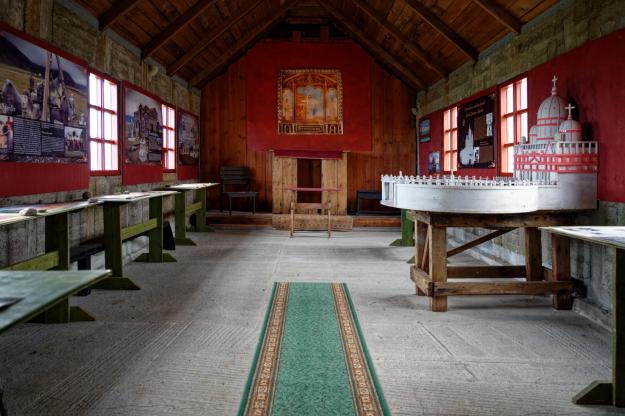
To the left is a church he built, which has a lovely interior, today used as part of exhibiting pictures and other information about him and his art.

The most striking thing in here is his model of the St. Peter’s Church in Vatican City.

The building to the right of the church is a gallery (not currently in use) and dead ahead is the (rebuilt) house he lived in.  There are various artworks gathered outside.

The statue is a recreation of that of Leifur Erikson, which is outside the  Hallgrímskirkja church in Reykjavik; the circle of lions is his recreation of an original from the Alhambra. It’s a working statue, after a fashion, in that it needs manual charging with water.

The place seemed awfully remote to us, and we wondered how on earth one could sustain a life so far from the nearest town.  But the lady in charge of the exhibition pointed out that things have changed in the nearly 100 years since Jonsson first lived there.  For a start, Bíldudalur was a much larger town then, and had a variety of shops; also Jonsson lived among a community of some 200 souls, with another one of 100 people not far away; and, of course, there was much more reliance upon supplies being brought in by boat. So life wasn’t as tough as we might have thought when viewing it through 21st-century eyes.

After bumping our way back to today’s version of civilisation, we headed again into the mountains. En route, we did stop to see something quite uniquely Icelandic – an outdoor, public, hot spring bathing pool.

One can just change in the little hut and bathe in the hot water – it’s a public facility.

The paved road then gave way to another ungraded surface which took us up into the mountains where we actually saw some residual snow. This remains even during the summer, in those shady parts where the sun can’t reach.

The next stop was a treat, as it was a visit to the biggest waterfall in the Westfjords – the Dynjandi waterfalls.

There are seven waterfalls, each of which has an individual name, and there’s a path one can climb to pass them all on the way to the big one – Dynjandi itself.

It really is a great place to visit, a very impressive sight and well-organised.

We lunched there on sandwiches bought earlier and then headed round to the next peninsula in the Westfjords, to a place called Hrafnseyri, where there’s a museum which features a replica of a turf-roofed house

and a rebuilt version of an old church.

After this visit, we headed – again across the knuckle of a peninsula finger – towards Þingeyri. As ever, this mountain road gave us some impressive views. We were lucky enough to witness a phenomenon which is not uncommon in Iceland, but is not the sort of thing you often stumble across in the UK – valley fog.  Clouds appear to be spilling out of the fjords into the sea, and it’s a striking sight.

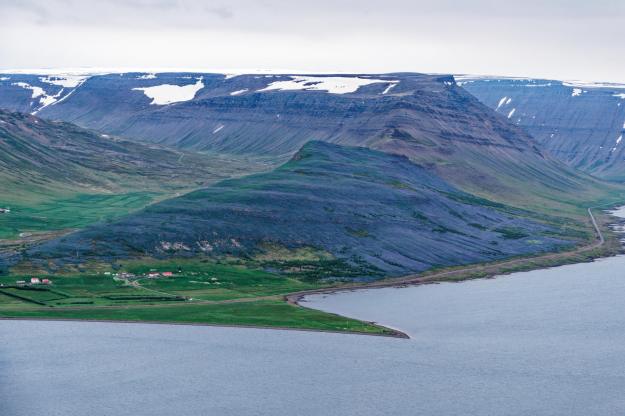
There were, of course, other impressive views over the fjords.

and, as we neared Þingeyri, Dagur suggested we could try an interesting track across a hill (the one in the centre in the above picture, actually) which offered some fine views.  So, off we went. But only so far, as it turned out to be such an arduous climb that Dagur wasn’t sure that even a modern Land Rover Defender could handle it without risk. So it ended up with Dagur and me scrambling up the rest of the path to the top. I just thought you might be interested in a the vital signs of a photographer as he ascends a climb taking photos on the way, wanders about taking photos at the top and them comes down again:

But it was worth the climb for some fantastic views.

(Note the vast extent of the lupins in the last of these photos.)

After a very careful descent, we visited Þingeyri and then travelled around to the next finger of the peninsula towards Flateyri.  En route was a uniquely Icelandic scene.

A perfectly pointy mountain above some houses and swathes of lupins.  I’m so glad we came whilst these were in flower.

The final stop of the day was to marvel at the size of the earthworks they’ve built above Flateyri to protect against avalanche. Here are pictures of the right-hand wall and the overall sight from the harbour, but it’s difficult to convey how huge the endeavour is to build this.

We then headed to our final stop for the night, Ísafjörður. We checked in to the eponymous hotel, had a very fine dinner, which featured wolffish, and took a brief stroll around the town…

and thence to bed.

I’m promised that tomorrow will be spent mainly driving and so there really, really should be fewer photographs and drivel from me.  Thank you for reading this far, and I hope you’ll check in on tomorrow’s exploits.