Thursday 15th July 2021. We’ve been home a couple of days now and are gradually easing ourselves back into all the home-based routines that had dominated, well, the last 18 months, really. The number and intensity of the seriously unfamiliar sights we’ve been treated to for two weeks have overlaid the mundanity of our return to domestic routine with a patina of unreality. Before this fades, I thought it would be an idea to pull together some thoughts into a sort of valediction whilst things are still reasonably fresh in our minds. All of the following should be read in the context that we had an excellent holiday experience which it would be difficult to improve upon.
- Is Iceland expensive, as is reputed? It’s certainly not cheap. For lunch, dinner and a couple of drinks daily, the total cost for fifteen days ran out at over £2,000 for the two of us. A large gin & tonic could be around £12, for example, and a glass of wine with dinner around £10. This may seem steep, but then again I don’t know how these compare with, say, London prices. However, this was a holiday, and the exchange rate made it difficult to do the necessary mental arithmetic to establish how much things translated to in English money, so we firmly turned our face against worrying about it.
- The gin. There is a good variety of Icelandic gins. We found that the flavour of many brands, such as Himbrimi, while tasting perfectly gin-like neat, seemed to disappear when tonic was added. An exception to this is Icelandic Angelica gin, which we only really discovered on the flight home, but which was very nice in a G&T.
- The diet. As we travelled around in Iceland, it seemed that every restaurant menu featured the same items – cod and/or arctic char, lamb, beef, occasionally chicken. Of course Iceland is an island and has more sheep than natives so the presence of fish and lamb is not a surprise. Generally, menus seemed to prioritise fish/meat and potatoes over vegetables; and the fruit typically available at breakfast tended (rather counter-intuitively) to be melon, watermelon and pineapple. But then the island’s climate isn’t really a fruit-growing one and its ecology isn’t particularly vegetable-friendly. So, Friðheimar apart, many things have to be imported; Dagur told us that a large proportion of this is centrally-managed, hence the uniformity of produce across our travels.
- It’s very easy to pay in Iceland. Everywhere, absolutely everywhere, enabled contactless payment and we used our phones for this. Terrifically convenient and well-organised. You don’t even need to be connected for Google Pay to work.
- Talking of which, Iceland’s connectivity is generally excellent. There were a couple of remote places where the mobile signal didn’t reach, but I could almost always get online if I needed to; and – at the moment. at least – calls and data go against my UK quota, so I could do the utterly critical tasks, like Instagram, at any time. Such a relief, you can’t even guess.
- Iceland is a large island, certainly larger than we had realised. To see what we saw round the island took 13 days of relentless tourism. Even then, we really only skimmed the surface; the country would repay a deeper. slower visit; or, of course, several shorter ones. In our case, having a knowledgeable guide like Dagur was a key ingredient to the success of the holiday.
- And, of course, it’s vastly different between summer and winter. We have only experienced the former, and certainly want to go back during the winter time to experience the difference. While we spent a fortnight exploring the whole coastline during the summer, our guide reckoned that one can experience most of what Iceland has to offer in the winter (ice caves, geothermal hot pools, northern lights) in just a few days whilst staying within striking distance of Reykjavik and thus avoiding having to travel in what might well be rather problematical road conditions.
- The light. We travelled near midsummer, which meant that although the sun officially set (we were just below the arctic circle), it never got really dark. A photo example can be found in an earlier post. For me the practical upshot was that I tended to lose track of time whilst writing the blog every evening since I didn’t have the cue of it going dark; so I sometimes looked up to find that it was after midnight. All the hotels had blackout curtains, but all let in a certain amount of light. My advice to travellers that find it difficult to sleep in the light is to bring a sleep mask if your time there is in summer. (Of course, at midwinter, it barely gets light, particularly in gloomy weather.)
- The weather. Ah, the weather! As far as we could determine, the only predictable thing about the weather is that it will be windy (Chris Foster, Jane’s friend in Reykjavik, commented that Iceland is the fourth windiest place in the world – and no-one lives in the other three). Anything else can change very rapidly. We packed for cold and rain but were lucky, by and large, to get cloudy or sunny weather. We should have packed sunscreen, but didn’t.
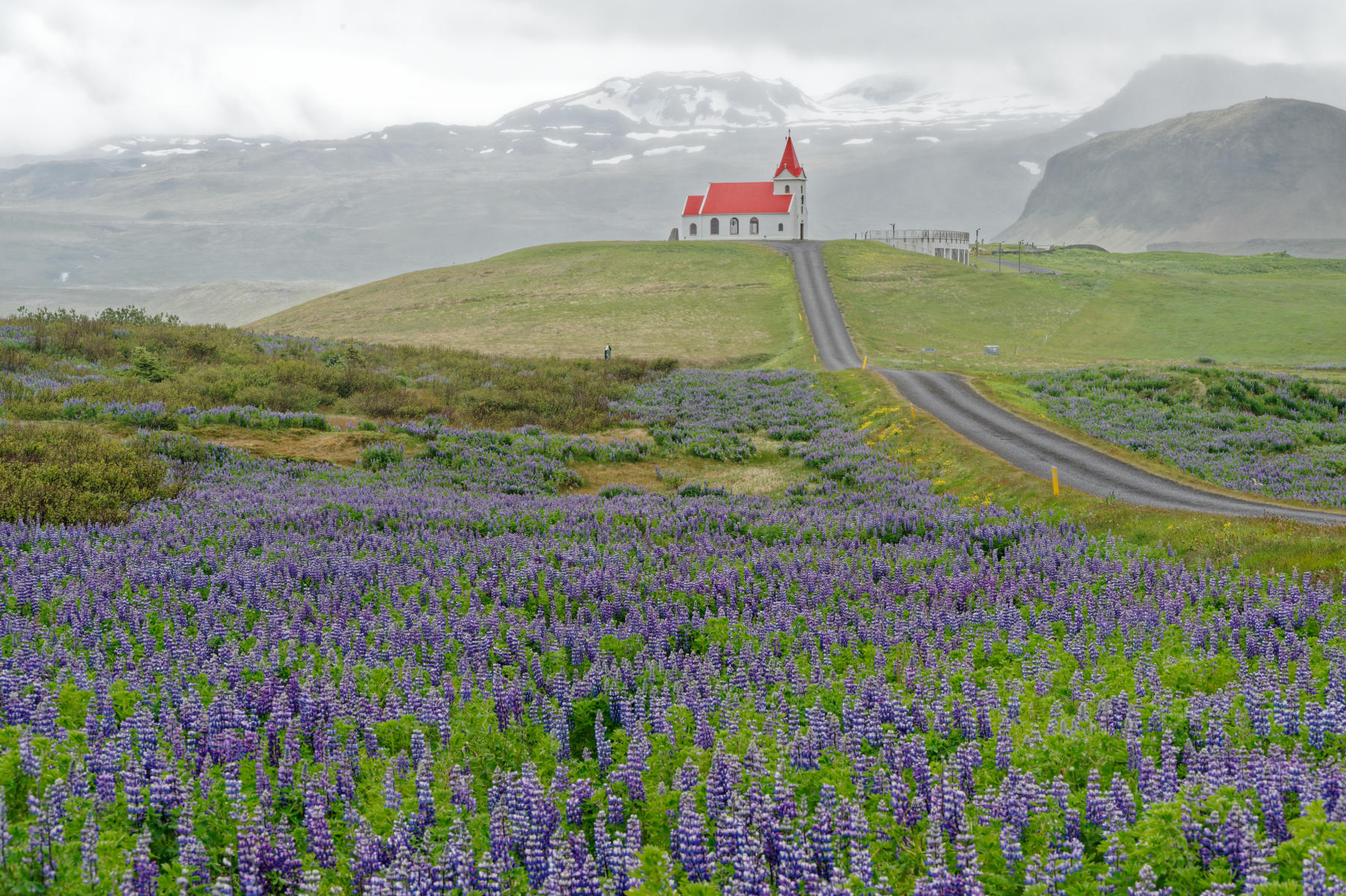
- The lupins. This is a contentious issue among Icelandic people; some appreciate their environmental benefits and some hate their invasiveness. But one thing is certain: during their brief flowering period, around mid-June to mid-July, they are a colourful addition to the countryside. For the rest of the year, they’re just green, apparently.
- The scenery. It’s anything from attractively scenic to jaw-dropping. In a way, it’s a shame that so much good scenery is concentrated in a single island. Pretty much every mile brings a fresh sight that, anywhere else, would have you stopping the car to take a photo; but in Iceland it’s commonplace and after a while, I wonder if one gets a bit inured to the passing landscape unless it’s a massive waterfall, a geothermal hotspot or a panorama over a fjord.
- The birdsong. It was a practically ubiquitous and continuous soundtrack to our holiday, with the drumming of snipe and calls of curlew, kittiwake and other birds ever-present. Jane said that it reminded her of her childhood in darkest Somerset, with a level of birdsong you rarely if ever hear today. The same idea applies to insects; Dagur had to clean the Land Rover’s windscreen of splatted invertebrates on several occasions, an activity that is no longer so common in England.
- The roads. The major roads are very well tarmacked; less major roads are hard and (largely) level, without a tarmac surface but easily navigable in a normal car; and below that are large numbers of very bumpy tracks which may be found on a map but which really require a serious 4×4, such as the Land Rover Defender that we were in, to be sure of getting along without problems; and the highland mass in the middle, with bridgeless river crossings and rough tracks, should be avoided unless you have serious overland capability, local knowledge and at least one backup car.
- Whilst on the topic of roads, the wildlife. Or, more accurately, the sheep. They’re not strictly wild, but are free to roam wherever they want, which is quite often on the road. The sensible ones know to get off the road as a car approaches, but they’re not always sensible, and ceaseless vigilance behind the wheel is necessary.
- The language. It’s a bastard. It has several of its own characters, plus a lot of diacritical marks so even the letters you recognise aren’t necessarily pronounced the way you might think. Both Jane and I really struggled with understanding and pronouncing place names. I have a favourite sight, the canyon at Fjaðrárgljúfur, but I’m buggered if I can retain the name in my head for more than a few seconds at a time.
- The people. All the Icelanders we met were very smiley, happy-looking, friendly people. This may, of course, be a side effect of the long days of summer, and the reverse may be the case during the winter, but we left with a positive view of the natives. Given that the population is about 350,000 and the tourist industry in a good year brings in two million visitors, it’s unsurprising to find other nationalities at work in the hospitality industry as well. Generally, we got excellent service wherever we went. In these post-Covid times, though, one has to be a little careful when out in the wilds of the Icelandic countryside to establish what’s open and what isn’t.
Should you visit? Unless you want a fly-and-flop, sunshine-and-beach holiday, the answer is yes. It’s an astonishing, remarkable, unique place. We feel very lucky that we have been able to visit and look forward to going again.