Tag Archives: Tourism

Catch As Ketchikan

Wednesday 17 August 2022 – Long read alert! Grab yourself a cuppa or a glass of something cold and settle in for a spell.

This is the last post about the cruise, for today we are At Sea, having departed our final port of call, Ketchikan, yesterday. From the decks of the ship, it looked an attractive place.

and we got prime parking position bang in the middle of the downtown waterfront. It was also clear what a major role tourism plays in its economy.

As ever it was an action-packed day, but for once our luck with the weather deserted us.

Ketchikan measures its annual rainfall in feet, and gets somewhere between 12 and 15 feet of rain every year.  If you check out this average climate page, you’ll see that “A lot of rain (rainy season) falls in the months: January, February, March, April, May, June, July, August, September, October, November and December.” Yesterday proudly performed in line with the averages.

No matter. We disembarked promptly for our excursion, a “photo safari”.  Whilst we awaited the start, we took a couple of photos from the quayside

The statue above is called “The Rock” and depicts the various influences in the development of the place – Tlingit, loggers, fishermen and airmen.

Our tour was led by Theresa

who was very friendly and helpful, but garrulous to the point of gabbling. It was only her second or third time of leading the tour, I think, and maybe she was a little nervous.  However, she had a few tips of particular value to iPhone users, but some of which could also apply to Android phones, and she took us to some nearby locations we might not have found by ourselves and some more remote ones, too.

We started at Ketchikan Creek, which runs through the downtown area.

You can see the downtown/old town buildings in the photo above, and we headed over to them. They surround a street sensibly called Creek Street and are very charming, even in the pissing rain.

I caught a glimpse of a raven slyly feeding on some scraps it had found.

Ketchikan styles itself “The Salmon Capital of Alaska”, and, since the salmon were running, we could see why.  On the positive side, one can see a salmon ladder beside the creek, where the salmon make their way upstream to spawn

but one can also see (and often smell) the carcases of those that didn’t make it – the creek waters are littered with dead salmon.

There’s a salmon sculpture by the banks of the creek, carved by Terry Pyles

and named in honour of the native carver Jones Yeltatzie, who had originally put a painted wooden salmon there.  Salmon dominate as a wildlife specimen, but there are plenty of other animals in the area, and these are celebrated in an artwork on the side of a Creek Street building.

Theresa took us to another area by the creek, where we could also see salmon working their way upstream; nearby houses were attractively coloured but a little run down.

After that we took to the road to cover a variety of different locations: a viewpoint which shows that Ketchikan has its working side as well as the quaint downtown area;

the library, which normally has a great view but today was struck by the Walker curse – “would have been better if it were clearer!” –


but which offered a nice close-up;

the harbour, which has a very extensive marina;

a floatplane mooring;

Ward Cove;

and, finally, Totem Bight State Historical park, also called Potlatch Park.  This features a replica native village, laid out as closely as possible to the traditional manner and constructed using traditional materials and hand-made tools. Construction started in the 1930s.

and, somewhat bizarrely to my mind, a small vintage motor museum.
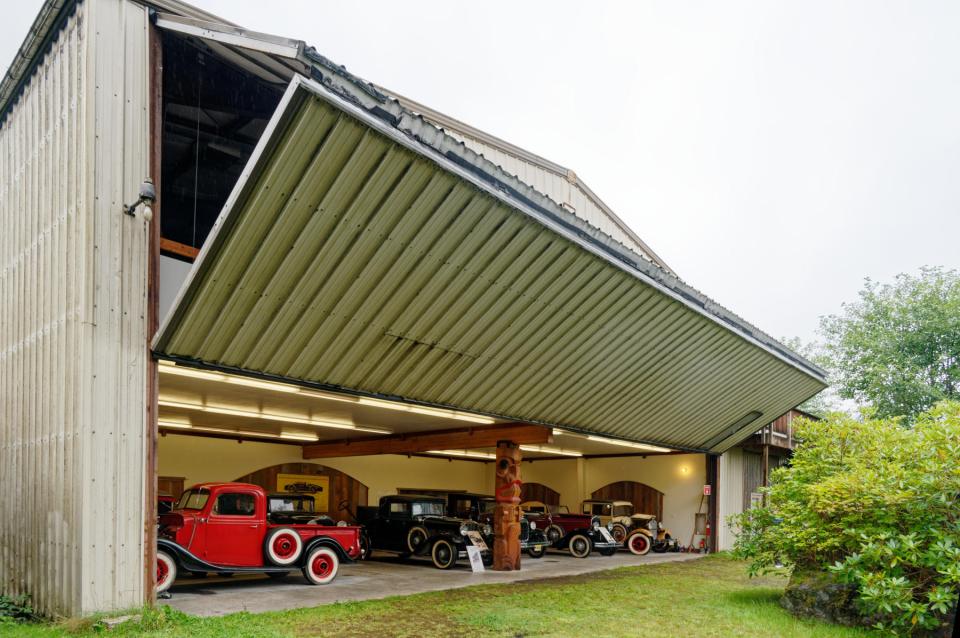
The place had the most amazing gift shop. You really don’t expect to find life-size cars in a gift shop, do you?

The gift shop also featured a museum of older artifacts (e.g. guns)

and Jane found an exquisite advert.

Our time ran out at this point and we had to hasten back for the second adventure of the day, something which was surely to be the cultural zenith of the entire cruise – the Great Lumberjack Show!

We blundered about trying to find it at first, but succeeded in the end. There was a Lumberjill outside it as we went in

to seating by an arena which was clearly set out as a competition between USA and Canada.

The host was “Lasagne Joe”, who asserted that he was a chef,

and who was the MC for a variety of different “Timber Sports” set pieces with each team of two guys trying to beat the other.

It was as staged as WWF wrestling, but massively entertaining; and the athleticism, strength and skill of the guys was very impressive indeed.  Of course, it ended in a draw which meant that a tie breaker in the shape of log rolling was needed to settle the score.

The whole thing was ridiculously good fun and the athletes posed for photos afterwards as we filed out.

It was then not long before our ship departed, so we spent a few minutes looking round at the downtown, which has its fair share of attractive buildings and quirky bits

Jane pointed out, as we walked along, that up ahead wasn’t an apartment block we had to skirt, it was our ship!

It being my birthday, we treated ourselves to champagne and nibbles – the treat was the nibbles, as the champagne was available at no extra charge – and then went to The Grill for a hot rock meal – massive prawns for Jane and steak and sweet potato fries for me.  It was a nice end to a very entertaining day.

This morning, we awoke to very different weather.

and the sun combined with a patch of fog as we had a (latish) breakfast to give us the sight of our very first fogbow!

The rest of the day passed in relative indolence, interrupted only by starting the process of getting packed up ready to be kicked off the boat tomorrow morning. Oh, and lunch, which we took at the pizza place at the far end of the deck as shown below.

I must say that it was great to see the sun.  Ketchikan excepted, we’ve been extraordinarily lucky with the weather in Alaska, but in most cases “lucky” translates as “not raining”.

As we passed Vancouver Island (and, indeed, the place we’ll be in next week in an attempt to see grizzly bears in the wild), we got some nice views from our cabin.

And thus ends a week of sybaritic self-indulgence, Silversea style.  I’m very impressed with the Silversea offering. The food has been excellent, the service has been pretty much faultless, the excursions have been interesting and varied, and our butler, Francis, has done a really superb job of looking after us all week. I would expect us to be future customers of Silversea, but we’ll probably aim for their expedition-style boats, which are rather smaller and we think that’s probably more our style.  It’ll be 2024 before we find out and there’s a lot of, erm, water to flow under the bridge in the meantime,

We still have the practicalities of getting off the ship in good order, a process which is at once both convenient and a nuisance.  Silversea demand that we have our suitcases packed and ready by 2300 today, and we must leave the cabin by 0800 tomorrow.  This relieves us of faffing about with last-minute packing, but also means that we don’t have access to things that we might normally use overnight. I’m not sure whether this is a good arrangement or not;  I guess we’ll find out in due course.

If you’ve read this far, then congratulations on your patience and staying power and thank you for sticking with it.  We reach Vancouver early tomorrow and so will have the day to wander about gawping at things and moaning about the heat (29°C, with the sun threatening to split the paving stones).  So do come back and see how we got on, won’t you?


Skagway – It’s The Rail Thing

Sunday 14 August 2022 – Another eventful day beckoned, which meant, you guessed it, an earlyish start, for we had to be out and about by 0845 with our tourist faces on. The weather forecast was once again uncertain about whether it would rain, and the view at breakfast supported that uncertainty.

It was cool, but we were still able to sit outside for breakfast which was pleasant. We decided that we would laugh in the face of the prospect of rain, mainly because we would be spending almost all of our tourist minutes under cover: the morning was a train ride, the afternoon a trolleybus.

Rather conveniently, because Silversea had managed to get a good parking spot for the ship, the railway came to us, rather than us having to be ferried to it. A short walk took us to our train

and what seemed like a slightly longer walk took us to a carriage which we picked randomly. As carriages go, it was fine, but (from a photographer’s perspective) we should have taken a carriage near the rear of the train for maximum cute “here’s the train going round a bend” photo potential.  And once we were in a carriage and a kindly gent dressed as a ticket inspector had, erm, inspected our tickets, we were enjoined not to move carriages, so we had to make do with where we were.

Where we were was towards the front of a train that would take us along the White Pass and Yukon Route.  This is a railway that in its entirety goes to Whitehorse, the capital of the Yukon Territory in Canada.  We would not be going that far today – simply climbing nearly 3,000 feet to the White Pass summit, looping round and coming back down again, a distance of around 40 miles in total. The Silversea blurb described it as a scenic railroad journey, so I had high hopes of being able to take photos of some, you know, like, scenery and that.

The railway has a huge historic influence on the origins of Skagway, all bound up in the 1896 Yukon Gold Rush. Skagway (we learned later, as you’ll find out if you keep reading) has unique attributes – the furthest north deep sea port, and a convenient notch in the surrounding mountains to make access a fraction less than impossible.  There had been two routes from Skagway to the Canadian Klondike: the ridiculously steep Chilkoot Trail and the longer but flatter White Pass. The founder of Skagway, William Moore, discovered the White Pass and busily set about creating an infrastructure to exploit support the hopefuls who would rush there in their tens of thousands in the – faint as reality demonstrated – hope of getting rich. Part of that was getting a railway built; this started in 1898 and it took just over two years to build the route.  For many years after the gold rush it was used to carry ore and concentrates to the deep sea port of Skagway, and then, after a period of disuse, it was reinvented as the tourist attraction it is today.

It is scenic, but in the early part of the journey those damned trees tend to get in the way of the view. Inside the carriages, a (rather stilted) commentary is broadcast, including alerts for things to look out for.  However, the best place to be to take actual photographs is standing on the platform outside the compartment, where you can’t hear the commentary.  So I spent practically the whole journey standing outside on the carriage platform, which was a bit chilly. I missed a few decent shots on the way up; but since the way down is simply the reverse, I made some mental notes of things I wanted to capture if possible on the return journey.  There were gaps in the trees to capture the odd scene, though

(that’s Skagway in the distance – you can tell by the cruise ships) and Jane did a great job of passing on alerts from the narrator to give me the best chance of catching decent scenes.

Bridal Veil waterfall

a bridge higher up on the railway – looks dangerously flimsy to me.

Regrowth after a landslide, or glacial erosion

Going over the “flimsy” bridge.

A steel bridge, in use until 1969 and once the tallest cantilever bridge in the world.

Eventually, we reached the border with Canada, marked with an obelisk and the flags of each nation

and we looped around and headed back down again – stopping, somewhat bizarrely, for customs purposes when we reached the US border.

I caught some video on the way down

and also this scene, which was one I missed on the way up and wanted to be sure to capture.

The train duly delivered us back to the ship, where we snatched a swift lunch before heading out for Phase II of the day – a Street Car tour of Skagway.

Our driver and guide was Anna,

who was clearly a larger-than-life character and had a robust delivery to match, full of historical nuggets and pungent comment. She took us around Skagway, which is a very attractive little town, telling us stories about the buildings we passed;

the church, for example, was the first granite building in Alaska.

She took us to an overview point to give us a, erm, overview of the town

before taking us to the Gold Rush Cemetery, where many who died during the gold rush years are buried.

Two key characters in the development of Skagway were the villain, Jefferson Smith, who got the nickname “Soapy” by conning customers with bars of soap, and the hero, Frank Reid, who killed Smith.  Actually Reid was a thief and murderer on the run, but that seems to have been forgotten because he was the cause of Smith’s death, as part of which, he himself was killed.  Anna, as one might expect, milked this strange and sorry saga for all it’s worth.

Anna ended the tour back in town, which gave us the opportunity to go for a quick walk around it taking better photos of this attractive place than can be easily done from inside a bus. There are many colourful timber buildings, especially on Broadway along which the railway used to run

including the Skaguay News above, which used to publish the news regularly, once every month. (The original name of the town was Skagua, meaning “that windy place” in the Tlingit tongue, and the name has since been anglicised). There was the odd occasional mural or other quirky item,

an extraordinary rotary snowplough for clearing the railway,

and a statue of Skookum Jim, a Tlingit native, and Captain William Moore, representing their discovery and mapping of the White Pass.

This brought us back to the ship for its 4pm departure for our next port of call, Sitka.  We’re due to go on a hike and much scenery is promised in the blurb about it.  Therefore, in theory, there should be some lovely photos to look through tomorrow to distract you from my commentary.  You’ll just have to check in to find out, won’t you?

Juneau what we did next?

Saturday 13 August 2022 – We could afford a relatively relaxed start to the day, because Silver Muse wasn’t due to dock in Juneau until 0930. This gave us plenty of time to (a) have a leisurely breakfast and (b) fret about exactly what clothes would be the best choice for our first Adventure of the day, which was to scale the local monster, Mount Roberts. Well, as far as what they call the Tramway Station, but what we’d call the cable car station (just before the number 1 if you click that last link, i.e. about a third of the way to the top; what do you think we are, mad?).

A major consideration would be the weather – would it be cold? would it be wet? The forecast was for showers, and a temperature of about 15°C.  We both had fairly heavy duty jackets available, but we could see from the view from the boat

that it wasn’t actually raining so I decided instead to risk just a rain jacket over an extra fleece layer, with a waterproof camera bag tucked into the backpack that Jane personfully volunteered to take with her, along with a couple of small water bottles, a spare camera battery and my wallet, because she’s a sucker trouper. (Hah – Ed)

The official trail starts outside Juneau, so, to get there, we thought it would be good to walk through the town.  The ship was docked about a mile outside town, and we spurned the free shuttle bus in favour of walking into Juneau. I’m glad we did, as although the first part of the walk was along the road, it gave us a view of the ship

and we arrived in the town via a boardwalk, which was quite attractive.

(There’s little doubt about what Juneau’s main industry is…)

You can see the “tramway” departing in the photo above. We stopped by the bottom station to ask about ticket prices.  An all-day pass to go up and down the mountain in the cable car would have cost us $45 each, but the lass at the counter told us that as long as we spent $15 apiece in the restaurant at the top we could ride down for free.

We carried on through Juneau which is an attractive place, provided you don’t mind a profusion of jewellery shops.

Many of the cross streets are actually staircases

because the town is built on the side of Mount Roberts (not, counterintuitively, Mount Juneau), giving it the nickname of Alaska’s answer to San Francisco. There are quirky buildings and street art

and we particularly thought it would be worth seeing the State Capitol

which has a statue outside it of William Seward himself.

Just by the Capitol we met a Canadian couple, Cynthia and Steve, whom we’d chatted to whilst awaiting the Seward train, and we fooled around with a statue just in front of the Capitol.

This is Jane, bearback riding,

Just along from the Capitol, there’s a small but perfectly formed Russian Orthodox Church, which is really cute.

(In the competitive nature of these things, there’s a cathedral next door.)

The stream of attractive houses continued

with some lovely colours of paintwork.  We call these houses the Basin Street Blues

despite the fact that they’re actually in Basin Road, because we don’t want the truth getting in the way of a good joke.  Or even that one.

Passing a couple of other interesting sights,

we eventually reached the start of the Mount Roberts trail. It became apparent that an event was under way which involved people Running Up That Hill. We had a brief chat with a friendly-seeming marshal who told us that his brother lived in Wolverhampton and, presumably to get some sort of revenge on us for this horrible family destiny, told us that the trail was “vigorous” and the cable car station was “about 45 minutes” up it.

Bastard.

The trail was steep

and muddy in places


(there were marks along the way to guide us – the above is a root map)

and with some sections so steep they put in steps.

It runs through forest, which is great if you like forest, but this did mean that the trees rather relentlessly got in the way of anything like a decent view to give us an excuse to stop and photograph it in order to have a bit of a rest. It really was quite hard work for us, and presumably more so for the runners who occasionally overtook us as they headed up the mountain. And then passed us again as they came down again whilst we were still panting up.

I was very glad that I didn’t bother with the heavy jacket.  Even with fleece and rain jacket I felt distinctly overdressed, and before too long both Jane and I were in shirtsleeves – once again, very lucky with the weather.  We met a chap coming down who told us that he’d seen a bear and her cub just off the trail which made us at once excited and terrified.  We never saw the bear, which is at once a shame and a relief. We also passed a couple of girls who told us that the “sidewinder fries” at the top were excellent.

45 minutes? Hah! It was a good 90 minutes of toiling up the hill (and a climb, I might add, of 627 metres which is 2,000 feet) before we finally saw the top station before us.

There was finally a view worth looking at

and we could see our ship, too

but the main priority was to get to the bar and spend that $30,

I can report that the sidewinder fries are indeed excellent and the beer – Alaskan Koelsch – was, too.  The walk up represented the most exercise that either of us had done for some weeks, so we felt pretty pleased with ourselves, particularly since we met Cynthia and Steve again; they had ridden the cable car up so I felt we’d chalked one up for the UK. Not that we were smug about it, or anything.

I had our beer-and-fries receipt ready to show for the ride down, but no official showed the slightest interest in checking our bona fides, presumably because there were very few customers riding the cable car, so we could have saved ourselves the $30.  On the other hand, that would have meant I didn’t get the beer, and that would have been a shame.

We took the shuttle bus back to the boat, and just about made it to La Terrazza for a swift lunch.  This ended Phase I of the day, but we had still more excitement to come in the form of a whale-watching excursion. Since we had a little time to spare, I had a strategic kip by way of prep for this, and Francis brought us hot water and milk (and canapes) so we could make some decent Twinings Earl Grey tea before we headed out to the quayside again.

The excursion was billed as a “Whale Watching and Culinary Experience” with a subtext of a great photo opportunity, which is obvs why I wanted us to opt for it.  A coach ride took us to Auke Bay and we boarded a double-decker catamaran which took us out into Stephen’s Passage.  I didn’t feel a thing, your honour.

Commentary was provided by a young lass who was a marine biology student and who was clearly on top of and enthusiastic about her subject.  The skipper clearly knew roughly where to go and before too long we spotted a whale so everyone rushed to the outside deck to take photos.

This whale was called Sasha, who is sufficiently well-known to be referred to as “The Alaskan Whale”. Apparently you can see the letters A and K in her tail flukes, but I wasn’t able to verify that.  I got a couple of snaps of her, above,

and this one, showing the scar across her back from an unfortunate encounter with a ship’s propeller. We saw a couple of others as well, and if/when I get time I’ll update this post with some video.

Overall the trip, although the culinary experience was nearer being just a snack bar, was good; these were the first whales we’ve ever seen, despite having gone on whale watching trips elsewhere.

The journey back to the dock in Auke Bay took us past a decent view of the Meldenhall Glacier

and then we were back at the ship a short while before it left Juneau at 10pm.

And so ended another fairly intense day.  We have a couple of tours in the plan for tomorrow – a train ride and a bus tour of Skagway.  Since we’re likely to get rained on, being inside looks to be the best option, but you’ll have to come back tomorrow to find out how the weather treated us.