Tag Archives: Tourism

Afterthoughts: So…..Croatia, eh?

In the midst of dealing with the fallout from being away for a fortnight (laundry, mainly, though having lots of nice cups of tea also features heavily), I think it’s worth gathering our thoughts about the last couple of weeks and sharing them here, just in case it helps others planning something similar. Generally, both Jane and I thoroughly enjoyed our experience of Croatia and would heartily recommend it (particularly the Dalmatian coast) as a walking and/or sailing destination.

Timing. July and August can be fiercely hot all over Croatia. The best time to visit is May or (like we did) September. This is the second time we’ve visited in that month and the weather we experienced was, by and large, lovely. The Croatian tourist season runs out at the end of September or very early in October and things start to wind down quite markedly, so getting hotel rooms later than September might be challenging.

Walking. Our experience of walking in Dalmatia is very positive, but it was definitely a good thing to have thoroughly researched the level of difficulty in prospect, and the levels of fitness required, before booking the walking tour. We were operating towards the top end of our range with many of the group younger (and fitter) than us… Anyhoo:

  • The tracks are plentiful and well-marked (though I wonder how many of them we would have found without having an expert guide to do this for us).
  • Most of the routes we undertook were short on shade, which means that the walking can be pretty hot work, and taking lots of water is essential.
  • The tap water is perfectly drinkable, so take your own bottles and refill.
  • Very few of the walks we did passed any outposts of civilisation, so it’s advisable to take some food with you as well.
  • Mobile signal appeared to extend over much of the terrain we covered.

Sailing. This is big business along the Dalmatian coast. There are lots and lots of sailing boats, even some small towns sport large marinas and generally this part of the Adriatic is a good place for sailing, with or without an engine (take note, however, of the section below about the weather).

Landscape. The Dalmatian landscape tends towards being mountainous and scrubby – the land is difficult to farm, being stony. So the trails through it are pleasant enough and will occasionally offer great views from the tops of hills, but are otherwise not particularly scenic and are in some cases quite challenging. Our admiration for the local people who used these trails simply to get from A to B (often with their livestock, and often despite advanced age) grew day by day! We followed a couple of trails through woodland, which were more rewarding.

Townscape. The cities we visited all had old towns, which are all worth looking around. The towns and villages are by and large somewhere between pretty and handsome – well-maintained, tidy and picturesque.

Money. Croatia is no longer the cheap destination it was, but it’s not too expensive, either. In the towns, debit cards were widely accepted in shops, cafés and restaurants, and it was easy to find ATMs. You might find places that will accept Euros, but it’s best to have local currency (Kune) available. If you’re off the beaten track, you’ll need cash to be able to buy anything.

Eating out. Tourism is an important industry in Croatia and so there is usually a plentiful supply of cafés and restaurants in the towns, with English spoken and good service.

Cuisine. As you’d expect, there’s some good fish on offer, and seafood (especially squid and octopus). But emphasis tends to be towards meat and potatoes – the vegetarians in our group had some difficulty getting anything more imaginative than a plate of grilled mixed vegetables on occasion. For non-vegetarians, a couple of traditional dishes are worth seeking out: Pašticada, a slow-cooked beef stew; and Peka, a baked dish of meat and, yes, vegetables, cooked under a dome in barbecue coals. But there’s no problem finding more cosmopolitan fare such as steak, pizza or burgers – the burgers I had were very good, and served without bread, which I prefer.

Drinking out. You’ll find that most restaurants have a limited selection of wines and what is offered is likely to have been made locally or nationally. Croatia has a well-developed wine-making tradition and the local wines are perfectly good without being stellar. Local beers tend to be of the lager persuasion and are perfectly good.

Liqueurs. Something of a Croatian speciality is the production of liqueurs based on local produce – one we found to be very nice is based on sour cherry, but you’ll also come across walnut liqueur and something called Prošek, which is grape-based and quite sweet, among other variations such as olive and cornelian cherry. These are quite often offered as a welcome drink and I think it’s polite to sample at least one…

Bloody Cruise-Ship Tourists. Many of the larger or more attractive towns in Croatia are magnets for the big cruise liners – Dubrovnik and Split have a constant stream of them during the holiday season, for example, and Trogir during the height of the season is reportedly an utter zoo. So you may find that such towns are crowded during the day.

Bloody weather. Actually, for the most part our weather was pretty much perfect – a bit hot for me for going uphill, but sunny, warm and lovely for sitting outside when eating or drinking. But the Bura wind that we experienced is capable of wreaking havoc on sailing boats and travel itineraries. I was grateful for the experience of our captain to know it was coming (it took many others by surprise) and plan accordingly; if you’re considering sailing in the Adriatic, this is the sort of thing that can become very suddenly of very great pith and moment. Having said all that, and with the benefit of hindsight and no havoc having been wreaked, we’re glad to have experienced it; apart from anything else, the Bura clears the air and the visibility after it died down somewhat was vastly improved.

For anyone interested in sailing, walking, history, archaeology and/or pretty places to visit, the Dalmatian coast of Croatia is somewhere that we think should be high on the list. We hope that these thoughts, along with the descriptions of our various vacation days, help in understanding the possibilities that Croatia presents to the tourist.

Day 14 – Trogir; the unexpected bonus

28th September. The bura wind, although it only actually blew strongly on one day, had a considerable impact on the overall itinerary for the week, right from the start:

  • The threat it posed meant we had to leave Dubrovnik as soon as everyone was on board, which is why we had our visit to the Old Town before we boarded. This gained us a day, since the Dubrovnik tour was supposed to take place the following morning, by which time we were already under way.
  • Its threat still loomed over us after a day on Brač, making it too dangerous to move out, thus meaning a second day’s entertainment on Brač. This lost us the day we’d gained, but enabled me to fly my drone for some photos and video.
  • The fact that we were still on Brač meant we were unable to get to the furthest island, Vis, simply because of the distance involved. So the planned visit there was abandoned, which gave us the day back.
  • This enabled Filip to suggest the town of Trogir, near to Split, as a candidate for a visit.

So, Trogir it was. The above goes to show how uncertain things can be when cruising the Adriatic, and I commend Filip and the crew of Perla for thinking ahead, planning accordingly, and being flexible enough still to make the programme for the week interesting, entertaining and varied.

The journey to Trogir was short, so we tied up once again to a handy piece of rock that was in the environs so that those who wished could go for a swim.

Then, because we couldn’t tie up near to Trogir’s old town island, we made our way to Trogir marina, which is (at least to my inexperienced eyes) absolutely vast and really emphasises the importance of yachting, sailing and cruising as an activity in the Adriatic – more on this later.

From the marina, we took a water taxi towards the old town. I was hoping to get a great photo of it from the water, but it’s not easy; the most striking feature is a fortress at the edge of the town

and you’ll be able to see the view from the top if you just control your impatience and read on. You do get a sense of the character of the old town from the water

and, if you look to the left, a small idea of the sheer number of visiting (small) cruisers – again, more on this later.

Our guide for the day was Igor (supplemented, as ever, by the energy, enthusiasm and knowledge of Filip) and he conducted us into the old town, taking us past charming alleyways

to the central square. Like most space in the old town, it was full of cafes and umbrellas, so difficult to capture as a photo. It features a loggia which was being used to showcase another group of Klapa singers (I got a very short snippet of a similar group in Split). So, here’s a longer video of this lovely a capella style of singing.

As well as the general charm of the place, there are some interesting things to occupy the historically-interested tourist. There’s a museum which has a lovely courtyard

and which enabled Filip to wax lyrical about some of the archaeological and historical aspects of the town. Frankly, it was a level of detail that was too much for my limited attention span, so I took the opportunity to have a short kip when I found a nearby chair. From a photographic point of view, the only item that I found really interesting was the ceiling in the library they have there, the Garagnin – Fanfogna library.

It’s a lovely example of trompe l’oeuil painting.

After the museum, Igor and Filip took us to the Benedictine convent of St. Nicholas, which has in it something whose historical and archaeological pith and moment had Filip at his most rapturous. It is a bas-relief which dates right back to the beginning of the 3rd century BC. It depicts Kairos, son of Zeus, and God of the Fleeting Moment.

This bas-relief was almost certainly modelled on a bronze statue of Kairos made by the (apparently) famous Greek sculptor Lysippos from Sikyon.

Kairos is permanently running or flying, and hence the favourable opportunity (his tuft of hair) must be grasped swiftly, otherwise he has passed you by, and all you can see is the bald back of his head.

After all of this culture, the only thing for it was to take coffee in the cathedral square, after which we visited the cathedral itself. It’s not particularly large or impressive in and of itself, but it has a couple of items of note. The carving of the choir stalls is very detailed and intricate.

And a chapel off to the side has a really intriguing ceiling

which shows God actually poking his head through the sky to keep an eye on proceedings. The cathedral also has other intricate carving, for example in the baptistry ceiling

and in the door itself, which depicts many scenes from the bible around it.

Since the cathedral has a bell tower, it seemed only reasonable to climb up it. Getting to the top gives you a fine view over the town

and also makes you glad not to be up there on the hour as there are two enormous bells there

which are active, as you can see from the electric striking mechanism.

We had a little free time, and Filip recommended another good viewpoint, the tower of the Kamerlengo fort which is such a striking sight as you arrive to Trogir. So we paid our 25 Kuna each to climb the tower and were indeed rewarded with a fine panorama.

The old town is to the left of this picture, with its waterfront in the centre. It is notable that the boats on the waterfront are triple-parked, so visitors on these sort of cruise boats might have to walk through two other boats to get to land. You can also see the number of smaller yachts that are moored here – further evidence of how important yachting is in the Adriatic.

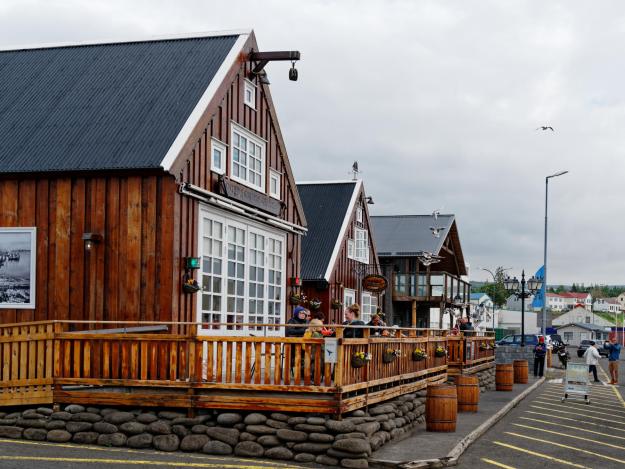
As we walked to catch our taxi back to Perla, I took a couple of shots of the handsome waterfront buildings

to try to capture a bit more of the vibe of this very pleasant town. It was our last destination as tourists, and an agreeable place to spend time, all the more so because it was unexpected – I believe that we were the only tour group organised by Peter Sommer actually to visit Trogir, which makes up for missing out on seeing Vis.

Back on the boat it was time for packing and the Last Supper on board. Boško, our chef, had prepared us a lavish meal and we took the opportunity to try to drink the boat dry. We failed, of course, but it was fun trying and made for an agreeable Last Night feeling to the whole proceedings.

This is the last blog entry to describe the fortnight’s relentless tourism. Assuming we get home safely, I might be moved to some philosophical musings about the holiday in general, in which case there might be another blog entry. You’ll just have to keep an eye out to see, won’t you?

Day 13 – Split the difference

September 27th. Almost, but not quite, entirely unlike meeting an old friend, we returned to Split which (the observant among my readers will have noticed) we visited in the first week of our time in Croatia. I had expected the second visit to be more or less a re-run of the first only in cooler temperatures, but it didn’t actually work out like that.

Although the sun was shining and the visibility was good, the approach to Split from the sea was not as good a photo opportunity as I had expected. It’s Croatia’s second-largest city (behind the capital, Zagreb) and is clearly a huge tourist destination, which we could infer from the large cruise ships parked at the edge of the harbour. And the city sprawls to east and west and so is difficult to capture in a single photo. You can get some nice shots on the approach, but only by zooming in to cut out, as far as possible, undesirable elements. Bits of it look nice

but even in the shot above, you see a few modern and less attractive apartment blocks. The bell-tower in the Diocletian Palace is a clear landmark.

We arrived in Split just before lunchtime, and tied up to the south-west of the city for lunch and an instructive lecture from Filip about: times Roman from 1st to 4th Century AD (up to the time of Diocletian, of course); the growth of both Eastern and Western Roman Empire under Trajan; the military prowess of Diocletian (which established him as #3 in the all-time hit parade of Roman emperors); his setting up of a tetrarchy; and the length of his rule – nearly 20 years, which was a long time to survive as an emperor – before he retired (the only Roman emperor to do so) to the palace he had built in Split (believed to have been his birthplace).

We disembarked at around 1.30 to gather for our walk to and around Split, and were approached by a tall, extravagantly made-up, dubiously blonde woman who waltzed up and said “hello”, in a very deep voice. I was about to tell her that whatever it was that she wanted to sell us was something we weren’t interested in when she was greeted warmly by both Filip and Tom, our captain. So it turned out that she (Stella) was to be our guide, so I’m glad I didn’t say anything, particularly as she was bigger than me.

As we walked into Split, we actually saw our first – and only – Dalmatian dog!

(well-spotted by Jane). We gathered around the bronze model of what the powers that be thought that the Roman palace probably looked like, before entering the palace by the south gate, as we had the previous week. But instead of carrying straight on as we had before, we turned left and went much deeper into what was the basement part of the palace. The skill of the builders in designing and constructing arches, vaults and ceilings was apparent

as was the scope of the archaeological excavation – the entire basement had been largely used as a rubbish dump in medieval times and it takes a long time to excavate and restore such large spaces.

Some interesting things have been found, such as a thousand year old cedar timber

and in the back of the chamber, some workings have been left which give some idea of how awkward the excavation must have been.

Here’s a close-up of the compacted rubbish of ages.

Some glimpses of the upper levels can be caught – for example this view of some bottles in a cafe somewhere above us.

After wandering round in the basement levels, we finally emerged, blinking, into the above-ground levels of the palace. Diocletian (much to the fury of Rome) gradually adopted the Egyptian attitude to ruling which basically involved asserting his godhood; to bolster his claim he brought several sphinxes and many porphyry columns from Egypt which was then under his control. The largest surviving sphinx is on display in the main palace courtyard

and is reportedly some 3,600 years old.

After a coffee break, and some delicious ice-cream (the ricotta-and-fig combo went down a storm with most of our group members trying it), we then went to the temple of Jupiter, which is adorned with the work of Roman sculptors who used a new technique of fast drilling, thus enabling greater intricacy among the detail work.

We also visited the cathedral, essentially a re-purposing of Diocletian’s mausoleum (ironic as he was notorious for his persecution of Christians) which is decorated in real religious bling.

Running around the top of the mausoleum is a carved mural depicting various scenes of Roman life, including hunting.

The story goes that Diocletian received a prophecy that if he killed a boar, he would become emperor, and that this gave him the idea to kill his predecessor, whose name was the Latin for “boar”; perhaps this carving is Diocletian justifying his actions? As in so many cases, “no-one knows” the exact truth and there is much speculation about the details of history of this time, as indeed there is about what the basement areas of the palace were used for.

Modern, historical and Roman life come together in a shop just off the main square.

Here you see: a part of the drainage (sewerage?) system of the original Roman palace, preserved under glass within an upmarket scarf shop (similarly, next door is a bank where the PCs and desks of today’s office are set among the pillars of the ancient Roman palace). Filip also explained that in the times of Louis XIV, the Sun King, Croatian mercenaries in France wore distinctive cloth around their necks to identify them, in a style called “à la Cravate” – a description and appearance which has given the name “cravat” to today’s posh neckwear.

Before we left the palace for a final stroll round Split, we were treated to a small snatch of “Klapa” – traditional Dalmatian singing – in the vestibule of the palace courtyard.

After that, Jane and I made our way back up to the terrace we had visited the week before, in the expectation of getting a much improved view over Split, It was certainly clearer and the afternoon light looked good over the city, but it wasn’t quite the spectacular photo opportunity I had expected. Still, not too bad a view.

In the evening we took a longish walk around the harbour and into the 19th-century back streets of Split to a restaurant called “Ostarija U Vidjakovi”, where we were treated to a traditional Croatian dish called “pasticada” – very tender beef, which had been marinated and then slow-cooked in a rich sauce, served with gnocchi. This was extremely tasty, and very filling, so we were glad for the 25-minute walk back to the boat to settle the meal down before retiring for the night.

The morrow held out the prospect of visiting an old town called Trogir. This had not been on the original itinerary, but because of the vagaries of the weather during the week, we now had the luxury of the extra time to visit it. So, I’ll describe how that went in the next entry. I’m quite looking forward to reading it, myself….