Tag Archives: Scenery

Day 4 – Siq, and ye shall find

Wednesday 18 May 2022 – It was never really one of my bucket list items to be the first to breakfast at a big international hotel, but we achieved it anyway this morning.  The alarm went off at 0500 and we arrived just in time to push open the breakfast room door and ask them whether they were open. Fortunately, they were and we had a swift but satisfying breakfast (Twinings Earl Grey included) and were a couple of minutes early to meet Ali, our guide for the day.

The Mövenpick is literally just across the road from the Petra visitor centre, so we were on our way into the site within minutes.  To give some context to the day’s peregrinations, let me give some idea of size and distance.  Here’s a map of the site.

Something I hadn’t internalised is that the site is 27 square miles. The thing that everyone knows about from the Indiana Jones film is The Treasury, which is a third in from the right.  Our destination today was the Monastery – top left.  In all, including some great detours that Ali knew about, we walked 12 miles and ascended over 500 metres (sorry for the mixed units, but you’re all international folk so you can work it out, can’t you?).

Like Marwan did in Amman, Ali gave us a huge amount of historical, geographical and cultural information, only parts of which have stuck, but I’ll try to include some of what he told us.

The first thing he kept mentioning was the Nabatean Kingdom.  I confess that I’d never heard the term before, and I was of course too embarrassed to confess this, so I looked it up. The Nabataeans were one of several nomadic Bedouin tribes that roamed the Arabian Desert in search of pasture and water for their herds. They emerged as a distinct civilization and political entity between the 4th and 2nd centuries BC, with their kingdom centered around a loosely controlled trading network that brought considerable wealth and influence across the ancient world. They were allies of Rome, annexed into the Roman Empire by Emperor Trajan (trajuced?) in 106 AD. This explains much of the Roman bits and bobs we came across on our visit today, although there was much other pagan content in their culture and practices as well as later Christian influence. Petra was the capital of the Nabateans.

After a short walk from the visitor centre, you come to the location of the formal gate to Petra, though the arch that once signified it no longer stands, as it (along with masses of other buildings and monuments) has fallen prey to the multiple earthquakes that have shaken things up, or possibly down, over the last two thousand years.  However, there are a couple of things that mark the gate, the most striking of which is the Bab Al Siq, the gateway to the Siq.

May I ask you, please, to take note of the moon in the first of these pictures, which signifies that the time at this time was 0637, exactly the sort of hour you’ll only find me awake when I’m on holiday.

One of the reasons we started so early was to try to avoid the worst of the day’s heat.  The second was to try to get ahead of the crowds, which we largely did, although we weren’t entirely alone  as we walked along the Siq.

(There are many enterprising locals who will offer you camel rides or horse rides if you want to take the weight off your feet. Some of them have a little problem understanding the words “no, thank you”, but not to an upsetting degree.)

Then you enter the Siq, a narrow gorge resulting from natural splits in the mountains which was the main entrance for religious people (the tradesmen’s entrance was round the back).  Down each side of the Siq run water channels

which work quite well, given that the entire thing runs downhill. Quite a considerable amount of time and effort has been spent in damming and maintaining the various water courses to keep them (a) running and (b) not drowning people, as there is a potential for heavy rain to bring huge amounts of water into Petra.

On the way along the Siq, Ali pointed out various phenomena, both natural and man-made. There are many niches to various deities, some of which were permanently resident and had recognised symbols representing them

and some were left empty for visitors to install their own gods. There is a natural formation which looks a little like an elephant (actually I think it looks more like a manatee, but apparently I’m in a minority, here),

and there are other man-made carvings such as this, which if you look carefully, can be recognised as a camel and a man, albeit somewhat eroded by wind and rain.


After just over a kilometre, you begin to get a glimpse of something vast and man-made

and so you soon arrive at The Treasury, the largest structure in Petra.

Having started out early, we’d been very lucky that there were relatively few people there, but the place was still afflicted by people who simply couldn’t bear to have a picture of the noble historic works of ancient civilisation without them gurning in front of it.

Ali pointed out some details on the Treasury.  For example, up the side you can see marks where the original workmen installed ladders so that they could work on the structure from the top downwards.
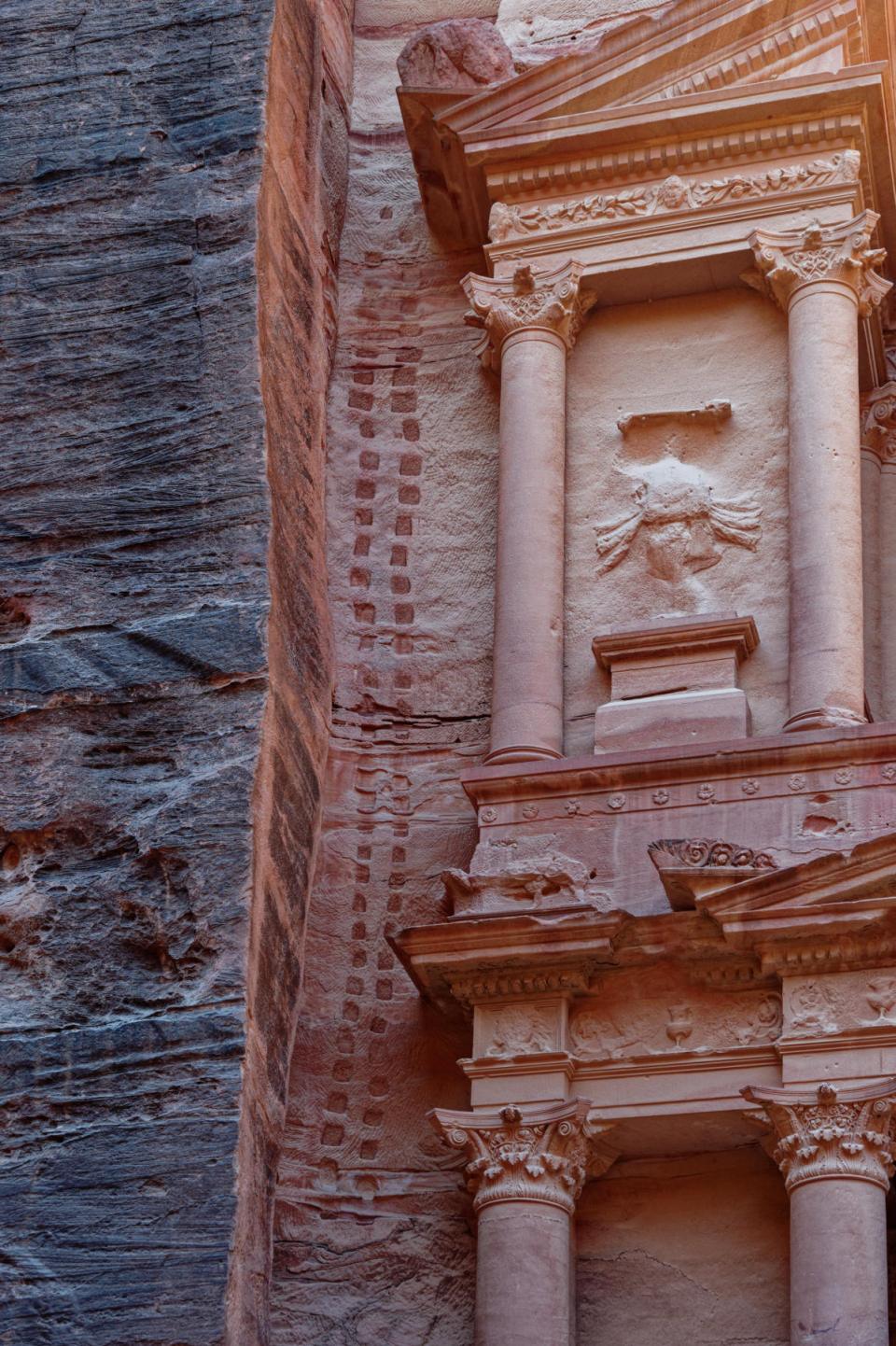
At the top of the centrepiece is a funerary urn which was reputed to contain a Pharaoh’s treasure. So, obviously, you shoot bullets at it to try to open it.
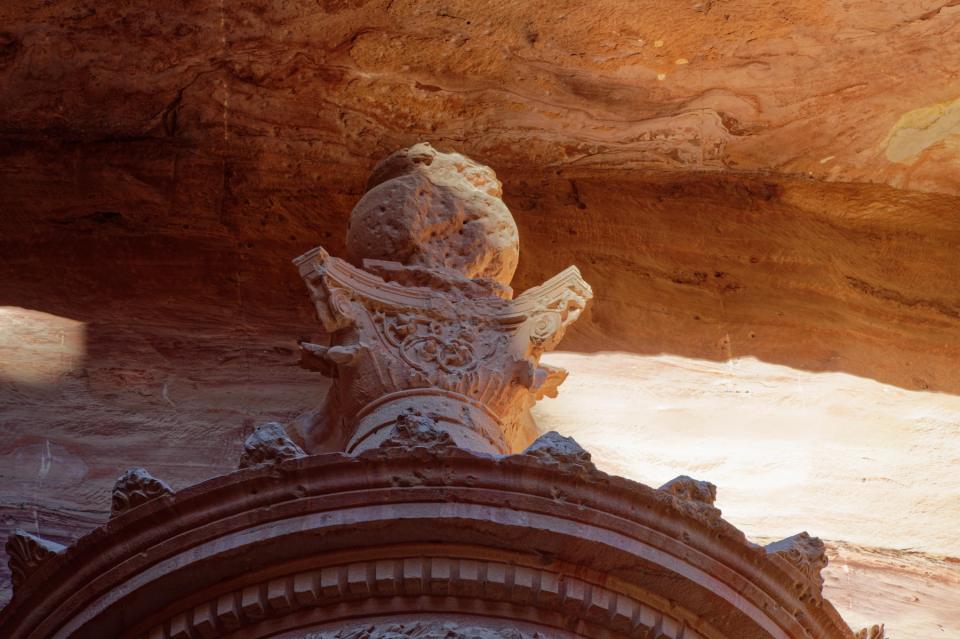
The next landmark is the street of façades.  This is a street which, amazingly enough, has façades carved into its walls.

As you walk along you will notice many caves carved into the walls.  We took a look at one of the more colourful ones

but inside it’s pretty much like all of the others,
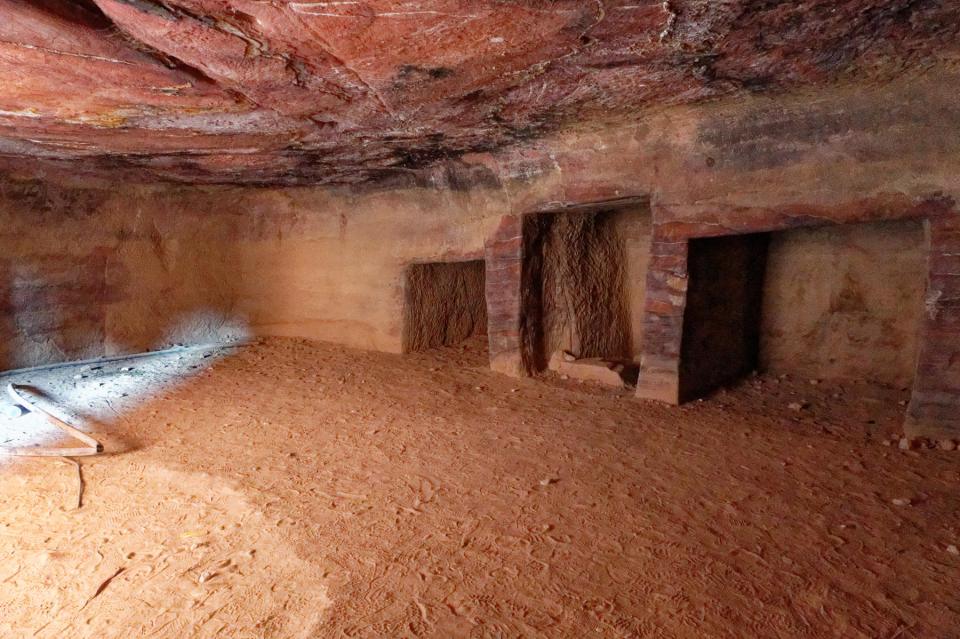
a living space with cavities carved into the walls for ashes, or sometimes actual remains.  This bears out a comment from Suhir, our guide in Jerash, who rather dismissively said that Petra was basically a necropolis.  I think maybe he was a little sensitive about being a guide to a place which, although impressive, didn’t quite match Petra for charisma.  But he has a point; virtually every cave was a living space plus storage for the dead; and some of the other structures were just tombs, albeit quite fancy ones, like these.

At this point, Ali took us off the main drag to show us some of the lesser-visited parts of the site and thus demonstrated to value of having a guide, as we wouldn’t have found these things by ourselves.  Firstly, a couple of great views over a part of the site, including (in the first picture) a prime minister’s tomb;

and a superb view over something that I hadn’t realised (until today) existed in Petra – a Roman Theatre

(although, as we now know after our tour of Amman, this was more in the Greek style, being sculpted from the surroundings rather than standalone); secondly, some great caves

including a spectacularly coloured one – truly breathtaking.

This one was used for hospitality by a Bedouin who had been born in such a cave (but lived in a nearby Bedouin village). We took tea with him whilst Ali snuck off for a quick smoke.

Thirdly, we got a surprise Church, not something one might have expected on a site such as Petra.  It was probably built around the fifth century AD, thus making it Byzantine in period, and has been only slightly restored after being devastated in various earthquakes.

On either side it has – brace yourselves! – mosaics! Yay!

(These are depictions of beasts known across the Roman Empire.)

Finally, Ali led us to a fantastic view over the Great Temple.

At the right hand end of the picture is a three-pillar gate to this end of the city.  As we walked down towards it, some reconstruction of Roman Guard shenanigans was under way.

And that marked the end of the guided part of our day. So we bade Ali farewell, and embarked forthwith on Phase II – the ascent to The Monastery, billed as climbing over 800 steps to the top of a mountain.

It’s a little awkward and/or steep in a couple of places, but the trail is clear, and all one has to do is to toil upwards, avoiding some oncoming traffic occasionally

(you will be offered donkey rides incessantly as you go up.  One of the things that I hadn’t expected was the ubiquity of retail opportunities as people try to sell you souvenirs and handicraft items.  See later).

The easy availability of donkey rides means a liberal amount of donkey shit on the steps, so you have to watch your step.  We came across this lady who appeared to be cleaning it up

but since there was still a vast amount of the stuff around she was either totally ineffectual or was simply collecting it for fuel.

There’s some great scenery to be viewed on the way up.

and, as I say, several retail opportunities, where one is hailed as a great buddy or asked to support the families.

We made the mistake of falling into conversation and drinking tea with this lady, who turned out to be a great salesperson; we didn’t get away without paying really quite a lot of money for a couple of items, but it would have been awkward just to leave.  She was later seen in action with others.
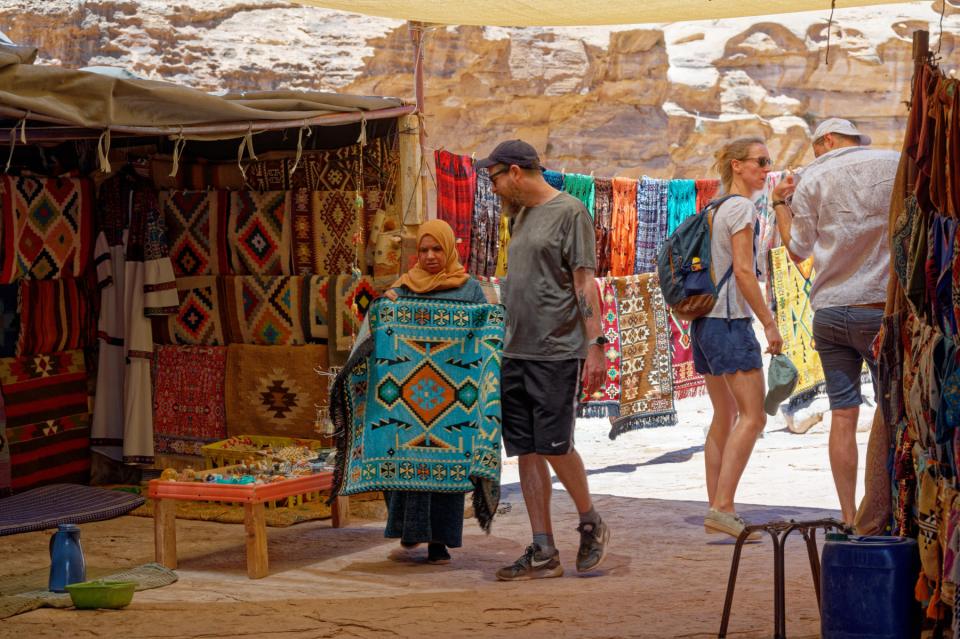
I would recommend smiling and being firm with a “no, thank you” unless you want to get involved with a sales transaction. The attitudes are not aggressive, but sometimes a little persistent.

Then, before we knew it

we’d reached the top.  It didn’t look altogether ancient and monastic, to be honest.

but then we turned the corner….

Ali had mentioned that you could walk past the Monastery for a fantastic view over the far valley.  I wasn’t too sure of the route until we looked around a bit.

So we followed the signs and arrived at the viewpoint and, well…

It was precipitous, mind.

We headed back down to the Monastery and I took advantage of another route promising to be the best view in the world.  Frankly, it wasn’t, but en route, I got a brilliant angle on the Monastery.

After all that clambering about, it was time to head down, and we reached the bottom without any mishap. It was getting quite hot by this stage, and some people were suffering a bit as they walked up (frankly, I think that some of them were showing more courage than common sense).  Some people cheated.


Our original plan had been to have lunch when we reached the bottom, but we decided instead to head back to the hotel, rest for a bit and then get a late lunch.  All this was prior to the excitement of the evening which was to see “Petra By Night”.

Something that I hadn’t appreciated until we started the walk back was quite how far below the level of the hotel we were. It was a long, hot and relentless uphill pull for the best part of three miles, and as far as I can tell the hotel’s altitude is not far below that of the Monastery.  There were a couple of diverting moments on the way back.

and the Treasury was considerably more crowded than it had been at 7am.

It was now just about midday and the sun was (a) very hot and (b) directly overhead, so my hope of finding some shade from the high walls of the Siq was ill-founded.

so we sweated and stumbled our way all the way back to the hotel, pausing only to take a photo of the Roman guards at the gate.

The rest and lunch at the hotel were very welcome indeed.  We treated ourselves to some proper western food, and the hotel burger and chips were a transport of delight for me.

At 6pm, Saeed delivered our Petra By Night tickets, and we set out some moments before its official start time and joined the queue in the souk by the visitor centre.  There is some entertaining, and probably borderline illegal marketing at work for some of the boutiques there.

I bet they didn’t ask Harrison Ford for his permission.  There was quite a crowd for the event and we started shuffling along down the track to the Siq

and it was all going quite nicely until people started using torches and other lights, and talking loudly (mostly rubbish) which completely ruined the atmosphere that we infer the organisers wanted by lighting the way by candle light. Long story short, we eventually got to the Treasury where lots of lights were arrayed and people were sitting waiting for the show to begin.

The show, or at least the bit we stayed for, was music with a strong local cultural content – an Arab flute and a rebaba, an Arab one-string instrument. The flute playing was OK, but the rebaba was accompanied by shrieking vocals and with appalling audio quality, so we left. The walk back was much nicer, because it was much less plagued by fuckwits with torches.

And so we come to the end of a long, long day.  We’ve walked over 15 miles, ascended and descended 750 metres and we have to get up  in six hours to basically do it all over again, although we’ll be visiting a different part of the Petra site. So stay tuned to see whether we survive….

Day 3 – We hit peak Mosaic

Tuesday 17 May 2022 – We had an early start today; once again, the only times we have to get up early is when we’re “relaxing” on holiday.  Anyway, come 8am, we were on the road that would lead us eventually to Petra, but which had several stops on the way.  Almost all of these stops seemed to involve mosaics, so I hope you like mosaics.

The first stop was in the town of Madaba, the “City of Mosaics”, to visit St. George’s, a Greek Orthodox church. The reason that so many people visit it is that it is the home of a very famous mosaic, the oldest surviving original cartographic depiction of the Holy Land, dating from the 6th century AD. The mosaic was rediscovered in 1884, during the construction of a new Greek Orthodox church, St. George’s, on the site of its ancient predecessor. Outside (and replicated on cards in the on-site retail opportunity) is a large display explaining what the remaining areas of the mosaic are.

The map mosaic itself is very difficult to convey photographically, because it is so large.  I took a couple of snaps, of course I did, but I also tried to give an idea via video.

It is amazing that there are still areas of the mosaic that are still hiding under tiling work that has been laid on top of it, for some bizarre reason.

As well as this historic ancient mosaic, the church has an incredible array of modern mosaics, made in the Madaba School of Mosaics (these days called the Madaba Institute for Mosaic Art and Restoration), which can be found on every available display surface.

They are very intricate and beautifully made.

On searching for the etymology of the word “mosaic”, I learned that it has its roots in the Latin for the Muses.  It’s also true that Mosaic (capital M) means “pertaining to Moses”, which is relevant for our next stop, which was at Mount Nebo, the site from which Moses was allowed to see the Promised Land, and where he then died. It is obviously a site of great historical and religious significance, but the Moses Memorial church there (originally built in the 4th century AD and restored by the Franciscans in 1932 to working monastery status) is quite a plain building, and not ornate at all.

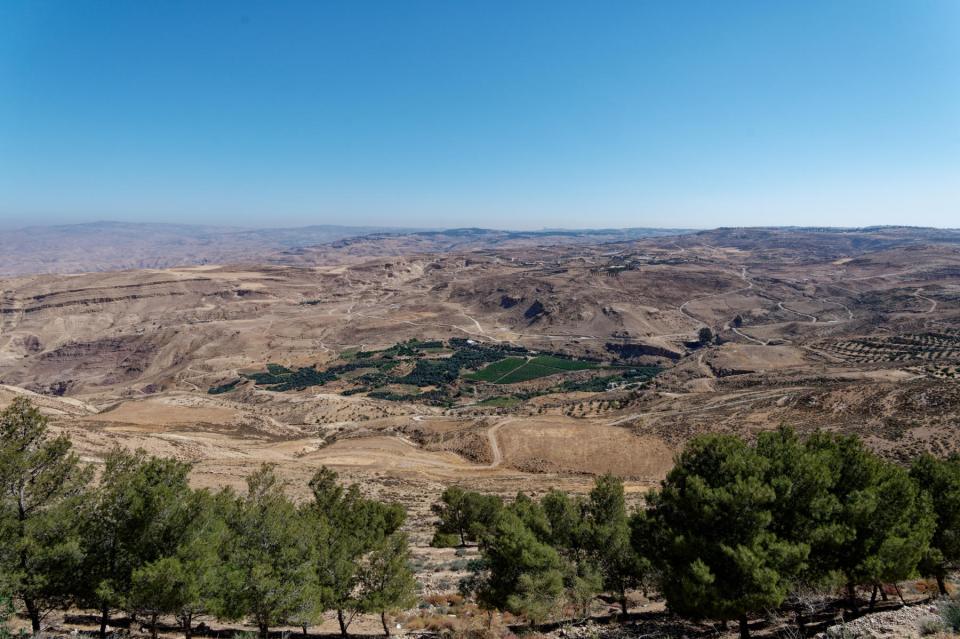
Since this is where Moses could see the Holy Land, you might expect there to be a decent view.  You’d be right.

It’s a popular spot for people to look from, and marked by a representation of Moses’ staff.

On display outside the church are a couple of the mosaics from the original building

but it’s inside the church where the real action is, mosaic-wise.  The most impressive is a 6th Century mosaic in the Diakonikon Baptistry in the church, pictured as captured on a non-Diako Nikon camera.

There are many, many, wonderful and intricate mosaics there.  Some have the shapes often found in stained glass, and there is also some real stained glass cunningly shaped to look like a mosaic.

I’d love to go into more detail, but honestly there is so much there it would become dull if I were to share all the photos I took.

We went back into Madaba and visited the Madaba Arts and Handicraft Centre.  We got a very interesting insight from a chap there who explained about how both old and modern mosaics were made.  There were several people at work creating mosaics – the centre is a co-operative which provides training to budding mosaicists, many of whom have special needs.

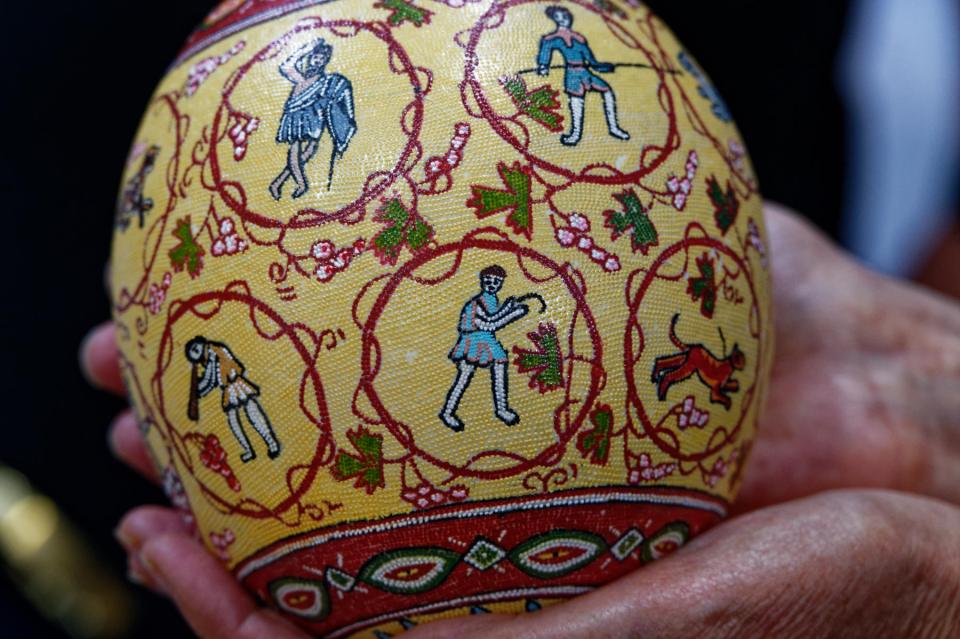
As well as what anyone would understand to be mosaic work (with pieces of stone down to about 2mm in size), the centre also has work that is “micromosaic” – creating art with pieces of stone so tiny that they can only be worked through a magnifying glass; or indeed with dots of powdered stone “paint” – pointillisme in stone.  The resultant work is remarkable.

Ostrich eggs are common bases for this kind of artwork, and the chap was such a good salesman that Jane failed to escape without buying an example.  The co-operative does good work in supporting disadvantaged people, mainly women, and has the financial support of Queen Noor of Jordan, so we’re pleased that the money is going to support a good cause.  No, really.

So that was peak mosaic, and we left to continue our journey towards Petra.  En route, we passed an unusual roundabout decoration.

We have been unable to understand why this choice of decor has been made but we’ve seen more than one example.

Saeed drove us along the King’s Highway*, a scenic and historic route so-called because it once linked the realms of three kings – Ammonite, Moabite and Edomite.  It’s preferable to the Desert Highway, which is straighter, faster and has fewer speed bumps, but is dull.

By contrast, the route that Saeed took us had some wonderful scenery,

an unusual new marketing look to a fast-rising supermarket chain,

some more fantastic views,

a remarkable, if ramshackle, tea stop-cum-retail-opportunity run by yet another welcoming Jordanian (pictured below with Saeed),

and stopping for a visit to Kerak (or Karak) Castle, a 12th-century Crusader castle which also had a significant strategic role up to the Ottoman period in the 19th century.  It was badly damaged in a siege and has really only partially been restored.  It has a looming presence over the surrounding countryside.

It looks impressive from the outside and is huge and rambling on the inside, but lacks information boards and other things to help understand its story.  You can understand its strategic importance, given that rule 1 of such a place is to have a commanding view over the countryside so you can spot any unwanted marauding going on by your enemies.

but the site itself, while it has several impressively castle-y lumps of masonry

didn’t have a story to tell, or at least not one that came over to us.

The town of Kerak would actually be a wonderful photo site – all tiny narrow streets, chaotic traffic and colourful shops.  We didn’t get a chance to see it beyond one rather optimistic piece of marketing.

Shortly after this we stopped for lunch at an unusual restaurant-cum-retail-opportunity called Midway Castle

where we had a taste of the National Dish of Jordan – mansaf (slow-cooked lamb with rice, flatbread and a special yoghurt sauce).  Yes, I have a picture of it.  No, I’m not going to share it with you.  Then we pressed on, again largely avoiding the Desert Highway, which meant we saw camels

sheep and goats,

more impressive scenery

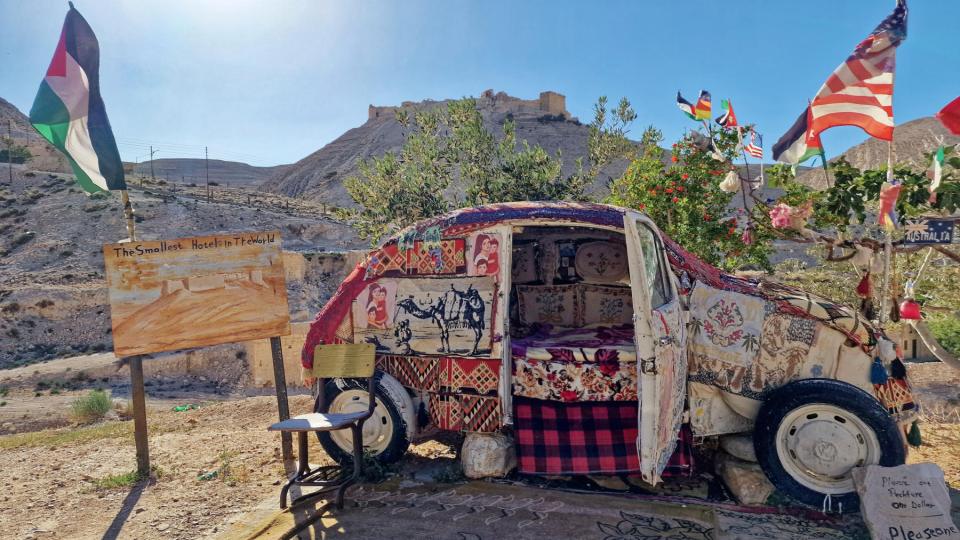
and the “Smallest Hotel in the World”.

We also passed by Shobak Castle

but didn’t go in, as we didn’t need a loo break.  Our final stop, as we hit the outskirts of Wadi Musa (the “Valley of Moses”, where Petra can be found) was at the spring that is the source of the water running through the valley, and may be the place where Moses struck the rock with his staff and water came forth for his thirsty Israelites:

It’s remarkably low key for something that bears the name of Moses.  People can stop by and fill their containers with water

underneath the writing taken from the Koran that says  something along the lines of “From water, all life begins.”

And so our journey ended at the Mövenpick, Petra. We immediately had a meeting with Ali, a representative of the organisation that provides tourist guides for Petra, because we had decisions to make.  Unfortunately, The Powers That Be have decided to close a hiking route that we had planned to take (from Little Petra to Petra Monastery) in a couple of days’ time, so we had to work out what our alternative was going to be.  Oddly enough, “sitting in the bar and drinking gin” didn’t seem to be the right thing for me to suggest, so we’ve got two hikes set up for tomorrow and Thursday, both of which involve quite a lot of walking and climbing of stuff.  And because we want to beat (a) the tourist hordes and (b) the heat of the day, we have to get under way at 0630 tomorrow.  O, the joys of being a tourist!

But, assuming we survive, the coming days should be absolutely wonderful, despite a 5am alarm call.  So do please stay tuned to see how things turned out.


*  “Along the King’s Great Highway, he drives his merry load /  at 90 miles per hour in the middle of the road.”  With thanks to Flanders and Swann

Day 1 – Northern Jordan: Umm Qais, Ajloun and Jerash

Sunday 15 May 2022 – Five hours’ sleep was all we got, but that didn’t seem too much of a problem as we got up and headed down for what turned out to be a perfectly decent international hotel breakfast, with a target of meeting Said at 9am.

The itinerary for the day involved heading right up to the north-west of Jordan, some 120km and a 2-hour drive.  Many useful things happened during that time: a rapid education into a more detailed understanding of the highly variable quality of Jordanian road surfaces (made more so by the apparently random insertion by The Powers That Be of some pretty aggressive speed bumps); the driving philosophy among the locals, which appears to rely heavily on the “Insh’Allah” school of self-preservation; and small repayment on my sleep debt.

The bits of Jordan we saw revealed a country with charming and hospitable natives, exceedingly crappy road surfaces, a complete disregard for the rules of the road and a pervasive roadside rubbish problem consisting mainly of plastic bags littering the verges. (I realise that we in the UK haven’t got much grounds for moral superiority here, but it was noticeable.).  The speed bump thing appears to be a test of concentration for the driver, as the bumps are sometimes mild and sometimes aggressive, placed without any connection to reality and surrounded by  some pretty impressive potholes at times.  The net effect, when combined with the locals’ attitude to speed limits, road positioning and courtesy, is to make everyone cram the anchors on a few yards before each speed bump and then accelerate off as fast as possible once having established that tyres and suspension are still OK.  It doesn’t do much for fuel economy or passenger comfort but it stops life on the road being dull. And it didn’t detract in any way from our enjoyment on the day, because, Insh’Allah, we weren’t involved in any accidents.

So, a couple of hours after we started out, we arrived at Umm Qais, or, more specifically the proximate ruins of the ancient Gadara. Compared to Jerash, which we visited later, it’s a compact site – no need for a dedicated guide, as Said showed us around and talked about the history as we went.  The site’s museum has on display some lovely mosaics

and fine statuary

which have been extracted from the ruins.  It also has some wonderful displays of the intricate pottery that the people from the Graeco-Roman period were capable of

as well as some considerable ability to mould massive stone into useful things such as doors.

There are the remains of ancient shopping arcades

a very impressive Roman theatre

and many slabs of remarkably well-preserved carved marble to marvel at.

From the top of the site, you can see the Golan Heights

and the Sea of Galilee

which gives a clear indication of how near the site is to the border with Israel.

Having got to pretty much the top of Jordan, we then turned south, and our next stop was the historic castle at a town called Ajloun (reached via a stop-start drive through the traffic congestion of the rather scruffy city of Irdib. Jordanian traffic congestion isn’t as bad as Indian traffic congestion, but that doesn’t mean I’d be prepared to risk my bodywork by driving around there). However, en route we got a few more sidelights into Jordanian life.  For example, we were in peak chickpea season.  Said was given a bunch by a mate in the Umm Qais car park

and we saw several pickups loaded to the gills with harvestings.

Roadside fruit stalls are commonplace.  Some of them look well-established and flourishing

but others not so much.

These stalls are clearly a good way to get produce cheaper than normal markets, but the corollary of this is the need for alertness for people screaming to a halt unexpectedly in front of you to pick up a few loquats or whatever.

Anyway….

You can see Ajloun Castle from a distance away –

yes, there it is on the top of the hill.
It’s a massive slab of masonry, originally started by Saladdin in the 12th Century as part of his successful attempts to get rid of the Crusaders.  Since it sits at the highest point hereabouts, it gives a great view over the surrounding countryside if you happen to be on the lookout for marauding Lionhearts.

It is very photogenic.

so a pleasure to walk around, as well as being quite well described by information boards. There was one thing that gave me pause:

“Tourism Police”?  “I’m sorry, sir, but I must arrest you for wearing Bermuda shorts that aren’t garish enough.  And those sunglasses!  Couldn’t you afford Oakleys?”

In the car park area outside where cars and buses were randomly strewn about there was a rather lovely coffee stop, which underlined the hospitable nature of Jordanian life.  It was clear that Said was well-known by the people running it and we were invited for some delicious  cardamom coffee served by an imposing but charming chap called Nazih.

And then it was time for lunch, which we took in Jerash.  Well after time, actually, since it was nearly 4pm by the stage.  Said took us to a restaurant called Artemis, obviously a popular tourist destination, judging by the number of tourist buses in the car park and from the bread-making theatre going on outside.


View this post on Instagram


A post shared by Steve Walker (@spwalker2016)


It’s rather a neat way of serving customers with the bread that accompanies their meal. The restaurant offers a very tasty buffet meal and there’s a lot of room inside so it was easy to get a decent lunch.

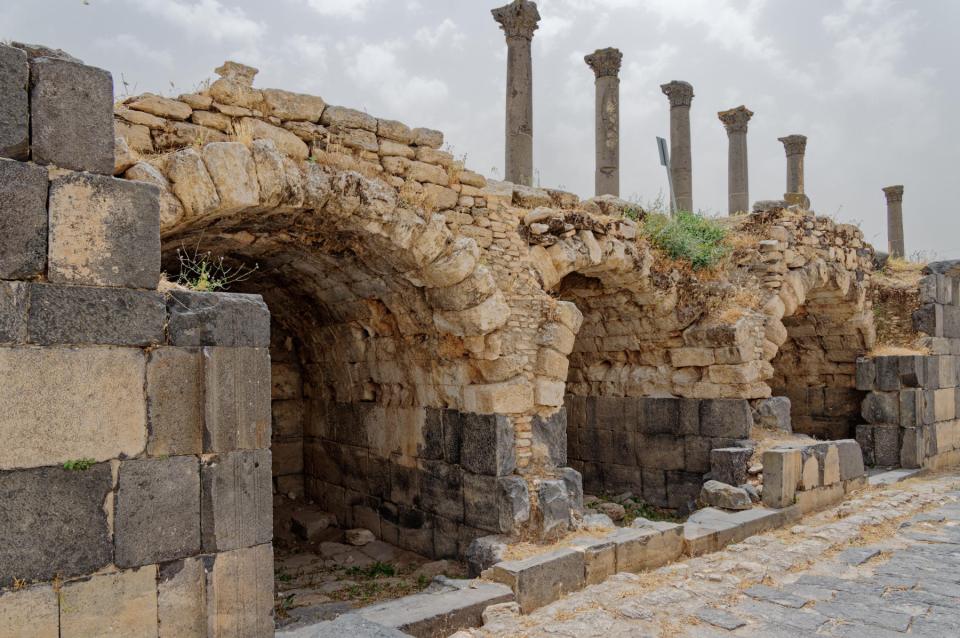
Jerash is a large city and it contains a very substantial architectural site featuring neolithic, Graeco-Roman, Byzantine and early Muslim influences.  It’s sufficiently substantial to warrant having a guide specially to take you round the site; ours was called Suhir and he did a very good job of conveying the history of the place.  Some of the Roman ruins are the largest remaining in the world, eclipsing even those in Rome – the most striking example is the Forum.

The site is really quite large, with the main drag being over 800m long.  There are any number of fascinating historical details to be seen en route, for example the tracks left by the chariots on the main street.

There are smaller details to be seen:  recesses which held olive oil lamps

manhole covers enabling access to the drainage system

and some phenomenal mosaics.

There’s the inevitable tourist attraction, of course,

but the chap was still charming even when we didn’t want to buy anything.

At the north end of the main street is the colonnaded road leading to the Damascus Gate

(the main gates are all named in recognition of the countries that border Jordan – Syria to the north, Palestine to the west, Egypt to the south and Iraq to the east).

At the north end of the site is a Roman Theatre,

But the highlight of the day happened as the sun was sinking and we were walking towards the other Roman Theatre, near the Forum.  As we neared it, we heard a completely unexpected sound and so we went in to see what was going on.


View this post on Instagram


A post shared by Steve Walker (@spwalker2016)

On investigation, it turned out to be a Jordanian bagpiper whose only English (apart from the word “welcome”) was to emphasis how he’d been to Swindon and to the Edinburgh Tattoo. Jane got him to play the Skye Boat Song (and told him its history) and he then jammed a few other numbers whilst a little impromptu Scottish dancing went on around him.  I’ll spare Jane’s blushes by not publishing that video clip, but it was surprisingly affecting to have this confluence of very different cultures in such a remarkable setting.

This was the end of the day’s tourism, and we headed back to where Said was waiting to whisk us back to our hotel. A couple of apples, a couple of dates, couple of gins and a mug of Twinings Earl Grey have been the necessary fuel to feed this blog posting. It’s been a long, intense and enjoyable day; a full-on introduction into the sort of thing we can expect over the coming weeks as we travel round Jordan.  I hope you want to come along for the rest of the ride.