Tag Archives: Photography

Chance favours the prepared photographer

Friday 5 June 2026 – One of my favourite sayings in life is a quote from Louis Pasteur, which can roughly be translated (he was foreign, you know) as “chance favours the prepared mind”. In other words, you can sometimes improve your own luck by having the future possibilities at the back of your mind.

The following is a story about how this mindset enabled a photographic plan to come together. To quote The A Team‘s Hannibal Smith, “I love it when a plan comes together”. Photographically speaking, this happens to me quite rarely; normally a plan leads to a bitterly disappointing brush with reality. One exception was a visit to the lovely old city of Ghent in Belgium, where I planned ahead and got some very gratifying photographs around the canals by getting up ridiculously early one morning when the weather forecast was favourable for the reflections which I so love in a photo. That was the last occasion a plan came together – and it was 15 years ago. A few days up in the northern reaches of England looked like it might present another opportunity.

Ever since the fortieth anniversary of our graduation from university, a group of my now-graduate friends has met every year, each year choosing a different place to explore around a dinner. In 2026, the chosen site was the Settle-Carlisle Railway. Unlike one of our previous venues, the Gloucester-Warwickshire Railway, this is not a heritage railway, although it does have some historical interest, having been rescued from oblivion several times. It runs normal trains on normal tracks. Apart from the usual pleasant chance to catch up with my university friends, what really piqued my interest about this rail journey was that the line goes across one of the great pieces of building work in the country – the Ribblehead Viaduct. I had long wanted the chance to see and photograph this impressive construction, and particularly to get some aerial shots of it with my drone, that area being not in any way restricted for flying. Perfection would be to get a shot of a steam train on the viaduct, but I would, I decided, be content with any old train if that were possible.

The itinerary for our day out involved taking the train from Settle to the Ribblehead Station, getting off there, admiring the viaduct and then carrying on to Carlisle for the rest of the day. I wasn’t sure that this would give me enough time to set the drone up and get the shots I wanted, so I hatched a complementary plan which said I would get up early and drive out to the viaduct, getting the shots I wanted and joining the rest of the group as they were shooting through.

The bugger factor was the weather. The forecast weather on the Monday evening before our trip was dreadful and for the trip itself not encouraging.

The actual weather we had on the evening before was not too bad, so I thought I might get away with my early morning plan.

Wrongly, as it turned out.

I drove through some drizzle, low cloud and actual heavy rain, trying to think positive thoughts, but when I arrived at Ribblehead, this is as much of the viaduct as I could see,

and what I could see was through fairly persistent drizzle. Not a chance of flying in those conditions, then. Sighing, I returned to the hotel, the only consolation being that at least I arrived back in time to get some breakfast before our trip to Carlisle.

As we departed the hotel to catch the Carlisle train, laden with camera and tripod for an attempt at a group photo at Ribblehead, I thought I might as well take the drone along, just in case – perhaps I might get a quick chance at a flight when we arrived at Ribblehead.

Hah!

This was the view walking from the station towards the viaduct. There is a viaduct in this picture, I promise you.

Again, not a candidate environment for aerial photography. Or any photography, really, though I did try for a few shots of the viaduct as we walked to it.

I had brought my Sony RX100 model vii with me as a convenient camera for catching snapshots around Carlisle, and, of course, had the phone, too.  So I thought I’d do some photographic nerdery and take comparative shots of the same scene with each camera.

The only processing I’ve done is to correct the keystoning, i.e. make the verticals vertical, and crop the Sony images to be the same shape as from the phone.  The middle one is how the shot came out of the Sony (I took care not to overexpose it), and I have tweaked its light levels for the one on the right to make it comparable with the phone results. It shows what an impressive job your mobile phone cameras can do these days, doesn’t it? Of course the Sony can match it, but the phone scores heavily for convenience – no processing necessary to get a decent image.

Actually, my preferred processing of the Sony image for the shot would be this

which shows the benefits of taking a RAW image to get maximum quality. The downside is that every photo needs to be processed.

We stumbled damply back to Ribblehead station and took the next Carlisle train, and there was something of an improvement in the weather as we bowled along through the very lovely North Yorkshire countryside,

and it was seeing this that made me change my plans for the rest of the day. I decided that it might be worth taking an early train back from Carlisle to see how the weather was back at Ribblehead; current plans have me visiting Carlisle again next year. So that’s what I did. And I’m glad I did, because the conditions back at Ribblehead had somewhat improved.

This was the view from the station.

(noting, however, that conditions weren’t perfect).

I walked up the road to recreate the scene which had been so dismal that morning, and the difference was striking.

Although the same scene one minute later had changed somewhat.

I was therefore faced with a brisk wind which was whipping the conditions through quite quickly, but it was clear that it would be worth having a go with the drone – which my prepared mind had ensured that I had with me, allowing chance to favour me.

It was quite tricky trying to work whether the weather was going to traduce me, so I hastened to a point quite near the viaduct and whizzed up the drone to scope out what the scene would look like.  At that point I heard a lovely sound – the two notes of a train horn!

I quickly whizzed the drone over to its maximum 500m distance and stationed it where I could get a clear view of the viaduct,

and the train obligingly came through while there was still some life left in the drone’s battery.

Having scored that small victory, I set about trying to take some other shots I had visualised. The changeable weather made things a bit tricky, and it was breezy with some very significant gusts. I had learned my lesson some years ago when I very nearly lost a drone into a strong tailwind, so I made sure that I was stationed downwind of the drone at all times and went to the middle of the viaduct to set up some photos, the nicest of which I think is this,

and to take some more video.

My original thought was to take footage as I reversed the drone through an arch. The first time I tried this, the drone had just got backwards through the arch before a gust of wind suddenly smacked it forwards. I’m glad I’d centred the drone on the arch, otherwise the wind might have smashed it into the brickwork. I did get arch footage in the end, but it was ruined by a berk walking into my shot as the drone flew back through the arch.  Since he was there doing his own drone work, this counts as unforgiveable, but because I was focussed on watching the drone, I didn’t realise what he’d done until I reviewed the footage later. So I have to content myself with the plan B footage I also took, which I quite like.

All in all, I’m very happy to have got the shots, although I’m disappointed that my “reverse through the arches” didn’t come out as I would like. I’m really impressed that a 250g drone (a DJI Mini 3 Pro)  could (by and large) still operate in strong gusty winds and still give smooth footage. It was amazing to watch it thrashing about in the breeze whilst it delivered rock steady video.

What really pleased me was my decision to take the drone with me even though the weather prospects were poor. Chance does indeed favour the prepared mind; I doubt I’ll ever get back to Ribblehead and I’m content to have made the best of the day as it offered itself.


Day 19 – San Gerardo to Alturas: ¿Quetzal?

Thursday 9 March 2023 – In Spanish, “¿Qué tal?” is a friendly greeting, meaning, among other things, “what’s up?”.  In our case today, what was up was us and when we were up was 0430. The reason? We had to meet a guide at 0515.  Yup – we were looking for wildlife again.

Specifically, we wanted to see the Resplendent Quetzal. Well, more Jane than me, to be honest; at that time in the morning what I wanted was more sleep.  However, the chance to see one of these birds wasn’t going to present itself again, and the chance to do so was the reason for our precipitous plunge into the San Gerardo valley; for the Resplendent Quetzal can be found here, if you get your timing right – and we were in Quetzal season.

Accordingly, at 0515 our guide, Marco, turned up and we set off in his 4×4 back up the trail we’d driven down last night – somewhat more rapidly than I would have done, if I am to be honest.

The morning was rain-free, thank goodness.

Marco cautioned us to stay close to him as he might move quickly to get to a vantage point to see something.  He also made sure that we had phones with us, not, to be sure, so that he could contact us in extremis, but so that he could set up photos with them using his spotter scope.

As the day lightened, it became clear (unsurprisingly) that in our quest for the Quetzal We Were Not Alone.

There were several groups, mostly accompanied by guides all of whom were communicating with each other, often over radio, about what could be seen and where. In total, I’d say there were about 40 people all trying to see the same species.

What followed was a typical Birder morning. Here, in 15 seconds, is a summary of our movements for the next 150 minutes, over a range of about three miles.

So, did we see a Quetzal?  Was it easy?  Was it quickly achieved?

Yes. No. No.

The first excitement was a group of Black Guans.  There being nothing else even remotely Resplendent to be seen, we spent some minutes and several frames on capturing them.

Marco proved to be extremely adept at getting mobile phone camera images through a spotter scope.  To give you some idea of what he could achieve, his image, using Jane’s phone, is on the left, mine, achieved with my Big Lens (10-400mm zoom for you  camera buffs out there) is on the right.

There was also a frisson when someone spotted an Emerald Toucanet, a small bird Jane had particularly wanted to see because it’s such a weird construction, like a Finch has had a Toucan beak bolted in Photoshop.  Here’s a good photo of one, courtesy of Flickr – see what I mean?

Emerald Toucanet

They’re serious creatures, though, and a major predator of Quetzal chicks, apparently.  They’re bastards, same as all Toucans.

To give you some idea of the frustrations and disappointments of birding, here are the results we got in trying to photograph this elusive bird.

I still have difficulty seeing it even in the spotter image.  Here it is closer up.

As ever, with my shocking eyesight, all I ever saw was a flicker of movement as the little fucker flew away, never to be seen again.

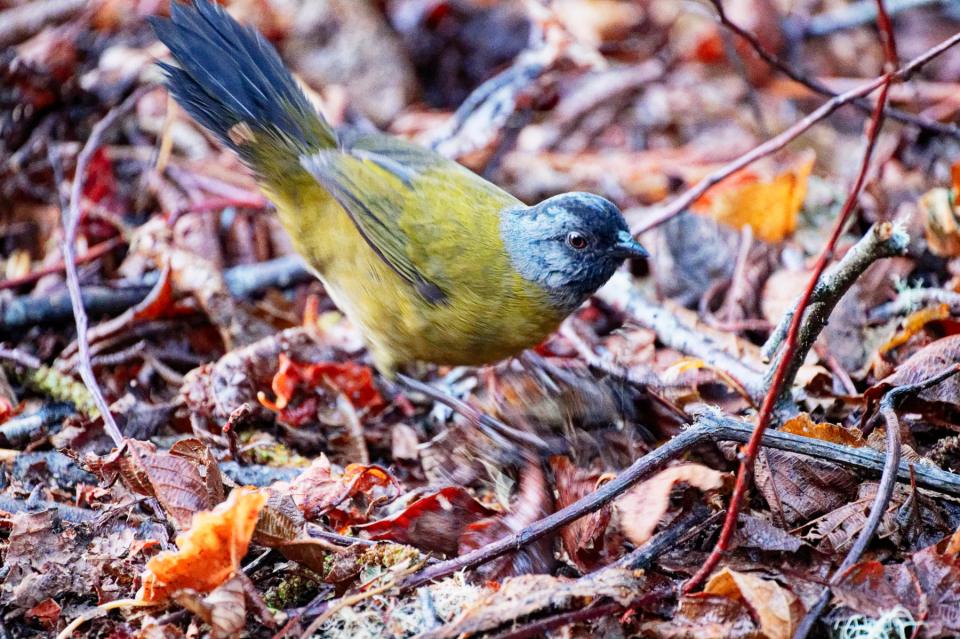
I busied myself with getting a photo of a Big-Footed Finch, which was stamping around in the leaf litter to disturb insects to eat.

It’s not a big bird, but since it was only about six feet away, even I couldn’t miss it.

Marco spent a lot of time looking for a Quetzal

even going so far as to mimic its call to try to lure one into some kind of visual contact.

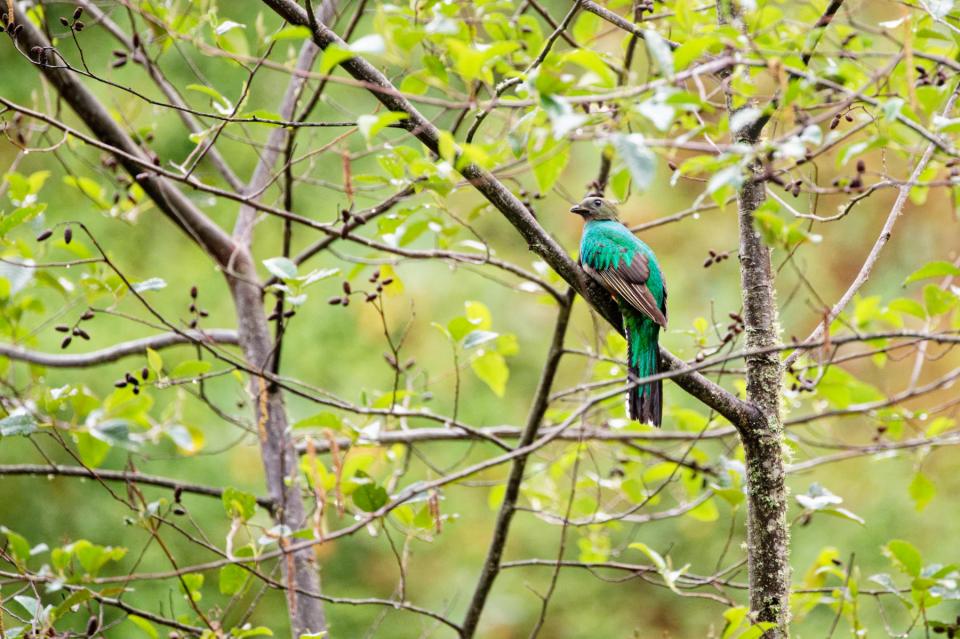
Eventually, reports of a sighting filtered through and we raced along to where it had been seen.  Courtesy of lots of patient explanation from Jane and Marco, I eventually set eye on my first (male) Quetzal.

It’s there, right in the middle of your picture.  Honest.

It was creating a nest.  I even got some really crappy video of it pecking away at the tree. (This was about 0630, by the way, so we’d been looking for an hour or so.)

For a while, as we belted up and down the track, I began to despair of ever actually getting a decent photo of one of these damned things, because of a combination of my poor eyesight and the talent these benighted creature have for positioning themselves with leaves or twigs in the way, or against the light.

We did see some, though, even though the little buggers kept adopting the wrong pose, such as facing away from the camera,

or with bright light behind them, or sometimes both, dammit.

Jane and Marco were getting some success with her phone and his spotter.

and finally – finally! – one settled facing me where I could see it and take photos before it fucked off again.

Resplendent is such a good word, isn’t it?  The male grows those long tail feathers every year; the female doesn’t have that extravagant braggadocio. Here’s a female from Jane/Marco

and this is the best I could do

although – hah hah! – I accidentally took a photo of this female as she tried to get out of my shot.

We covered three and a half miles over two hours in our quest for these photos, sometimes in a car, sometimes at a run, more often than not at a standstill saying “where are you, you little bugger?” But it was ultimately very satisfactory, some might even say worth getting up at 0430 for.

It’s interesting to note the “shot silk” effect of the bird’s colour. As the angle changes, so does the colour you see.  For example, we saw long tail feathers of blue, but over the bar in the restaurant

they’re green.

Oh, how we feasted after our successful hunt! Well, avocado toasts and a cup of tea, anyway. Marco mentioned that Lauraceas had a garden just down the road and so we popped down there to see what we could see.

Jane also managed to get some video of a Volcano Hummingbird – no mean feat as, like other hummingbirds, it doesn’t hang about much.

But then it was time to leave the delightful scene by the stream

and head off to our next destination, Villas Alturas, in Domenical on the Pacific (west) Coast.

Of course, the first thing we had to do was to get out of the San Gerardo valley.  But it was not cloudy or raining, and six or so miles to get back to Route 2 only took us about half an hour.

However, when we got there, we discovered that we were well back into the clouds… and rain…

and roadworks! with steaming freshly-laid asphalt, which didn’t help speed the journey.

We eventually turned off Route 2 and once again had some pleasant countryside to drive through

before a final, very bumpy, half-mile up a track to the Villas.

However, once we were checked in, we discovered that we had a villa with a great view

to be seen from a delightful balcony.

We had gin and tonic for the fridge and some peanuts, the freezer already had ice in it and so we made ourselves at home with mucho gusto, as they say in these here parts.  The food in the restaurant is good, the service willing (albeit a little patchy), and they’ll do our laundry for us for $16. And, delightfully, we have nothing to do for 36 hours.

So, it’s now 1400 on Friday 10th March and you are up to date with the holiday travels for the moment.  We move on tomorrow, but have a few more delightful days of nothing organised until all of a sudden it gets serious again.  You’ll just have to keep checking back in to see what, if anything, has been worth reporting. For now, cheers!

Holiday packing agonies (photography style)

Friday 5 August 2022 – In a couple of days’ time, my wife and I embark on our most ambitious overseas travel – a major holiday crossing Canada from left to right and taking several weeks to do so. You can read the details in the Travel Blog pages of this site, if that’s your bag (I hope it is). But this posting is among the Photo Blog pages, since I’m using it to express my (usual) angst about the agonies of packing photo gear for such a major endeavour.

You’d have thought by now that I would be able to work out what gear to take on a holiday. After all, relatively recently we travelled to South America for 6 weeks, and gear wasn’t a problem then, was it? Not entirely a rhetorical question. Since I still chucklingly described myself as a pro photographer back then, I had a larger selection of cameras and lenses to choose from – and even then had to buy a particular lens for the trip. In the end, I took a ridiculous number of cameras with me – a DSLR with a general-purpose travel zoom lens (27-450mm equivalent), a backup compact camera, a Tough camera for snorkelling, and an Osmo – a camera-and-gimbal setup for video work. I managed to cram all of this into a MindShift 26-litre backpack, along with an Android tablet, two power banks, a sensor cleaning kit, rain sleeve, power adapters and cables. This was my carry-on bag and (whisper it) was far too heavy, even though it was within the airline carry-on size limits. No-one ever queried it, fortunately.

This was fundamentally a sound set of choices, but not perfect. For example, I had no strap or sling for the camera, as I fondly imagined that the backpack would come with me wherever I went. Good as it is, the backpack was occasionally too cumbersome, and so I had to hand carry the camera, which was also cumbersome, but less hassle than dealing with the backpack every time I wanted to take a shot. Also, I put a tripod in my main suitcase but I never used it. A little serious thought would have told me that it wasn’t appropriate for the sort of trip we were planning.

I only have one “proper” camera now:

The lens (24-200mm) is a great general-purpose travel lens. However, the actual equipment I feel I need to take with me looks like this:

Here’s what I’m going to pack

  1. Big Camera. As above., but since part of the trip will be attempting aurora photography, I need to include a wide-angle lens and a tripod.
  2. There will be wildlife opportunities, so I need a telephoto lens (see below).
  3. Video setup. I have quite low standards as to what constitutes acceptable video quality, so I will use my Samsung Galaxy phone. Experience in Jordan shows me that the Samsung’s stabilisation is really rather good, so strictly speaking I probably don’t need to take a gimbal with me. But I have a small gimbal, so I’ll take that, too.
  4. Laptop, for processing the photos and writing this blog. And a tablet, but that’s mainly for reading the papers in the copious spare time I probably won’t have any of. With luck.
  5. Other stuff. Backup drive, power bank, cables, filters, card reader, mobile hotspot(s)
  6. Oh, and a drone. This is a big change from even a year ago, when flying a drone was beset by rules and regulations that made it largely impractical without doing a huge amount of preparatory (paper)work. There have been two key recent developments: firstly regulations allowing much more flexibility if the drone in question weighs less than 250 grams; and (unsurprisingly) the arrival on the market of highly capable drones that meet that restriction. I have swapped the DJI Mavic I had for 5 years in favour of a DJI Mini Pro 3, with which it should be possible to get some really good photos and video, weather permitting. I won’t be able to fly it everywhere, particularly not near wildlife, but it’s a very capable piece of kit which I hope will give me the chance for some great aerial images.

I don’t have the option of entrusting any of this to a suitcase, as Li-Ion batteries are not allowed in hold luggage. So I have to try to get it all in a lug it about on my back.

Packed, it looks like this:

(Laptop, tablet and mains brick will go in the back pocket.)

Weight?

Two stone. 28 pounds. Nearly 13Kg. Please don’t grass me up with the airline….

I’m almost certainly making my life more difficult than I need to; it may be that the general purpose lens is up to the wildlife job. But then again…..I am a little anxious about getting decent wildlife images; a 200mm focal length is not really quite powerful enough and there are bears of both grizzly and polar sorts to be photographed. I have a very good wildlife lens (200-500 f/5.6) but it is huge and weighs a ton (well, 2.3kg, anyway) which disqualifies it from coming to Canada. Reading an Amateur Photography magazine article gave me an idea for something almost as good: a Sigma 100-400 lens. It is 1 kg lighter and considerably smaller.

(it’s the one on the right, here, wearing the FTZ adapter necessary to fit it to my Z6.) Courtesy of Wex Photo, I managed to acquire one second hand. Technically, it works well and – this is of critical importance to me – my RAW processor of choice, DxO Photolab, understands it; image quality therefore is maximised and all I have to do is to nail the composition. That’s all. Wish me luck….