Tag Archives: Mountains

France v Italy

Friday 19 January 2024 – One of the various activities that Crystal Ski had organised during the week was an outing from the Sauze end of the Via Lattea – Milky Way – skiing area over to the other end of the system: Montgenèvre, which is just over the border in France.  I had the very vaguest recollection that I might have visited there on a previous Sauze holiday, but couldn’t be certain.  Anyway, after a week of getting very familiar with the lifts and runs close to Sauze D’Oulx, I thought that a change would be as good as a rest.

I was slightly, but tellingly, wrong in that.  Read on to find out in what way….

While it’s possible to ski from Sauze to Montgenèvre, it’s somewhat time-consuming and in any case one couldn’t rely on the links being open, as high winds were bedevilling the area, resulting in some critical link lifts occasionally being closed for safety reasons. Crystal Ski had, in any case, organised a coach to take us over, a journey of about 40 minutes, at an extra cost of €25.  The coach was to depart from the Tourist information Office, which was where (you’ll remember) we were deposited on our arrival some days before – a 10 minute walk down through the town, carrying boots and skis.  So about 40 people arrived and checked in with the Crystal team, loaded skis and boots into the loading bays of the coach and hopped on board for the journey.

When we arrived, the reverse process was a little more chaotic, as people tried to unearth their skis and boots from piles of other people’s equipment

but soon enough we were heading for the nearest lift.

Montgenèvre’s skiing in split by the road. The majority of the lifts were on the same side as the coaches, but the Crystal team recommended crossing the road and heading up the other side, the Chalvet area, as this would get the benefit of the morning sun; so I hied myself thither. There was a bit of jostling for position for the gondola ride up but after only a short delay I was headed up the mountain.

At the top of the gondola, there was a very limited choice of activity – ski back down, or choose between two lifts. The nearer of these, a chair lift, was very iced up and not operational, so I headed for the other, a drag lift. As I approached it, it also stopped going, which was a bit dull. There was obviously Something Going On, as a skidoo with flashing lights headed up the track after a few minutes; perhaps someone had had a misfortune? We never knew. After some moments, people got fed up and began to drift away to other parts of the mountain, so of course the lift started again. So I hopped on.

It was a long, long drag lift – and cold. It was difficult to get an accurate idea of temperature, but I suspect it was several degrees below freezing and there was quite a stiff and chilly wind blowing.  As I went up, I looked for evidence of pistes to ski down, and such evidence seemed a bit scant.

(Actually, if you look carefully at the picture above, you can just see that there’s a track in the distance on the left.)

Having reached the top, it was clear that there was only one way down – the piste to a further lift was marked “closed”

and it was here that the difference in style between this resort and Sauze began to be borne in on me. Much of Sauze’s skiing area is below the tree line, which I find very attractive, and which helps when trying to work out which general direction one is supposed to take.  Much of  Montgenèvre’s is above the tree line, and hence very open, making the choice of direction less intuitive.  These wide open spaces are great for people who are looking to ski off-piste, but I wasn’t – it’s fucking dangerous to go off piste by oneself – so I found the area a bit disorienting.  What was even more disconcerting was the discovery that very few people had skied in the area, and so the snow was soft and deep.  Again, expert skiers tend to love this and actively seek it out.  Me? Not so much – particularly since I was on my own, meaning potential problems if I fell and incapacitated myself.  I could just about see where people had skied before and so followed this general direction

but it was hard work for me, as the soft snow highlighted the shortcomings of my technique, and frankly I didn’t enjoy myself hugely.  However, I was where I was, so I blundered about, fortunately without falling or doing anyone else any damage.  Restful, it was not – skiing in this deep stuff saw the one and only time during the week when I actually had to stop and take a breather because I was exhausted. I did, though, eventually find some satisfaction in being able to link a few turns even in the softer snow. I doubt I’d have got many points for technical expertise, but my artistic impression, consisting mainly of swearing loudly when the conditions caught me out, was certainly unique, and I have to admit that the views were pretty good.

At this point – the point at which I could really have done with a rest and a coffee, the other key difference between this French resort and the Italian one I was used to became clear – finding a mountainside restaurant was difficult, because they’re very few and far between and don’t advertise themselves with any clarity.  In Sauze, it is difficult to ski more than a few hundred metres without passing a sun deck that announces the presence of a restaurant or café.  Here, I couldn’t find any such evidence.  Montgenèvre is a purpose-built ski area, and the priority was clearly on getting people skiing rather than relaxing.

I decided to get down to the town in search of a coffee, so skied down and crossed the road.  The other side did feature some trees, but was largely more of the same wide-open space

and even standing by the main buildings, I couldn’t detect anywhere to have a coffee.  Anyway, it was getting close to lunchtime, so I decided that a restaurant was what I should seek.  I got Google Maps out and could see that there were just a couple anywhere near the skiing area, which, again, I thought was odd; I would have expected several to be available.  The first one was packed, but the second one had space, so I sat myself down to a simple, but very good, lunch of steak haché and chips with a beer.

After lunch I skied on the other side, where more people had skied and thus the pistes were firmer – indeed, icy in places.  A couple of the pistes and lifts I wanted to explore were closed, but it was a decent afternoon’s skiing.  Again, there were some fine views to be had

but I found that I had used up a lot of my energy dealing with the morning’s more challenging (to me) conditions, so I stopped skiing quite early in the afternoon, making sure that I had enough time to find that elusive cup of coffee before the 4pm deadline for getting back on the coach home.

The skiing was more varied and more challenging than in Sauze;

but, being a purpose-built skiing operation, I found it less charming.  This is not a view shared by others who were part of this excursion, for whom, the views and the existence of some very easy skiing made for great enjoyment. But I missed the charm – and particularly being able easily to stop for a coffee/beer and a rest. This is, I think, a difference in my current approach to skiing and how I used to go about things; before, I was more interested in covering ground and ticking off all the lifts and runs in an area; now, I’m more engaged by simply being active and relishing the exercise, not minding repeating pistes if I found them enjoyable. The net of this is that, at least for this limited sample of two resorts, I found the Italian experience the more attractive.

I’ve got a couple more posts up my sleeve about this holiday and how I’ve found it, so I hope you’ll check in to read them in the coming days. For now, au revoir!

Farewell to Victoria – Victoria to Farewell

Tuesday 23 August 2022 – For reasons which will become clear, this will be a fairly brief post, somewhat hastily cobbled together. I hope you enjoy the photos, though.

The day started well, in that we were up promptly, breakfasted, checked out of the hotel and in for our private charter flight, a small float plane, from Victoria to the Farewell Harbour Lodge. For a while, though, it all fell apart. The lass behind the check-in desk at Harbour Air told us that there would be a delay. It wasn’t quite clear why for a while, but eventually we understood the situation. Cloud and fog made flying in to Farewell Harbour too dangerous in the view of the Harbour Air despatcher, who was therefore unwilling to send a plane to us in Victoria unless the situation at the far end cleared. We were advised to wait and see whether the weather and the forecast changed. New forecasts came in every hour, and each one indicated that visibility would still be a problem.

Naturally, we started pondering alternatives, but the raw truth is that we needed to get somewhere over 500km away to an island in the Johnstone Strait, so flagging down a cab or seeking a bus ride wasn’t really an option. Even driving to the nearest place on Vancouver Island whence we could catch a water taxi looked too difficult.

Despite the best efforts of BT, whose circuitry detected a crisis and therefore implemented a cap on Jane’s phone, we managed to contact Discover Holidays, who are looking after us whilst we’re in Canada. Fortunately, Jane got through to a lady called Sarah, who had worked on developing our itinerary with the heroic Brendan at NATS, so we didn’t have to waste time explaining the problem to her. The idea of a driver was mooted, but then all of a sudden, a plan came into being which was to fly us as near to Farewell Harbour as the weather allowed (e.g. Campbell River) and take a water taxi from there. So we got our plane after all.

We climbed in, buckled up and the pilot taxied out past the air traffic control tower

(because Victoria Harbour is unique in Canada because it actually has a runway marked in the harbour), and off we went. Conditions were pretty clear, so here are some of the photos we managed to garner as we went:

Victoria Harbour, with the breakwater we walked around yesterday at the top of the picture;

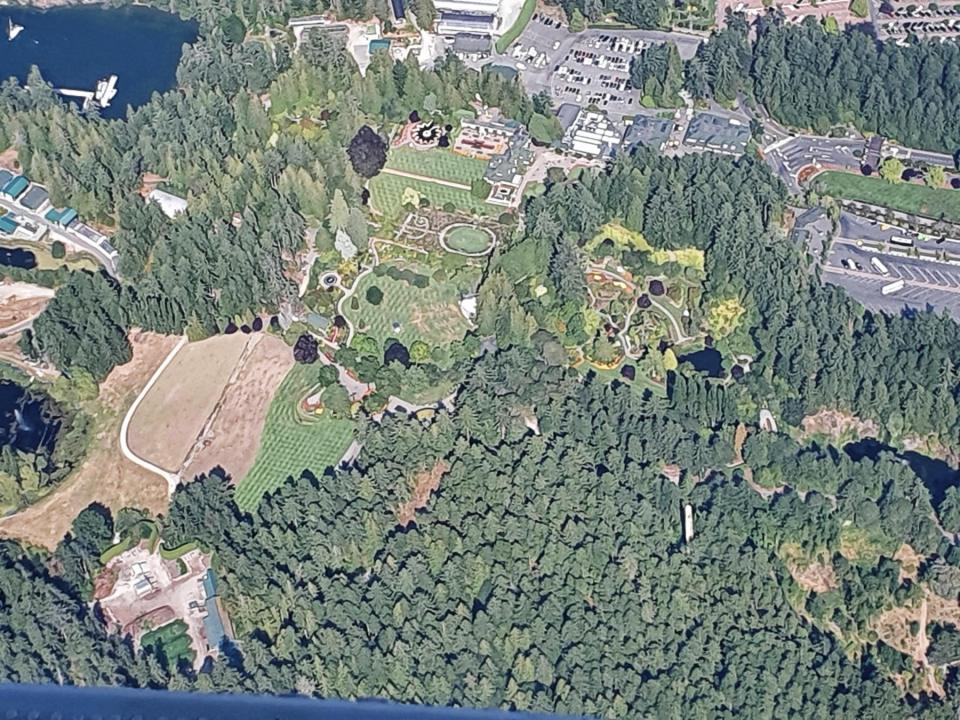
Butchart Gardens;

evidence of some fairly drastic logging;

several views showing what a big slab of land Vancouver Island is;

a couple of arty attempts on my part;

a photo by Jane of Campbell River (meaning – yippee! – it had cleared and we were carrying on all the way to our proper destination);

coming down towards our landing and skimming along just below the clouds; and finally

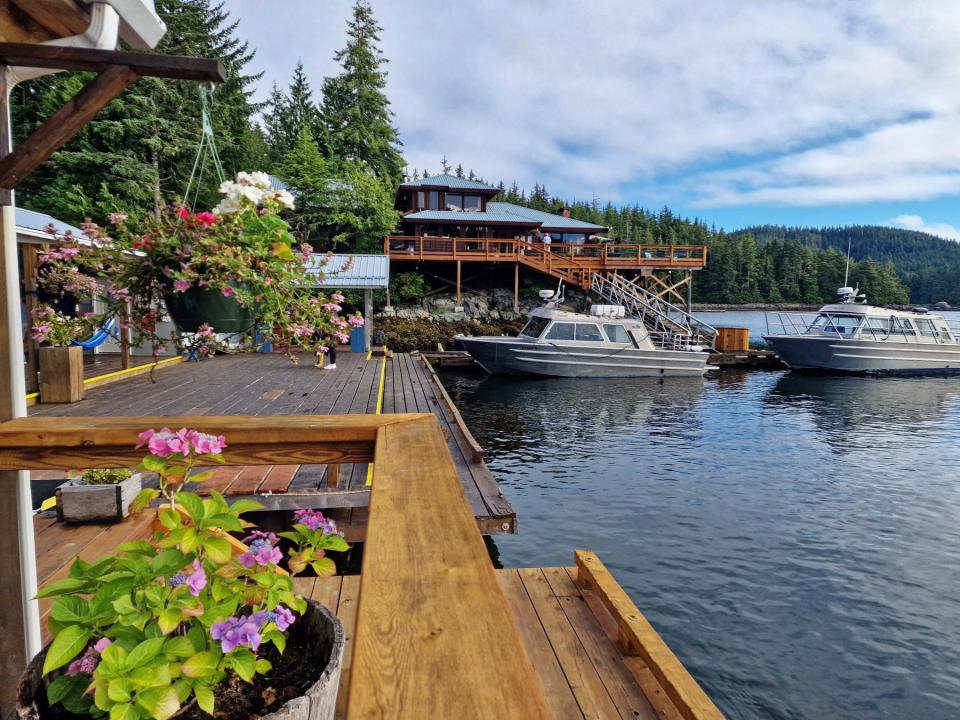
arrival at Farewell Harbour Lodge, where we found out a couple of interesting nuggets. Firstly, the pilot of our plane (a De Havilland Beaver – I was going to call this post “Nice Beaver” but Jane gave me One Of Her Looks) was named, appropriately, Dakota; and secondly, Tim, the proprietor of the lodge, could take the credit for us arriving, as it was his suggestion that we fly as far as the weather allowed, and he was pretty sure it would clear, as indeed it did.

It was, thus, with considerable relief that we arrived at the lodge (which looks great and seems very well-organised)

only some five hours late and just in time to get a beer in as Tim gave us the indoctrination spiel. A key fact that emerged from this is that tomorrow will be an early start, hence my brevity. I am being brief. Yes, I am.

We actually peered round the back of our cabin and found where they park the boats, as well as this scene

which is documentary proof that you can indeed have your kayak and heat it. Thank you. Thank you for listening to my joke.

A delicious dinner was at 7, after which we got a very interesting talk on humpback whales from a lady called Vicky, and so it’s now quite late – at least relative to the 0530 alarm we’ll need if we are to join in tomorrow’s excursion to seek grizzly bears and other fauna. So I hope you’ll excuse me whilst I get to bed to try to get some sleep. Come back tomorrow and find out if we made it.

Skagway – It’s The Rail Thing

Sunday 14 August 2022 – Another eventful day beckoned, which meant, you guessed it, an earlyish start, for we had to be out and about by 0845 with our tourist faces on. The weather forecast was once again uncertain about whether it would rain, and the view at breakfast supported that uncertainty.

It was cool, but we were still able to sit outside for breakfast which was pleasant. We decided that we would laugh in the face of the prospect of rain, mainly because we would be spending almost all of our tourist minutes under cover: the morning was a train ride, the afternoon a trolleybus.

Rather conveniently, because Silversea had managed to get a good parking spot for the ship, the railway came to us, rather than us having to be ferried to it. A short walk took us to our train

and what seemed like a slightly longer walk took us to a carriage which we picked randomly. As carriages go, it was fine, but (from a photographer’s perspective) we should have taken a carriage near the rear of the train for maximum cute “here’s the train going round a bend” photo potential.  And once we were in a carriage and a kindly gent dressed as a ticket inspector had, erm, inspected our tickets, we were enjoined not to move carriages, so we had to make do with where we were.

Where we were was towards the front of a train that would take us along the White Pass and Yukon Route.  This is a railway that in its entirety goes to Whitehorse, the capital of the Yukon Territory in Canada.  We would not be going that far today – simply climbing nearly 3,000 feet to the White Pass summit, looping round and coming back down again, a distance of around 40 miles in total. The Silversea blurb described it as a scenic railroad journey, so I had high hopes of being able to take photos of some, you know, like, scenery and that.

The railway has a huge historic influence on the origins of Skagway, all bound up in the 1896 Yukon Gold Rush. Skagway (we learned later, as you’ll find out if you keep reading) has unique attributes – the furthest north deep sea port, and a convenient notch in the surrounding mountains to make access a fraction less than impossible.  There had been two routes from Skagway to the Canadian Klondike: the ridiculously steep Chilkoot Trail and the longer but flatter White Pass. The founder of Skagway, William Moore, discovered the White Pass and busily set about creating an infrastructure to exploit support the hopefuls who would rush there in their tens of thousands in the – faint as reality demonstrated – hope of getting rich. Part of that was getting a railway built; this started in 1898 and it took just over two years to build the route.  For many years after the gold rush it was used to carry ore and concentrates to the deep sea port of Skagway, and then, after a period of disuse, it was reinvented as the tourist attraction it is today.

It is scenic, but in the early part of the journey those damned trees tend to get in the way of the view. Inside the carriages, a (rather stilted) commentary is broadcast, including alerts for things to look out for.  However, the best place to be to take actual photographs is standing on the platform outside the compartment, where you can’t hear the commentary.  So I spent practically the whole journey standing outside on the carriage platform, which was a bit chilly. I missed a few decent shots on the way up; but since the way down is simply the reverse, I made some mental notes of things I wanted to capture if possible on the return journey.  There were gaps in the trees to capture the odd scene, though

(that’s Skagway in the distance – you can tell by the cruise ships) and Jane did a great job of passing on alerts from the narrator to give me the best chance of catching decent scenes.

Bridal Veil waterfall

a bridge higher up on the railway – looks dangerously flimsy to me.

Regrowth after a landslide, or glacial erosion

Going over the “flimsy” bridge.

A steel bridge, in use until 1969 and once the tallest cantilever bridge in the world.

Eventually, we reached the border with Canada, marked with an obelisk and the flags of each nation

and we looped around and headed back down again – stopping, somewhat bizarrely, for customs purposes when we reached the US border.

I caught some video on the way down

and also this scene, which was one I missed on the way up and wanted to be sure to capture.

The train duly delivered us back to the ship, where we snatched a swift lunch before heading out for Phase II of the day – a Street Car tour of Skagway.

Our driver and guide was Anna,

who was clearly a larger-than-life character and had a robust delivery to match, full of historical nuggets and pungent comment. She took us around Skagway, which is a very attractive little town, telling us stories about the buildings we passed;

the church, for example, was the first granite building in Alaska.

She took us to an overview point to give us a, erm, overview of the town

before taking us to the Gold Rush Cemetery, where many who died during the gold rush years are buried.

Two key characters in the development of Skagway were the villain, Jefferson Smith, who got the nickname “Soapy” by conning customers with bars of soap, and the hero, Frank Reid, who killed Smith.  Actually Reid was a thief and murderer on the run, but that seems to have been forgotten because he was the cause of Smith’s death, as part of which, he himself was killed.  Anna, as one might expect, milked this strange and sorry saga for all it’s worth.

Anna ended the tour back in town, which gave us the opportunity to go for a quick walk around it taking better photos of this attractive place than can be easily done from inside a bus. There are many colourful timber buildings, especially on Broadway along which the railway used to run

including the Skaguay News above, which used to publish the news regularly, once every month. (The original name of the town was Skagua, meaning “that windy place” in the Tlingit tongue, and the name has since been anglicised). There was the odd occasional mural or other quirky item,

an extraordinary rotary snowplough for clearing the railway,

and a statue of Skookum Jim, a Tlingit native, and Captain William Moore, representing their discovery and mapping of the White Pass.

This brought us back to the ship for its 4pm departure for our next port of call, Sitka.  We’re due to go on a hike and much scenery is promised in the blurb about it.  Therefore, in theory, there should be some lovely photos to look through tomorrow to distract you from my commentary.  You’ll just have to check in to find out, won’t you?