Tag Archives: Aerial

Chance favours the prepared photographer

Friday 5 June 2026 – One of my favourite sayings in life is a quote from Louis Pasteur, which can roughly be translated (he was foreign, you know) as “chance favours the prepared mind”. In other words, you can sometimes improve your own luck by having the future possibilities at the back of your mind.

The following is a story about how this mindset enabled a photographic plan to come together. To quote The A Team‘s Hannibal Smith, “I love it when a plan comes together”. Photographically speaking, this happens to me quite rarely; normally a plan leads to a bitterly disappointing brush with reality. One exception was a visit to the lovely old city of Ghent in Belgium, where I planned ahead and got some very gratifying photographs around the canals by getting up ridiculously early one morning when the weather forecast was favourable for the reflections which I so love in a photo. That was the last occasion a plan came together – and it was 15 years ago. A few days up in the northern reaches of England looked like it might present another opportunity.

Ever since the fortieth anniversary of our graduation from university, a group of my now-graduate friends has met every year, each year choosing a different place to explore around a dinner. In 2026, the chosen site was the Settle-Carlisle Railway. Unlike one of our previous venues, the Gloucester-Warwickshire Railway, this is not a heritage railway, although it does have some historical interest, having been rescued from oblivion several times. It runs normal trains on normal tracks. Apart from the usual pleasant chance to catch up with my university friends, what really piqued my interest about this rail journey was that the line goes across one of the great pieces of building work in the country – the Ribblehead Viaduct. I had long wanted the chance to see and photograph this impressive construction, and particularly to get some aerial shots of it with my drone, that area being not in any way restricted for flying. Perfection would be to get a shot of a steam train on the viaduct, but I would, I decided, be content with any old train if that were possible.

The itinerary for our day out involved taking the train from Settle to the Ribblehead Station, getting off there, admiring the viaduct and then carrying on to Carlisle for the rest of the day. I wasn’t sure that this would give me enough time to set the drone up and get the shots I wanted, so I hatched a complementary plan which said I would get up early and drive out to the viaduct, getting the shots I wanted and joining the rest of the group as they were shooting through.

The bugger factor was the weather. The forecast weather on the Monday evening before our trip was dreadful and for the trip itself not encouraging.

The actual weather we had on the evening before was not too bad, so I thought I might get away with my early morning plan.

Wrongly, as it turned out.

I drove through some drizzle, low cloud and actual heavy rain, trying to think positive thoughts, but when I arrived at Ribblehead, this is as much of the viaduct as I could see,

and what I could see was through fairly persistent drizzle. Not a chance of flying in those conditions, then. Sighing, I returned to the hotel, the only consolation being that at least I arrived back in time to get some breakfast before our trip to Carlisle.

As we departed the hotel to catch the Carlisle train, laden with camera and tripod for an attempt at a group photo at Ribblehead, I thought I might as well take the drone along, just in case – perhaps I might get a quick chance at a flight when we arrived at Ribblehead.

Hah!

This was the view walking from the station towards the viaduct. There is a viaduct in this picture, I promise you.

Again, not a candidate environment for aerial photography. Or any photography, really, though I did try for a few shots of the viaduct as we walked to it.

I had brought my Sony RX100 model vii with me as a convenient camera for catching snapshots around Carlisle, and, of course, had the phone, too.  So I thought I’d do some photographic nerdery and take comparative shots of the same scene with each camera.

The only processing I’ve done is to correct the keystoning, i.e. make the verticals vertical, and crop the Sony images to be the same shape as from the phone.  The middle one is how the shot came out of the Sony (I took care not to overexpose it), and I have tweaked its light levels for the one on the right to make it comparable with the phone results. It shows what an impressive job your mobile phone cameras can do these days, doesn’t it? Of course the Sony can match it, but the phone scores heavily for convenience – no processing necessary to get a decent image.

Actually, my preferred processing of the Sony image for the shot would be this

which shows the benefits of taking a RAW image to get maximum quality. The downside is that every photo needs to be processed.

We stumbled damply back to Ribblehead station and took the next Carlisle train, and there was something of an improvement in the weather as we bowled along through the very lovely North Yorkshire countryside,

and it was seeing this that made me change my plans for the rest of the day. I decided that it might be worth taking an early train back from Carlisle to see how the weather was back at Ribblehead; current plans have me visiting Carlisle again next year. So that’s what I did. And I’m glad I did, because the conditions back at Ribblehead had somewhat improved.

This was the view from the station.

(noting, however, that conditions weren’t perfect).

I walked up the road to recreate the scene which had been so dismal that morning, and the difference was striking.

Although the same scene one minute later had changed somewhat.

I was therefore faced with a brisk wind which was whipping the conditions through quite quickly, but it was clear that it would be worth having a go with the drone – which my prepared mind had ensured that I had with me, allowing chance to favour me.

It was quite tricky trying to work whether the weather was going to traduce me, so I hastened to a point quite near the viaduct and whizzed up the drone to scope out what the scene would look like.  At that point I heard a lovely sound – the two notes of a train horn!

I quickly whizzed the drone over to its maximum 500m distance and stationed it where I could get a clear view of the viaduct,

and the train obligingly came through while there was still some life left in the drone’s battery.

Having scored that small victory, I set about trying to take some other shots I had visualised. The changeable weather made things a bit tricky, and it was breezy with some very significant gusts. I had learned my lesson some years ago when I very nearly lost a drone into a strong tailwind, so I made sure that I was stationed downwind of the drone at all times and went to the middle of the viaduct to set up some photos, the nicest of which I think is this,

and to take some more video.

My original thought was to take footage as I reversed the drone through an arch. The first time I tried this, the drone had just got backwards through the arch before a gust of wind suddenly smacked it forwards. I’m glad I’d centred the drone on the arch, otherwise the wind might have smashed it into the brickwork. I did get arch footage in the end, but it was ruined by a berk walking into my shot as the drone flew back through the arch.  Since he was there doing his own drone work, this counts as unforgiveable, but because I was focussed on watching the drone, I didn’t realise what he’d done until I reviewed the footage later. So I have to content myself with the plan B footage I also took, which I quite like.

All in all, I’m very happy to have got the shots, although I’m disappointed that my “reverse through the arches” didn’t come out as I would like. I’m really impressed that a 250g drone (a DJI Mini 3 Pro)  could (by and large) still operate in strong gusty winds and still give smooth footage. It was amazing to watch it thrashing about in the breeze whilst it delivered rock steady video.

What really pleased me was my decision to take the drone with me even though the weather prospects were poor. Chance does indeed favour the prepared mind; I doubt I’ll ever get back to Ribblehead and I’m content to have made the best of the day as it offered itself.


Ayers and Graces

Sunday August 25 2024 – Before we could get to today’s keenly-awaited excursion, we had to deal with the non-trivial matters of getting up, showered and dressed within the confines of our small cabin. Although it required some fairly precise choreography between the two of us in order not to be bumping into each other all the time, it was (for me, at least) much less awkward than I had been fearing.  The bathroom area in our little cabin is small, but very well-organised, and doing the morning’s ablutions was remarkably trouble-free. I was also quite surprised to have slept reasonably well; my last experience on a sleeper was from London to Edinburgh and it was ghastly – noisy, uneven and uncomfortable. The Ghan was rather noisy at times – there was what felt like shunting done during the night, leading to lots of creaking and groaning, some of it on my part; and it was accompanied by a certain amount of lurching (the carriage, not me), but throughout all that we both managed to grab a reasonable amount of sleep.

We got a good breakfast, swiftly and competently served by the crew, who really work hard and do a good job; our section manager was a lass called Esther, who, as well as helping dish out the meals, was excellent at ensuring that we knew where we had to be and when, and that we had the right bits of identification card on our “Look At Me, I’m A Tourist!” lanyards.

I have had a great and abiding love of aerial photography, having had the excitement of my first views from an aeroplane at the age of nine. (Hence, on this trip I’ve been lugging around with me a drone which I haven’t really had a chance to use yet.) This love of aerial photography means that today’s excursion is one which I’ve been looking forward to with considerable excitement. First, we had to get to Alice Springs (or Mparntwe, as it’s known to its indigenous owners), through countryside of a type which was really rather familiar by now – scrubby and burnt in places.

At about 11.30am we pulled in,

and, as is standard in large-scale tourist activities everywhere, were sorted into buses to take passengers onward to their various activities for the day. Our bus was driven by the usual bluff Australian chap, in this case called Gerry, who was good enough to take us up to a viewpoint so we could take in A Town Called Alice (see what I did there?).

The viewpoint has a complicated aboriginal name

but we know it as Anzac Hill, which leads to the War Memorial.

On the way up, signs remind visitors of the many contributions to the war efforts of the 20th and 21st centuries made by solders from Australia and New Zealand, from WWI through to Iraq.

The lookout offers a great set of views over Alice Springs.

The gap above is where the road south leads out of town. This is the Stuart Highway, the longest road in Australia, which has been with us since Darwin and will still be with us after some 2,700km as we reach Port Augusta, just 300km short of Adelaide, the ultimate destination of this train ride.

Apparently, property prices in Alice are very high despite its rather remote location. This is because it can’t expand any further without infringing on indigenous land or cattle stations.

On the way down from the lookout, the backs of the commemorative signs are also decorated with reminders of the various conflicts.

Gerry also drove us around Alice to get a view of the place. It’s unremarkable  – just this town, you know? – and it’s kind of difficult to capture the feel of a place from a moving coach, but it does have (at least) a couple of striking murals.

Slightly frustratingly (because I wanted to get on with the day’s main activity), we had to have lunch first; this was served to the Ghan’s passengers at a place called Madigans.

It’s worth mentioning that the stewards from the train were part of the service, so their responsibilities carry on even off the train; they really do earn their corn.

And then – at last! – we were off on our excursion proper.  Here is a clue as to what we were about to do.

It’s a Cessna 208 Super Caravan, an aeroplane with which we first became familiar in Madagascar as we flew north to Anjajavy. Two of these aircraft awaited the group of 12 undertaking today’s flights, and there was a ripple of amusement as one lady, who was maybe one egg short of a clutch, couldn’t get to grips with the idea of a caravan being anything other than something you go camping in.

It was interesting to see the GABA (Great Australian Bugger All) from above,

though the landscape was actually very varied and interesting.

It included Pine Gap, the local US spy base near Alice,

and a not-inconsiderable bush fire

whose smoke affected the view across some salt flats.

After about an hour in the air, though, we caught the first sight of the reason we’d undertaken this 90-minute flight.

Yes, there it is, top right.

Uluru, or Ayers Rock in the old language. The pilot made sure that each side of the plane had a good view of this remarkable lump of masonry, which has a variety of aspects, depending on the angle of view.

It is, of course, an iconic part of the Australian landscape, and a considerable tourist magnet, as shown by the size of the local airstrip

and the number and variety of accommodation opportunities in the vicinity, such as this – another one which looks suspiciously like camping.

What we hadn’t known about beforehand was another remarkable rock formation quite close by Uluru, which we also flew by for a look –

The Olgas, or Kata Tjuṯa in the local indigenous language. There are 36 domes in this extraordinary formation.

The day’s aerial excitement wasn’t over, either. We landed at Ayers Rock airport to refuel and took off once again

to fly back to Alice, but we took a slightly different route back, over another fantastic formation called King’s Canyon – another local landmark which we hadn’t known about before today.

Apparently, one can go walking around the canyon, which sounds like a very interesting way of passing a morning.

By this time, the sun was going down, and the angle of the light really highlighted the considerable amount of geology that goes on in the area.

Among all of this huge landscape, one could spot the occasional outpost of civilisation

and looking at it in its greater context, one could only wonder

Why? Why there? What’s going on?

The ride back was actually more interesting than the ride out, but eventually it was time to land back at Alice

and be taken to our evening meal, which was at the Alice Springs Telegraph Station, the original site of the first European settlement in central Australia, one of twelve stations along the Overland Telegraph Line.

It was billed as “dinner under the stars”

which was fine in theory, but somewhat overshadowed by the clouds which cropped up and made seeing the stars a bit tricky.  A chap called Tom tried to show us some of the local astral geography, but it required a certain feat of imagination to get much out of his undoubtedly enthusiastic efforts. There was also the possibility of a camel ride

and a band entertained us just loudly enough to make conversation difficult,

so we took the opportunity of the first bus back to the train in order take a rest after a memorable day. I know that seeing Uluru is something that practically every tourist visiting Australia will do, but our view of it today was a great pleasure; and to see the other formations in the area was, if anything, even more exciting.

We have one more day on the train, or, more accurately, largely off the train; tomorrow we spend much of the day visiting a place called Coober Pedy where life is largely underground for a variety of reasons. This is an intriguing prospect and one I hope you’ll return to these pages to find out more about.


Farewell to Victoria – Victoria to Farewell

Tuesday 23 August 2022 – For reasons which will become clear, this will be a fairly brief post, somewhat hastily cobbled together. I hope you enjoy the photos, though.

The day started well, in that we were up promptly, breakfasted, checked out of the hotel and in for our private charter flight, a small float plane, from Victoria to the Farewell Harbour Lodge. For a while, though, it all fell apart. The lass behind the check-in desk at Harbour Air told us that there would be a delay. It wasn’t quite clear why for a while, but eventually we understood the situation. Cloud and fog made flying in to Farewell Harbour too dangerous in the view of the Harbour Air despatcher, who was therefore unwilling to send a plane to us in Victoria unless the situation at the far end cleared. We were advised to wait and see whether the weather and the forecast changed. New forecasts came in every hour, and each one indicated that visibility would still be a problem.

Naturally, we started pondering alternatives, but the raw truth is that we needed to get somewhere over 500km away to an island in the Johnstone Strait, so flagging down a cab or seeking a bus ride wasn’t really an option. Even driving to the nearest place on Vancouver Island whence we could catch a water taxi looked too difficult.

Despite the best efforts of BT, whose circuitry detected a crisis and therefore implemented a cap on Jane’s phone, we managed to contact Discover Holidays, who are looking after us whilst we’re in Canada. Fortunately, Jane got through to a lady called Sarah, who had worked on developing our itinerary with the heroic Brendan at NATS, so we didn’t have to waste time explaining the problem to her. The idea of a driver was mooted, but then all of a sudden, a plan came into being which was to fly us as near to Farewell Harbour as the weather allowed (e.g. Campbell River) and take a water taxi from there. So we got our plane after all.

We climbed in, buckled up and the pilot taxied out past the air traffic control tower

(because Victoria Harbour is unique in Canada because it actually has a runway marked in the harbour), and off we went. Conditions were pretty clear, so here are some of the photos we managed to garner as we went:

Victoria Harbour, with the breakwater we walked around yesterday at the top of the picture;

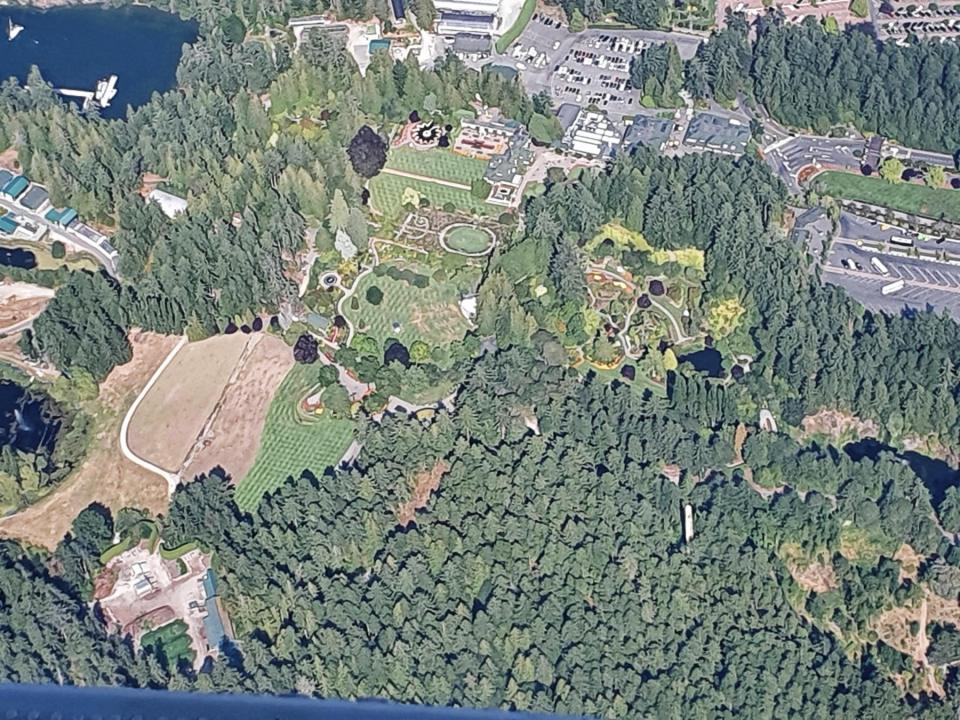
Butchart Gardens;

evidence of some fairly drastic logging;

several views showing what a big slab of land Vancouver Island is;

a couple of arty attempts on my part;

a photo by Jane of Campbell River (meaning – yippee! – it had cleared and we were carrying on all the way to our proper destination);

coming down towards our landing and skimming along just below the clouds; and finally

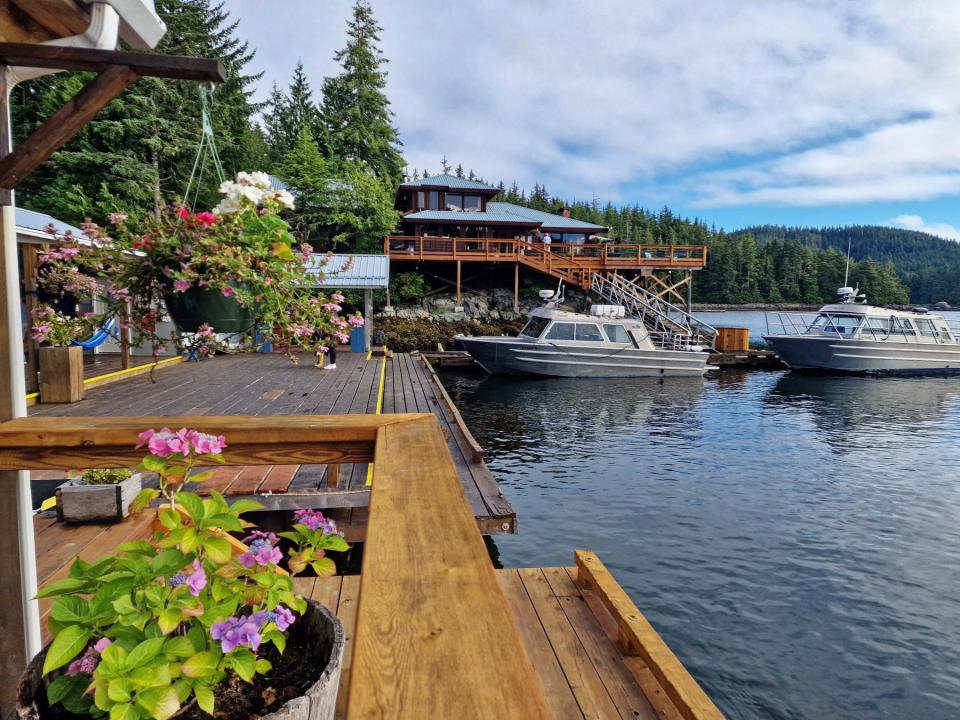
arrival at Farewell Harbour Lodge, where we found out a couple of interesting nuggets. Firstly, the pilot of our plane (a De Havilland Beaver – I was going to call this post “Nice Beaver” but Jane gave me One Of Her Looks) was named, appropriately, Dakota; and secondly, Tim, the proprietor of the lodge, could take the credit for us arriving, as it was his suggestion that we fly as far as the weather allowed, and he was pretty sure it would clear, as indeed it did.

It was, thus, with considerable relief that we arrived at the lodge (which looks great and seems very well-organised)

only some five hours late and just in time to get a beer in as Tim gave us the indoctrination spiel. A key fact that emerged from this is that tomorrow will be an early start, hence my brevity. I am being brief. Yes, I am.

We actually peered round the back of our cabin and found where they park the boats, as well as this scene

which is documentary proof that you can indeed have your kayak and heat it. Thank you. Thank you for listening to my joke.

A delicious dinner was at 7, after which we got a very interesting talk on humpback whales from a lady called Vicky, and so it’s now quite late – at least relative to the 0530 alarm we’ll need if we are to join in tomorrow’s excursion to seek grizzly bears and other fauna. So I hope you’ll excuse me whilst I get to bed to try to get some sleep. Come back tomorrow and find out if we made it.