Tag Archives: Landscapes

Lanzarote Day 7/8 – Bin to Lanzarote; Binter Gran Canaria

Friday 4 March 2022 – Changeover day!

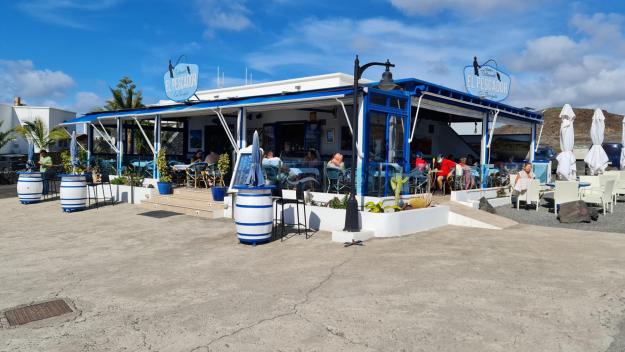
Yesterday was spent doing Not A Lot; five days of relentless tourism and 500 km of purposeful driving around Lanzarote, we decided, Was Enough, and so we contented ourselves with simply driving over to El Golfo in Il Fiat Hybrid and had a nice – and very substantial – lunch in a restaurant called El Pescador.

I made the mistake of starting with a tuna stir fry which turned out to be an entire meal even though it was in the starters section of the menu; so when the huge lump of grilled Fish Of The Day turned up for main course I could only finish half of it. It was all good food though. The only other thing we did there – apart from discover that the restaurant which had been recommended to us was closed on Thursdays – was to revisit the green lake to see if it had increased in verdancy since our previous visit almost a week earlier. It hadn’t really, but it was nice to see it again.

Near our car in the car park was one that was decked out rather fetchingly in a design by That Manrique – further evidence of his lingering influence over the islands.

The rest of the day was spent in mundane activities – checking in to our Gran Canaria flights, catching up with the news and other bits of the papers and saying farewell to the lovely Dominica in the hotel restaurant.

Today was mainly spent getting from Lanzarote to Gran Canaria. We left the Casona de Yaiza at about 0930, got to the airport, dropped off the hire car, had coffee and got on a flight with the idiosyncratically-named Binter Airlines which took just 45 minutes to get us there. Once there we were greeted by not one but two Castaways reps, which was fine, because one of them could speak no more English than I can Spanish, i.e. almost none. The other, however, did a fine job of making sure we had a map of Gran Canaria and some suggestions as to places to visit whilst here. More importantly, the pair of them navigated us through a huge underground car park to the Cicar rental office where it eventually became apparent that they hadn’t quite got a car ready for us. It was thus great having locals to argue our cause and after a short wait we ended up with a Peugeot which we think is probably a 308; whatever, it’s a lot bigger than the Opel Corsa to which we were entitled, and it seems like quite a posh car.

From the airport to our home for the week – the Hotel Rural el Mondalón. This looks like it’s going to be a nice place to stay; it’s a working farm as well as a hotel and it’s quite swish.

We have a ritzy room above a lovely little courtyard

with a small balcony that has a view over part of the farm.

We arrived at 2pm, and its restaurant was still open for lunch, and we were told by the excellent Augustin at reception that it had just reopened, so we counted ourselves lucky on our timing.

Once we got to the restaurant, it was indeed reasonably clear that they had indeed just reopened, as it looked like they were sorting through minor teething troubles on an ongoing basis. Also, it’s a meat-focussed menu, and we ordered the fish, which arrived looking splendid on the outside but undercooked (well, raw, actually) on the inside. They bunged it in the microwave for a short blast and it returned rather better cooked. It was actually a good fish but one of the accompaniments – a fried plantain – was unrewarding to eat. But it was overall OK, even if it looks unlikely that we’ll rush back for lunch every day.

Whilst the Casona de Yaiza in Lanzarote was quirky in appearance and very comfortable, it had a couple of things that I missed: a lounge where one could just sit and order a drink whilst, e.g. writing the day’s blog; and facilities for making a Nice Cup Of Tea – the only mugs of tea we got were at breakfast. And, look, I know that’s pathetic, but when you get to our age this sort of thing begins to matter. So we were delighted to find that our room in Gran Canaria (named “Albillo” – a type of grape; every room was named after a grape variety) featured not only a kettle but also a fridge! This meant that a trip to the nearest supermarket was high priority so that we could procure a selection of life’s essentials – gin, tonic and milk. The nearest place was nearly a mile away and down a busy road with no pavement, so we drove there, bought the goods and hightailed it back to the hotel for a delicious cup of tea. Or three.

I took the chance to wash out a few smalls and hung them out to dry on the rack on our balcony put there specifically for that purpose. That is why it then started raining. Quite heavily, actually.

And that’s about it for the day, actually. We seem to have fallen into a pattern of having a big lunch and no evening meal, so the rest of the day has been given over to relaxing and, on Jane’s part, thinking about expeditions we can make on the morrow et seq. Not a lot to report in this posting, but hopefully lots to come over the next week, so do check back in and find out what we get up to.

Lanzarote Day 6 – The Third Man(rique)

Wednesday 2 March 2022 – As yesterday, our plan was to explore more of the northern end of the island, ticking off tourist boxes as we went. That Manrique had a hand in much of the content of the day. It’s a tribute to the man’s vision, influence and energy that this will be the third day of exploring his works across the island.

So, to start: Jameos del Agua. The word “jameo” is of ancient island origin and refers to a hole that is produced as a result of the collapse of the roof of a volcanic tube. Jameos del Agua was the first Art, Culture and Tourism Center created by César Manrique, and it is the reflection of one of his creative pillars: the harmony between nature and artistic creation. The space includes a restaurant/nightclub, an underground lake, an auditorium and a pool; it’s quite a place, and a deservedly popular tourist attraction.  We thought it would be best to start the day here before it got too overwhelmed by bloody tourists.

Apart from the fact that it’s signposted from all over the island, the entrance is relatively easy to find.

After buying tickets, you go down stairs into the restaurant/nightclub part.

You can, if you wish, pause to stare down into the depths of one of the caves to some subterranean water.

There is a subterranean salt lake,

which is quite zen to stare at for a bit, accompanied by birdsong

provided by chaps like this.

In the water there is a unique and endemic species of squat lobster,  Munidopsis polymorpha, which is blind and albino.

The water is beautifully clear

and you can walk alongside it and look back along the tunnel from the other end.

After this zen experience, you emerge blinking to what looks like a swimming pool.  Well, it is a swimming pool, but, allegedly, only the King of Spain is allowed to swim in it.

The setting features a lone canary palm tree stretching over the water and several species of cactus (I won’t bore you with pictures – there are plenty of cacti shown later in this post).  At the far end is the entrance to the auditorium which is another zen sort of setting

which features several touches typical of Manrique, such as lobster door handles

and a remarkable light fitting (seen here reflected in the mirror which forms the back wall of the auditorium).

The auditorium section concluded our visit to this remarkable place.  Having been inspired about the aloe plant by our visit to Yaiza’s Aloe Museum, we thought it might then be interesting to visit an aloe plantation.  The company Lanzaloe has a showcase park near Orzola, at the northern tip of the island, where you can walk around and learn about the growing of the Aloe plant.  Quite large areas are given over to the plants. We’re not quite sure if they flower constantly, or if we were just luckily visiting in the right season, but the yellow flower spikes made quite a sight!

That the plants flourish in such numbers is due to a process labelled “fertigation”, which Lanzaloe are quick to explain is a natural and sustainable way of using composted aloe and goat manure, and vermiculture, to create an organic liquid that promotes growth.

The site also features some cute cacti

as well as some olive and argan trees.

After this visit, we decided that it would be a good idea to go for some lunch, erring slightly on the early side in the hope of avoiding full restaurants. We drove into Orzola and, mirabile dictu, found what looked like it might very well be a parking spot.  It was surrounded by blue lines, and we weren’t at first sure what this meant; but we found a sign which explained it all.

I find the self-reporting aspect of the parking rules to be rather amusing, and, indeed, somewhat charming.  Fortunately, Jane had pen and paper and so we were able to leave a note of our parking time on the dashboard and we set off into Orzola.  We didn’t get more than a few yards when we stumbled across La Nasa Restaurante El Norte, which looked to have tables available, so we went in and were very cheerfully and briskly served a decent fish lunch.  It was a nice lunch, but not a Nice Lunch, if you see what I mean – we were out in about an hour, but had dined quite well; Jane even had a parrot fish.  It repeated a bit on her later, but that’s another story.

Where we had parked was near the Orzola rocks, so we went for a wander among them to settle the lunch a bit.

Among all the lumpy bits of volcano which form the rocks is some actual sand-coloured sand, which is something I didn’t expect – I tend to expect black sand in such assertively volcanic places.  The ocean splashed pleasingly against the rocks, as you can see in the photo above.

Our next item, again inspired by the Yaiza Museum, was cochineal; slightly to the south is an area around the town of Mala which grows large amounts of prickly pears in order to harvest the cochineal beetles that infest them in order to create cochineal dye. We’d read about the Cochineal Museum in Mala, so thought we’d visit. Reader, we found the museum. It was closed.  It’s all a bit bizarre – there’s a building with “Museo de Cochinilla” in large friendly letters on the outside, but its doors are locked and there’s no reference to it on Google Maps.  If Google Maps says it doesn’t exist then it doesn’t exist – but there it was.  A Schrödinger situation if ever there was one.

It’s clear that the area is still one where prickly pears are grown in profusion

and the beetle infestation is clear to see.

Not all plantations are so well-organised, though.

Mala is also home to another of Lanzarote’s famed tourist attractions, and another Manrique creation – the Cactus Garden. Again, the entrance is difficult to miss

and, once inside, you realise that it does exactly what it says on the tin.

For those interested in cacti, there is an extraordinary variety in different shapes and sizes.

(I have several dozen other cactus photos, but I won’t bore you with them.)  The garden features several typical Manrique touches, such as cactus-shaped door handles

and some attractive features among the cacti.

There’s a coffee bar with a decent view over the garden, which also features a very Manrique staircase down towards the exit.

Our visit to the cactus garden over, we had just one more thing to see – the salt flats at Los Cocoteros, just along the road a bit.  As well as the salt production facility, the village has a “Piscina Natural”, a seawater swimming pool.  I took a video pan across it – it’s a bit noisy and shaky because of the wind, but I hope it gives some idea of the facility, which is filled with sea water coming in through a couple of large tubes at one end, and has a beach at the other.

The salt flats here are nowhere near as extensive as the Salinas de Janubio that we saw a few days ago, but there’s still  lot of area given over to salt production.

These are new salt flats – there’s also an area which was once given over to salt production but that seems to be disused now.

This left just one final box to tick, and it’s not really a tourist tick box, just something we passed on many occasions, including our original drive to the hotel from the airport, and wanted to take a photo of.  Doing this involved exiting the motorway and parking on the slip road with hazard lights flashing whilst I dashed across the road. But that sounds more perilous than it actually was.  Anyway, here’s the photo.

For me, these buildings have overtones of Binibeca Vell, the artificial fishing village-cum-resort on Menorca.  Whatever, they’re very appealing buildings and it occurred to me that one reason they’re attractive is that they’re different from the norm in Lazarote, which is angular and blocky, like below.

We have no idea what those buildings are, but their difference from the norm is striking. I think that’s why Teguise has such a different feel, too – the buildings have curves and angles that are not 90° and so feel refreshingly different.

That concluded our day; for once we had formed a plan and largely stuck to it, although the existence or not of the cochineal museum was a small diversion.

Accordingly, we have Done Lanzarote (Timanfaya bus ride excepted), which leaves us with a day to laze about, check in for our Friday flights and find a final Nice Lunch somewhere.  It’s been a full-on six days of relentless tourism and gale force winds and it’ll be nice to take it easy before we travel on to Gran Canaria.  Lanzarote has been a revelation and we’ve had a great time exploring it.  As I say, the adventure continues on Friday as we go to Gran Canaria, and I hope you want to check back in later to see what we make of the place.

Lanzarote Day 4 – Colora Tourer

Monday February 28 2022 – The day dawned with much more promising weather, although the yellow wind alert was still in force for the island (quite correctly – see later). So it was that after breakfast (including the usual very welcome couple of mugs of Earl Grey) we headed off to complete the major unticked tourist boxes for the south of the island – Caldera Colorada and the Timanfaya National Park bus tour (because you’re not allowed to walk in it).

The first part of the plan seemed to be going well when all of a sudden….

This was a temporary road block and we never quite worked out what was going on to cause it. After a few minutes the van backed away and we carried on on a completely clear road. Shortly afterwards, we parked near the Colorada crater and followed the path that led round it.

It’s quite near El Cuervo, which we walked into a couple of days ago, just a couple of kilometres as the raven* would fly if it weren’t for the bloody wind.

The bloody wind was practically non-stop gale force.  While it never actually blew us over, there were times it seemed near to doing so. Because of the geology (you can see from the lumps above), the northerly gale meant you were either struggling into it, or being blown along from behind, depending on which side of the hill you were.

(Parenthetical note – it’s interesting to look at the Terrain View of the area in Google Maps.  It gives a good insight into just how lumpy Lanzarote is. Colorada is marked top right and you can see Yaiza, where we’re staying, bottom left.)

As we started the loop round Colorada, we could see Cuervo in the distance.

As we walked along, the coloured part of the mountain, the south westerly slope, gradually came into view.

There were some people actually clambering up the side.

I’m not sure whether this is allowed, but there’s a sort of track leading up at an angle, so I suppose people do it regularly.  We decided against it and carried on until the full glory of the coloured slope was revealed.

The lump in the foreground is a massive rock, called a “Volcanic Bomb”, which gives you an idea of how it got there – not something to be standing under as it came out of the sky. The red volcano’s colour is caused by a richness of iron oxide in the cinders that poured out during its eruption – among the last of the Timanfaya eruptions in the 1730s.

As you can infer from the terrain map above, the area has no shortage of substantial hills, each evidence of volcanic activity and each having a different colour cast.

The photo above is of Montaña Ortiz (so tiz).  Almost unobserved in the foreground we spotted a pink geranium, just about holding its own against the wind.

One nearby volcano, Volcán de Las Nueces, provided a final striking image for the walk.

It’s a walk well worth doing; there are over a dozen information boards at strategic points around the volcano, giving insight into the geology at work and its effect on the landscape.

Our cobwebs having been thoroughly blown away, we set out to tick the other boxes – the Timanfaya Visitor Centre and the Timanfaya National Park itself.  The former is quite large and has a lot of information for those who are interested in the specifics of vulcanology, but somehow didn’t grab our attention, so we didn’t stay long. Had there been a coffee bar, we might have taken a breather, but there isn’t one.  There are toilets, though….

The day’s plan came severely unstuck some 4km down the road from the Visitor Centre, when it became apparent that the queue for the National Park was huge.  Traffic was backed up in the opposite direction for several hundred yards, so we decided that no bus trip was worth that amount of aggravation.  An early lunch seemed a good idea, and we had a recommendation of a specific restaurant – El Pescador in Playa Quemada. It turned out that getting there early (about half past midday) – without a booking – was a good idea as it soon got really quite busy.  We had a good lunch with a mixed fish grill, and we’re happy to add our vote for the place.

Jane suggested that we should try to start exploring more northerly parts of the island, so we headed off in that general direction. As we were going along she suggested that we should stop at a feature called Las Grietas, a crack in the side of Montaña Blanca, just past the town of Tias.  And so we did.  From the outside, it doesn’t look much.

But climb in, and it’s pretty dramatic.

A person can just about squeeze through, and it’s a little tough to climb in the loose gravelly surface, but thoroughly worth it, even though you get shoes full of the little stones.

(That was just one shoe’s worth.)

As we headed back to the car, we noticed a couple of young people seemingly camped out beside it.  When we got there, it turned out that they were a French couple who had no transport.  They couldn’t call a taxi because there was no mobile signal and they asked us if we could give them a lift to the airport. They were lucky – Jane’s French is very good, courtesy of the time she spent living in Paris, and so it seemed reasonably safe to help them out – the airport was only a couple of miles away.  So that was our Good Deed For The Day – they were very grateful.  We never established exactly how they managed to get themselves to Las Grietas, but we were glad to help them, anyway.

We resumed our original plan, which had been to see some of the northerly bits, with the possibility of visiting The Other salt factory, Salinas De Los Cocoteros.  En route, it became clear that we were heading into César Manrique country, as this installation on a roundabout showed.


View this post on Instagram


A post shared by Steve Walker (@spwalker2016)

We were by then close to the César Manrique Foundation, set up to allow people to visit the house that was his home from 1968 – 88, and also the setting for a gallery of some of his art – and at the moment still home to a celebration of the centenary of his birth in 1919. As you might expect, it’s a striking place, with a cactus garden outside it

and another of his wind-driven mobile art works by the entrance.


View this post on Instagram


A post shared by Steve Walker (@spwalker2016)


There are plenty of his artworks on display and the house itself is very unusual – Manrique exploited volcanic bubbles to create the lower floor

and the general atmosphere is very congenial.

Just by the house is a roundabout where Manrique was killed in a road accident in 1992.  There are two more of his wind-driven mobile artworks by and on the roundabout to mark the scene.

Our next stop was a feature nearby called the Stratified City (known in Spanish as Antigua rofera de Teseguite), which is a large set of rocks which have been created over the course of thousands of years by wind, sun, and rain. It’s quite a sight.

It’s also quite a site for idiots leaping about and taking selfies, but that’s just my age showing again.  I still don’t understand the thought process that says that a fabulously old geological feature can somehow be improved by having a gurning face in it. Anyway, we wandered off the main part and found a few quieter places for photos, and it’s quite an awesome place.

By this stage, the sun was nearly setting so we decided that Salinas De Los Cocoteros would have to wait for another day and we headed back to the hotel for a quiet evening.  We still have many, many tourist boxes to tick in the north of the island, and it looks like the weather tomorrow will be as nice as today’s – and a lot less windy.  So please check back in then and see how we got on, won’t you?

* El Cuervo is Spanish for raven…