Tag Archives: Landscapes

Lanzarote, Day 1 – an early start

Friday February 25 – And so the adventure begins – with an 0330 alarm for an 0430 taxi to Heathrow.  We can tell when we’re on holiday – it’s pretty much the only time we have to get up early.

The UK is well on the way to unlocking as the pandemic recedes – restrictions no longer legally required but left to personal discretion. So we were not too worried about falling foul of paperwork as we left the UK, but still felt a little in the dark about what would await us as we arrived in Lanzarote.  Jane had, as ever, done a masterful job of ensuring that we had completed all the things we thought we needed to do, but there was always a tiny lurking doubt in the corner of the mind that perhaps we might get an unwelcome surprise. So, clutching vaccination records and Spanish QR codes (backed up to Dropbox coz you never know), we stumbled out into the dark and into the taxi.

We actually arrived before the official start time for dropping off bags for our flight, but that didn’t seem to matter, and the bag drop and security parts of the process were swift and largely trouble-free, bar a poke at my laptop with an explosive detector swab. I didn’t see any instructions to wear a mask, but pretty much everybody was wearing one as they walked around. So we found ourselves a seat in what had by then become quite a busy terminal.

So busy, in fact that the queue for a coffee was sufficiently daunting that we didn’t bother.

The flight was uneventful and on time.  Mask wearing was mandated whilst not eating or drinking, but since I had a rental car to drive at the far end I couldn’t join in with the chap sitting next to me as he waded into a couple of G&Ts. The main concession to Covid on arrival was that disembarking was done in sections.  The first ten rows were called out through the front exit of the plane, then the last ten through the rear exit.  Finally the middle rows were called and we shuffled off onto the mystery bus tour that ended at the terminal building.

UK passports are still accepted at the electronic gates and after the passport gates were some desks set up to review Covid paperwork. Courtesy of Jane’s efficiency we had the right QR codes on paper and were waved through immediately, so in practically no time at all we were in the baggage hall, doing the carousel stare thing.  I took the time to pick up the keys to a rental car, the process for which took less time than the arrival of our cases.  My bag took so long to come through that I was actually beginning to fear the worst, but it finally made its appearance and so we went out to meet the Castaways rep, Eva, who escorted us to our motor, a tiny Fiat Hybrid – brand new, just 18km on the clock.  Tiny as it was, we could fit everything in and so we embarked on a tour of the car park trying to find the exit, which we managed on the second go round, with Jane getting reassurance from a nice chap that the exit was actually open.

I had brought a satnav with us which made the journey to our hotel, the Casona de Yaiza, pretty straightforward, and I discovered that I actually could still drive a car with a steering wheel on the wrong side and a manual gearbox, apparently without upsetting any of the other road users. I also discovered that I had got out of the habit of wearing a mask for short transactions indoors, and was politely reminded, when I refilled the car, that mask wearing indoors in Spain is still a legal requirement.

Because of our early start, our arrival at the hotel was quite early, too.  The reception wasn’t quite ready for us, but after a couple of minutes a nice lady called Chus (short, I think, for Maria Jesus) checked us in and explained a few things about the island – good places to go, places where you’re not allowed to go, that kind of thing – by which time it was lunchtime, for which I was frankly quite ready, having had only a bowl of cereal and two large sandwiches by this point. So we went into the restaurant, which is quite charming

where we were served by a lass called Dominica, who was equally charming.  The meal included a gazpacho based on papaya, which Jane pronounced to be delicious, and a fillet of a fish we eventually found out was called a pejerrey, a Peruvian Silverside (?) which was equally delicious.

Replete and tired, we had a short rest and then pottered round the hotel, which is as charming and quirky as the restaurant.

There are artistic touches all around, including some nice mosaic work

and plenty of succulents, some of them very substantial.

So this is to be our home for the next week as we discover the delights of Lanzarote – some walking, some driving, some appreciation of the art of César Manrique (who was to Lanzarote what Gaudi was to Barcelona) and some Nice Lunches beckon.

As the afternoon drew to a close, we thought we’d take a walk around, particularly taking up on a route mentioned in the book “Walking in Lanzarote”, one of the Sunflower books which we’ve valued so much over the years as a source of ideas for destinations and walks.  So, off we strolled, past some amazing gardens.

One house had converted its garden into a vineyard.

Also, we passed some open spaces covered with just the black laval soil (more like fine gravel, really), in some cases with people working on them, although we couldn’t see any plants or other evidence to explain what they were trying to achieve.

Some of these expanses of black soil had circular enclosures in them.  We can’t quite work out what’s going on, here – is it cultivation? Clearing for building?

The route description mentioned a flight of steps leading down to a roundabout which surrounded a Norfolk Pine.  We found some steps

but they clearly weren’t the right ones.  Heading back to the hotel, we eventually discovered what the route description had been talking about, but by that stage it was quite dark so a photo wasn’t possible.  However, since this is close to the hotel, rest assured that I will eventually and photographically take the necessary steps.

That’s it for today.  It’s been a long one and so rest and recovery is the order of the, well, night. Do check in again over the course of the next days to see how the week develops.


Day 12 – Yes, We Canyon!

Saturday 10th July 2021. One loses track of time on an excursion such as ours. It was something of a jolt to realise that it was the weekend, at least for everyone else; we just carried on in our little dream world as we explored the southern region of Iceland before joining the “Golden Circle” route tomorrow. And, probably, hordes of bloody tourists.  We’re now within range of day trips from Reykjavik, and it showed in the number of punters and the number of coaches at the various places we stopped for a gawp.

The first of these was yet another Interesting Church, this one on the site of a medieval convent at Kirkjubæjarklaustur, very near our hotel.

Like almost every Interesting Church we’ve come across, it was closed, and I have yet to hear a credible explanation of how come there are all these churches which seem almost universally to be unused on any kind of a regular basis.  Is there a vicar or priest? Is that person a visiting official? Who pays for the upkeep? etc, etc. Anyway, it’s lovely to see such interesting church designs; and this one is not the last of this trip.

The next place we went to has to be one of the most arresting sights of our holiday in Iceland. It’s called Fjaðrárgljúfur and is billed as a canyon.  As you approach it, you begin to get some idea of what awaits.

Then you look carefully and you can just make out a couple of sheep as the merest dots (just left of centre in this picture)

and then you climb to the observation platform and see this

This was the first Shot Of The Day. It is a truly awesome sight, without being completely overwhelming (like, say, the Grand Canyon is).  A remarkable start to our day. You can walk down towards the other end, passing some sheep

(one was sleeping and we hope it didn’t really drop off) and have a look from there.

There’s a figure on the right bank as we look along it from here, and that gives some idea of scale.

We next got a chance to see a couple of uniquely Icelandic things.  The first was a sheep rounding circle.

There are half a million sheep in Iceland – more than the number of resident people – and they are basically free to roam.  This means that you can come across them almost anywhere, sometimes, alarmingly, in the middle of the road as you drive along.  Somehow (by horse, dog, 4×4, anything that works), every September these wandering sheep are rounded up from wherever they’ve got to, a convulsive effort over around three days which is a massive part of Iceland’s culture and something that all farmers have to join in on.  The sheep are herded into the central pen and then individual farmers pick out their sheep (they all have ear markings) and separate them into that farmer’s segment.

The second insight came as we got a chance to try to grasp the impact of an enormous event in Iceland’s – and indeed the world’s – history – the Laki Eruption of 1783-5.  This was of staggering size and impact: an outpouring of an estimated 42 billion tons or 14 km3 (3.4 cu mi) of basalt lava and clouds of poisonous hydrofluoric acid and sulfur dioxide compounds that contaminated the soil, leading to the death of over 50% of Iceland’s livestock population, and the destruction of the vast majority of all crops. This led to a famine which then killed approximately 25% of the island’s human population. The lava flows also destroyed 20 villages. The eruption and its aftermath caused a drop in global temperatures, as 120 million tons of sulfur dioxide was spewed into the Northern Hemisphere. This caused crop failures in Europe and may have caused droughts in North Africa and India.

We stopped in the middle of the huge lava field resulting from this eruption.  It’s difficult to convey the scale of it – kilometre after kilometre of moss-covered lava, because only moss – nothing else – will grow on lava, and this takes centuries to develop.

I created a Facebook 3D photo which might help to underline the scale of this.

Our next port of call was what Dagur called the “Yoda Cave” – actually used as the setting at the star of Star Wars – Rogue One, as the cave our heroine dashes into to escape from some band  or other of marauding riffs.

It looks quite impressive from the inside as well.

This is in a part of Iceland that used to be an island, but the volcanic actions raised the land up around it.

This is close to a town called Vik, which has an Interesting Church, more for its location than its architecture.

In the distance to the left can be seen the “Three Trolls”, Reynisdrangar, rocky outcrops off the beach, Reynisfjara. You can get a closer view of them from Vik’s black sand beach.

We headed over towards them and I guess this was the first time we came across hordes of tourists – Reynisfjara is a popular spot and the car park was crowded. There are a couple of lava caves

one of which has basalt columns by it – popular for kids to climb on.

We carried on along the coast a short way, stopping at the clifftop at Dyrhólaey, which has a view over an impressive rock arch

as well as the surrounding countryside

it’s own troll

and – delightfully –

puffins!  Dagur explained that these are often blown over from their usual colony to the east during August.  The fact that some are here at this time of year, and that they appear to have burrows that they are using, implies that this is becoming an established puffin colony in its own right.  I took loads of pics, obvs, and even nearly managed an in-focus one of a puffin flying off.

But the wind was gale force and so hanging about to try to get a better photo was not a comfortable option. We moved on.

The southern region is marked out, as I posted yesterday, by glaciers and the road to our next major stop offered a chance to get a nice picture of one of them – an offshoot of Vatnajökull, but I don’t know which one, I’m afraid.

The rest of the day was almost exclusively about waterfalls, which was a relief.  It’s been ages since we saw a decent waterfall and I was beginning to get withdrawal symptoms.  Our next stop, then, was at Skógafoss, but we were hungry so stopped for lunch at the hotel there before exploring the waterfall itself.

And it’s a splendid sight.  The car park was crowded, as was the shoreline, with lots of people getting in each other’s way as everyone tried to get fucking selfies, which always enrages me. Mind you, I did manage to get something out of other people’s cavorting.

By aggressive use of sharp elbows, I got to the front where I had a few seconds to get a view of the falls unsullied by tourist vapidity. But actually, the second Shot Of The Day came about as a girl walked in even further through the spray towards the falls and gifted me with the perfect shot.

Before the next waterfall, we stopped briefly to view some turf houses in a place called Drangshlíð.

I found this post about them on the web, but it didn’t really leave me any the wiser.

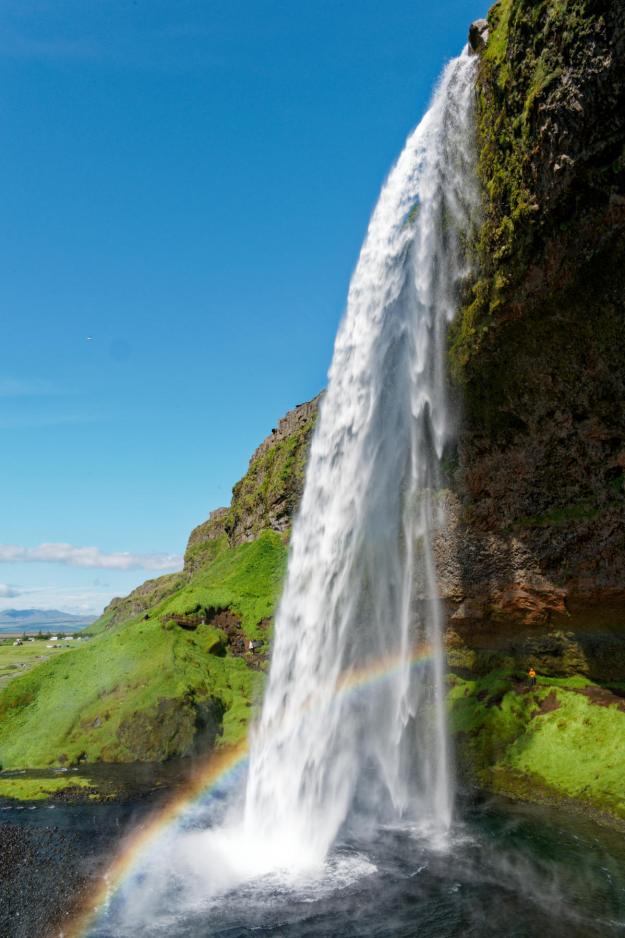
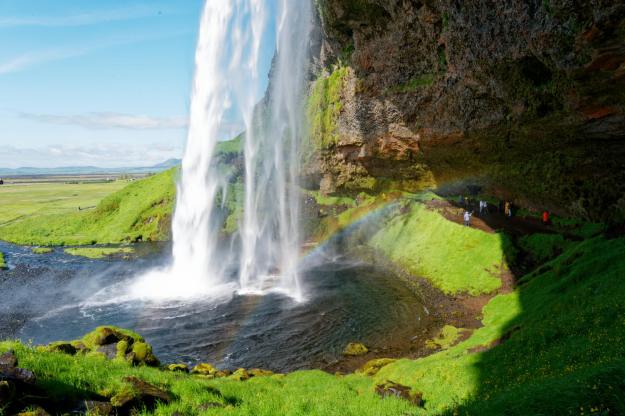
A few kilometres along the road we stopped at Seljalandsfoss, which is another great sight.

It’s very popular, as it’s a waterfall you can actually walk behind

after having done which, you can walk along to another one, called Gljufrabui.


View this post on Instagram


A post shared by Steve Walker (@spwalker2016)


And that was nearly it for the day’s interesting bits.  We are staying the night in the Sel Guesthouse near Skalholt, and it is a charming place.  Though the charm is somewhat rustic, it has WiFi and other mod cons, geothermal hot water in the bathroom, but no restaurant.  So we made our way to the Farmhotel Efstidalur, which really is a working farm.  From the cafe, you can see the cows

and upstairs in the restaurant you can eat them.  We had a pulled beef salad which was absolutely delicious.  Then we indulged ourselves with some of their home-made ice cream downstairs.

Thus ended our day. We will be Doing The Golden Circle tomorrow, with the major tourist sites and sights that this offers. It should be a good day, and it’s our last day on this tour, so let’s hope for a final Grand Day Out. Please check in tomorrow to see what actually happened, why don’t you?

Day 3 – Flipping birds!

Thursday 1st July 2021. Another Long Read Alert – lots of pictures again!

For a holiday such as this, where sightseeing and photography are basically the whole point of the exercise, the weather is anything from important to critical.  This makes Iceland a place of great uncertainty, since it’s basically impossible to have any confidence in what the weather gods will bring.  So, the morning ritual of opening the blinds to peep out at the weather is a time of heightened tension.  This morning?

Not too bad, it would seem.  Not that this is a guarantee, or anything, but at least we know it’s not hurling it down for the moment.

After breakfast we set off for various destinations around the area, the southernmost bit of the West Fjords.

Off we went, and it soon became clear that the promise of a sunny day was an empty one.

I mean, it’s a nice view and all, but suddenly the horizon’s gone.  Near this spot is a bizarre statue.

It is of Julius Oskar Þorðarson, who was apparently the boss in charge of the gang who built the road it stands on, back in 1947.

A few kilometres on the scene cleared a bit, so we got a good view of the road to Patreksfjörður. Slightly to the side of that was an appealing optical illusion.

The trees look like a pine forest until you realise that the blue patches are the ubiquitous lupins, at which point it becomes clear that the trees are less than 2 metres tall. (There are very few tall trees in Iceland because of the paucity of much of the soil and the relentless strength of the wind; the only ones you’ll see  are imported and sufficiently short that wind doesn’t tear them to shreds. Hence the local joke: what do you do if you are lost in a forest in Iceland? Stand up…)

Patreksfjörður is an appealing town, which, like so many in this area, is located on crammed into a thin strip of land between the sea and a thundering great mountain.

The locals are building a wall to keep out the avalanches which are a constant possible threat. You might be able to make out the earthworks in the centre of the picture, above the buildings.

The town centre has some handsome buildings

and it’s generally an agreeable place.

We then moved on towards the hotel where we were to stay the night, the Hotel Latrabjarg. En route we passed a rather bizarre sight.

This is the not-so-good ship Garðar, billed as the oldest steel ship in Iceland, built in 1912 and now abandoned here to rot. No, me neither.

However, just by the wreck was the rare occurrence of a stretch of water unruffled by wind, which gave me the opportunity to indulge my favourite sort of landscape photo, a reflection.

There was uncertainty about whether our overnight hotel would be able to offer us dinner*. In the end, we decided to eat somewhat down the road and so planned lunch in Breidavik, with a further plan to return there for a sufficiently early dinner to allow for an activity which was best planned for the evening.

Before lunch, we went to the beach.  Of course we did.

On the southern extremes of this peninsula is an area called Rauðisandur, “Red Sands”.  It’s not really red, but actually, well, sand-coloured.  But nonetheless it felt extremely out of keeping with a holiday among glaciers and mountains, to go to a vast expanse of sand.

So, the mountains stop and the sand starts.

and the “beach” is actually a sand spit with water inland of it.  But it still feels like you’re on the beach.

Dagur, in chasing a particular photographic angle, did his Cnut act

and was just as successful, ending up with boots full of seawater.  I don’t know if he got his shot or not, actually.

The water inland of the sand gives an opportunity for some interesting shots

and in places you can see that the sand is not all sand-coloured.

One has to walk a short distance to get from the car park to the sand, and the walk, and an episode on the way to lunch, gave me slight pause.  As you head towards the sand, you pass a really lovely view.


I couldn’t walk past that without stopping to admire it, and of course take a photo. Dagur walked past it without a glance.  Shortly after we left the sands, we asked him to stop so we could take photos of no fewer than three waterfalls visible from the same spot.

Dagur, again, hadn’t really thought about stopping for it.  He’s so used to the fantastic sights that you can see in Iceland that he doesn’t see small fry like these scenes, whereas to us Brits, they’re fascinating and lovely.

After lunch we drove to the other end of the sand spit for a walk around.  It turned out that the walk took us past the nesting grounds of some Arctic Terns, who were not best pleased to see us, and so started dive bombing us.  They’re very agile flyers, and so it’s disconcerting to have them head straight for you, only to veer away at the last instant (or even peck at your head en passant, apparently).  From several dozen attempts, I managed to get a couple of halfway decent pictures of a tern in flight.

There was a lot of bird activity.  In a little stream nearby was a little chap we think is a Dipper (though not a big one).

and the skies were filled with the sights and sounds of dozens of different types of birds coming and going.

Near where we parked for this walk was a cute little black church

with Oyster Catchers on the surrounding wall.

They got rather agitated as we approached and we think they probably had a nest in the wall.  So we left them to it and headed to our hotel. We had a chance for a refreshing cuppa before heading out to an early dinner.

The reason for eating betimes was that we wanted to get to the Latrabjarg cliffs to see

the puffins, which are nesting at this time of year and which come out in the evening after a day in their burrows.

It’s a popular spot with photographers

and, to be fair, it’s a rewarding time to be out chasing photos.  The puffins are very cute and don’t seem at all fazed by having people thrusting long lenses at them.  It’s quite easy to get good photos, and I even managed some video.

We actually made two visits to the Latrabjarg cliffs, with the later one being fractionally more satisfying.  In between times, Dagur whisked us off to an area called Keflavik (same name as the airport, rather different scenery).

It’s actually past the end of of the sands where we birdwalked, and down a very rough road (as you can see above).  You get a nice view, though, and it’s so difficult to get to that very few people will have seen it from this viewpoint.

It’s a Wild And Lonely Place (WALP Factor 8).

and Dagur also took us to see a monument to an extraordinary rescue attempt by Icelandic farmers of English sailors who were shipwrecked nearby, back in 1947. The farmers had to carry loads of gear out to this WALP and haul sailors up the cliff in very difficult circumstances – a major effort to save a dozen lives.

(I think the weather’s always foggy here, which is probably why the ship was wrecked.)

The day today had featured a lot of avian activity with some very satisfying results.  I think that tomorrow will involve longer periods in the car spent travelling around, so maybe tomorrow’s enthralling episode will be shorter.  There’s only one way to find out, so see you then, I hope.


* In this part of Iceland, towns are small and far apart, and often only accessible by unsurfaced roads. Generally speaking, it’s a Wild And Lonely Place, so you can’t make any assumptions about whether anything is still open or offering what one might think of as a normal service. On entering the Latrabjarg peninsula, for example, there’s a sign informing you that there are no fuel stations in that part of the island.  As it happened, the Latrabjarg hotel could provide food, but not early enough for our purposes.