Tag Archives: Tourism

Oman Day 7 – Back to “civilisation” with a bump

Wednesday Feb 27. So this was it – our goodbye to the camps that the Hud Hud Travels team had so splendidly set up and run just for us – sad in a way, but holding out the tingling anticipation, at the end of the day, of:

  • getting online
  • unlimited running hot water
  • unlimited electricity

I may not be as jaundiced about camping as I was earlier in the week, but still my heart leapt at the prospect of all of the above.

However, there was packing to be done and breakfast to be had before we said our goodbyes and headed off for the day’s adventures. These largely centred around a drive over the Hajar mountains, widely touted as the most scenic drive in these ‘ere parts. Touted correctly, too, in my opinion. The road itself is a bit of a bone shaker

(and should not under any circumstances be undertaken in anything but a robust 4×4 – see later) but offers some really spectacular scenery.

You’ll notice in the last of these that there’s a village nestling among the savage scenery. This, and others, are inhabited by people who have lived in the Hajar mountains for generations. For them, life is simple, spelt t-o-u-g-h, but it’s one they know and when the government, in an enlightened attempt to make life better for them, builds an entire village for them

the uptake is quite low, according to Rashid. However, the younger generation are more prepared to move and so eventually social housing projects such as this may well be fully populated, and the problems of delivering water, electricity and life’s other essentials to the remote areas of the Hajar mountains may well diminish.

At the high point of the drive is the Salma plateau. If you want my opinion, it’s a bit up-and-down to be credibly called a plateau

but I suppose everything’s relative. Anyhoo, the most interesting feature of the plateau are the “beehive tombs”, some 28 of which can be found here, with many more in other locations such as Al-Ayn and Al Khtum.

Above are two of the well-preserved ones, but many have decayed. The workmanship on them is quite remarkable.

Jane crawled inside one to see what it was like inside.

As you continue the drive, you can look back and see the ones which have survived over the centuries.

On we drove, enjoying the spectacular mountain scenery.

until we came to a village nestled in the middle of all this rockery!

The question naturally occurred to me – why the actual do people set up a habitation in such remote parts? Rashid’s answer was simple – they found water, and had developed skills in locating sources of water which enabled them to perpetuate this life, tough as it is. This village is called Qorun (I think) and, indeed, is centred around a well.

Above you can see the tanks to which well water is pumped before being loaded on to the water trucks for distribution to the remote parts of the village and other mountain sites, too.

A diversion was provided by a baby donkey, who wondered if we might have some food.

There are wild donkeys in the mountains, but also some which are owned by villagers, along with goats and sheep. If you look in detail at the layout of the village, you can see where the animals are kept.

Theirs are the shelters extending out from caves and hollows higher up the rocks to centre and right of the picture above – but those used to be the actual domiciles of the villagers themselves in times gone by!

After a while we reached the top and crossed over to the point where we could see the coast, and we stopped for lunch in front of yet another stunning view.

(The faint line across the middle is actually the horizon, with the ocean meeting the sky.)

Rashid spent some time explaining elements of the view to us, whilst around us there was a certain amount of wildlife activity. We were inspected by goats

and, delightfully, Egyptian vultures.

(we think we spotted a Turkey vulture as well, but are not entirely sure. It’s amazing that Oman has to import its wildlife from other middle eastern countries, don’t you think?)

Lunch over, we made the descent to the coastal plain. This is where a 4×4 – and an experienced driver like Rashid – becomes essential, as the road is incredibly steep in places – difficult to convey photographically, but here’s my best shots.

We saw a few more features on the way down: a face in the rocks;

the caves where mountain people used to live;

and another government housing project intended to encourage these folk to live in better accommodation which so far languishes mainly empty, since the people refuse to move.

We finally made it down to the coastal plain and spent a few minutes cruising the (lovely, smooth, tarmac) coastal road near a town called Fins looking for gazelles, since this is the coastal end of a reserve called Ras al Shajar. We saw a few, but they’re quite shy, so I have many photos of their back ends as they ran away.

Then Rashid took us to see something that is, on the face of it, a bit strange – a Frankincense tree. It was rather marvellous to see something in real life that I had previously only come across as a biblical reference. So here it is – the only Frankincense tree in northern Oman:

There are, Rashid told us, many in southern Oman, around Salalah, but this is the only one in north Oman. I’m not sure I can understand why people haven’t taken cuttings from it to make other trees (because you can see where cuttings have been taken), but there we are. Rashid also told us about male and female Frankincense. Looking closely at the tree, this is a patch of female

and this of male

They are subtly different in the scent they produce, apparently, but I’m only a bloke so I don’t really understand these things. The tree was in flower, so here’s your chance to see Frankincense flowers.

Our next tourist stop-off (because by this stage I’d begun to feel that we were ticking the boxes – gazelles, tick, Frankincense tree, tick) was Hawiyat Najm, or the Sink-hole park. There’s maybe nothing unusual in yer average sink hole, but this one is slightly unusual in that it’s fed by both fresh water, from the mountains, and salt water, from the sea. Anyway, there are steps down into it and you can go swim in it if you like – after you’ve paid to get in, of course. Like Wadi Bani Khaled, this is very much a tourist spot, but it’s quite striking.

So there we were – all the boxes ticked and it was finally time to go to the hotel which would be our home for the next four nights – the Chedi, in Muscat. This is a seriously posh joint and I’m entirely pleased to report that we were upgraded to one of their Executive Suites, and so have separate bedroom, bathroom, terrace and lounge, which is where I sit and type, for these blogs don’t write themselves, you know. Jane has pointed out that all this luxury seems a bit fake after the gritty reality of life in the mountains or desert. I kind of understand what she’s trying to say, but I’ll grab that unlimited electricity and hot running internet with both hands and be grateful.

Tomorrow, we get to tour the highlights of Muscat, so tune in to the next installment to find out how that went. ‘Bye for now!

Oman Day 3 and 4 – In Transit (well, Toyota Land Cruiser, actually) to, and a day at, the beach

Saturday 23 Feb The day had a fairly relaxed start, as the main objective was just to get to our next camp. This was in Barr al Hikman, by the coast, and a good six hours’ drive; so we weren’t expecting to tick large numbers of tourism boxes. But there was interest and scenery in the day even so.

The first thing we did was to go and peer into the local gorge. Near our Jabal Shams camp was a sheer drop

with a view so staggering that it’s impossible to capture on camera.

see what I mean? I tried various video tricks to capture it and I will post any that worked here in due course. But it was a gorgeous view (see what I did there?)

The first stop on our journey was in a town called Bahla, which has a couple of highlights worth seeing. It enabled me to capture a shot of what a typical set of Omani shops looks like.

These are typical of the small, individual booth-type shops that stand by the roadside (there are national brand shop chains, banks etc as well). By decree of the Sultan all shops display a description of their trade or products in English as well as Arabic, which lends a strange familiarity to a very unfamiliar scene! As it happens, these shops were next door to Bahla’s Grand Mosque, which is a striking building.

The main thing that Rashid wanted us to see was the fort, which is being reconstructed, and is a very impressive edifice.

(In front of it is the special local hall for celebrations such as weddings – but for men only. This exercised Jane somewhat, unsurprisingly.)

Rashid also took us to a viewpoint which enabled us to see over the whole of Bahla, showing what a dominant landmark the fort is.

A significant endeavour is the wall which runs right round Bahla. It’s of rudimentary mud brick construction, but stretches right round what you can see above. The authorities have also built a rather imposing gate over the main road into town.

On we motored, and the scenery changed dramatically to reflect the sort of landscape that covers a huge part of Oman – basically desert of various sorts. Plain sand

scrubby vegetation revealing the presence of some water

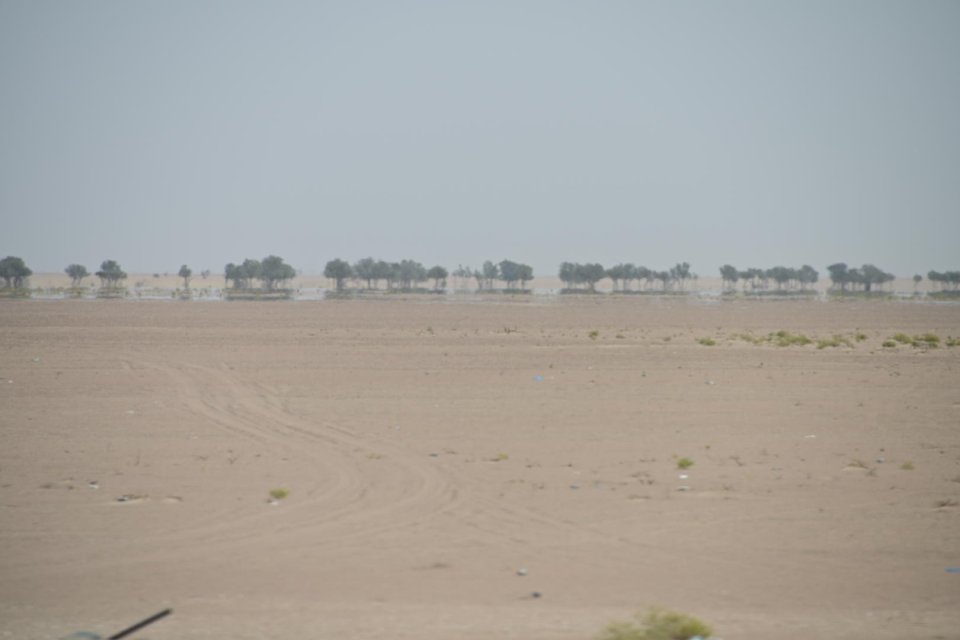
and mirages of non-existent water; and the ever-present risk of bumping into a camel.

(this means itinerant camels, of course. We also saw another way that you could find camels on the highway:)

This was the scenery that we had for our lunch break.

At about 3.15, we reached Muhut and linked up with the manager of our beach camp, a South African called Devon, who led us on a 50 minute drive over the salt flats to our site – a necessary step, since Rashid didn’t know where the camp was (each camp pretty much gets set up from scratch and the exact location will thus move), and you can get seriously lost when the landscape is nothing but flat sand and scrub. That said, there are markers which those in the know can use, such as this, which shows a fisherman’s track

(my caption for this photo is “The Crate Outdoors”. Thank you. Thank you for listening to my little joke).

Tyres are used to mark junctions.

None of this, however, matches good new-fashioned GPS as a navigation aid, which was what got us to our beachside camp at Barr al-Hikman. This was the same in principle as our mountain camp (majlis, bedroom tent, bathroom tent), but in a very different style:

and it was lovely and warm!

We went for a short stroll along the beach to see what was what. Behind the camp is a lagoon where there were actual flamingoes

There were crabs all over the place

and some mystery plants actually growing in the sand.

The rest of the day panned out pretty much along the lines of our previous, mountain, evenings, only without the shivering – so I was actually able to take a sorely-needed shave.

We ended the day with a splendid dinner on the beach in nice temperatures and with a breeze whose coolness was, for a change, welcome.

And we wound down after dinner shooting the breeze with Devon and making our way further down our supply of gin – a pleasant and relaxed end to a wonderfully relaxed day.

The night passed comfortably enough, but for one noisy distraction – a crab had dug and entered a hole below where our tent was sited, and this wasn’t noticed when the tent was pitched. So the poor thing was scratching to get out for much of the night, but was trapped under the ground sheet. Devon rigged up an escape tunnel in the morning, and it looked like the critter got out OK.

The beach camp is basically 90 minutes by 4×4 from anywhere, so it’s not a base for excursions. Our expectations therefore for Day 4 were of sloth. This turned out to be the case.

Sunday Feb 24 Breakfast was at a relaxed 9am

and we spent the day entirely at leisure. Jane took the occasional stroll to look along the beach, coming across a nice selection of objets trouvés

and I took the opportunity to document the holiday so far (these blogs don’t write themselves, you know). We had a lovely lunch and I tried to capture some photos of local wildlife, with distinctly mixed results. We saw sandpipers

curlews

a heron

and any number of the crabs as they burrowed in for the night (not, thankfully, under our tent this time).

and we whiled away the day in contented relaxation. Tomorrow we have to transfer to the desert, so the story will continue then – tune in again to find out how it went.

Oman Day 2 – The Cattle Market

Friday Feb 22. It was a chilly dawn; the wind that had whistled and moaned during the night had dwindled but not desisted, so our early (0600!) breakfast, while excellent, was taken quite hastily. Ironically, the tea we were offered by default was – you guessed it – Twinings Earl Grey, which made something of a mockery of our smugly eschewing packing it so that we could experience the mystery of the Arab world. However, the free supply of Earl Grey was always very welcome.

Very soon after breakfast we bundled ourselves into the relative warmth of the car to take us to our first item on the day’s agenda – a cattle market in Nizwa.

The sunrise, though cold, was pretty

and led to some lovely views over the mountains.

So, off we bumped (honestly, neck and core muscles get a thorough workout travelling these tracks; even with the expert driving of Rashid, I was still banging my head on the window pillar occasionally. I hereby apologise to Hud Hud Travels for the resultant damage to their motor).

We had to make an early start in order to get to the Nizwa cattle market (which happens every Friday, that being the start of the weekend in these here parts) whilst there was worthwhile action taking place. And action there was – a central platform around which sheep, goats and cattle were paraded with auction staff trying to conclude deals with the surrounding crowds. Here are a couple of photos, but to understand the dynamism and noise of what was going on, see the video below.

A video gives a much better idea of the considerable bedlam quotient of the market.

Then Rashid took us around the souk which adjoins the cattle market site, which has many conventional types of market stall,

but also features racks of dates (of which there are some 38 varieties in Oman):

(and there’s a booth where visitors are offered coffee and dates);

a local sweet called halwa;

which always contains saffron, alongside a selection of other sweet ingredients;

live birds and other animals (some for eating, some for pets);

even guns are for sale

though one wonders, sometimes, if people have the right idea!

It’s not at all clear why the trade in guns is so brisk, since hunting is forbidden in Oman. Still, boys will be boys, eh?

There are plenty of stalls selling tourist fodder,

and we spotted this group of old chaps sitting around and talking among themselves.

All in all, Nizwa on a Friday morning is a busy and buzzy place.

Another major tourist attraction in Nizwa is its fort. Many towns had forts to repel bands of maraudings Riffs (often, it seems, coming from Nizwa itself) but in most cases these forts are disused and in a poor state. Many are being reconstructed, and the one in Nizwa is a shining example – so much so that it was formally reopened by Oman’s ruler, the widely loved and respected Sultan Qaboos bin Said al-Said.

The fort itself is the circular tower, and the building which encloses it is Nizwa Castle. The castle courtyard beside the entrance to the fort proper plays host to a variety of things – occasional displays of dancing and singing

an elegant display of the local air conditioning technology,

(porous flasks filled with water, which slowly seeps through and evaporates in the wind, cooling the remaining water in the flask – which has a cup in the neck to allow for drinking and to keep the flies out – and also the room inside); and demonstrations of the making of Omani bread, which is wafer-thin. The making of it is very interesting – the sort of skill that years of practice makes look easy.

Inside the fort there are several exhibit rooms, including some interesting photos of before, during and after its reconstruction. If you’re not careful, you come across singers and dancers in the corridors.

At the entrance to the fort can be found four patches of light on the floor, like this one

If you stand on one and look up, you see that there is a shaft going straight up to the top of the tower.

It turns out that these shafts guard every entrance to the fort and defenders can use them to pour boiling date syrup onto intruders. This is very nasty stuff which sticks to the skin as it burns it, so it’s a powerful deterrent.

If you go to the roof of the fort you can see the tops of the four shafts (as well as wells and access hatches to high security prison cells)

The roof is an attractive scene

and offers good views over Nizwa, including its Grand Mosque

an idea of what cannon might have once fired on

and a panorama across its huge date plantation.

Lunch was taken in Wadi Tanulf, which was (yet) another dramatic setting.

Along the sides of the wadi are some openings which have been used by people living there and tending goats – good choice of domicile, since it’s close to water, if there is any.

There are also openings much higher up. Anyone who lived here must have been pretty fit!

The afternoon’s activity was a walk up Wadi Ghul, which we had looked across yesterday. Now we had the opportunity to walk along part of it. Rashid took us as far along as the car would go, and then sent us off to explore. As ever the geology was quite epic, with huge boulders litering the bed of the wadi

and impressive rock formations.

For a country which is so dry, rain seems to cause a lot of problems. We came across this car, which (we know) is a rental car and (we think) must have been caught in a flash flood – it certainly wasn’t going any further!

It seems to be routine that after rainfall some tracks and roads are badly disrupted by rockfalls. The rainfall doesn’t even have to be torrential. Because the land is so dry, whatever rain falls just runs off immediately, hence creating a perpetual danger of flash floods. If you find a decent road surface, you can be sure that there’s a storm drain beside it to funnel the water away; and among the hills there is a lot of evidence of the erosion that shapes the landscape, even in this dry country.

After the walk, it was time to get back to our camp on Jabal Shams. The wind had died down a bit, but this was merely going from icy chain saw to freezing scalpel. I attempted to do some writing (these blogs don’t write themselves, you know) and Jane wandered off to look for – and found – some rock drawings that Patrick had mentioned (and some he hadn’t found, too!). These have presumably been done by the people living up in the mountains in times gone by, although it’s difficult to get any kind of detail.

A donkey? (above) and a camel (below)?

and a horse? (below)

But the cold drove us, after another excellent evening meal, to another early-night-with-hot-water-bottle. At least this time we weren’t having to get up at 5am, but in a more leisurely fashion so that we could depart for the next stage of our holiday – two days by the beach at Barr Al-Hikman. The promise was of warmth, which sounded great to frozen ears. Read the next gripping instalment to see how things went.