Tag Archives: Scenery

Oman Day 2 – The Cattle Market

Friday Feb 22. It was a chilly dawn; the wind that had whistled and moaned during the night had dwindled but not desisted, so our early (0600!) breakfast, while excellent, was taken quite hastily. Ironically, the tea we were offered by default was – you guessed it – Twinings Earl Grey, which made something of a mockery of our smugly eschewing packing it so that we could experience the mystery of the Arab world. However, the free supply of Earl Grey was always very welcome.

Very soon after breakfast we bundled ourselves into the relative warmth of the car to take us to our first item on the day’s agenda – a cattle market in Nizwa.

The sunrise, though cold, was pretty

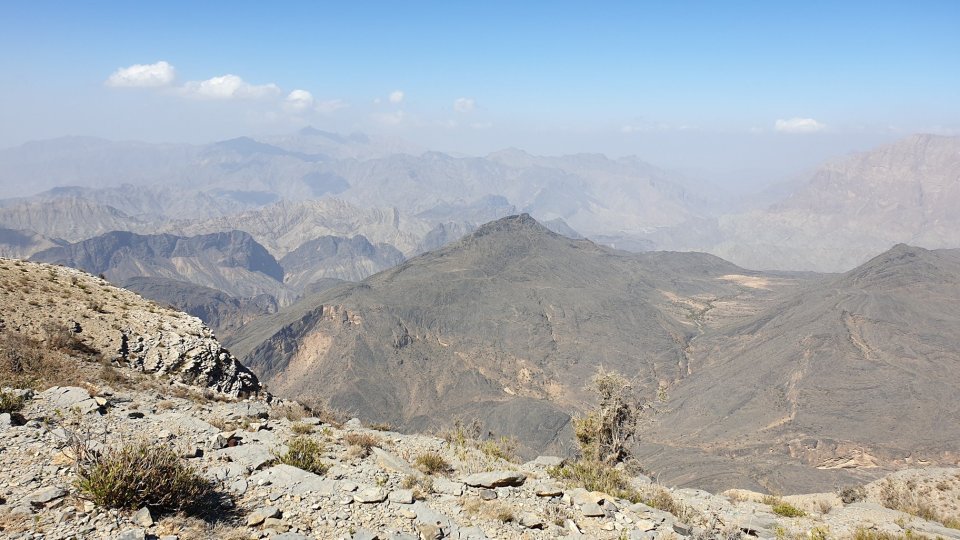
and led to some lovely views over the mountains.

So, off we bumped (honestly, neck and core muscles get a thorough workout travelling these tracks; even with the expert driving of Rashid, I was still banging my head on the window pillar occasionally. I hereby apologise to Hud Hud Travels for the resultant damage to their motor).

We had to make an early start in order to get to the Nizwa cattle market (which happens every Friday, that being the start of the weekend in these here parts) whilst there was worthwhile action taking place. And action there was – a central platform around which sheep, goats and cattle were paraded with auction staff trying to conclude deals with the surrounding crowds. Here are a couple of photos, but to understand the dynamism and noise of what was going on, see the video below.

A video gives a much better idea of the considerable bedlam quotient of the market.

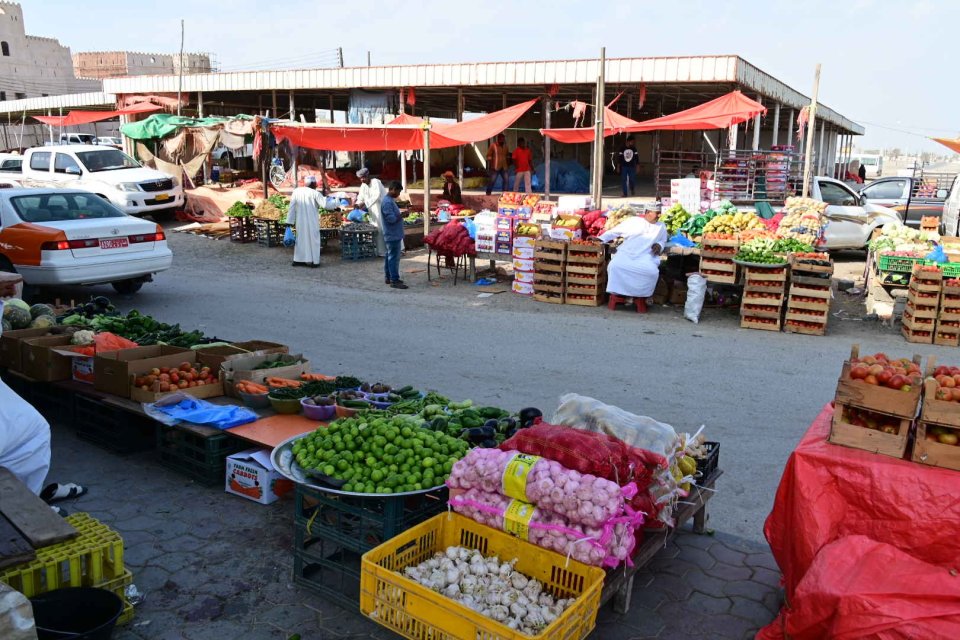
Then Rashid took us around the souk which adjoins the cattle market site, which has many conventional types of market stall,

but also features racks of dates (of which there are some 38 varieties in Oman):

(and there’s a booth where visitors are offered coffee and dates);

a local sweet called halwa;

which always contains saffron, alongside a selection of other sweet ingredients;

live birds and other animals (some for eating, some for pets);

even guns are for sale

though one wonders, sometimes, if people have the right idea!

It’s not at all clear why the trade in guns is so brisk, since hunting is forbidden in Oman. Still, boys will be boys, eh?

There are plenty of stalls selling tourist fodder,

and we spotted this group of old chaps sitting around and talking among themselves.

All in all, Nizwa on a Friday morning is a busy and buzzy place.

Another major tourist attraction in Nizwa is its fort. Many towns had forts to repel bands of maraudings Riffs (often, it seems, coming from Nizwa itself) but in most cases these forts are disused and in a poor state. Many are being reconstructed, and the one in Nizwa is a shining example – so much so that it was formally reopened by Oman’s ruler, the widely loved and respected Sultan Qaboos bin Said al-Said.

The fort itself is the circular tower, and the building which encloses it is Nizwa Castle. The castle courtyard beside the entrance to the fort proper plays host to a variety of things – occasional displays of dancing and singing

an elegant display of the local air conditioning technology,

(porous flasks filled with water, which slowly seeps through and evaporates in the wind, cooling the remaining water in the flask – which has a cup in the neck to allow for drinking and to keep the flies out – and also the room inside); and demonstrations of the making of Omani bread, which is wafer-thin. The making of it is very interesting – the sort of skill that years of practice makes look easy.

Inside the fort there are several exhibit rooms, including some interesting photos of before, during and after its reconstruction. If you’re not careful, you come across singers and dancers in the corridors.

At the entrance to the fort can be found four patches of light on the floor, like this one

If you stand on one and look up, you see that there is a shaft going straight up to the top of the tower.

It turns out that these shafts guard every entrance to the fort and defenders can use them to pour boiling date syrup onto intruders. This is very nasty stuff which sticks to the skin as it burns it, so it’s a powerful deterrent.

If you go to the roof of the fort you can see the tops of the four shafts (as well as wells and access hatches to high security prison cells)

The roof is an attractive scene

and offers good views over Nizwa, including its Grand Mosque

an idea of what cannon might have once fired on

and a panorama across its huge date plantation.

Lunch was taken in Wadi Tanulf, which was (yet) another dramatic setting.

Along the sides of the wadi are some openings which have been used by people living there and tending goats – good choice of domicile, since it’s close to water, if there is any.

There are also openings much higher up. Anyone who lived here must have been pretty fit!

The afternoon’s activity was a walk up Wadi Ghul, which we had looked across yesterday. Now we had the opportunity to walk along part of it. Rashid took us as far along as the car would go, and then sent us off to explore. As ever the geology was quite epic, with huge boulders litering the bed of the wadi

and impressive rock formations.

For a country which is so dry, rain seems to cause a lot of problems. We came across this car, which (we know) is a rental car and (we think) must have been caught in a flash flood – it certainly wasn’t going any further!

It seems to be routine that after rainfall some tracks and roads are badly disrupted by rockfalls. The rainfall doesn’t even have to be torrential. Because the land is so dry, whatever rain falls just runs off immediately, hence creating a perpetual danger of flash floods. If you find a decent road surface, you can be sure that there’s a storm drain beside it to funnel the water away; and among the hills there is a lot of evidence of the erosion that shapes the landscape, even in this dry country.

After the walk, it was time to get back to our camp on Jabal Shams. The wind had died down a bit, but this was merely going from icy chain saw to freezing scalpel. I attempted to do some writing (these blogs don’t write themselves, you know) and Jane wandered off to look for – and found – some rock drawings that Patrick had mentioned (and some he hadn’t found, too!). These have presumably been done by the people living up in the mountains in times gone by, although it’s difficult to get any kind of detail.

A donkey? (above) and a camel (below)?

and a horse? (below)

But the cold drove us, after another excellent evening meal, to another early-night-with-hot-water-bottle. At least this time we weren’t having to get up at 5am, but in a more leisurely fashion so that we could depart for the next stage of our holiday – two days by the beach at Barr Al-Hikman. The promise was of warmth, which sounded great to frozen ears. Read the next gripping instalment to see how things went.

Oman, Day 1 – starting off on the wrong boot

Wednesday Feb 20 – Thursday Feb 21. So, at last! The day of our departure for our Oman adventure, under the aegis of a company engagingly called Hud Hud Travels*, had arrived! Our itinerary took us around northern Oman, taking in mountains, beach and desert before a final few days in Muscat, the capital city of Oman. Jane was excited; I was apprehensive, since the first three locations were in camping sites. OK, special, luxurious, private camping sites, but nonetheless…..

*Hud Hud is the Arabic word for a bird, the Hoopoe

Our flight to Oman was not until the evening – 1945, to be precise. One might be forgiven for thinking “what a luxury – the whole day to pack and get everything just right before a smooth departure for the airport in a taxi”.

That was the theory, and it worked in almost every respect. We ended up with lots of time on our hands and so we relaxed with a final cup of tea (for we had decided to revolutionise our holiday experience by not taking tea bags with us in order to experience the full mystique of the Arab way of life, don’cha know?). Then suddenly the taxi was there and so we piled in, and negotiated a curious route to the airport in order to avoid the inevitable rush-hour congestion on the M25. It was only when walking towards security at Heathrow that I realised I had forgotten to change into the walking boots I had carefully set aside for the trip as we had been told that there would be some hiking involved. In the great scheme of things, this doesn’t count as a disaster, but I wasted a certain amount of champagne drinking time cursing my own stupidity.

There are no shops in Heathrow Terminal 5 which will sell you walking boots.

Anyway, the rest of the travel went very well. We had lashed out on Premium Economy, the aeroplane was a Boeing 787 Dreamliner, and so we had a comfortable, if somewhat sleep-deprived, flight.

We were met in Muscat by our guide, Rashid, whose English was fluent if uniquely quirky, grammatically speaking, but who proved himself to be an excellent, thoughtful and knowledgeable guide. I’d been expecting a chance to sit down, have a coffee and get a briefing on what to expect for the day. But off we drove straight away, and before I knew it, there we were in the midst of our first Omani market, the fish market in Barka, a town neighbouring Muscat. I confess to being on the back (unsuitably shod) foot, so I didn’t get photos and videos that I feel really captured it. Like other markets we visited, it was crowded and noisy, with all the buying and selling being done by men

with many counters selling fish that had been caught that day

(above, Rashid poses beside one of the counters).

Outside the fish market area there was also a thriving trade in non-fish items. Across the road was the area where the fish are brought in, by fishermen on small boats. Sadly there was no action to photograph, but Rashid explained a little bit of the way the system works. People on the quay buy the catch off incoming fishermen and then sell it on to other people who operate in the market. Sometimes these people sell the fish direct, but often they split the catch and sell different parts either to different traders, or to people who further prepare (e.g. fillet or salt-preserve) the fish before selling it on. Complex and multi-level, but lots of opportunities for individuals to make their cut. I couldn’t make head or tail of it and couldn’t see money changing hands; but it clearly works.

Fish market duly visited, we were off again towards the next destination. We considered the idea of buying me some trainers or some such, but then decided that the shoes I was wearing (M&S finest Nubuck) would probably be OK. All that self-cursing was wasted emotional energy. Like it almost always is.

As we left the Muscat area, the terrain changed quite abruptly, and it was clear that we were heading towards the mountains.

So, via a stop to buy some snacks, we headed towards our next destination, en route to which we got our first initiation into what many of the roads in Oman are like.

Rashid parked up some way along the track at the start of something he called “Snake Gorge” (heaven knows what it is in Arabic), and we got out to take a look.

This was, had I known it, the first test of my footwear choice. I thought we had merely stopped for a photo opportunity, but no, this was going to be a bit of a hike, including wading through shin-deep water. So, while I think I would have been happier leaping from rock to rock in boots, I would still have gone barefoot for the wading bit.

I’m not quite sure how to describe Omani mountain scenery. It demands to be photographed, but it’s a bit stark to be what I’d call “picturesque”. Here are some snaps from our hike.

The water, Rashid told us, was from rain which had fallen a couple of weeks earlier. So it was somewhat surprising to see small fish in the pools left after the bulk of the rainwater had cleared, and even toads, who were making the most of their time together.

It’s not clear how they got there – perhaps washed down from further up in the mountains? We also saw a rather striking red dragonfly

whose pose also gave a chance for a close-up of the striated rock prevalent on our route.

The rest of the day was spent travelling towards our camp, which was near the top of a mountain called Jabal Shams (“Sun Mountain”). We stopped off for some opportunities to see the stunning views that can be found in the Omani mountains:

(above is a view of a village called Al Hajir. I hereby apologise to the residents if I have the spelling wrong.)

In the photo above, if you look carefully you can see a tiny patch of green by the road going down the middle of the shot. This turns out to be a small but perfectly-formed artificial grass football pitch, called “Peter’s Pitch”.

It was apparently set up there for a film shoot and was left there afterwards. Peter, Rashid told us, was an itinerant occidental who provided funds so that the pitch could be kept there for the locals to use.

The mountain scenery during our journey was remarkable. Here’s a typical panorama:

And even our lunch stop, at a place called Al Sharaf, had a pretty nifty view.

After lunch we stopped in a village called Al-Hamra. Yes, it’s the same derivation as that of the famous palace complex in Spain. Hamra means red, and that comes from the distinctive colour of the mud used in the original buildings, seen here from across the valley. It dries to the shade of brown you see here.

In the foreground is the town’s plantation of date palms. Date palms are incredibly important to the Omanis. Not only do they provide dates (duh!), but the trunks, sawn lengthwise, can be used for roof beams; the leaves can be used in buildings as shade for the upper floors. The leaves are fibrous and can be dried to provide all sorts of fencing and screening; leaf fibres woven into mats and baskets; and the central stalks of the leaves are strong enough to be used in roofing (see later for our short visit to a bedouin home).

The old village itself has plenty of original buildings

and the town, in common with many in the area, has a watch tower

which in days gone by provided a vantage point to watch for invaders from nearby Nizwa, which was wont to send out raiding parties for food and females when they ran short themselves.

We also stopped to take a look at parts of a river called Wadi Ghul and the now-abandoned village on its banks

You can see the sweep of the original from the ruins of the fort on the hill to the left, to the village buildings on the right. Notice that the date palm plantation and other irrigated plantations, are still intact, and maintained by the modern day village from which this photo was taken. Oman is a very dry country and considerable care and ingenuity goes into preserving what rain falls and using it for irrigation (desalination plants are also an important part of providing water to the Oman population).

Then, as we were heading towards sunset, we approached our camp. It was first visible from across the valley

It’s there, honest – towards the top of the hill on the right…

yes, there…

…ah, there it is. We bumped our way along a very rudimentary track and caught sight of it again.

Our tents are in the background; this side of them are the tents for the crew who would support us for our two-day stay. We were greeted by Patrick, the camp manager, who then showed us round our facilities: our bedroom tent

with its bathroom tent behind and to the left; and the majlis tent, where we could relax.

It was getting quite late by that stage, so there was nothing for it but to crack open the gin (bought at Oman Airport duty free) and make the most of what sunshine there was before the temperature dropped.

Which it did, like a stone, with the chill exacerbated by a pretty stiff breeze. This weather somewhat informed my initial assessment of the practice of camping (I have put my thoughts about camping on a separate medium as I try to keep the language on this blog fairly moderate).

Before long we were eating a superb dinner lit by fire- and candlelight, sitting in front of the majlis.

but gradually becoming colder and colder, despite the fire. So we retired as soon as decently possible to a very comfortable bed, made even more welcoming by the presence of a hot water bottle for each of us. We did eventually get warm, but sleep was rendered elusive by (a) the wind, which was very noisy, both in itself and by making the tent creak and flap and (b) the knowledge that we had to get up at 5am to wring the most out of our experiences the next day. I thought this was supposed to be a bloody holiday!

Anyway, warmth and sleep eventually arrived and so we passed the night in reasonable comfort. To find out what happened on day 2, you’ll have to read the next entry, won’t you? See you there!

Afterthoughts: So…..Croatia, eh?

In the midst of dealing with the fallout from being away for a fortnight (laundry, mainly, though having lots of nice cups of tea also features heavily), I think it’s worth gathering our thoughts about the last couple of weeks and sharing them here, just in case it helps others planning something similar. Generally, both Jane and I thoroughly enjoyed our experience of Croatia and would heartily recommend it (particularly the Dalmatian coast) as a walking and/or sailing destination.

Timing. July and August can be fiercely hot all over Croatia. The best time to visit is May or (like we did) September. This is the second time we’ve visited in that month and the weather we experienced was, by and large, lovely. The Croatian tourist season runs out at the end of September or very early in October and things start to wind down quite markedly, so getting hotel rooms later than September might be challenging.

Walking. Our experience of walking in Dalmatia is very positive, but it was definitely a good thing to have thoroughly researched the level of difficulty in prospect, and the levels of fitness required, before booking the walking tour. We were operating towards the top end of our range with many of the group younger (and fitter) than us… Anyhoo:

  • The tracks are plentiful and well-marked (though I wonder how many of them we would have found without having an expert guide to do this for us).
  • Most of the routes we undertook were short on shade, which means that the walking can be pretty hot work, and taking lots of water is essential.
  • The tap water is perfectly drinkable, so take your own bottles and refill.
  • Very few of the walks we did passed any outposts of civilisation, so it’s advisable to take some food with you as well.
  • Mobile signal appeared to extend over much of the terrain we covered.

Sailing. This is big business along the Dalmatian coast. There are lots and lots of sailing boats, even some small towns sport large marinas and generally this part of the Adriatic is a good place for sailing, with or without an engine (take note, however, of the section below about the weather).

Landscape. The Dalmatian landscape tends towards being mountainous and scrubby – the land is difficult to farm, being stony. So the trails through it are pleasant enough and will occasionally offer great views from the tops of hills, but are otherwise not particularly scenic and are in some cases quite challenging. Our admiration for the local people who used these trails simply to get from A to B (often with their livestock, and often despite advanced age) grew day by day! We followed a couple of trails through woodland, which were more rewarding.

Townscape. The cities we visited all had old towns, which are all worth looking around. The towns and villages are by and large somewhere between pretty and handsome – well-maintained, tidy and picturesque.

Money. Croatia is no longer the cheap destination it was, but it’s not too expensive, either. In the towns, debit cards were widely accepted in shops, cafés and restaurants, and it was easy to find ATMs. You might find places that will accept Euros, but it’s best to have local currency (Kune) available. If you’re off the beaten track, you’ll need cash to be able to buy anything.

Eating out. Tourism is an important industry in Croatia and so there is usually a plentiful supply of cafés and restaurants in the towns, with English spoken and good service.

Cuisine. As you’d expect, there’s some good fish on offer, and seafood (especially squid and octopus). But emphasis tends to be towards meat and potatoes – the vegetarians in our group had some difficulty getting anything more imaginative than a plate of grilled mixed vegetables on occasion. For non-vegetarians, a couple of traditional dishes are worth seeking out: Pašticada, a slow-cooked beef stew; and Peka, a baked dish of meat and, yes, vegetables, cooked under a dome in barbecue coals. But there’s no problem finding more cosmopolitan fare such as steak, pizza or burgers – the burgers I had were very good, and served without bread, which I prefer.

Drinking out. You’ll find that most restaurants have a limited selection of wines and what is offered is likely to have been made locally or nationally. Croatia has a well-developed wine-making tradition and the local wines are perfectly good without being stellar. Local beers tend to be of the lager persuasion and are perfectly good.

Liqueurs. Something of a Croatian speciality is the production of liqueurs based on local produce – one we found to be very nice is based on sour cherry, but you’ll also come across walnut liqueur and something called Prošek, which is grape-based and quite sweet, among other variations such as olive and cornelian cherry. These are quite often offered as a welcome drink and I think it’s polite to sample at least one…

Bloody Cruise-Ship Tourists. Many of the larger or more attractive towns in Croatia are magnets for the big cruise liners – Dubrovnik and Split have a constant stream of them during the holiday season, for example, and Trogir during the height of the season is reportedly an utter zoo. So you may find that such towns are crowded during the day.

Bloody weather. Actually, for the most part our weather was pretty much perfect – a bit hot for me for going uphill, but sunny, warm and lovely for sitting outside when eating or drinking. But the Bura wind that we experienced is capable of wreaking havoc on sailing boats and travel itineraries. I was grateful for the experience of our captain to know it was coming (it took many others by surprise) and plan accordingly; if you’re considering sailing in the Adriatic, this is the sort of thing that can become very suddenly of very great pith and moment. Having said all that, and with the benefit of hindsight and no havoc having been wreaked, we’re glad to have experienced it; apart from anything else, the Bura clears the air and the visibility after it died down somewhat was vastly improved.

For anyone interested in sailing, walking, history, archaeology and/or pretty places to visit, the Dalmatian coast of Croatia is somewhere that we think should be high on the list. We hope that these thoughts, along with the descriptions of our various vacation days, help in understanding the possibilities that Croatia presents to the tourist.