Tag Archives: Scenery

Day 8 – Making a great deal more foss

Tuesday 6th July 2021. Yes, I know that obsessing about the weather is terribly British, but it simply has to be pointed out that today was the first day that the weather outlook for us here

was better than at home.

Hah!

In reality, the weather here today really was pretty good – even, at times, a little too warm.  So, we’ve been lucky so far.

Our first stop was actually to the “supermarket” just along the road so we could buy something that would serve as lunch.  It wasn’t what we’d think of as a supermarket and the selection was a little sparse, but we found some pizza-ish sort of things that would probably do, and – mirabile dictu – a couple of apples.  To be honest, whilst the food we’ve eaten in the hotels and restaurants here has been very well-cooked, well-presented and tasty, we’ve discovered that They Don’t Do Fruit And Veg Much here, so the quest for dietary fibre is often, erm, fruitless. That’ll be me showing my age, then.

So: a morning of waterfalls beckoned.  Firstly, the most powerful waterfall in Europe – Dettifoss.


View this post on Instagram


A post shared by Steve Walker (@spwalker2016)


As I hope you can hear from the sound on the video, this is an awesome thing. It must be said, though, that we preferred those from yesterday.  Dettifoss, because it’s carrying such a volume of glacial rock fragments, actually looks a bit muddy.  I know it’s pathetic to expect pristine white water, but there you go: we’re tourists – what do we know?  Dettifoss is one of several waterfalls along a canyon, and there was an insight into the impact of the glacial sediment on the water flow via a view of whatever the geologists would call the side street of a canyon.

You can see the clarity of the water which is out of the mainstream.

The second waterfall of the day is visited on the same hike which took us to Dettifoss. It’s called Selfoss, and it’s also pretty impressive.

You can see photographers on the far side of the canyon. These are the keen beans who have risked the tyres and suspension of their vehicles and a possible broken ankle or two to get to the Dedicated Photographer side of the canyon. Ok, the view of Selfoss would have been better from that side, and you can also get a Classic Shot of Dettifoss from over there; but our schedule, and my not-preparedness to lug a tripod over rocky terrain and spend much time setting up long-exposure shots, conspired against my achieving anything other than the standard Tourist Pics (which I’m very happy with). Dagur did his Pro Photographer bit as best he could at Selfoss, given that his clients were too pathetic to go the extra mile.

But the two falls were anyway impressive to see.

And that wasn’t the end of the foss we had to make this morning, as there was a third waterfall to visit, Hafragilsfoss, down another rocky track.

It wasn’t possible to get really close to this one because the track, even under normal circumstances a somewhat tricky descent, was impassable because of rockfall.  Such a shame. No, really.

It was getting towards lunchtime by this stage, and we were understandably anxious to get at our pizza-ish goodies, and Dagur suggested that we could hike to lunch at Katlar, which was along, you guessed it, a rocky track a little further downstream in the canyon. So we loaded up with lunch goodies and set off. We hit a decision point and, through a process that I don’t quite understand but am very grateful for, took a side track. This was actually a revelation, as it led through a landscape that we simply hadn’t come across before in Iceland, involving, as it did –  trees!

and wild flowers!

It really was a gorgeous walk, beside a river which of course gave rise to more photo opportunities.

After a while, we wound our way back towards Katlar, which is a gorgeous gorge

but decided in the end, and mainly because of the increasing numbers and importunateness of the flies, to head back to the car, where we ate our lunch in air-conditioned comfort but with no view.

At the next stop, we agreed between us that it wasn’t worth spending time heading toward the lava cave that Dagur had originally in mind (we’d already passed a couple, maybe not so grand, earlier in our walk).  However, the car park for that trek was interesting as it illustrated the difference between how serious Icelanders go on serious camping holidays

and how the Germans do it in Iceland.

After this, we went to an oasis of calm called Ásbyrgi Canyon.  This is a huge horseshoe-shaped wall of rock with a lake at its foot (Icelandic legend has it that this was a hoofprint of Odin’s 8-legged horse, Sleipnir. I couldn’t possibly comment on the veracity of that.)

And yes, a rocky trail leads down to the lake and at first blush it didn’t look as if it was going to be all that calm

but fortunately the bus load of Americans left shortly after we arrived and it settled down a bit. From the lakeside, you can’t capture the scale of the place in a photograph. You have to climb up to a viewing platform to do that.

But I did try a little snippet of video (creative director again was the distaff side) to give some idea of what it’s like on the lakeside.


We then headed back to the hotel, via a small town called Husvik, the Whale Watching capital of Iceland, where Dagur took the Land Rover off to clean it whilst we pottered around. The town is typical of our experience so far here, in that there are some attractive buildings

but much of the town is basically workmanlike rather than pretty.  It does, however, feature an unusual church, which we of course added to our collection of same.

After Husvik, we headed back to the hotel but Dagur took us by an alternative route which enabled us to get some insight into the reason for the lupins in Iceland.  You  can see them dotted about in the laval soil here.

Dagur told us that he remembered being driven along this road by his father when he was quite young, and it was just black sand. And this sand had been a major problem, particularly as it blew in the wind; soil erosion was one issue, and damage to cars’ paintwork was another. So the lupins were planted to combat soil erosion and they work – but it’s still ongoing and will be a task that carries on for generations to come.  The authorities are trying to leaven the mix with grass planting as well as lupins and this seems to be working overall; the problem is really to decide exactly where to cover with the programme, as a huge area is affected by this issue.

And thus ended another varied and interesting day, apart from the bit where Jane educated the hotel bar staff about Boulevardier cocktails. We have another V&I day in prospect tomorrow, with – who knows? – perhaps even more puffins! But much of the schedule will be decided on the hoof and so you’ll simply have to come back here and find out what we got up to, won’t you?


Day 7 – Fossicking

Monday 5th July 2021. We had the luxury of a slightly late start in that we were leaving the hotel as late as 10.30. This gave us the opportunity to have a wander around Akureyri.  We’d been past the botanical garden en route to the hotel yesterday, and thought this might be a decent starting point. And There Was A Church….

Akureyri is the capital town for the region and, like the UK’s capital, has charm in sporadic doses among other, less appealing, aspects.  But there is quirkiness, such as the pavement outside the art museum

and the steps that lead to the college.

There are also fine edifices, such as the college’s main building

and other residences.

The botanical garden, one of the most northerly in the world at only 50km south of the Arctic Circle, was created in 1912 and has extended over the years to form a pleasant oasis, free to enter and walk around.

Worth a visit for all floraphiles, but I won’t bore you with too many photos.  It’s only flowers, after all…

On the way down, we passed the church, which shows some art deco influences

and featured ravens on its spires.

The town has some pleasing buildings among the workmanlike ones.

As we left, Dagur was upbeat about the weather prospects for the day.  Akureyri, however, was pretty much blanketed by fog.

But, as we emerged, blinking, from a tunnel shortly after we hit the road, the weather on the exit side of the hill was completely different

and stayed pretty good for most of the day.

The first two ports of call were waterfalls. (The Icelandic for waterfall, by the way, is “foss”, just in case you were wondering about the title of this post.)

Dagur decided on the hoof to visit the first one, which is called Aldeyjarfoss.  There’s a slightly precarious walk down to it, but it was definitely worth the diversion.


View this post on Instagram


A post shared by Steve Walker (@spwalker2016)

The second styles itself, rather immodestly, as “The Waterfall of the Gods” or Goðafoss. It is an impressive sight, one has to admit.


View this post on Instagram


A post shared by Steve Walker (@spwalker2016)

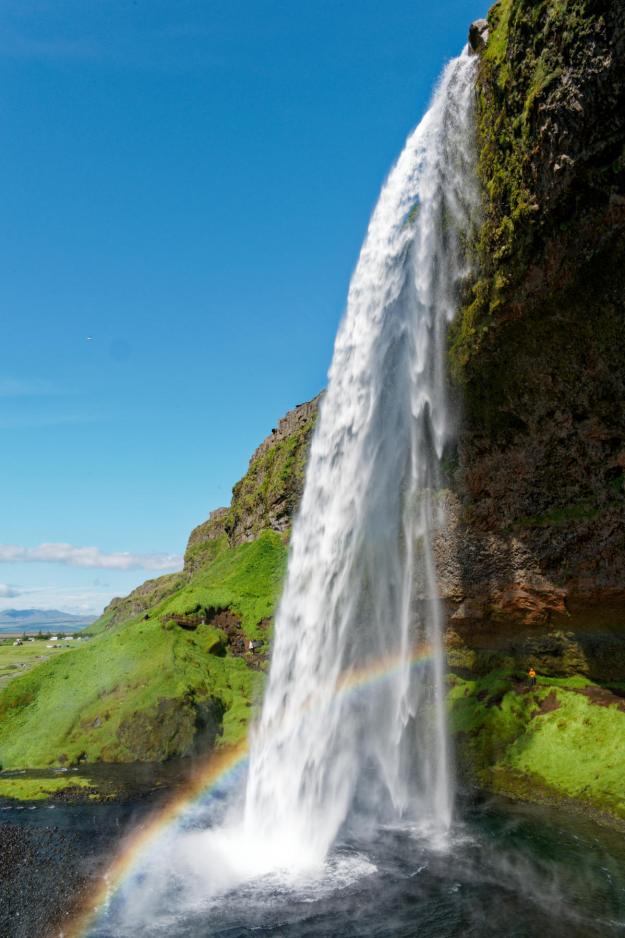
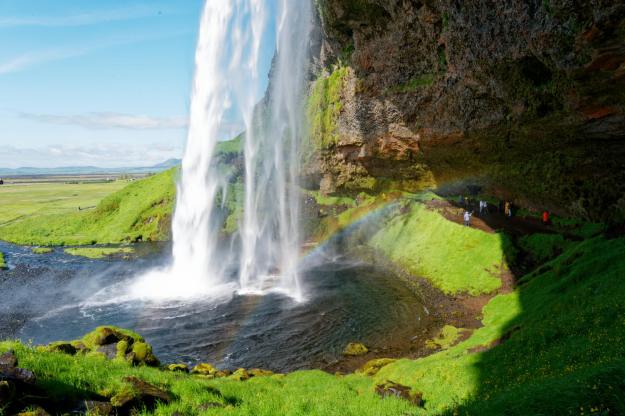
Since the sun was out, rainbows were on offer in the spray.

There was a restaurant by these falls, at which we bought some (sadly not particularly appetising) lunch. But at least they also had beer and Earl Grey tea, so all was not lost.

After lunch we headed for our overnight destination, beside Lake Myvatn. The landscape changed as we approached, from the rolling, farmy sort of countryside to a more austere, rocky appearance, which signified that we were in an area of geothermal activity – hot springs, in other words.  The water can come out of the ground at 100°C (as they discovered the hard way when excavating the tunnel that led us through from Akureyri), and so has obvious uses for heating, such as the Myvatn Nature Baths nearby.

What I couldn’t show in photos was the seething, steaming cauldron nearby with “Danger – 100°C” warning signs on it.

The rest of the day was spent exploring this new, extraordinary – and active – landscape. We stopped first at the Námafjall Geothermal Area. which features smoking fumaroles and boiling mud pots, surrounded by sulphur crystals of many different colours. This sulphur gives the area an overwhelming smell of eggs, and ones that have not been treated well, at that.

It really is an extraordinary landscape

but then almost everything in this area is.  There’s a geothermal energy plant

a volcanic mountain, Kafla, with its very own crater lake

and a huge area called Leirhnjúkur, which is basically a field of lava from eruptions over a period during the 1970s and 1980s.  A walking trail leads across it to the crater of Hófur, and the entire landscape is utterly extraordinary.  I took loads of pics, obvs, and here are some of them.


View this post on Instagram


A post shared by Steve Walker (@spwalker2016)

(Jane has to take the credit for setting up the last shot for me – pointing me in the right direction after I’d been looking in the wrong place.).

We walked the area for about 90 minutes, marvelling all the way at the amazing landscape – just another facet of Iceland’s stupendous geology.

We then went to our hotel, the Fosshotel

which proved to be very good – excellently organised rooms, good food in the restaurant, and it will be our pleasure to stay here two nights.  Mind you, Jane thinks the cocktail barman needs to up his game a bit.  We’ll see how he gets on when asked for a Boulevardier tomorrow evening…..

We have more waterfalls to see tomorrow, among other delights which I shall be sure to report in these here pages.  So do please come back again to catch up with the delights of our next day out.


Day 6 – Hallo, Turf*

Sunday 4th July 2021. Happy Independence Day, people in the USA!

The usual obsessing about the weather attended our waking, and actually the day looked to be just, you know, ordinary – no sun, but then again no rain, which put us ahead of the game, in our view. And here’s our view of the hotel, to give you an idea of the weather today.

The day promised to be a mixed bag, with a variety of cultural experiences on the schedule. Our first stop was to gawp at a rock formation near the hotel called Hvitserkur, but described to us as a “drinking dragon”.  It took us a little while to see it….

…but actually, if you think of the left hand end as the head, it becomes clearer.  Jane swears it’s more like a drinking donkey with a load on its back, and I’m remaining neutral on the rock naming issue.  The scenery around this point is quite appealing

but it is clear that we’ve left the Westfjords area with its air of being a rock-and-moss-strewn Wild And Lonely Place.  Generally, this, the northern region, has a much less savage landscape.

Our day would take us over 200km through north-western region and into the north-eastern region, ending up at the regional capital of Akureyri. But we had several aspects of Icelandic culture to experience en route, not the least of which being a record haul of unusual churches, which seem to be a bit of A Thing in Iceland.  We started  this collection at Þingeyrakirkja (pronounced “Thingeyrakirkjya”, but I want you to know that I’ve mastered the knack of getting Icelandic characters into my blog posts).

Construction of the church took 13 years and required transporting stone from Nesbjörg, a scene of historical battles against the Vikings, throughout the winter of 1864-65, by sled over the ice-covered lake Hóp on an 8-km journey. It’s slightly unusual, being a Roman Catholic church in a land whose church is officially Lutheran.  Being Roman Catholic it has, of course, got some fancy artefacts in it.  The church itself was locked, which meant peering through the window into a gloomy church with the interior backlit by the windows opposite.

However, with the combined miracles of modern digital camera sensors and intelligent software, it became clearer what we were looking at.

There was also a gallery visible through a different window.  The processing results were less impressive, but still gave a fair idea of what was inside.

Thank you Nikon and DxO.  Oh, and Jane, for helping me deal with the worst of reflections in the window glass.

A church would be the subject of our next stop, but on the way there we got a reminder that we were in horse country.

Iceland has a unique genetic strain of horses and the authorities go to extreme lengths to keep it pure; Icelandic horses (never “ponies” in polite Icelandic company, despite the fact that they’re all smaller than 15.2 hands) are famous in riding circles for having a unique gait, halfway between walk and trot, called “tölt”.

So: next church: this one is Blönduóskirkja – so-called because it’s in a town called Blönduós  – and features another eccentric design.

Today being Sunday, we thought it might be open.  Like so many churches around the island, it wasn’t.

The next stop was also a church and the start of our brush with Icelandic turf constructions. It is called Víðimýrarkirkja, and is part of the Skagafjörður Heritage Museum (Skagafjörður is the name of the county it’s in). It’s small but beautifully formed.

and the inside is a delight both to look at

and to smell – it has a wonderful, woody, scent.

One of the other parts of the Heritage Museum is at Glaumbær, and also heavily features turf.

It looks like several turf houses

but this is an illusion.  If you step in the main entrance above and explore, it becomes clear that it goes back a long way

and there are different rooms off this passageway, such as this kitchen.

In fact, the whole construction is one house, constructed in sections up to 1879, which would have belonged to a wealthy person (a bishop, actually) and where some 24 people would have lived.  The timbers in the house give away the fact that this was a wealthy man’s house, as timber is a scarce resource in Iceland because the original settlers chopped down all the trees. A more typical example would have much less timber and of much coarser quality.  There are around a dozen turf houses left in Iceland, all examples of dwellings of wealthy people, and some were even inhabited as late as the 1960s.  The buildings look great now, but life in them would not have been too wonderful – two dozen people crammed into such a space would not have been that pleasant, and it’s too easy to romanticise life back then.

I’ve got a load more photos of the other rooms and the outer sections – toolsheds, etc – but don’t want to bore you more than I’m already doing, so I’ll move on, as we in fact did.

Dagur next took us on a tour of his native town, Skagafjörður, before we stopped off at Hofsos, a pretty village with a lovely harbour.

We then spent some time with Dagur’s mother, father, younger brother and niece, who have a summer house nearby; it was a very pleasant interlude, and they are a charming and hospitable family.

Our final brush with Icelandic culture was to visit Siglufjörður, which was a centre of a huge herring processing industry in Iceland, and is now home to the Herring Era Museum.  The town itself is quite handsome.

It would have been even more so had the fog not obscured the mountains, but it’s an appealing place.  To the left in the picture above is the Sigló Hótel, an imposing and attractive building, which is a strong candidate for a stay when we come back to Iceland in the future.

The Herring Museum itself (visible on the far quayside in the picture above) is very interesting as it gives a superb insight into the extraordinary size, scope and complexity of the herring industry which was so important to Iceland (still is, in fact, but it’s much more industrialised now).  Again, I have dozens of photos but will just show you a couple here.

The museum is actually five buildings of which three contain exhibits.  The biggest one is the boathouse.

As well as boats, it has examples of fishing equipment of all sorts, and a couple of idiosyncratic wooden figures of people from that era: a fishwife;

and an old salt, clearly out to try something on with passing people.

The next building is the fish oil factory, which shows the sort of huge machinery used to process herring into oil and fishmeal.

Upstairs is a gallery which gives a lot of information about the history and size of the industry and the importance of its products.

One gets a powerful impression of how tough the life must have been – hard labour in unremittingly unpleasant conditions. The third building covers the salting process and also contains the lodging for the “herring girls” who worked there in the summers.

As Jane pointed out, most ships have a bridge in them, but this is ridiculous.

Shortly after this visit, we arrived in Akureyri and checked into our room, so far towards the furthest reaches of the hotel that the WiFi reached only intermittently), at the Kea Hotel (comfortable enough, but so cramped that if one person is sitting at the desk, another can’t get round to the window) before heading out for a decent meal at a nearby restaurant called Strikið. We’ll explore the town more tomorrow and I’ll report back, so stay tuned for the gen on this, the capital of the northern region, and more waterfalls.


*  The title of this post is after an idea proposed by my wife. I just thought you ought to know this.