Friday 9 September 2022 – We departed the UK one month ago and we return thither in one month’s time. Our time in Jasper marks the end of Part II – the Rocky Mountains Bit – and it’s been excellent. Part I – the Rugged North West and Wildlife Bit – took three weeks, which was relatively leisurely; Part II has been more full-on.
So we declared today a rest day.
We had originally considered visiting a couple of nearby lakes or taking an easy hike, but the lure of a lazy day proved stronger. Also, we had thought to go into Jasper itself and report back to Brendan, our long-suffering travel agent in the UK, about what it was really like in Jasper (which still has no power; we’d overheard a group yesterday discussing how they were moving on from Jasper because their hotel had no heating and no hot water). That plan got scuppered by a shuttle bus which departed too early.
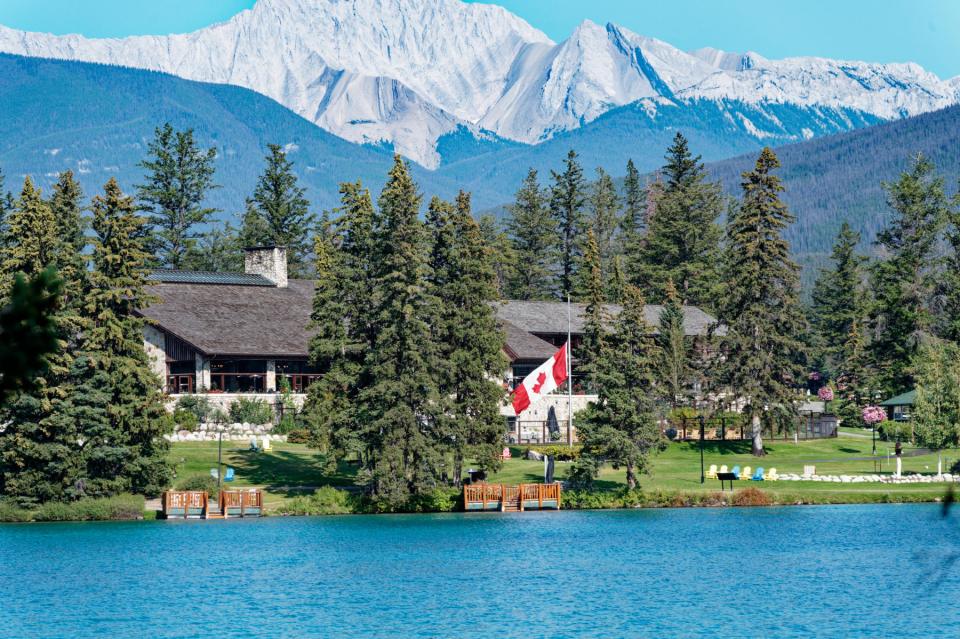
Since the sun was shining, we took the opportunity to walk around the (considerable) grounds of the Lodge. It’s very photogenic.
We had some other encounters:
in the Smokehouse, where they serve breakfast, a Bison’s head (making this not so much a Breakfast Bowl as a Breakfast Bison);
A statue that can’t bear weight;
next door to it, an Eagle statue;
a greedy squirrel, stuffing his face with pine nuts;
and a Loon, also called a Great Northern Diver in Europe.
Sorry about the Loon photo, but that’s the best my camera could do. Also observing it, though, was a chap called Neil who was not so much a Loon enthusiast as a Loon obsessive; he even described himself as such. We had a very pleasant chat with him about these remarkable birds. He had a very expensive-looking long lens and video setup and was pulling together a four-minute piece on some aspect of the birds. The Loon is depicted on the Canadian one-dollar coin, which is why they’re called Loonies. That knowledge will win you a pub quiz one day, see if it doesn’t.
The main objective of our stroll, though, was to see a particular group of cabins, collectively called Outlook Cabin.
The reason for our interest was that these cabins were used during one of the many visits to Canada by HM Queen Elizabeth and her retinue, because they offered peace and a degree of isolation. Apparently she liked the Park Lodge for its tranquility; in the light of the news of her death, it seemed appropriate to visit it.
And that was the extent of our activity today, resulting in a mercifully short blog entry. Reader, you can have time off for good behaviour.
Tomorrow we embark on Part III, which is largely a series of successively easterly city visits. We start with a drive to Edmonton. The only thing I knew about it was that it was where Wayne Gretsky, a world-famous ice hockey player, expounded his art, playing for the Edmonton Oilers, a team name which doesn’t somehow convey the image of a chic place. However, we’ve chatted with a couple of hotel staff who are from Edmonton, and it sounds like an interesting town with a few ITTDs. We also have a few digressions en route, so we’re back to relentless tourism after our day panting in the shade. I hope you’ll come back to read about them as we go.
Thursday 8 September 2022 – I hope you like photos of scenery, glaciers and waterfalls, coz there’s rather a lot of them here. If so, please read on…..
As far as we could find out, there was no reason for us to avoid going to Jasper. The news was that the entire town of Jasper was without power, but the Fairmont Jasper Park Lodge, we were assured, has its own generators, and the Icefield Parkway was, according to the Park’s Facebook site, still open. So off we set.
Well, there was one thing we had to deal with first – sunrise photography. I awoke at around 0630 without the necessity for an alarm call, and peeped out of the window to see whether conditions were going to favour mucking about with photography that morning.
That was an encouraging sight, so in between the various parts of getting up and packing ready to leave, I occasionally took a photo as the light developed.
At about 0715, a tiny breeze ruffled the surface of the lake
and I decided that I should hasten down to the shore to get a different viewpoint, preferably one without a bloody tree in the way (so Rocky Mountains, that) before the reflections dissipated. I was down and by the lake in five minutes, by which time the scene had changed dramatically.
— ANOTHER PHOTO DIGRESSION; FEEL FREE TO SKIP —
Having zoomed in to take the shot above, I noticed that my camera was making some odd choices about the light. This is the colouring it saw
which was greatly different from what my eyes were registering. Its decision about colour balance (a very low colour temperature of around 4,500K) was different, in that zoomed-in shot, than it had been a moment earlier for the wider scene (around 10,500K). I tinkered for a while with setting a different white balance on the camera, but settings of Sunshine and Cloud made no difference. In the end, I put the camera back on auto White Balance and adjusted the colour balance when processing the RAW image(s) in order to get nearer what the human eye (or at least my human eye) was seeing. This is another reason for shooting in RAW – it permits adjustment of colour balance without losing any image data, which is not the case for jpegs.
— END OF DIGRESSION; WELCOME BACK —
By 0735, the light had developed to this
and I started looking around for different framings, such as a little foreground interest,
and then the breeze, which you can see ruffling the water in the distance in the above image, rose just enough to eliminate reflections, signalling the end for me (and the dozen or so photo diehards who were also there; the idiots shooting selfies carried on prancing and posing because the truth is that they don’t give a stuff about the beauty of the image).
We left the hotel at about 0930, with a general intention to drive the Icefield Parkway and a specific objective to arrive at the Icefield Discovery Centre at about 1300, as we had booked An Adventure! The Parkway is billed as a hugely scenic drive, and it is – it is gated and you have to buy a permit in order to drive it (CAD 18 for us two seniors). I was driving, and while our rental car’s Lane Assist function would have allowed me to take photos from behind the steering wheel, I thought it best to leave Jane to spot and take images whilst we were actually under way. The scenery is, indeed, truly immense.
Every so often there is Something To See that’s off the road itself, and so we joined the stream of people stopping, leaping out of their cars, taking photos (even occasionally without themselves in them) and then leaping back behind the wheel and zooming off to the next Thing To See. I’m being sardonic, here, but the sights are lovely, even if the photos are, by definition clichéd. For example, Bow Lake gives plenty of scope for photos conveniently near parking places.
In the above photo, you’ll notice a red-roofed building. It turns out to have the endearing name of Num-Ti-Jah Lodge
and nearby there are several more nice views.
Further on is Peyto Lake, which offers some more wonderful views.
Like many of these roadside stops, it has toilets; these are basic unplumbed cabins with a stool and not much else. But the Peyto Lake ones had rather fetchingly been decorated.
More Big Scenery ensued
on the way to our next stop, the Mistaya Falls. As well as being attractive, as most decent-sized waterfalls are,
these are unusual in the shape of the channel that the water has carved out for itself, which is very twisty.
The viewpoint also provides a morning workout on the walk back up to the car.
You’ll not be surprised to learn that the Big Scenery continued to wow us as we moved on
and it became clear that we were coming into Glacier Country. There was the occasional distraction on the road,
but we made it unscathed to our Adventure!, which was hosted by the Columbia Icefields Discovery Centre.
We boarded a coach which took us a little way down the road, where we boarded a “snowbus”, (to, for, by, with or from snow) with Murray as our driver/guide.
These snowbuses are very specialised vehicles; there are only 25 in the world and 22 of them are here at the Columbia Icefield. (Since you ask, two of the others are in Churchill on Hudson Bay and the final one is in the Antarctic.) The terrain we would cover was not something any conventional vehicle could cross, so he bade us fasten our seatbelts and not stand up whilst he was driving, even though the typical speed was about 4 kph. The designers were parsimonious in the extreme with the legroom allocated to each seat, so I was jammed in with no risk being dislodged by anything short of the sort of explosion which would have done for us all anyway; but I buckled up, as did everyone else; and we headed on to an actual glacier. Looking out of the bus windows, we could just make out some figures on the ice
(see the little dots by that boulder?), and soon enough we trundled (slowly!) out onto the Athabasca Glacier, where we were allowed to step out on to the ice.
We were joined by other snowbuses from the centre
and pretty soon the bounded area we were permitted to roam was quite crowded.
Photo opportunities, unsurprisingly, abounded: close-ups of the Athabasca glacier higher up
displaying that wonderful blue colour that glaciers show (among all the dirt and rock they collect as they move); photos back to the Discovery Centre at the foot of the opposite side of the valley
where, incidentally, the Athabasca Glacier once reached, giving a clear insight into how much and how fast it is receding; and photos of various other glaciers
all of which are fed by the vast area of the Columbia Icefield – the largest area (200 sq.km) of glacial ice in the Canadian Rockies, the edge of which is visible as a layer in the above photo, and which extends back over the tops of the mountains. An icefield, we learned, is different from a glacier – an icefield is stationary and the snow falling on it and being compressed under its own weight, feeds the glaciers, which move. The Columbia Icefield feeds five glaciers and meltwater from those glaciers feeds into three oceans – the Pacific, the Arctic and (if you include Hudson Bay as part of it) the Atlantic.
The Athabasca glacier is pretty swift. It moves 30 metres a year, apparently; but its replenishment is only 25 metres’ worth of glacier, so it is thinning and receding, as is almost every glacier in the northern hemisphere.
Having spent our 30 minutes on the glacier (including a very suspiciously-coloured patch of ice among the blue)
we got back into the snowbus and thence transferred to a coach that took us to the Skywalk
which I found a bit difficult to understand until I saw the meat of it:
a walkway jutting out from the cliff face – a remarkable feat of engineering. The trail leading to it has some nice artistic touches
and enables views of the valley below
(that’s the Athabasca River, by the way). One then gets to walk out on to the glass floor of the Skywalk
after being careful to follow instructions. It’s a sturdy glass floor
and the Skywalk offers some great views of the valley and some of the glaciers.
The Skywalk itself is pretty neat.
In the middle, back to camera and wearing a woolly hat, was a chap who was offering to take photos of people for them. I think that was his job; if he was a professional photographer, he may well have been wondering what it was he did in a previous life that condemned him to such a role; but it gives people joy, so (through gritted teeth) good luck to them.
We were bussed back to the Discovery Centre, where we had a coffee and a last look at the glaciers in the surrounding area.
Above is the Snowdome; you can see the thick layer of ice on top of it, which goes to feed the glaciers. We had a good view of the glacier we’d been on.
There, if you look carefully,
you can just make out the snowbus and its people.
It was as we queued for our coffee that we learned of the death of our Queen. Having generally kept up with developments, we’d known that this was not unexpected; but it was still sad news and we paused for a moment of reflection and respect.
As we drove on, there was – goodness me! – more Big Scenery. By this stage we had only two more planned stops, both waterfalls. The first was the Sunwapta Falls
which, like the Mistaya Falls, were splendid without being spectacular, and finally the Athabasca Falls
which were a great deal bigger; something even an Icelander might make a foss about.
That was the final official Thing To See of the day as we made our way towards Jasper, but there was still some Big Scenery on view as we neared the town.
Our hotel was the Fairmont Jasper Park Lodge, a large and pleasant resort, with many attractive, if well-used, cabins spread across a wide area. It was well after the cocktail hour by this stage, so we didn’t stop to take any photos of what looks like a very photogenic place; more in my next post. Once we’d conquered the navigation of the site to find our room, we simply headed for the main lodge and a welcome drink and evening meal. We had a small surprise on our walk back to our room, though:
A. Elk, who may or may not have a theory which is hers*
In fact there were four of them – two adult female elk and two younger ones – calmly helping themselves to the grass and shrubbery on offer.
On that interesting note, we ended the day. It’s been a long one with a huge amount of fascinating things to see – with, fortunately, good weather and no smoke from the fires which are still affecting the area. So; since you appear to have made it this far, thank you for reading about it. We may well have a quieter day tomorrow; please come back later and find out.
Wednesday 7 September 2022 – Today’s main adventure (booked ages ago as we thought it might otherwise not be available) was to visit the nearby Moraine Lake at sunrise. One of the (many) reasons I’m not a better landscape photographer than I am is my reluctance to inconvenience myself greatly, e.g. getting up in the middle of the sodding night just to get a photo. However, having heard that the Moraine Lake thing is A Thing, and having seen wonderful images such as this one as an incentive
and bearing in mind that I would be in the immediate environs, I decided that we should invest time and money in this. Oh, yes, it wasn’t free, you know; it’s so popular that the car park is full even before 5am when they close the car park to stop vehicular chaos; so the hotel organise a shuttle bus to take you over and bring you back, with a breakfast voucher thrown in, at a mere CAD90 per head. And we would have to get up at 0500 to be on that shuttle.
We made it to the shuttle and, once at Moraine Lake, headed for the Rockpile, which is a popular site for taking photos – not the best, but we weren’t in a position to spend time researching where we should rather be. It’s a good morning workout to get to the top of the Rockpile, where my dream of getting some decent elbow room to set up a tripod in peace and quiet were subject to a rude awakening.
A measured, carefully set-up photograph was clearly not going to be an option; but actually it seemed that a handheld operation would be fine; we even managed to get a spot where we could stand without upsetting anyone else. The trouble here is the same as everywhere scenic we’ve been thus far – the bloody trees get in the way. This was my initial, pre-sunrise, image.
Now, compare that carefully with the one from Cat and Joe, and you can see (a) what I mean about the bloody trees and (b) why I was not exactly overjoyed with the prospects for the morning. There was a stiff breeze which ruffled the surface of the lake, so reflections were not going to be a part of the final image; and the visibility was merely OK; not the sort of clarity one would like for having got up at such a horrid hour.
However, there we were, and the bus to take us back wasn’t going to be there for over an hour, so there we stayed. I tried various angles to improve the composition of the image. Nope. I possessed my soul in patience, hoping for the breeze to drop. Nope.
I’d like to say that eventually the sun hit the distant mountains. But it didn’t. It landed on them with a gentle but distinctly soggy thud
and thereafter hardly made any bleeding effort to improve my day. This was the best image I can manage, and that’s with all of the clarifying and beautifying powers of software at my immediate disposal.
Not bad, I suppose, but not worth getting up at five o’ bleeding clock in the bleeding morning for, frankly. We had a diversion in the form of a visit from a Steller’s Jay, of which neither Jane nor I managed to get a really satisfactory image
and then it was time to stumble down the path to catch the bus back to the hotel. Where the early morning image captured from our bedroom window was, frankly, vastly better.
Our consolation was a splendidly unhealthy breakfast at the hotel, and our penance for the dietary lapse of that breakfast was to take ourselves off for a walk around the other, southern side of Lake Louise. A suspiciously enthusiastic chap behind the concierge desk had recommended the short hike to the Fairview Lookout – about 45 minutes, he said. this is Google Maps’s rather amusing understanding of the route.
Not quite sure if this is a remarkable standing broad jump across the lake, or whether Google’s assessment of my ability to walk on water exceeds even my own.
The concierge warned us that it was quite steep. He was right. Bloody hell, it was steep.
I realise that conveying steepness is not easy in a photo, so let me try a different vehicle.
I hope this conveys the message. The trail is less than a mile long, but in half of that distance, it climbs 500 feet in a single, relentless gradient. That’s one in five, or in technical terms as used by 70 year old Walkers, “Fucking Steep”. However, we made it to the top, passing several groups of younger people who had stopped “to check that they were on the right path”; yes, for a rest, actually. As we passed them, I muttered through gritted teeth, “I bloody hope this is worth it”, which tended to lift their spirits a bit. Yes, it did.
And it was worth it.
Although, it has to be said, there was a message in the wider photo I took from the same spot.
The message was of reducing visibility and the prospect of indifferent weather. See later.
We stumbled smugly down the hill back to the hotel and looked back to where we could just see the Lookout among the trees in the hillside.
Here it is in the context of the whole hill; you can just about make it out if you look carefully.
We then embarked in the third task of the day – to ride the Lake Louise Gondola, used during the winter to transport skiers and during the summer
for sightseeing – the Summer Gondola. The hotel is a shuttle bus ride from the gondola and we caught the 11.40 shuttle, which got us to the gondola at about midday. On arrival, we chatted to the chap who was in charge of booking return shuttle rides; he told us that people spent an hour or an hour and a half at the top normally; so we booked a return at 2.10, went in and bought tickets for the gondola and headed out to ride up.
A few drops of rain were coming down at this point. And there was a bit of a breeze. One has the option of either riding an open chair or a closed gondola cage. We took the cage option, just encased.
On the way up, we saw a couple of mule deer
and began to realise the extent of the poor visibility that was bedevilling our sightseeing efforts. In theory, you can see Lake Louise and our hotel from the lift. In practice
it was a challenge. The conditions were so challenging that even my beloved PhotoLab software is defeated.
We got to the top, which was now being lashed by a fairly stiff wind, and headed for the observation deck. Jane got this photo
with its lovely play of light (but crap visibility) and I got this
to illustrate the stark chasm between what we might have been able to see in good conditions and what was actually on offer.
At this point it started raining so we decided to head back down again – in a closed cage – and try for an early shuttle bus back to the hotel. In that, we succeeded, but not before the chap with whom we’d booked the return shuttle – and who permitted us to ride an earlier one back – spent an unconscionable amount of time chatting to the driver of the shuttle whilst we waited – patiently, of course – for the driver to open the bloody doors to let us in from the rain.
I’m not normally one to moan about the cost of things, but it has to be said that we’d spent around two hundred quid to fail to get decent views. Of course one has no right to expect perfection and one has no control over the weather, but that doesn’t mean I don’t feel aggrieved.
So, we got an afternoon off, which at least enabled me to catch up with the blog. Having tried and failed to book somewhere for dinner in the hotel (it’s full and everything gets booked up) we wandered back into the Lakeview Lounge at about 4pm, when it was simply first come, first served; no reservation needed. We had a great lunch and, because we were sitting outside on the patio (under space heaters, I should add), were entertained by a couple of chipmunks who were scampering about looking for food. I can proudly announce that I now have a photo of a chipmunk eating a chip.
We leave the hotel tomorrow and head for Jasper up a section of road called the Icefield Parkway, reportedly one of the 10 best scenic drives in the world. The anticipation we feel for this is tempered by knowledge of what may well have been responsible for the poor visibility today, and even the rain, which was not in anyone’s forecast for the day:
huge wildfires near Jasper. At this stage (9pm Wednesday evening), the Parkway is open and our hotel in Jasper (another Fairmont) has its own generator, so isn’t affected by the power outages that are plaguing the area. As things stand, we can go ahead with our current itinerary. Tomorrow, who knows? Check back in and find out!




 (image credit: Cat & Joe,


 (image credit: Jasper National Park Facebook Page,