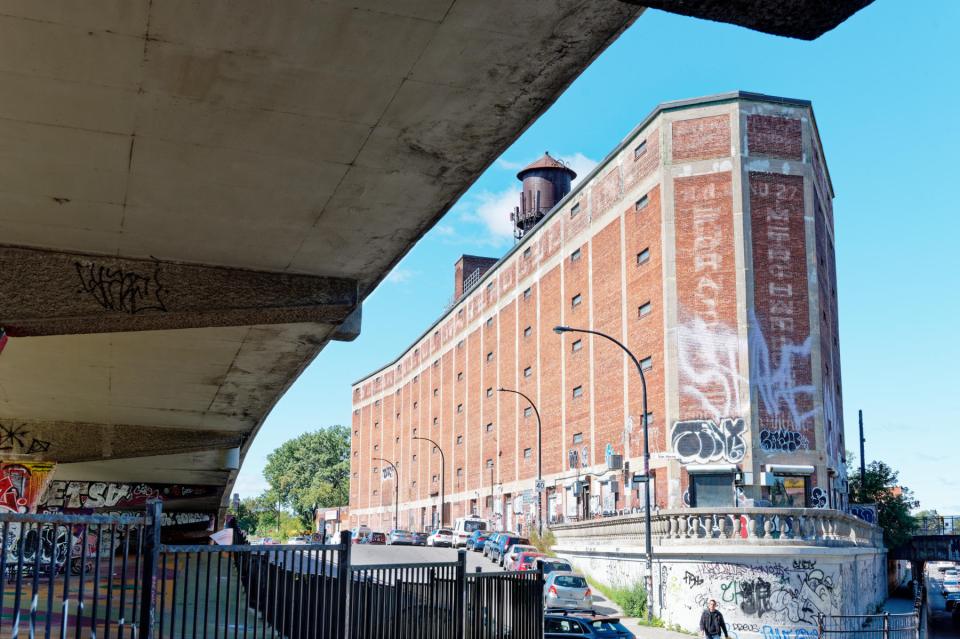
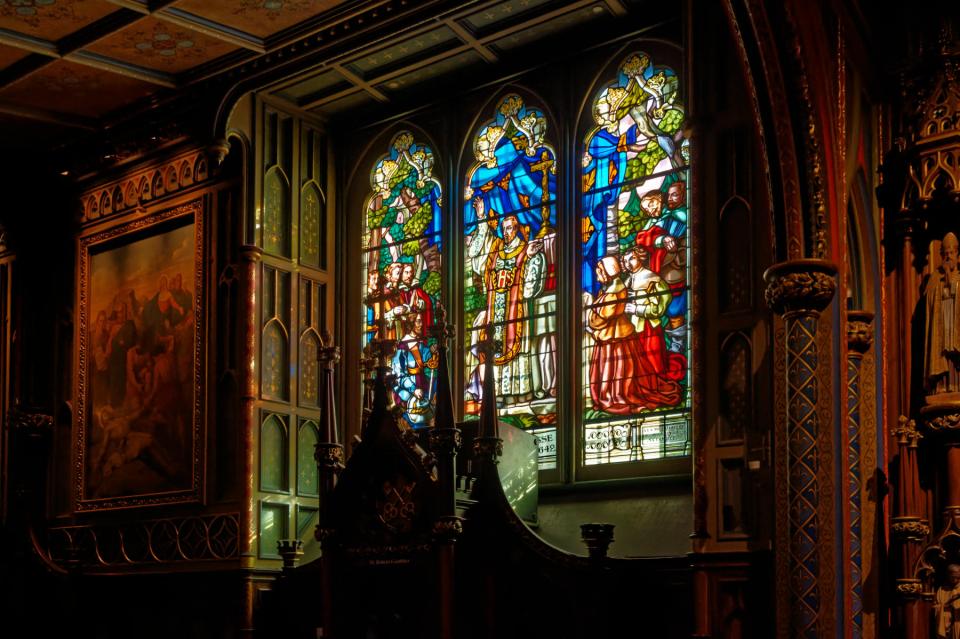
Category Archives: Uncategorised

Hallelujah!

Thursday 22 September 2022 – The only thing we had to do today was to get ourselves from Québec to Montréal; all else would be (a) bunce and (b) unplanned.  It involved a rather early start, since our train departed at 0810; however, we were business class, obvs, and would thus get breakfast on the train, which gave us back a little time.  Québec Station’s main entrance is rather grander in appearance than the windswept construction site that houses the taxi rank of unhappy memory from our arrival.

Nonetheless, if you look closely, you can see that the whole place is suffering from not having been well looked after recently. It’s sadly in need of a lick of paint; also, the coffee machine in the business class lounge wasn’t able to dispense actual coffee.  However, we were only there for about five minutes before it was time to board the train, so our souls didn’t suffer too badly.  Our carriage was similar to the one in which we travelled to Ottawa – indeed, we had the same seat allocation.  It also meant that our baggage travelled with us (so often the case in life) and there was room in the overhead locker for all our bits including my ludicrously heavy backpack.

The journey was unremarkable and quite short – enough to serve us a palatable breakfast and some coffee – and so we arrived in Montréal before midday.  Jane had done her research and so we knew that Montréal has an underground city similar to, although not so tightly networked as, that of Toronto; Montréal’s is called RÉSO and it looked like we could get from the station to our hotel, the Fairmont Queen Elizabeth, using its network. So it proved.  Of course, arriving that early meant that our room wasn’t ready and we spurned the chance to spend an extra 100 dollars a night (minimum) on getting an upgraded room that was available.

The weather outlook was for heavy showers so we decided to use the time until our room became available to go back into the RÉSO and explore a bit, on the basis that this carried the minimum risk of getting soaked. Back underground we went, and found, to no real surprise, that it was very similar to Toronto’s PATH: corridors and walkways;

eateries in profusion;

occasional glimpses of the outside world;

shops and shopping centres;

some interesting architecture;

and some quirky touches.

These two escalators were unusual in that they were both working.  In many other cases, one of the escalators was not.  This seems so systematic across the bits of the city we’ve passed through that I can only assume it’s because of routine maintenance in preparation for the forthcoming winter, rather than the kind of tight-fisted neglect which leaves so many UK escalators nonfunctional.

Having found ourselves in the Eaton Centre, a temple to consumerism that was of no interest to us, we realised that we were quite close to the city’s Christ Church cathedral, so we popped in for a look.

There’s a nice almost-cloister round the back, too.

We decided to walk back towards the hotel – not one of Fairmont’s more sumptuous establishments –

and mooch around near it until we were alerted that our room was available.  Our friend Ian Burley, whose Canadian recommendations have been very helpful as we work our way across the country, describes the area around the hotel as “charmless”.  He’s right; but that doesn’t mean it’s uninteresting.  Opposite the hotel, for example, is the newly installed 30m diameter steel Ring at the entrance to downtown’s Place Ville Marie

(sorry about the C2 crap in the way of a decent image); and next door to the hotel is the huge Basilica of Mary Queen of the World,

so we popped in there, too.  It’s rather different from Christ Church….

…one can easily tell which is the Protestant and which is the Catholic church.  Outside, this cathedral is architecturally complex in a similar manner to that of Sainte Anne de Beaupré.

Whilst walking around, we also saw this extraordinary building.

which looks like a bastion but is actually the Gare Windsor,

formerly the city’s Canadian Pacific Railway (CPR) station, and which served as the headquarters of CPR from 1889 to 1996.  It’s now mainly office space, and has a wonderful atrium.

We walked out into the courtyard outside, and spotted what we thought was our first piece of street art (something that’s very big in Montréal).  Actually it wasn’t really; this was the Place des Canadiens who are

Montréal’s hockey team.  There’s a kind of Hall of Fame by this big billboard.

Our room was by this time available, so we put our bags into it and then almost immediately headed out to see another of Ian’s recommendations and something that Jane particularly wanted to see –

the Leonard Cohen mural.  I should point out that this takes up 13 storeys on the side of a 21-storey building. I have used image manipulation to straighten the photo above.  To give you an idea of the context, this is how it looked:

The route we walked there took us through streets that weren’t all that pleasant, with many homeless and/or otherwise troubled people in evidence, and there was a powerful whiff of weed almost everywhere.  We walked back a slightly different route, which was less oppressive and in doing so spotted our first piece of real street art,

a mural so big that it was not possible to fit it all into a single image, but I’ve done my best here.  The general area around our hotel is pretty much a business district and so one wouldn’t expect it to have lots of charm. There are one or two odds and bits of interest

although I haven’t a clue what any of them are about; and there’s some interesting modern architecture, which I’ve attempted to convey in an arty shot here.

Many of the tall modern buildings hereabouts are quite interestingly architected, with modern takes on art deco and so forth, so it’s not without interest.

It was nice to have a chance to explore a little of the area in preparation for two days of currently unplanned wanderings.  Apart from anything else, it made us realise that we would need to get equipped with ticket for the metro in order to get to the areas we want to explore – it would take too long to walk. I’m sure that by the time we get to tomorrow, Jane will have worked out what we should be getting up to, and I bet it involves looking for street art among other things.  You’ll have to stay in touch with these pages to find out, won’t you? I hope you think this is a reasonable idea.


Québec Quests

Wednesday 21 September 2022 – Our second and final day in Québec dawned fine and sunny (according to the UK Met Office) or at least not raining (according to looking out of the hotel window). Given that it’s such a historic, individual and photogenic city, we felt we had to get out and explore; Jane had some specific sights she wanted to see as part of any wanderings on our part. To aid us in our quest to find out more about the place, we joined another “free” walking tour, this one led by Sam

who described himself as having a beard and a sense of humour – accurate in both cases, as it turns out. He was full of knowledge and amusing ways of putting stories across, often referring to the city’s official motto – “Je me souviens” – I remember.

To start with, we had to find Sam. The appointed meeting place was the fountain by the national assembly building

to reach which we walked up Rue St-Louis, which is an attractive street

containing the city’s oldest house

and its own city gate.

(not the original one – Sam explained that originally there was a much narrower opening, as befits a gate designed to restrict city access. After the British defeated the French here in 1759, they bolstered the defences in order (successfully) to resist the subsequent French siege. The city walls were saved from destruction in the late 19th century by the then Governor General of Canada, Lord Dufferin, who was enough of a visionary to realise the value of future tourism and so had the walls preserved and the gates widened to open the city to visitors). The fortifications, along with the rest of Old Québec, were designated an UNESCO World Heritage Site in 1985 and remain the only intact fortified colonial settlement in North America north of Mexico.

The National Assembly building has several statues in niches all over its façade. Sam identified two of them.

On the left – General Wolfe, the winner of the British fight for Quebec; on the right, the Marquis de Montcalm. History is written by the victors, and it’s unusual, and rather refreshing, to see any recognition on historic buildings of the people who came second. I think this is possibly a reflection of the thoughtful approach that Canadians seem to take to many aspects of life.

Sam is obviously a film buff, as he referred to a couple of films during his tour. One of them was “Catch Me If You Can“, a caper in which Tom Hanks tries to nab Leonardo DiCaprio as he blags his way across the world. The other was an Alfred Hitchcock thriller called “I confess“, about the dilemma facing a priest who receives confession from a murderer. Sam showed us the actual house where the “murder” was committed, something other guided tours don’t cover.

The current occupant of the house is clearly familiar with Sam leading tours past his house, as he came to the window and waved to us all.

Our tour then passed between two libraries – a modern one housed in an old French church and an old one housed in a more modern building which was originally a gaol.

Passing the Clarendon hotel, a building on a site with history that goes back as far as 1685, and is thus far older than the ancient-looking Chateau Frontenac

our next stop was at the Town Hall.

It’s a very imposing building, and doubtless Sam dispensed some interesting nuggets about it; but I became fascinated by its fountains.

After this, we headed (past a building with a very bizarre artwork attached to it)

towards Old Québec,

which is (a) historic, (b) photogenic and (c) contains many of the things Jane wanted to see. These included the “Breakneck Steps”, the city’s oldest steps, so called because they were once rather rickety as well as steep;

then round the corner to this:

which, presented as above (with some photoshoppery), looks like a city scene, but is actually the Québec city mural, telling the story of Québec;

indigenous artwork in a street off Place Royale;

and another wonderful building-side mural

(again, here, with image manipulated – it really looks as below).

The whole area is desperately photogenic

and gives what Sam asserts is the best view of the Chateau Frontenac – and who am I to argue?

Trees in the above photo actually hide the Funicular, which people can use to travel up to the hotel square if they are prepared to pay the 4 CAD fare.

The Place Royal features the outline of where the first building in Québec stood

and Sam pointed out that this was where Tom Hanks and Leonardo DiCaprio actually stood during the filming of “Catch Me If You Can“. Just round the corner is the ultimate Selfie Spot,

where one can ruin a perfectly decent city scene by appearing in it, on the Old City Centre Swing. There are any number of photo opportunities around this part, and the place really, really feels like Paris.

It isn’t, of course, but is often used in films to portray France. In the above, the piano accordion is actually an electronic instrument and you can’t move far without the smell of popcorn pervading the air – giveaways that you’re not in France after all. (Another one is the ubiquity of tin roofs; in France, lead is more commonly used.)

That ended Sam’s entertaining and informative tour, so we headed back up to the hotel up the

172 steps you need to climb.

For once, instead of eating at the hotel, good as its meals are, we had booked an early dinner outside, at a place recommended by Ian Burley called Le Hobbit. The restaurant is in Rue St-Jean, which gave us an opportunity to walk to it past the Observatoire de la Capitale, which is on the 31st floor of a building next to the National Assembly. So once again we headed up Rue St-Louis, pausing to take a photo of Churchill and Roosevelt

(these sculptures celebrating their meeting here in 1943 to plan the D-Day Landings) and found our way to the top of the Observatoire building. One needs to book, and, helpfully, there’s a QR code on the ground floor for paying one’s entrance. But we didn’t have internet access, and it needed help from a sympa young chap who was guarding the Observatoire on the top floor to help us pay our entrance fees. That achieved, we had a few minutes to wander the four sides of the Observatoire, looking at the views of the city around us.

Then we crossed to Rue St-Jean, which is jolly picturesque,

includes the Church of St. John the Baptist which gives the street its name

and has some interesting shop windows.

We had a very good meal at Le Hobbit (thanks, Ian). Then we wandered back to the hotel in the gathering gloom, via the Old Town, to see if it was as picturesque at night as it is during the day.

This signalled the end of our time in Québec, as we had to be ready to catch an earlyish train to Montréal the next morning. It would have been nice to have had more time to explore – a lesson learned for future holidays of the pith and moment of this one – but it was lovely to have seen what we did. Jane thought that maybe it was just a little bit too picture perfect, but I loved the place. Maybe we’ll be back; who knows? But tomorrow is onward! to Montréal, so please come back to see what we made of things there.

Anne Interesting Tour

Tuesday 20 September 2022 – The weather forecast for the day was gloomy, and the reality out of our hotel window

didn’t give huge cause for elation.  So, by an accident of fate, our plan to be on a bus for most of the day looked pretty sound.  There was a little uncertainty about precisely where the bus would stop, as a result of which we failed to be first on it and therefore to get the prime seats at the front of the upper deck.  This was a little bit of a shame, as the front windows actually boasted windscreen wipers, and so would have been clear for taking photos.

The driver, Dan, gave an interesting and folksy commentary as we went along and we tried to grab photos of the things he was talking about – never easy on a reasonably swift-moving bus on a rainy day, but one or two are worth sharing.

The route went north-east from Québec City, along the north coast of the St. Lawrence river.  This is the area where original settlers, erm, settled, and it seems that it took a few years for them to find the best area: at first they made homes on the banks of the St. Lawrence, but these got washed away by the unexpectedly high tides; so the next attempt was on top of the cliffs that bordered the river, but these were subject to the  bitterly cold north-easterly winds; finally, the best location turned out to be at the foot of the cliffs, out of the reach of the tides and sheltered from the winds.

By this stage, the settlers had learned about the potentially 12 feet of snow that could be expected during the winter, and so the houses tended to have steps up to the entrances.  We tried to catch some pictures of these houses as we went by.


On thing that we noticed was the colour of the roofs, many of which were (like that church spire I mentioned in my last post) silver in colour.  It turns out that these are tin, chosen because it is reasonably long-lasting and also fire-resistant.  Many have brightly-coloured roofs.

The reason for this is historical, as there’s no real need for the colour now.  But in the days of the original settlers, with houses relatively few and far between and 12 feet of snow on the ground in winter, the coloured roof was perhaps the only landmark a person could see.  The house in the photo immediately above features a “spring kitchen” – a place where folk could gather as the weather broke after winter, to celebrate the arrival of spring.

Houses that were farms tended to a strip of land that stretched back to the banks of the river – that way it was easy to understand land ownership.  Some of the farm houses are very handsome

and some of the older buildings show , from the reduced height of the door, that people weren’t as tall then (late 16h and 17th century) as they are today – perhaps as much as a foot shorter on average.

The tour made its first stop in St-Anne-deBeaupré, a small town of perhaps 3,000 souls, but home to an astonishing Basilica.  The first church was built by sailors, seeking protection against shipwrecks off Ile-Oeuf on their way upriver to Quebec City (Saint Anne, the mother of the Virgin Mary, is the patron saint of sailors).  But the church has grown and grown, and has a reputation similar to that of Lourdes as a place for the sick to come on a pilgrimage and be cured.

It is huge

and ornate, both outside

and inside.

The doors are covered in beautiful copper, both outside

and in.

and there are extraordinary stacks of crutches and other mobility aids

which have been left here by people who have been cured of their illnesses.

There are no fewer than three other religious establishments immediately around the Basilica,

a couple of churches and, above, a commemorative chapel  of the third church.   On the gentle slopes of the hillside behind the chapel and beside the Santa Scala pictured above it are twelve bronze statues of the Stations of the Cross.

All in all, it is clear that Sainte-Anne-de-Beaupré is a very significant religious centre.  There’s something excitingly called a Cyclorama

which is not, after all, a wall of death for daredevil motorbikers to whizz round, but actually a 365-ft representation in the round of Christ’s crucifixion – sadly closed since the pandemic and not yet re-opened.

After this stop, we retraced our journey back towards Quebec City. Driver Dan described the next stop as a “Copper Shop” and I wondered why we would visit a police station.  At first, it seemed merely the sort of retail opportunity that is often an unwelcome intrusion into a tour, as we were ushered into the lobby lined with works of art made from copper.  I was wrong to misjudge it, though.  We were at Cuivres d’Art Albert Gilles Boutique et Musée. Our group was given a short demonstration of how sheet copper can be transformed into a work of art.

although what we saw was a mere illustration using thin sheet metal; the real material is five times as thick and takes real skill, dedication and time to make into a final sculpture.

The studio, which was started by Albert Gilles who has passed the flame to daughter and grand-daughter, also hosted an exhibition, including Albert’s work to create silver representations of the life of Christ,

a project which took him 15 years, as well as some other lovely items.

The key thing that prevented this from being an unwelcome attempt to sell us stuff came with the knowledge, imparted by Madame, that Albert Gilles had created the copper doors for the Basilica at Sainte-Anne-de-Beaupré (along with work at some 60 other churches).  We left with a great, erm, impression of the man, his work and his art.

We next stopped at the Montmorency Falls.   These are 83 metres high, thus higher than Niagara, although not as powerful.

The falls are impressive enough from ground level, but one can reach the top for a different viewpoint.  You have a choice: walk up steps to the right of the falls as you look at them – 487 steps, we’re told, since we didn’t take this option (not enough time) – or a cable car to the left, which is quicker, less work but costs more.

The cable car is unique in my experience in two ways: the cars are clamped to the cable and it’s the cable that moves; and each car is clamped to two cables, which (obviously) both move. From the top of the cable car, you go past Montmorency Pavilion

and can take a couple of viewpoints, the better of which is ruined, in my photography-solipsistic world, by zipwire cables spoiling the view.  There’s a suspension bridge across the falls, which is quite exciting.  On the left from this viewpoint you can see the steps which hardy souls can climb and which would probably give the most satisfying viewpoint.

In the distance, in the upper of these two pictures, you can see a much larger suspension bridge. This leads to – indeed is the only road access to – the Île-d’Orléans, which is where we headed next.

This island is home mainly to farms, as building regulations forbid the creation of any other kind of industrial construction.  It produces mainly fruit and vegetables – strawberries, apricots, potatoes and apples. There’s a 9-hole golf course, a couple of churches and a decent selection of very handsome (and expensive, obvs) homes.  There’s a Nougaterie, and a blackcurrant farm, Cassis Monna & Filles, which Ian Burley recommends for its gin, but rather than go there, we ended up at a chocolate shop, right at the western point of the island, where you can actually see back over to Québec.

If you look carefully, you can even see the central tower of our hotel, just above the left-hand cruise ship.

The chocolate shop is very obviously a popular place for tours

but we resisted the urge to dash in and stuff our faces.  Instead, since this was the last stop of the tour and we were back at the hotel shortly afterwards, we headed to a hotel restaurant called Sam (for reasons we discovered the next day) where, by virtue of force of personality, or perhaps just plain luck, we just managed to squeeze in for a late, and very good, lunch and a couple of cold, and very welcome, drinks.

Was this a “Fabulous Country Tour”?  Well, not really – and of course the dull weather didn’t help – but it was interesting and we learned quite a lot about early settlers; and the Basilica was a truly remarkable place.  We enjoyed the day and could now look forward to our second and final day in Québec.  The weather outlook was rather better, so we could expect to have a good chance to explore this fascinating city in more detail.  Do come back and find out, won’t you?