Friday 9 September 2022 – We departed the UK one month ago and we return thither in one month’s time. Our time in Jasper marks the end of Part II – the Rocky Mountains Bit – and it’s been excellent. Part I – the Rugged North West and Wildlife Bit – took three weeks, which was relatively leisurely; Part II has been more full-on.
So we declared today a rest day.
We had originally considered visiting a couple of nearby lakes or taking an easy hike, but the lure of a lazy day proved stronger. Also, we had thought to go into Jasper itself and report back to Brendan, our long-suffering travel agent in the UK, about what it was really like in Jasper (which still has no power; we’d overheard a group yesterday discussing how they were moving on from Jasper because their hotel had no heating and no hot water). That plan got scuppered by a shuttle bus which departed too early.
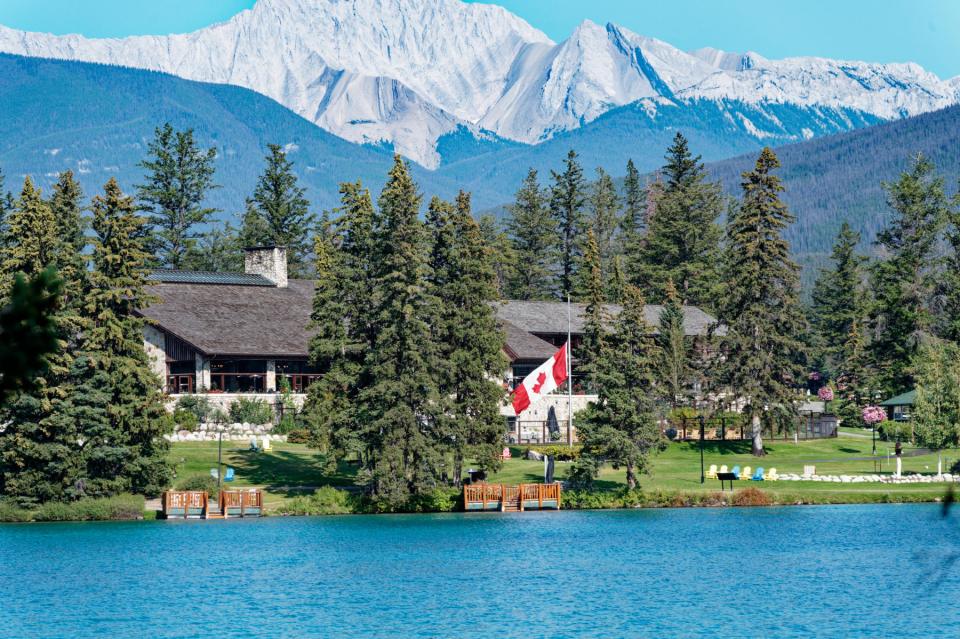
Since the sun was shining, we took the opportunity to walk around the (considerable) grounds of the Lodge. It’s very photogenic.
We had some other encounters:
in the Smokehouse, where they serve breakfast, a Bison’s head (making this not so much a Breakfast Bowl as a Breakfast Bison);
A statue that can’t bear weight;
next door to it, an Eagle statue;
a greedy squirrel, stuffing his face with pine nuts;
and a Loon, also called a Great Northern Diver in Europe.
Sorry about the Loon photo, but that’s the best my camera could do. Also observing it, though, was a chap called Neil who was not so much a Loon enthusiast as a Loon obsessive; he even described himself as such. We had a very pleasant chat with him about these remarkable birds. He had a very expensive-looking long lens and video setup and was pulling together a four-minute piece on some aspect of the birds. The Loon is depicted on the Canadian one-dollar coin, which is why they’re called Loonies. That knowledge will win you a pub quiz one day, see if it doesn’t.
The main objective of our stroll, though, was to see a particular group of cabins, collectively called Outlook Cabin.
The reason for our interest was that these cabins were used during one of the many visits to Canada by HM Queen Elizabeth and her retinue, because they offered peace and a degree of isolation. Apparently she liked the Park Lodge for its tranquility; in the light of the news of her death, it seemed appropriate to visit it.
And that was the extent of our activity today, resulting in a mercifully short blog entry. Reader, you can have time off for good behaviour.
Tomorrow we embark on Part III, which is largely a series of successively easterly city visits. We start with a drive to Edmonton. The only thing I knew about it was that it was where Wayne Gretsky, a world-famous ice hockey player, expounded his art, playing for the Edmonton Oilers, a team name which doesn’t somehow convey the image of a chic place. However, we’ve chatted with a couple of hotel staff who are from Edmonton, and it sounds like an interesting town with a few ITTDs. We also have a few digressions en route, so we’re back to relentless tourism after our day panting in the shade. I hope you’ll come back to read about them as we go.
August 29 2022 – Today marked the end of the rugged-north-west-and-wildlife section of our time in North America, as we left Whitehorse for Vancouver. It’s been a full-on three weeks (except for the boring waiting around for things to happen bits, of course) and it will be rather nice to have three days in Vancouver with nothing on the agenda! We can please ourselves as to where we go and what we do. Bet we end up walking a lot, though.
Anyways, we woke to a morning of slightly uncertain-looking weather, with showers forecast. Nonetheless, Jane suggested we go for a walk, so off we went. We headed for the pioneers’ graveyard
at which point it looked like it might come on to rain. I wimped out at this point, not least because I had a blog to write, and Jane carried on with her original plan, to climb the Black Street Steps,
all 250-odd of ’em. The view from the top was recommended, but, frankly, had too many things in the way to make it very rewarding.
The steps feature a side section which allows for pushing e.g. a bike up the steps,
which looks rather like hard work; Jane reports that this chap was suffering somewhat as he laboured up the steps.
The route back to the hotel led past some interesting houses,
some unsuspected lanes running parallel to the surfaced roads,
and some colourful touches.
(Above is a mural outside the Yukon Chamber of Mining.)
Jane joined me in the hotel restaurant, which we discovered sold Empress Gin,
and we had a lunch which featured enormous portions in the hope that it would keep us going for the rest of the day (which it largely did, actually).
Then it was time to get the shuttle to the airport, which sounds straightforward but wasn’t. We thought we’d booked a shuttle at 2.45, which was about right for a 4.45 flight. But the hotel reception told us that there was no shuttle at 2.45, only at 1.15 or 5pm, so we put ourselves down for the 1.15, of course. Came 1.15, but no shuttle. We spoke to the receptionist, who disappeared backstage and the next thing, the driver appeared and said, “I’ll go get the bus”. On the way, he asked us which flight we were on, and when we told him it was at 4.45, he seemed surprised that we weren’t on the 2.45 shuttle – which he was going to drive!
Whitehorse airport is, like Port Hardy, too small to support a café in the departure area, but sophisticated enough to have mains and USB charging by the seating. We had a longish wait, since we’d got there early, so the charging points and the free WiFi were very welcome.
The flight back to Vancouver passed pleasantly enough. We were right at the back, which I don’t normally care for, but there was adequate legroom and it was perfectly comfortable. Conversation with the chap next to us passed the time very nicely – he was a resident of Whitehorse going (with wife and four kids!) to visit family in Vancouver – and Jane took some photos out of the window, as conditions were clear.
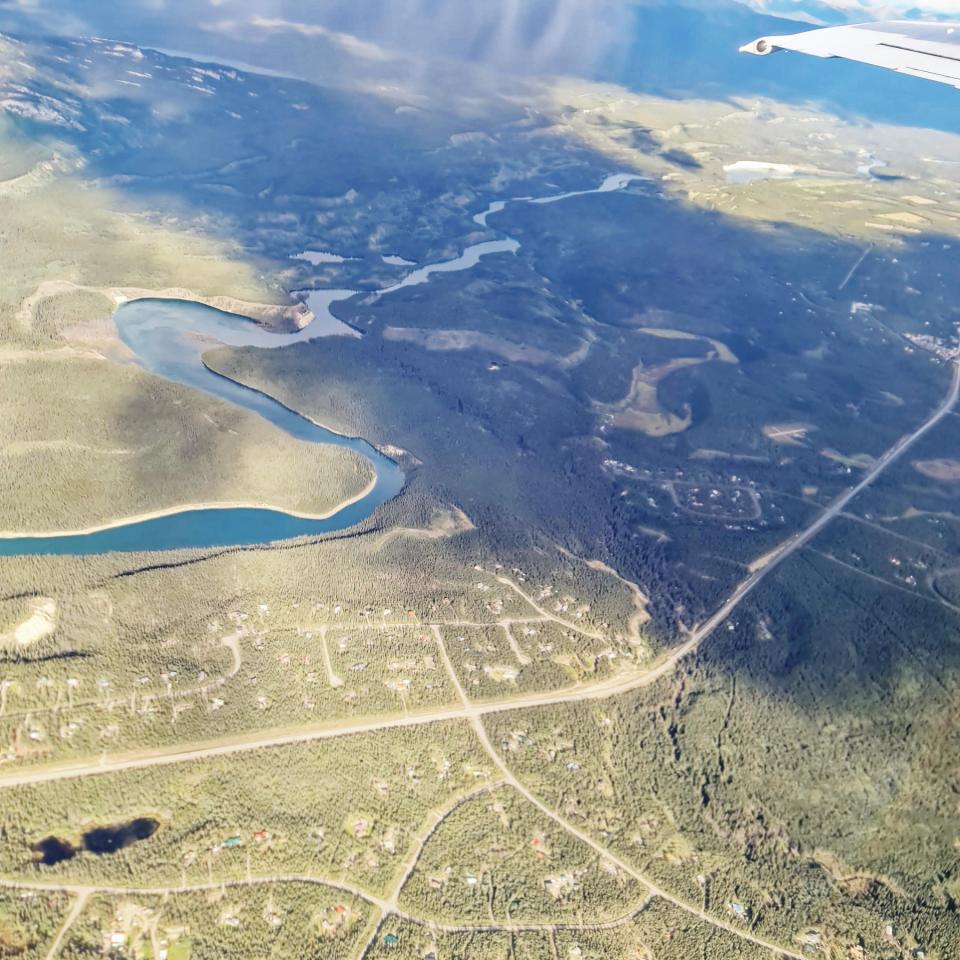
Shortly after take off, we passed the hydro dam (bottom left)
and you can see the dam itself (we visited it two days ago, remember?) and the waterfall to the left of it – the barrier forcing returning salmon into the ladder which runs back and then forth past the dam. I think this photo gives a good idea of how long that salmon ladder really is (nearly a quarter of a mile).
Here are some of the other photos Jane took.
the Yukon River;
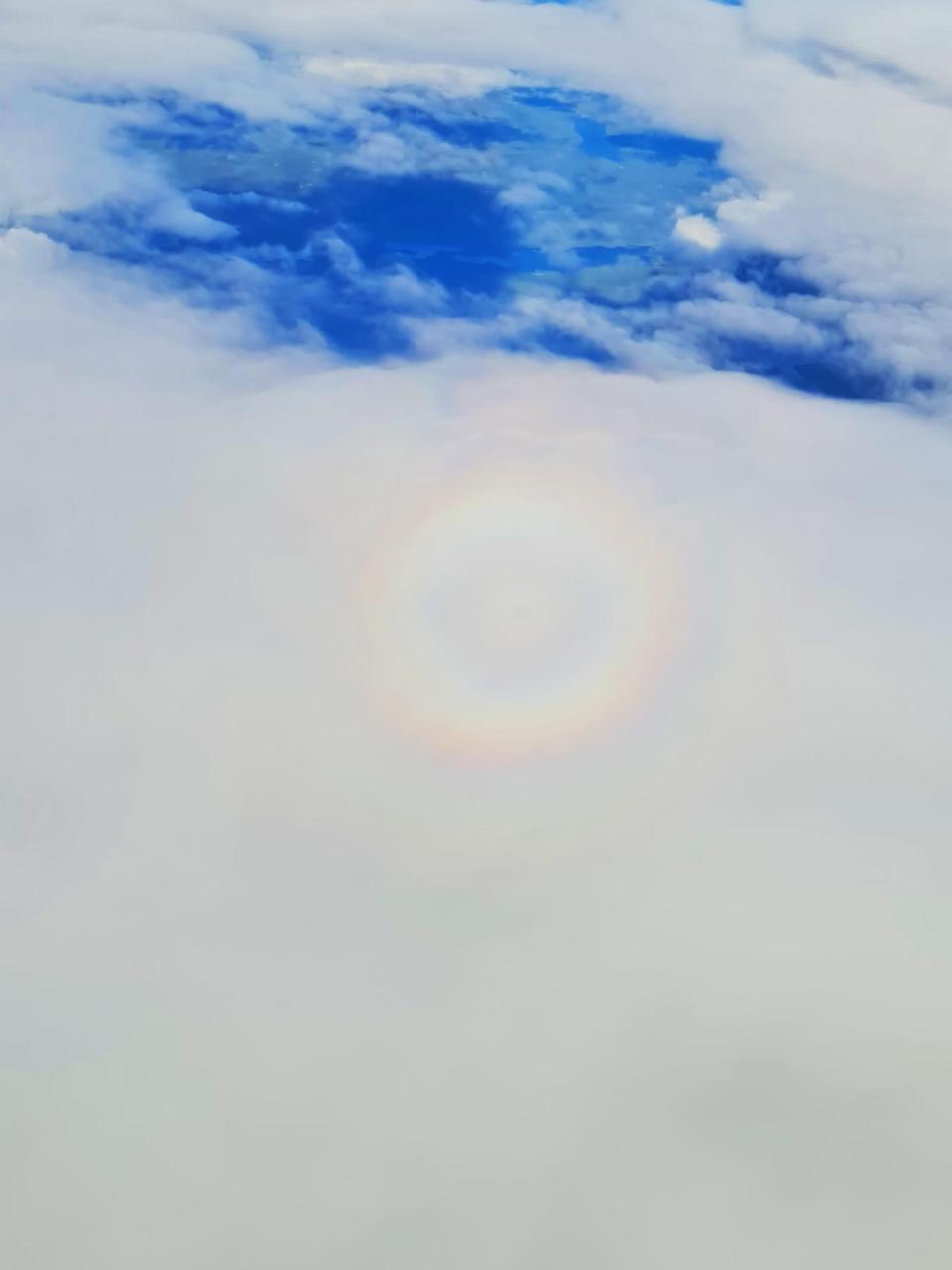
an interesting cloudbow;
some lumpy bits;
some lumpy bits with snow on them;
and finally downtown Vancouver, with the cruise terminal and Stanley Park to the left of the picture, the colourful port in the centre and Grouse Mountain to the top right.
When we arrived in the baggage hall, I noticed with some bemusement that the baggage carousel numbering started from 0. I really don’t know why, but there it is.
Our bags turned up eventually, as did a driver to take us the 30-minute journey into town and we found ourselves once again at the Fairmont Waterfront, just three floors higher than last time.
I expect that the next three days will take a toll on our shoe leather, but the weather outlook is very good, so I’m looking forward to exploring the place further. Assuming that happens, I may well take some photos, in which case they may well find their way on to these pages, should you wish to come back and check them out. See you soon, I hope.
Thursday 26 August 2022 – The plan for the day was to get to Thompson Sound, up the Kakweekan River, a salmon river (aren’t they all, round here?) where it might be possible to see more bear action. As the day before, the start was a boat journey for some 90 minutes with the lovely Sylvie at the wheel and James generally leading and giving us the benefit of (a) his knowledge and passion for the local ecology and (b) his dry-as-dust sense of humour. The two of them kept an eye out for shore-based wildlife as we went
and I tried not to worry about the driver taking her eye off the road. Actually, the chance of a traffic accident was, of course, pretty remote.
We passed a couple of salmon farms on the way,
and James explained the negative impact these have had over the years they’ve been established here. It’s impossible to farm salmon without diseases affecting them. If you put 100 people in a room for an extended period, for example, eventually sickness will spread; imagine that with salmon, but of course with vastly greater numbers of fish. The problem comes not with the farmed salmon infecting wild ones coming upriver to spawn, but with the smolts coming down-river after hatching; these catch the diseases and inevitably spread it among the wild salmon population. The wild salmon population is thus drastically reduced, which affects all the animals for which the salmon are prey; eagles, dolphins, orcas and, of course, bears. Fortunately, the number of salmon farms is decreasing as environmental activists, including the First Nations, exert pressure and even big business is beginning to understand that the environmental downside is worse than the commercial upside. The result has been (as seen everywhere where this has happened) an inverse correlation between salmon farms and the health of the local ecology.
We also passed a school of dolphins, who came over to investigate us and entertained us with their exuberance and skill.
The next stage of the journey was a short ride in a (heavily modified) four-wheel drive truck
Where I took the chance of getting a team photo – Sylvie on the truck, James on the right. After the ride, and some safety briefing from James about how to minimise the risks in case we came across a bear unexpectedly (stay together, no buggering off on your own to take photos, no screaming if you saw a bear, that kind of thing), we set off on a short hike
which led to a river that had to be crossed by a small boat on a rope system.
A few more metres along the track, Sylvie led us off to a place where we had a decent view of a decent view.
It’s interesting to note that, as free-flowing as this river seems, it’s very low, because there hasn’t been enough rain to supply it. We could see salmon – pink salmon, the small ones – making their way upstream, and while the river is alarmingly low, this is extremely good news. In previous years there were no salmon, so the bears couldn’t feed. The unique nature of grizzle bear biology concerns foetal development. A pregnant grizzly bear will maintain a foetus for a while before implanting it so it can develop, to feed up in order to support the coming cub. If there’s not enough to eat, the foetus will not implant, but instead will be terminated. The result has been a couple of years with no bear cubs at all, which is why seeing salmon in this river is such good news. James mentioned later that we were not, erm, out of the woods yet and that it needed to rain immediately, long and heavily in order to sustain the environmental cycles.
Anyhoo, our time in the spot by the river gave us the tiniest insight into the nightmare world of wildlife photographers. We sat there for a good two hours and nothing happened, beyond the odd salmon or two leaping up the falls. We took a short break for lunch at a nearby spot – once the abode of “Trapper Rick” but now shared by Farewell Harbour and a couple of other interested parties.
and then returned to where we were, where nothing continued to happen for another hour or so. Sylvie came round our group trying to establish a “should we stay or should we go” consensus. Had she suggested that we all leave, I would have happily taken up on it; but the feeing among the group was to stay, so I kept quiet.
Two minutes – two minutes – later….
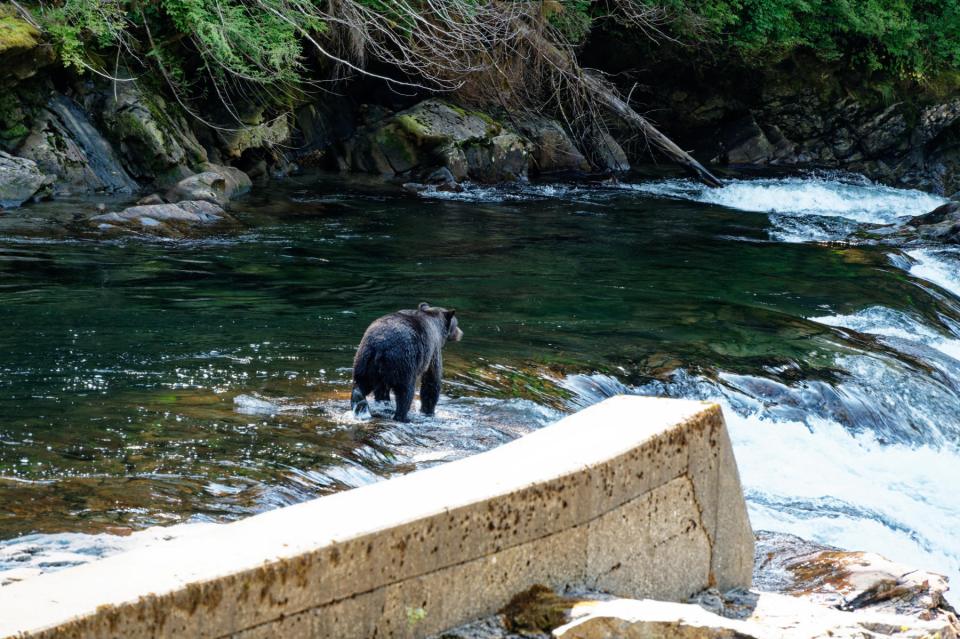
Which just goes to show that I have lessons to learn about patience. A bear appeared and calmly walked by, just below us, and crossed the falls in search of salmon.
We hastily – and quietly – moved to a lower viewing spot so we could watch the bear fishing. This spot had been occupied by another group, led by a couple of First Nations guides; but they had followed us to the cabin and were eating their lunch, so we had their spot to ourselves!
We were phenomenally lucky. Not only did the bear walk closely enough for some great photos, but then we were able to witness this.
It was spellbinding. The other group, alerted by James (there is constant communication between groups, sharing wildlife sightings and other information by radio) came hurrying back, so we moved out of the way to let them carry on the viewing. At that precise instant, and before the other group had a chance to get the same view we had, the peace and quiet were cataclysmically shattered as a helicopter came over. It didn’t just fly over, it swept sideways up the river at very low altitude, making a hell of a racket.
The bear, of course, was utterly spooked
and shot off into the woods on the far side, never to return. So the second group never got the chance to see what we’d seen and, more importantly, the bear lost the chance to eat salmon. It seemed that it was a government-sponsored flight for the purposes of counting fish. One understands that These Things Must Be Done, but this individual episode cast a bit of a pall over the proceedings.
There was clearly no point in staying there, as the chance of seeing the bear again was minuscule, so we headed back, now in sunshine. Sylvie showed us a bear rubbing tree on the way back. Bears will use a tree for a variety of purposes; scratching that elusive itch, of course, but also as a way of communicating with the local ursine community. Scratching leaves scent and the higher the scent, the bigger the bear – a warning to others about who’s the boss around here. Bears tend to choose sappy trees, and if you look closely, you can see individual hairs stuck in the sap.
On the way back, we passed the school of dolphins again and they obliged by entertaining us once more
and Sylvie spotted a black bear on a distant shore. Quite how she was able to do this is beyond me, as I could hardly see it even when I knew where it was. But there it was
looking for berries to eat.
A day which at one stage looked like it would be a dead loss (I had envisaged a post called “Doesn’t Bear Repeating”) had turned out to be richly rewarding. I felt really privileged to have witnessed today’s episodes, particularly the fishing, and hugely lucky to have scored the photos and videos now safely ensconced on my laptop.
The dinner back at the lodge was, as ever, absolutely delicious, and was followed by an interesting talk by Sylvie about “Heroes of the Forest”, by which she meant fungi and mycelia, essential components of an arboreal ecosystem.
And that, beyond a certain amount of drinking and conversation, was that for the day – richly rewarding, deeply interesting and hugely enjoyable (my earlier boredom has been largely forgotten).
This was our last evening here, and so we have to prepare to leave tomorrow. We travel to Port Hardy, thence to Vancouver and onwards to Whitehorse for another three-day adventure. The ever-excellent Tim has ensured that we have some entertainment laid on to divert us from the tedium of simply sitting around in an airport awaiting a flight. So come back tomorrow (or thereabouts – the internet connection here is not something one can rely on) to find out how our day and our journey went.