Tag Archives: Tourism

Day 19 – San Gerardo to Alturas: ¿Quetzal?

Thursday 9 March 2023 – In Spanish, “¿Qué tal?” is a friendly greeting, meaning, among other things, “what’s up?”.  In our case today, what was up was us and when we were up was 0430. The reason? We had to meet a guide at 0515.  Yup – we were looking for wildlife again.

Specifically, we wanted to see the Resplendent Quetzal. Well, more Jane than me, to be honest; at that time in the morning what I wanted was more sleep.  However, the chance to see one of these birds wasn’t going to present itself again, and the chance to do so was the reason for our precipitous plunge into the San Gerardo valley; for the Resplendent Quetzal can be found here, if you get your timing right – and we were in Quetzal season.

Accordingly, at 0515 our guide, Marco, turned up and we set off in his 4×4 back up the trail we’d driven down last night – somewhat more rapidly than I would have done, if I am to be honest.

The morning was rain-free, thank goodness.

Marco cautioned us to stay close to him as he might move quickly to get to a vantage point to see something.  He also made sure that we had phones with us, not, to be sure, so that he could contact us in extremis, but so that he could set up photos with them using his spotter scope.

As the day lightened, it became clear (unsurprisingly) that in our quest for the Quetzal We Were Not Alone.

There were several groups, mostly accompanied by guides all of whom were communicating with each other, often over radio, about what could be seen and where. In total, I’d say there were about 40 people all trying to see the same species.

What followed was a typical Birder morning. Here, in 15 seconds, is a summary of our movements for the next 150 minutes, over a range of about three miles.

So, did we see a Quetzal?  Was it easy?  Was it quickly achieved?

Yes. No. No.

The first excitement was a group of Black Guans.  There being nothing else even remotely Resplendent to be seen, we spent some minutes and several frames on capturing them.

Marco proved to be extremely adept at getting mobile phone camera images through a spotter scope.  To give you some idea of what he could achieve, his image, using Jane’s phone, is on the left, mine, achieved with my Big Lens (10-400mm zoom for you  camera buffs out there) is on the right.

There was also a frisson when someone spotted an Emerald Toucanet, a small bird Jane had particularly wanted to see because it’s such a weird construction, like a Finch has had a Toucan beak bolted in Photoshop.  Here’s a good photo of one, courtesy of Flickr – see what I mean?

Emerald Toucanet

They’re serious creatures, though, and a major predator of Quetzal chicks, apparently.  They’re bastards, same as all Toucans.

To give you some idea of the frustrations and disappointments of birding, here are the results we got in trying to photograph this elusive bird.

I still have difficulty seeing it even in the spotter image.  Here it is closer up.

As ever, with my shocking eyesight, all I ever saw was a flicker of movement as the little fucker flew away, never to be seen again.

I busied myself with getting a photo of a Big-Footed Finch, which was stamping around in the leaf litter to disturb insects to eat.
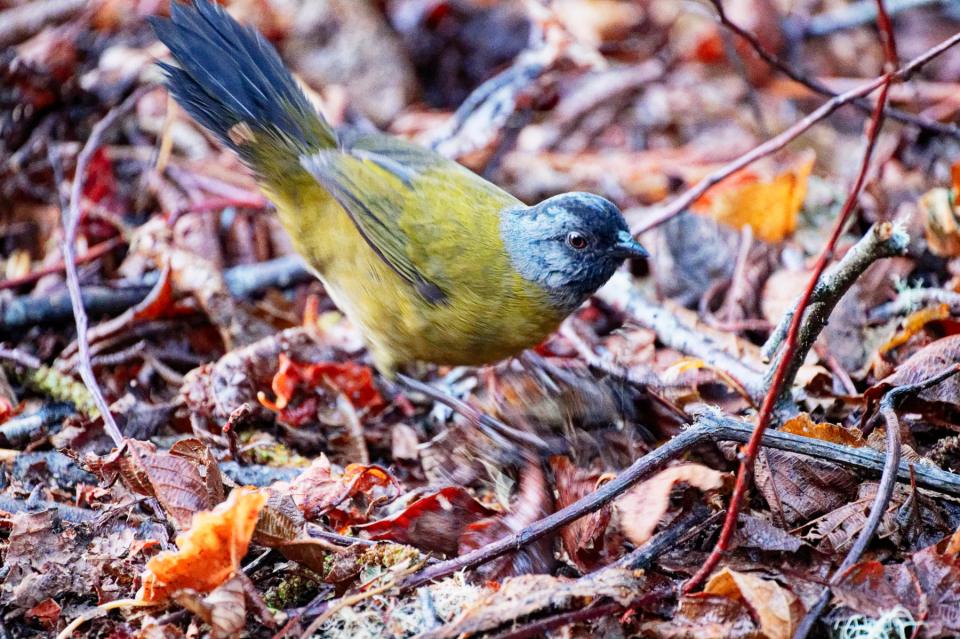
It’s not a big bird, but since it was only about six feet away, even I couldn’t miss it.

Marco spent a lot of time looking for a Quetzal

even going so far as to mimic its call to try to lure one into some kind of visual contact.

Eventually, reports of a sighting filtered through and we raced along to where it had been seen.  Courtesy of lots of patient explanation from Jane and Marco, I eventually set eye on my first (male) Quetzal.

It’s there, right in the middle of your picture.  Honest.

It was creating a nest.  I even got some really crappy video of it pecking away at the tree. (This was about 0630, by the way, so we’d been looking for an hour or so.)

For a while, as we belted up and down the track, I began to despair of ever actually getting a decent photo of one of these damned things, because of a combination of my poor eyesight and the talent these benighted creature have for positioning themselves with leaves or twigs in the way, or against the light.

We did see some, though, even though the little buggers kept adopting the wrong pose, such as facing away from the camera,

or with bright light behind them, or sometimes both, dammit.

Jane and Marco were getting some success with her phone and his spotter.

and finally – finally! – one settled facing me where I could see it and take photos before it fucked off again.

Resplendent is such a good word, isn’t it?  The male grows those long tail feathers every year; the female doesn’t have that extravagant braggadocio. Here’s a female from Jane/Marco

and this is the best I could do
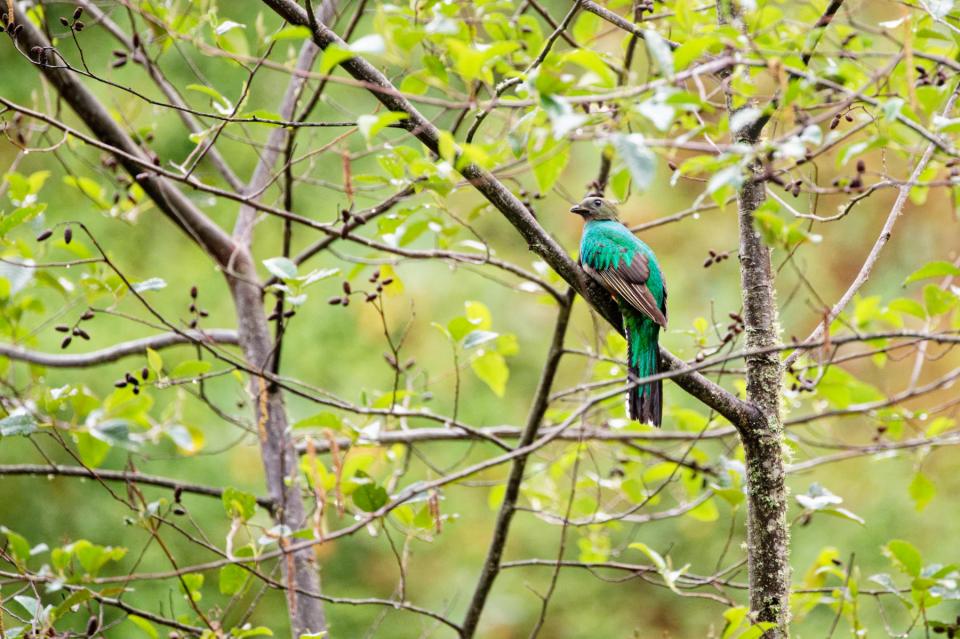
although – hah hah! – I accidentally took a photo of this female as she tried to get out of my shot.

We covered three and a half miles over two hours in our quest for these photos, sometimes in a car, sometimes at a run, more often than not at a standstill saying “where are you, you little bugger?” But it was ultimately very satisfactory, some might even say worth getting up at 0430 for.

It’s interesting to note the “shot silk” effect of the bird’s colour. As the angle changes, so does the colour you see.  For example, we saw long tail feathers of blue, but over the bar in the restaurant

they’re green.

Oh, how we feasted after our successful hunt! Well, avocado toasts and a cup of tea, anyway. Marco mentioned that Lauraceas had a garden just down the road and so we popped down there to see what we could see.

Jane also managed to get some video of a Volcano Hummingbird – no mean feat as, like other hummingbirds, it doesn’t hang about much.

But then it was time to leave the delightful scene by the stream

and head off to our next destination, Villas Alturas, in Domenical on the Pacific (west) Coast.

Of course, the first thing we had to do was to get out of the San Gerardo valley.  But it was not cloudy or raining, and six or so miles to get back to Route 2 only took us about half an hour.

However, when we got there, we discovered that we were well back into the clouds… and rain…

and roadworks! with steaming freshly-laid asphalt, which didn’t help speed the journey.

We eventually turned off Route 2 and once again had some pleasant countryside to drive through

before a final, very bumpy, half-mile up a track to the Villas.

However, once we were checked in, we discovered that we had a villa with a great view

to be seen from a delightful balcony.

We had gin and tonic for the fridge and some peanuts, the freezer already had ice in it and so we made ourselves at home with mucho gusto, as they say in these here parts.  The food in the restaurant is good, the service willing (albeit a little patchy), and they’ll do our laundry for us for $16. And, delightfully, we have nothing to do for 36 hours.

So, it’s now 1400 on Friday 10th March and you are up to date with the holiday travels for the moment.  We move on tomorrow, but have a few more delightful days of nothing organised until all of a sudden it gets serious again.  You’ll just have to keep checking back in to see what, if anything, has been worth reporting. For now, cheers!

Day 18 – Aquiares to San Gerardo. Interesting times

Wednesday 8 March 2023All we had to do today was to get ourselves from Aquiares to San Gerardo de Dota, about a three-hour drive. Once there, we could relax for the rest of the day. Simple, no?

Simple, yes. Also, interesting, almost entirely in a good way.  Almost.

We had the usual Hacienda breakfast – Gallo Pinto, fried eggs, coffee.  We tried the honey-processed coffee for a change and, although it didn’t have the farmyard aroma that so struck Jane, it didn’t frankly have the depth of flavour that we liked.

No matter, we had a nice view as we sat on the terrace overlooking the garden

although the clouds were fairly low.  We were joined (at a distance) by three Chacalacas

and I have to say that the fog lent the “Tree of Life” (a Ceiba tree) a very striking appearance as it overlooked the coffee factory.

As we exited the Hacienda to load the car, we heard a real commotion emanating from the trees near the car.

Toucans were gathered and shouting their fool heads off – we don’t know why, but are prepared to bet that it was with evil intent, because they’re bastards. Keel-billed Bastards at that, so we’d at last got reasonably close to them in the wild.

The route we followed started going up in the rather steep fashion that Costa Rican road designers quite frequently favour

but the surface was good and we eventually found ourselves among some really pleasant countryside.

However it soon became clear that we were on a very up-and-downy route, which invariably involves an encounter with a large, heavy and slow lorry, with its consequent tailback.

Under these circumstances, there’s nothing to be done apart from awaiting one’s chance to overtake in due course. We weren’t in a hurry and so it wasn’t too irksome. Once we did get past, we were treated to some lovely views

across what, it was increasingly clear, was agricultural land, with various kinds of materials used (we guessed) as shading for whatever was being grown there.

We passed through the town of Cervantes, which was tight in places

and gave us the chance to appreciate the arcane beauty of the local wiring systems.

We skirted the significant and not particularly attractive conurbation that is Cartago, and joined Route 2, which is the southern segment of the Pan-American Highway (locally in Central America known as the Inter-American Highway) that traverses Costa Rica, and therefore means that there is a significant number of huge trucks among the oncoming traffic. We passed wind turbines as we breasted one hill

and the attractive bits of scenery continued to make the journey interesting and pleasant – certainly the most enjoyable drive whilst we’ve been here, for me.

There’s a local habit of using old satellite dishes as advertising boards which is rather picturesque.

It became clear that we were quite high up in the hills

as we encountered fog from the clouds we were entering.

By this stage, we’d done all but about six miles of the 70-odd mile journey and it had taken us barely over two hours.  The reason that the overall journey time would be nearer three hours was soon borne in on us as we turned off the perfectly decent, if somewhat busy Route 2 on to

the trail leading down into the San Gerardo valley. The Pura Aventura materials had prepared us for it to be twisty and steep, but had given us the impression that the road surface was OK.

This was true for about the first mile. Then it became, in places, quite dramatically not true, a state of affairs hardly improved by the driving rain and thick cloud that enveloped us on occasion as we descended with, in at least the driver’s case, buttocks firmly clenched.

There were some great views on offer

but I have to say that I was greatly relieved to get to the bottom with car, dignity and sphincters intact, and to arrive at Lauraceas Lodge and check in.

The sense of relief at survival of those last miles was heightened when we got to our accommodation.  It was to be for only one night but it was quite something –

the best (of course!) of 4 cabins, large and roomy and all to ourselves with (praise be!) a kettle and mugs for the making of the well-earned cup of Twinings Earl Grey tea that we awarded ourselves. After a stiff drink and a late lunch at the Lodge restaurant, of course.

So, why, you might reasonably ask, had we subjected ourselves to this final descent? Well, you’d better tune back in tomorrow to find out, hadn’t you?

Day 17 – Aquiares – Fully Washed or Natural?

Tuesday 7 March 2023 – The day held a fully-guided, whole-day programme for us, to learn about the place we were staying – Aquiares; not a Spanish word at all, but from the pre-Columbian native language meaning “the land between rivers”.

The Hacienda set us up with a nice breakfast, with fried eggs and the ubiquitous Gallo Pinto, accompanied by coffee, served in a delightful filter pot.

This was a startling deviation from our usual breakfast fare which is tea, preferably Earl Grey, preferably with milk, because we’re English, so deal with it.  Coffee was provided and we never actually felt that asking for tea would be a good idea.  Jane, whose nose makes much more of scents that mine does, noticed a strong overtone of farmyard in the aroma of the coffee, which was also served without milk.  It was good coffee, but very different from what we would have had mid-morning at home.

And it is coffee that Aquiares is all about as a town, the Hacienda where we were staying is a refurbishment of the farmhouse for the coffee farm, and the day was to be about exploring coffee and Aqiares in more detail. Our guide Wilman, was, as far as locals were concerned, a stranger, since he hailed from Turrialba, a whole 5 miles distant. He gave us a full and intense day, as absorbing, entertaining and educational as our cacao session had been the day before, only much longer, deeper and more intense.

As we left the Hacienda, he bade us note the Ox Cart by its door, specifically its dimensions. Remember this for later.

Then we were taken deep into the coffee plantation.  This was possible because it’s huge – 926 hectares, the largest in Costa Rica and so big that it has 82 kilometres of trails in and around it. Our transport was not luxurious, but it was authentic, being one of the trucks used to transport the workers to the coal face.

Wilman disembarks from our “Tour Bus” into the coffee plantation

Since we were among the coffee plants,

Wilman then showed us how to pick coffee.  The things you pick are called “cherries” and the idea is that you pick the red ones.

Here’s what Jane and I ended up with after some 20 minutes of picking coffee.

It’s a back -breaking process, and the coffee plantation employs between 800 and 1,000 pickers (about half of whom are itinerants from Nicaragua) to pick the crop over about seven months of the year (July until February, roughly).

After we’d done this, he led us to a picking gang, whose chief was called Antonio

and a picker called Gerard but nicknamed Piggi, who showed us how it was really done.

Experienced pickers like Piggi would collect over thirty baskets every day. Antonio boasted that he once picked 80 baskets in a day (he started as a picker and worked his way up to be a chief, taking responsibility for a team of people picking in a certain area, marshalling them and making sure that the job is done effectively). The working day for a picker starts at 6am and finishes at midday, a siren at the factory sounding loudly (its a massive farm) to mark the beginning and end points.

Wilman also explained the anatomy of a cherry.  Inside the skin are two beans, which are covered in pulp, called mucillage (similar in principle to what we saw with cacao yesterday).

The mucillage is sweet and floral and the skin is fruity; these give the final product its distinctive taste.  This got us into the topic of varieties.  Although all the coffee plants at Aquiares are of the Arabica type, there are varieties within Arabica, each with their own characteristics and quality levels.  The finest quality beans are planted high on the hillside, the lower quality ones lower down.  So there is a tight control system to make sure that the right plants are seeded in the right place.  That said, we found a rogue bush.

This had found its way in through natural processes, and the beans would never get picked for the quality of coffee that was to be produced from that area.

Although the sun wasn’t beating down, the scenery was attractive.


The trees with orange flowers you can see are Poro trees and are important, as they are of the legume family, which means they enrich the soil by fixing nitrogen in it.  We could also see Aquiares town, with its coffee factory and church.

We then embarked on a walk, during which we could see the amazing extent of the plantation and the orderliness of the planting.

Wilman also told us about some of the farming methods used to maximise the crop while making the operation sustainable – cutting them back every so often to 60cm high, to increase bushiness;

planting new crops to replace older ones after about 25 years;

and sometimes planting two close together so they compete to grow more cherries.

On the way, this being Costa Rica, we saw plenty of birds – vultures

and a Black Hawk

as well as many birds too small for me to photograph (I left my Big Lens behind for the day).

We descended further and further, past rainbow eucalyptus trees

which are not endemic but have been planted because they take moisture out of the soil and thus mitigate any rotting of the coffee plants, and also provide essential oils for creating other, non-coffee products.

Down and down we went

until we emerged at one of the rivers that give Aquiares its name.

There’s a waterfall there that even an Icelander might consider to be worthy of the name.

There are a lot of boulders and stones in the area

and Wilman told us that the previous July there had been so much rain – twice as much as the average rainfall for the whole month fell in one day – that the river actually changed course.  It used to run behind the diagonal line of bushes you see beyond the boulders in the middle of the picture.  All of the rocks had been moved there by the sheer volume and weight of water during that rainfall.  That must have been an impressive sight!

We toiled back up the slope to the Hacienda for a nice lunch – chicken, rice and beans! – and then Wilman took us on to part 2 of the day – a visit to the coffee factory and the village of Aquiares.

Aquiares was founded in the 1890s by farmers looking to take advantage of Costa Rica´s railroad to the port of Limón.  An English family, the Lindos, acquired it in the early 1900s and built houses in the village and around the plantation, to house the workers and to attract more into the area.  There are still some of the original houses there

as well as buildings that were the original theatre and supermarket.

In order to qualify as a village, and also to support the incoming workers, who were largely Catholic, the Lindo family also imported a church.

The aluminium shell came from Belgium, the clock from Germany, the wood for the interior from Italy. There was some repair work going on – indeed, the church seemed to be supported by prayer alone –

and therefore it was open and we were able to take a look inside.

But the main thrust of the afternoon was to see round the factory, which turned out to be quite a brain-boggling visit, both from its scale and the variety of coffees it deals with.

It’s a big place

overlooked by the “Tree of Life”

from which the coffee farm takes its logo.

Coffee, Community and Conservation are three important things to the farm – conservation because 75% of the plantation is given over to coffee plants, but the other 25% is forest and trees which are not only the basis for the company’s conservation efforts but also make the entire operation carbon negative – it produces more oxygen than CO2.  The farm is also part of the Rainforest Aliance.

Wilman took us through the process of taking the picked cherries and turning them into beans to be shipped all over the world, both with a view of the original processes and also of the modern ones, which involve all sorts of conduits, feeds and sophisticated machinery for sorting the beans by quality and size.

The vast majority – 85% – of the cherries go through a process called “fully washed”, where beans are deposited into silos

(note that the green hopper is exactly the same size as the ox cart outside the Hacienda, which was originally used to transport the cherries or beans).

From here the cherries are flushed along with water, and are sorted as part of the washing process – poor quality cherries sink, good quality cherries go on to have the pulp and mucilage mechanically removed before ending up in a huge drier

and then are stored in silos as part of the maturation process.

Then the beans are sorted in various ways (by density, weight, size and colour)

and end up in sacks – white for lower quality, brown for higher quality.

You’ve been paying attention, so you’ll know that there are still 15% of the beans unaccounted for.  Well done. I have to say that by this stage in the day my brain was definitely begging for mercy as Wilman threw more and more complexities into the mix.

The 15% that are not “fully washed” may go through one of several small batch processes: “natural” where whole cherries are laid out and dried by the heat of the sun

Today’s cherries in the foreground, older ones behind it

Fermented cherries in the foregound

(in case of no sun – like today; it was raining outside – there’s a hot air blower, driven by a furnace fired by excavated old coffee plants,

as part of the sustainability aspects of the operation).  Retaining the pulp gives fruity notes to the finished product.

The “honey” process involves drying the beans with their mucilage covering which gives honeyed and floral notes.

The beans may be fermented, either in their own mucilage or added molasses or even kefir, and the various different varieties are treated in a variety of different ways. The number of combinations is bewildering but there are basically four coffee varieties and three treatments that form most of the company’s output. More details about the operation, the history and the credentials can be found on the company’s website, of course. My brain was begging for mercy by this point; having tried to understand the complexities of cacao yesterday, absorbing those of fine coffee today was proving a bit too much.

But the general lesson is clear – chocolate and coffee are as subtle, varied and complex as wine. The coffee we had at breakfast at the Hacienda was a Centroamericano  variety, made by the Natural process.  It will be interesting to get back home and try our usual coffee to see if all this education has had any effect at all.

So, foot- and brainsore, we headed back to the Hacienda, past a view of the factory and its coffee drying greenhouses

and some of the colourful houses in the village,

including one which I have to say I would find exceedingly annoying were I to live here.

However, I don’t, so it’s none of my bleedin’ business.

We took a light supper at the Hacienda and eventually headed for bed in slightly eerie circumstances – the Hacienda staff had gone home and we were the only guests.  We had the whole place to ourselves and it felt really quite odd.  This was also the second day without either gin or Earl Grey tea, which contributed further to the other-worldliness of the experience.  But we surived, and slept well in preparation for moving on the next day.

The morrow should be pretty dull.  We simply have to move on to our next destination, San Gerardo de Dota. What can possibly go wrong?