Tag Archives: Tourism

Three days in Boston

Tuesday 13 to Thursday 15 June 2023 – Both Jane and I have visited Boston before, but some three decades ago, and then, in my case, for a very short visit. Although short, it established Boston as one of my favourite American cities.  It’s compact enough to explore on foot, has considerable charm and, of course, a huge place in the history of the United States of America. (As an Englishman, I’m not bitter. Not at all. No, really.)

So we were both interested to visit and revisit the city, and it turns out that three days is a good length of time to spend exploring all the parts that are within walking distance of the centre.  One could actually spend more time there and still find new and interesting things to see and to do, but three days is all we had. So, we went for a walk. Obviously. Well, several walks, covering about 30 miles in total.

One of the great charms of the place is its architecture. It’s full of handsome and historic buildings, such as the state capitol, Massachusetts State House, one of the oldest state capitols in use,

and the Old State House.

The balcony is  where the Declaration of Independence was first read, on July 18, 1776, by Colonel Thomas Crafts. The declaration is read out every year on July 4th from the same spot.

Elsewhere, there are other fine buildings

with fine exteriors and, indeed, interiors.  Possibly the finest of these was something we saw courtesy of a photo tour, an offering from https://photowalks.com/  – the courtyard and interior of the Boston Public Library.

The library is on Copley Square, which offers various points of interest, at least to me.  The Old South Church pictured above is a wonderful building – Victorian Gothic with some inspiration from Venice. Its interior is a good match, too.

It features a wonderful display of stained glass.

The other significant church on Copley Square is Trinity Church.

Above is a photo of it reflected in the glassware that sheaths the Hancock Tower – still Boston’s tallest building, even after nearly 50 years – more of which later.  The church itself gives an opportunity for some nerdish photographical musing.  I took a photo with my Nikon Z6 and also with my Samsung Galaxy phone. The picture is towards the light, which makes it tricky to capture, as it’s very high-contrast.

The Nikon version is processed from a RAW image, which theoretically gives the best chance to get a top quality final version. Corrected verticals aside, the Samsung image is direct from the phone.  It’s a great demonstration of how advanced computational photography is becoming, as it’s coped very gracefully with a high-contrast situation and presented a very attractive image.

Anyway, we went inside.  This church also has a striking interior.

and another very fine display of stained glass.

The Hancock Tower gave me an opportunity to try to recreate a photo that I had taken on my previous visit in 1990.  Back then, the Hancock Tower was relatively new, having been completed in 1976.  That is, eventually completed in 1976, after teething problems which delayed it by five years.  One of the tower’s USPs is that it’s sheathed entirely in blue glass.  Therein lies a tale, because during construction several of the huge (500-lb, 4ft x 11ft) panes of glass actually fell from the building, and all 10,344 panes had to be replaced.  I bet the insurers were livid. More details can be found in the tower’s Wiki entry.

It’s always been A Thing to take a photo of the tower using reflection to create the illusion of the edge of the tower disappearing.  So Jane and I spent a non-trivial amount of time loitering on the pavement whilst we waited for the sun to shine and the bloody buses and other traffic to get out of the way to enable a second shot to compare with the one from 1990.  Here are the two versions, side by side.

I was a little luckier with the weather three decades ago, but it was a fun experiment to try again – and the new photo shows some of the development that has gone on in central Boston over the years.

Copley Square is at the periphery of an area of Boston called Back Bay, which is actually land reclaimed from the Charles River. It borders another area called Beacon Hill.  Both areas have a great deal of charm, and we spent much time, both on the photo tour and on other occasions, walking around these pleasant bits of Boston.

The whole area, basically south of the Charles River, is a pleasure to walk around, with riverside scenes,

and miscellaneous other vignettes.

The other main thing we had to in this area was to visit View Boston, a chance to ascend the 52 stories of the Prudential Building and see the city from the top floor. As you can imagine, there are some great views.

The day we visited was billed as the opening day of View Boston and we were very excited to be able to pay for the privilege of going to the top of the Prudential Center.  However, it was sparsely attended, which we hadn’t expected, and when I proudly shared some photos on social media, various friends mentioned that they, too, had seen the exact same views, so the occasion wasn’t as exclusive as I had thought.  However, View Boston did have a couple of treats for us.  One was a cocktail in the 50th floor cocktail bar, enhanced somewhat by the availability of Gunpowder Gin; and the other was a very impressive 3D model, which is brought to life with projected illuminations of various sorts, illustrating the days, or the seasons, or other features of the city, such as the Boston Marathon or the success of the Red Sox.

If you refer back to the map at the top of this post (you don’t have to – I’ll explain here), you’ll see that although we spent a fair proportion of our mileage around Back Bay and Beacon Hill, we did venture further afield.

One of the Things One Simply Must Do Whilst In Boston is, of course, to walk the Freedom Trail. a 2.5-mile path past a collection of museums, churches, meeting houses, burying grounds, parks, a ship, and historic markers that tell the story of the American Revolution. It’s marked out in the pavements, typically as a narrow line of bricks. It starts at the Massachusetts State House (which gives the opportunity for a schoolboy snigger),

runs through Boston Common

passes the Old State House (see above) and the Old City Hall

and ends at the Bunker Hill memorial obelisk.  On the way, one can learn about Paul Revere and his famous (indeed, revered) ride (and see his house), see Benjamin Franklin’s final resting place, and hear other famous names associated with the War of Independence, such as Samuel Adams.  No, not that Samuel Adams, he of the excellent local beer, but his son, who was an excellent political activist – a founding father of the United States, no less – but a rotten businessman, as the brewery went bust under his stewardship.

Walking the path, past streets of interesting-looking houses,

on the way to Bunker Hill, we passed USS Constitution,

which is nicknamed “Old Ironsides” despite the hull being constructed of wood, because an incoming cannonball bounced off. Entry is free and one can go below decks which is interesting and slightly challenging for anyone over about 5′ 9″.

We also diverted a little to take a look inside the Liberty Hotel.

The interesting part of the hotel is housed in the slight forbidding-looking grey building, which used to be the city prison, hence the ironic naming of it as the Liberty Hotel, and enabling the management to have bars inside it called “Clink” and “Alibi”.  The atrium is very ritzy.

Tempting as it was to stop for a drink, we pressed on and actually had a coffee in the very pleasant Beacon Hill Books and Café, which, like the Liberty Hotel atrium, was a recommendation from Saba, who runs the Photo Tour we did.

The other area of Boston we explored was around the seaport and harbour, which is a worthwhile expedition, leading as it does past some interesting sights.

We walked past what was clearly an artwork, but which wasn’t immediately engaging.

It’s by David von Schlegell and is called “Untitled Landscape”, which doesn’t give much of a clue, and consists of four large pieces of stainless steel facing each other at obtuse angles. Schlegell (I quote someone else’s blurb here) “intended to create objects of such a scale that could relate buildings, bridges, and other large objects”. Go figure.

However, I accidentally took a mobile phone photo of it directly from the side and all of a sudden

it was rather more interesting.

In our peregrinations around the city we saw a lot more, as it’s a very rewarding place to walk around.  But I didn’t want to inflict nearly 600 photos on you, so I hope this distillation gives you a good feeling for the parts of the city we covered, even if it’s not comprehensive.

I’m writing this from the depths of the New Hampshire countryside (seriously – if out walking we have been advised to stick to the roads, because Bears) and when we move on from here we’ll head to Cape Cod, a place I’ve heard much about but never visited.  If you keep your eye on these pages, you can follow us and I hope to see you again in due course.

So: Costa Rica, eh?

Friday 7th April 2023 – Rather later than the “couple of days” promised in my last post, here are some valedictory thoughts about Costa Rica, which are worth exactly as much as you’ve paid for ’em.

Overall? We would heartily recommend it for a holiday (or even for travelling). The people are amazingly friendly and helpful, the country is safe and the sights are interesting.  The wildlife is rich, varied and occasionally fascinating. There’s a great variety of microclimates to choose from – cool (and damp) cloud forest to hot (and humid) Caribbean beaches; as well as wildlife watching (which was the main reason we went) there are many activities to choose from –  swimming, stand-up paddleboarding, ziplining, lying around poolside, white water rafting, hiking. This site gives a good overview.

Some research is necessary to ensure your visit is as pleasurable as it can be.

Timing of your visit is important.

  • The rainy (or “green”) season lasts from May to November.  If you don’t like it when it rains, probably best to avoid these times – and anyway bear in mind that in many parts of Costa Rica it can rain at any time, which is why all the hotels provide umbrellas.  Outside the green season, the rain tends to be in sharp showers rather than continuous downpours.  You can find more information here.
  • If you want to see specific phenomena, check your seasons.  In Ostional, turtle season is February. In San Gerardo, Resplendent Quetzal season is March. And so on.

Location is important.

  • If you want to swim in the sea, the Caribbean coast is probably the best place to go.  It’s rarely safe on the Pacific coast, where rip tides are a feature.
  • If you want to have a base and drive around, then there are certain places to avoid, such as the Nicoya peninsula, where the road surfaces are not conducive to driving pleasure. Also, journeys take longer than you might think.  It’s difficult to average more than about 30mph anywhere and often this speed is aspirational rather than achievable.  Twisty roads, trappy road surfaces, and slow traffic due to heavy lorries all mean that patience is a virtue when driving from A to B.

Driving: the country is small enough that a car is a decent way to get around.

  • Every community (which may be as small as a handful of dwellings) seems to have a school for young children.  The areas around the schools are marked in the roads – “ESCUELA” – and on signposts.  The speed limit goes down to 40kph and then 25 kph around each of these areas.  I started off by observing these limits and then realised that no-one else paid them any attention at all so I stopped being so particular about this.
  • However, many (but not all) of these zones are guarded by speed bumps (“Reductor”), many (but not all) of which are painted yellow and/or signposted.  So it pays to be alert. Some of the speed bumps are aggressive.
  • There are also speed bumps to guard some (but not all) junctions with other roads.
  • Most major road surfaces are actually pretty good, although vigilance is required to avoid the occasional guerilla pothole or other degradation of the surface.  Once you get off the major roads, you’re either on dirt tracks, which are by and large fine provided you’re in a reasonably robust vehicle, or the surface is randomly paved and hence treacherous.
  • There was a reasonable supply of fuel stations wherever we went, and we covered most of the country.

Wildlife viewing: having a guide is essential, unless you are very sharp-eyed and expert at spotting small, well-camouflaged and occasionally deadly creatures.  Guides know what to look for when they hear the faintest noise; they know where to look for particular animals and they know the signs to look for that indicate nearby wildlife. And, once they’ve spotted it, they can tell you what it is that you’re looking at and will be able to use your mobile phone camera through a spotter scope to get a photo for you. I really believe that if you go walking unaccompanied you’ll miss 90% of the animals that are nearby.

Photography: if you want to take photos of these animals, for top image quality I recommend that you have with you a camera with the equivalent of a 400mm lens attached.  My particular kit was a Nikon Z6 with a 100-400mm zoom lens, which I used almost exclusively at the 400mm end – and I wished that I had a teleconverter to extend this to 560mm (but it didn’t arrive until after our return, regrettably).  There are other options:  a bridge camera such as the Sony RX10 IV will do a fine job; and increasingly there are mobile phones which will enable you to capture photos and video.  I can recommend the Samsung S22 (or, these days, S23) Ultra, whose 10x zoom capability will enable you to get good results if the light is adequate. And, as I said above, the guide accompanying you (you did arrange one, didn’t you? Good) can often get a decent photo using your phone and his/her spotter scope.

Spending money is easy.  Virtually everywhere we went was equipped to accept cards and, more often than not, phone transactions.  For cash, US dollars are accepted almost universally, and in one or two cases the dollar was the only currency accepted.  We did get some local currency (colones) out of an ATM, but never really needed them.  Some ATMs will dispense dollars as well as colones. It’s worth having cash available for tipping guides.  It’s not obligatory, but if the guide does a good job, I believe it’s the decent thing to do.

The only security tip we received was this: never leave anything in your car.  We were pretty careful and only left the car with anything in it a couple of times – and one of these was in a supermarket car park which had a security patrol.

Our favourite place? The Tranquilo Lodge. Superb in every way.

Our travel organiser? Pura Aventura. Equally highly recommended.

I’m a firm believer in the Reithian diktat which shaped the BBC in its pomp – I try to inform, educate and entertain and I hope I’ve achieved this in some small measure. These pages will go quiet for a while, until either something photographically notable happens to me or we go travelling again.  Whichever it will be, I hope to see you back on this site in the fullness of time. Until then…

Pura Vida!

Day 30 – Tranquilo to Heredia

Monday 20 March 2023 – As I said yesterday, all good things must come to an end, and so it was with our stay at the delightful Tranquilo Lodge. We had a relaxed schedule (nice change!) so could have a leisurely breakfast before saying our goodbyes.

The Lodge also had some last-minute wildlife for us. All the time we were there, Scarlet Macaws were flying to and from a tree in the far distance, in preparation, Sebastien told us, for mating. This was, sadly, the only chance to see them and we couldn’t get close enough for a decent photo.

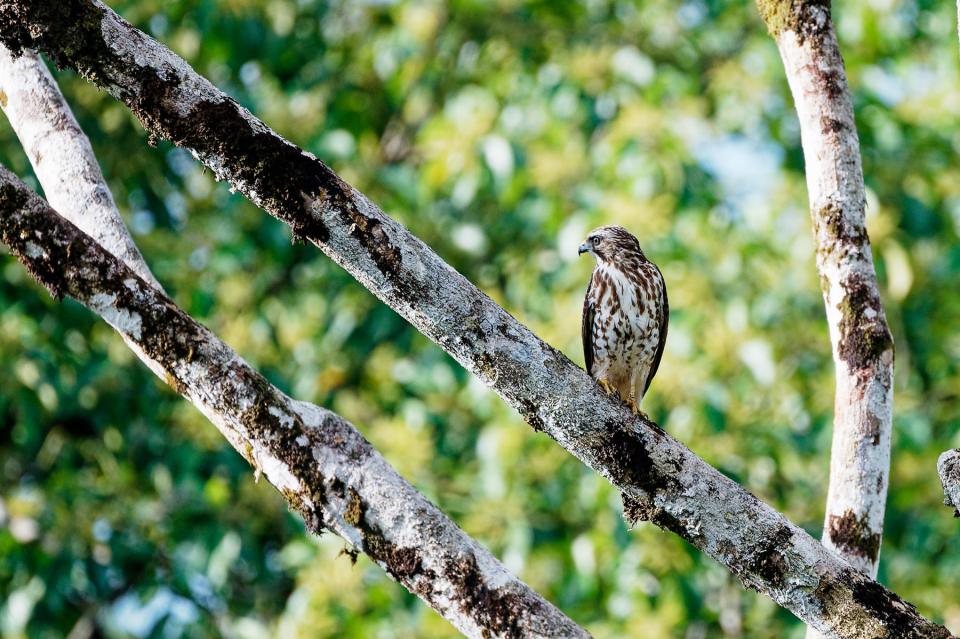
A Broad-winged Hawk was a little more obliging.

But we had a couple of gigantic insects on our veranda: a couple of Giant Katydids – each about 4 inches long not counting antennae

and, most impressively, a Dead Leaf Moth, one of the Giant Silk Moth family.

Here it is with a light switch for scale – it was the size of my hand.

So we said goodbye to Sumi and Raj, and Matthew and Jean-Pierre (lovely guys, but expensive acquaintances, these two – discussions with them have simply increased the length of the list of places we now want to visit) and, of course, Sebastien and Christophe.

Our four days at the Lodge were a superb, relaxed, comfortable, enjoyable and good-humoured counterbalance to the intense days that preceded them. Sad as it was to leave, our next destination, the Finca Rosa Blanca in Heredia, beckoned.

Heredia is, like Alajuela, where we stayed on arriving into Costa Rica, a suburb just north of San José, not too far from the airport. Since Drake Bay has its own airport, a flight from one to the other is the logical way to travel between the two. But first we had to endure the road from the Lodge to the airport, which was quite as bad as anything we’d encountered when we were driving ourselves around, But we made it OK, to a very tiny aerodrome,

where we checked in and were given our boarding passes.

There was no air conditioning in the building, but a very hot and humid day was somewhat mitigated by the giant fans in the roof – three of them in total.

We were amused by the manufacturer’s name, which had a distinct Ronseal overtone it it.

Our aeroplane, we discovered, was a Cessna Caravan (C208B for the aeroplane afficionados among you), which flew in and was swiftly loaded with the passengers’ bags.

and we rather informally wandered out to it

and boarded – 12 passengers and the plane was full.

Jane made an inspired choice of window seat, so I brutally dragged her out of it so I could take photos as we went along the 40-minute journey.

We had to wait a few minutes in San José airport to make contact with the driver who was to take us onwards, but Jane eventually found her and off we went, past an example of a sign I had been wanting, childishly, to take a photo of ever since we’d arrived.

Get your ferrets here! 😉

Yes, I know it’s an ironmongery. It still makes me chortle because I haven’t grown up properly yet.

San José’s main roads are fine, but as soon as you get away from them the surfaces deteriorate alarmingly and we did a fair bit of crater and pothole slaloming as we went along. But we made it OK to Finca Rosa Blanca, which will be our final resting place in Costa Rica; we have two nights here. We were welcomed and checked in in a very smooth and professional fashion and whisked along to our room to settle in.

It’s a funny old place – architecture somewhere between César Manrique, as we saw on Lanzarote recently, and the confected appearance of Binibèquer Vell, where we stayed one night in Menorca.

The entrance hall to our apartment is, well, entrancing.

Our entrance hall

and the pool is a thing of joy,

lavishly decorated.

The site has an “Old House” – once the building where all the accommodation was, before more modern apartments were added.

It’s a resort, with reasonably substantial grounds, but based around a function that I will reveal to you in the next post. There. Can’t wait, can you?