Tag Archives: Tourism

Ice and No Fire

Thursday 8 September 2022 – I hope you like photos of scenery, glaciers and waterfalls, coz there’s rather a lot of them here.  If so, please read on…..

As far as we could find out, there was no reason for us to avoid going to Jasper.  The news was that the entire town of Jasper was without power, but the Fairmont Jasper Park Lodge, we were assured, has its own generators, and the Icefield Parkway was, according to the Park’s Facebook site, still open.  So off we set.

Well, there was one thing we had to deal with first – sunrise photography.  I awoke at around 0630 without the necessity for an alarm call, and peeped out of the window to see whether conditions were going to favour mucking about with photography that morning.

That was an encouraging sight, so in between the various parts of getting up and packing ready to leave, I occasionally took a photo as the light developed.

At about 0715, a tiny breeze ruffled the surface of the lake

and I decided that I should hasten down to the shore to get a different viewpoint, preferably one without a bloody tree in the way (so Rocky Mountains, that) before the reflections dissipated.  I was down and by the lake in five minutes, by which time the scene had changed dramatically.

— ANOTHER PHOTO DIGRESSION; FEEL FREE TO SKIP —

Having zoomed in to take the shot above, I noticed that my camera was making some odd choices about the light.  This is the colouring it saw

which was greatly different from what my eyes were registering.  Its decision about colour balance (a very low colour temperature of around 4,500K) was different, in that zoomed-in shot, than it had been a moment earlier for the wider scene (around 10,500K).  I tinkered for a while with setting a different white balance on the camera, but settings of Sunshine and Cloud made no difference. In the end, I put the camera back on auto White Balance and adjusted the colour balance when processing the RAW image(s) in order to get nearer what the human eye (or at least my human eye) was seeing.  This is another reason for shooting in RAW – it permits adjustment of colour balance without losing any image data, which is not the case for jpegs.

— END OF DIGRESSION; WELCOME BACK —

By 0735, the light had developed to this

and I started looking around for different framings, such as a little foreground interest,

and then the breeze, which you can see ruffling the water in the distance in the above image, rose just enough to eliminate reflections, signalling the end for me (and the dozen or so photo diehards who were also there; the idiots shooting selfies carried on prancing and posing because the truth is that they don’t give a stuff about the beauty of the image).

We left the hotel at about 0930, with a general intention to drive the Icefield Parkway and a specific objective to arrive at the Icefield Discovery Centre at about 1300, as we had booked An Adventure!  The Parkway is billed as a hugely scenic drive, and it is – it is gated and you have to buy a permit in order to drive it (CAD 18 for us two seniors).  I was driving, and while our rental car’s Lane Assist function would have allowed me to take photos from behind the steering wheel, I thought it best to leave Jane to spot and take images whilst we were actually under way.  The scenery is, indeed, truly immense.

Every so often there is Something To See that’s off the road itself, and so we joined the stream of people stopping, leaping out of their cars, taking photos (even occasionally without themselves in them) and then leaping back behind the wheel and zooming off to the next Thing To See.  I’m being sardonic, here, but the sights are lovely, even if the photos are, by definition clichéd. For example, Bow Lake gives plenty of scope for photos conveniently near parking places.

In the above photo, you’ll notice a red-roofed building.  It turns out to have the endearing name of Num-Ti-Jah Lodge

and nearby there are several more nice views.

Further on is Peyto Lake, which offers some more wonderful views.

Like many of these roadside stops, it has toilets; these are basic unplumbed cabins with a stool and not much else. But the Peyto Lake ones had rather fetchingly been decorated.

More Big Scenery ensued

on the way to our next stop, the Mistaya Falls.  As well as being attractive, as most decent-sized waterfalls are,

these are unusual in the shape of the channel that the water has carved out for itself, which is very twisty.

The viewpoint also provides a morning workout on the walk back up to the car.

You’ll not be surprised to learn that the Big Scenery continued to wow us as we moved on

and it became clear that we were coming into Glacier Country.  There was the occasional distraction on the road,

but we made it unscathed to our Adventure!, which was hosted by the Columbia Icefields Discovery Centre.

We boarded a coach which took us a little way down the road, where we boarded a “snowbus”, (to, for, by, with or from snow) with Murray as our driver/guide.

These snowbuses are very specialised vehicles; there are only 25 in the world and 22 of them are here at the Columbia Icefield. (Since you ask, two of the others are in Churchill on Hudson Bay and the final one is in the Antarctic.) The terrain we would cover was not something any conventional vehicle could cross, so he bade us fasten our seatbelts and not stand up whilst he was driving, even though the typical speed was about 4 kph.  The designers were parsimonious in the extreme with the legroom allocated to each seat, so I was jammed in with no risk being dislodged by anything short of the sort of explosion which would have done for us all anyway; but I buckled up, as did everyone else; and we headed on to an actual glacier.  Looking out of the bus windows, we could just make out some figures on the ice

(see the little dots by that boulder?), and soon enough we trundled (slowly!) out onto the Athabasca Glacier, where we were allowed to step out on to the ice.

We were joined by other snowbuses from the centre

and pretty soon the bounded area we were permitted to roam was quite crowded.

Photo opportunities, unsurprisingly, abounded: close-ups of the Athabasca glacier higher up

displaying that wonderful blue colour that glaciers show (among all the dirt and rock they collect as they move); photos back to the Discovery Centre at the foot of the opposite side of the valley

where, incidentally, the Athabasca Glacier once reached, giving a clear insight into how much and how fast it is receding; and photos of various other glaciers

all of which are fed by the vast area of the Columbia Icefield – the largest area (200 sq.km) of glacial ice in the Canadian Rockies, the edge of which is visible as a layer in the above photo, and which extends back over the tops of the mountains.  An icefield, we learned, is different from a glacier – an icefield is stationary and the snow falling on it and being compressed under its own weight, feeds the glaciers, which move. The Columbia Icefield feeds five glaciers and meltwater from those glaciers feeds into three oceans – the Pacific, the Arctic and (if you include Hudson Bay as part of it) the Atlantic.

The Athabasca glacier is pretty swift. It moves 30 metres a year, apparently; but its replenishment is only 25 metres’ worth of glacier, so it is thinning and receding, as is almost every glacier in the northern hemisphere.

Having spent our 30 minutes on the glacier (including a very suspiciously-coloured patch of ice among the blue)

we got back into the snowbus and thence transferred to a coach that took us to the Skywalk

which I found a bit difficult to understand until I saw the meat of it:

a walkway jutting out from the cliff face – a remarkable feat of engineering.  The trail leading to it has some nice artistic touches

and enables views of the valley below

(that’s the Athabasca River, by the way). One then gets to walk out on to the glass floor of the Skywalk

after being careful to follow instructions.  It’s a sturdy glass floor

and the Skywalk offers some great views of the valley and some of the glaciers.

The Skywalk itself is pretty neat.

In the middle, back to camera and wearing a woolly hat, was a chap who was offering to take photos of people for them.  I think that was his job; if he was a professional photographer, he may well have been wondering what it was he did in a previous life that condemned him to such a role; but it gives people joy, so (through gritted teeth) good luck to them.

We were bussed back to the Discovery Centre, where we had a coffee and a last look at the glaciers in the surrounding area.

Above is the Snowdome; you can see the thick layer of ice on top of it, which goes to feed the glaciers.  We had a good view of the glacier we’d been on.

There, if you look carefully,

you can just make out the snowbus and its people.

It was as we queued for our coffee that we learned of the death of our Queen. Having generally kept up with developments, we’d known that this was not unexpected; but it was still sad news and we paused for a moment of reflection and respect.

As we drove on, there was – goodness me! – more Big Scenery. By this stage we had only two more planned stops, both waterfalls.  The first was the Sunwapta Falls

which, like the Mistaya Falls, were splendid without being spectacular, and finally the Athabasca Falls

which were a great deal bigger; something even an Icelander might make a foss about.

That was the final official Thing To See of the day as we made our way towards Jasper, but there was still some Big Scenery on view as we neared the town.

Our hotel was the Fairmont Jasper Park Lodge, a large and pleasant resort, with many attractive, if well-used, cabins spread across a wide area.  It was well after the cocktail hour by this stage, so we didn’t stop to take any photos of what looks like a very photogenic place; more in my next post.  Once we’d conquered the navigation of the site to find our room, we simply headed for the main lodge and a welcome drink and evening meal.  We had a small surprise on our walk back to our room, though:

A. Elk, who may or may not have a theory which is hers*

In fact there were four of them – two adult female elk and two younger ones – calmly helping themselves to the grass and shrubbery on offer.

On that interesting note, we ended the day.  It’s been a long one with a huge amount of fascinating things to see – with, fortunately, good weather and no smoke from the fires which are still affecting the area. So; since you appear to have made it this far, thank you for reading about it.  We may well have a quieter day tomorrow; please come back later and find out.

*  Monty Python sketch from the early 70s

Rocky Mountain Hire Car

Tuesday 6 September 2022 – We had a simple task today: transfer from Banff to our next hotel, the Fairmont Chateau Lake Louise, some 38 miles away along the Trans-Canada Highway.  Mode of transport – hire car; Google maps estimates the journey time as just a smidge under three quarters of an hour.

It took us all day. It included some two hours of walking. Obviously.

This is not, I should say, because we had any significant problems, although the guys at Avis increased the  chaos level of the start by initially handing us the keys to The Wrong Car; it was because Jane found us Interesting Things To Do On The Way.  The combination of Jane’s organisational skills and Google Maps’ dispensing of local knowledge is truly a thing to wonder at.

So, no, we didn’t drive directly the Lake Louise and sink gratefully into a hot bath or a cold cocktail.  We wouldn’t even have started out on the Trans-Canada Highway (Highway 1) had a section of the alternative Bow Falls Parkway (Highway 1A) not been closed.  However, closed it was, so we took Highway 1 until the relevant exit and backtracked in order to get to our first Interesting Thing To Do – Johnston Canyon.

Almost immediately we left the main road, a photo opportunity arose around a bridge, a river and a mountain.

The bridge has no name and is simply in a photogenic location rather than being itself a thing of beauty; but it does have an osprey’s nest in it.  The river is the Bow River, whose eponymous Falls we had seen in Banff and which was still a very fetching shade of glacial blue. The mountain is Castle Mountain, which you may recognise (because you have been paying attention, haven’t you?)  from photos from different viewpoints in previous blogs. It was once renamed Eisenhower mountain in recognition of the enduring legacy of Dwight D. Eisenhower’s impact on North America.  Reportedly, he was such a humble man that he never really saw the need for this recognition; and in any case there was something of a backlash from the locals who hadn’t been consulted on the name change. So its original name was restored, but the peak on the right hand side is called Eisenhower Peak.

This was the first digression, but we were soon at the attraction which Jane had planned we should visit.

(I find the French naming of these things amusing.) This canyon features a largely paved walkway beside the river which carved it out in the first place

and shows its glacial origins by its colour.  The walkway leads to Lower Falls and Upper Falls, and is a popular family day out – the walkway was quite, but not intolerably, congested. (We had to park in the overflow car park, which was about a quarter full. Gawd alone knows how packed the walkway would have been on a busy day.)

There is a bridge over the Lower Falls which leads to a small cavern giving a special viewpoint but which can only accommodate about two people at a time; this was obviously a popular activity, with a slow-moving queue.

We took a look at the falls, which are very attractive, although any Icelander would look at this and think (in Icelandic) “Hah! Making a foss about that?” *

We couldn’t be bothered to investigate the possibilities offered by the small cavern, so headed towards the Upper Falls.

Not very far, as it happens. The route thither was closed for “construction work”.  Never mind, we enjoyed the digression overall.

The overflow car park I mentioned had decent washroom facilities

which I schoolboyishly decided meant you could only pee on the left and poo on the right.

Our continuing journey took us back on to the main Highway 1, which rather nicely features wildlife corridors every 10 km or so, enabling animals to cross safely.

The scenery was quite striking, with lumpy bits and glaciers becoming more common.

Our next Interesting Thing To Do was, indeed, very interesting indeed; something that Jane had learned about on the Rocky Mountaineer whilst I was absent taking photos out of earshot of the commentary – the Spiral Tunnels.  Near a town called Field are two tunnels, completed in 1909, which twist trains back on themselves as a way of enabling transit without an unacceptably steep gradient – the steeper gradient had been tried but fatal derailments and runaway trains rendered a different solution necessary.  The link above explains how the tunnels work, but the practical upshot is that a train going through the lower tunnel twists back such that you can see it both coming and going, as it were.  We were fortunate that a long freight train was indeed going through it as we passed, so I tried to convey what goes on with a video.

The carriages barely visible through the trees in the foreground are towards the rear of the train; the middle of the train can be seen entering the tunnel in the background; and in the middle is the front of the train, having gone through the tunnel and turned through 270° before exiting, so now apparently moving in the opposite direction to the other parts.

Helpfully, there is an information board

and a model.

I hope that’s clear, then?

Field itself, although an unprepossessing town, is noteworthy for its proximity to the Burgess Shale – fossil formation containing remarkably detailed traces of soft-bodied biota of the Middle Cambrian Epoch (520 to 512 million years ago), and presumably discovered by an archeologist on a Field trip.  Thank you.  Thank you for reading my joke.

Our next stop was at a thing called the Natural Bridge.  I had no idea what this translates to, but it sounded intriguing and there were signposts, which made it easy to find and gives it credibility as an Interesting Thing To Do (ITTD).  Near it, Jane found a signpost which amused her.

I should point out that part of the Burgess Shale is the Mount Stephen Trilobite Fossil Bed. So, there.

The Natural Bridge is quite a sight (and sound).

and the colour of the water shows that it’s glacial in origin, although the silt level is very high, giving it a grey, milky appearance.

Google Maps asserts that there are Lower Falls a short way along a trail, and indeed there are, but getting a decent photo of them required determination, courage and mountaineering equipment.  Jane clung on to a tree whilst hanging out over a chasm to bring you this image

which is not at all bad, but it doesn’t do it real justice.  No matter; we had seen what a Natural Bridge looks like.

Our route to our final ITTD went by some more striking scenery.

(The Rocky Mountains really does this sort of thing rather well, wouldn’t you say?)

Paula and Sandrine, friends we had met at Farewell Harbour Lodge, had told us that their itinerary included staying at the Emerald Lake Lodge, and this sounds like it has definite possibilities as an ITTD, so we headed there.  Its ITTD cred was boosted by a car park full to bursting, so we had to park half a mile away along the side of the road.  As we walked towards it, I was wondering what we might see, when, through the trees I glimpsed something that gave me a bit of a clue.

It’s a lake whose glacial waters give it a green colour

although Jane asserts that it’s more turquoise than emerald, and who am I to argue? Anyway, the lake is very scenic; beside it is the Lodge, which consists of some equally photogenic accommodation.

Here are some more of the lakeside scenes.  I’m particularly fond of the last image.

The Emerald Lake was the last on today’s ITTD list, and anyway it was past earliest check-in time at the hotel, the Fairmont Chateau Lake Louise, so we headed there next.  Everything about it is huge

including the queue for someone to park your car for you – I wasn’t going to try it for fear of getting lost for days in the underground car park.

That’s how a 38 mile car journey can take all day and involve walking for a couple of hours.

Having heard that everything gets booked up here, we had in advance booked an early dinner in the Lakeview Lounge, which is quite aptly named.

and we enjoyed a very decent dinner which would have been dietetically blameless except for the gins.  But it was Gunpowder gin, which we’d first tasted through the good offices of friends, and so it would have been rude not to indulge ourselves.

After such an active and Interesting day, one might have thought we would retire quietly to our room and take things gently for the evening.  So we went for a walk. Obviously.  Well, the lakeside looked so pretty, we couldn’t resist.  And it was very scenic, walking along the north shore of the lake taking photos as the sun set.  The light was very interesting at times

and we managed to avoid the crowds of people who imagine that their presence in a photo improves the scene – there were a lot of these.

The hotel itself provides some nice framing opportunities

but the walk along the north shore, in dead calm conditions gave some lovely images.

And so, as the light finally faded

it was time for bed, as we had to set the alarm for 0500 in order not to miss tomorrow’s first ITTD.  You’ll have to come back tomorrow to find out what that was…..see you then.

*Foss is Icelandic for waterfall.

Rocky Mountain – Higher

Monday 5 September 2022 – We only had one item on the plan for the day, which was to travel on the Banff Gondola. The bottom station is a little way outside town, but there’s a shuttle bus and a kind soul at the hotel reception had provided us with passes that meant we could travel there for free. The bus stop was conveniently directly outside the hotel; we climbed aboard and were wafted electrically through the town and out the other side to Sulphur Mountain. The last hundred metres or so were rather slow, the reason being traffic congestion for this popular attraction, but we arrived well before our appointed departure time, wondering how they were going to manage the logistics.

As it happens, they didn’t. The queue for those who had tickets (we did) was very short

and they were happy to let us through early. I infer that the “departure time” idea is simply a matter of attempting to manage the flow of punters; there are ticket desks beside the entry queue and if it becomes popular, I suppose that ad hoc ticket purchasers will be given a later time and simply have to wait to board.

The setup is very familiar to anyone who has ridden a gondola elsewhere in the world. The Banff setup has 40 cabins each of which can seat up to four people; the cabins come round slowly to make it easy to board and then, once aboard, they whoosh down a rail to get up to cable speed and off you go. The only difference from other gondolas I have ridden was that the cabins were manhandled around (mostly by Australians, it seemed) at top and bottom instead of being moved along by machinery.

The ride up is fast and smooth, and small open windows allowed me to poke a lens out and get some nice photos of downtown Banff as we were whisked upwards.

If you know where to look (top right) you can even see our hotel.

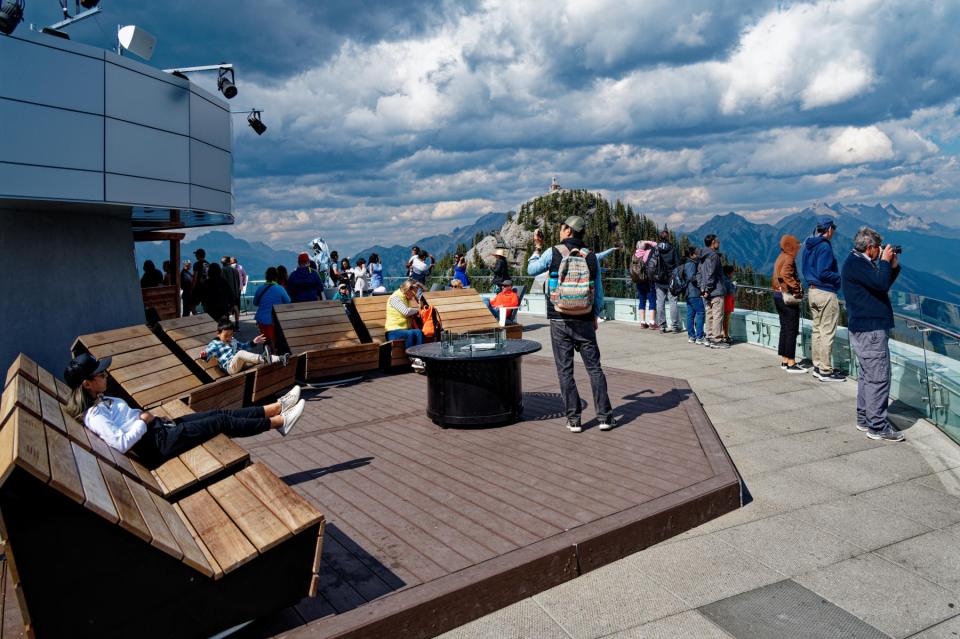
The top station is a very substantial 4-level building, offering coffee stops, a restaurant, a patio/observation deck and

a gift shop. Your exit on to the observation deck is greeted by a grizzly bear statue.

The observation deck is understandably popular

and the view from the top is wonderful, as one might expect.

There is a one km boardwalk leading to an adjacent peak

which has 83 steps down and 296 steps up; from that peak you also get some great views, including back to the top station itself.

On the walk over, we were joined by some wildlife which didn’t seem to mind humans much at all.

I’m not sure what the first bird is (maybe a Black-Capped Chickadee), but the second is a Grey or Canada Jay, unofficially Canada’s National Bird.

We also think we saw a Clark’s Nutcracker, which we’d learned about yesterday with Geoff. It has a fascinating partnership with the Whitebark Pine; it has learned how to eat the seeds from the tree’s pine cones – even to the extent of developing a special sublingual pouch where it can store dozens of seeds – and in a mast year there are too many seeds for the bird to eat, so the uneaten ones germinate and the trees spread. Much like the relationship between our Jay and Oak trees in the UK…

There was some great light playing across the views to bolster my photographic day.

After a short while and a coffee break, we headed down again. As we went, I wondered where this gondola fitted in to the skiing setup of Banff. From later research, the only conclusion I can come to is “not at all”; there are no obvious pistes leading down from the top station – just a walking trail for those of a hardy disposition – and all the ski maps I can find for Banff are of other places. So the Banff Gondola is not a skiing installation, but a tourist attraction. This explains the gift shops at top and bottom, which are rare in my experience of European ski lifts.

Back at the bottom, we caught the shuttle towards town, but got off a few stops early to have a look at the Cascade Gardens. These surround the National Parks administration building, itself quite an imposing edifice

from which decent views back over the town are available.

The gardens were originally developed in the 1930s and have since attracted some investment from China, which makes them popular with Chinese visitors, of which there are plenty. To get the photo above, I had to quickly dash in to the viewpoint where there is a perpetual queue of people taking photos of each other.

This urge to believe that an image of some pretty or impressive place can be improved by having oneself in it is something that I find difficult not to get enraged about, but then I’m just a grumpy old man. People doing selfies made it difficult to get decent pictures of the rest of the gardens, but we persevered and got one or two.

After the gardens, it was getting towards time for our late lunch, or, as they call it here, “dinner”. We dropped in to the rental place whence we should pick up a car tomorrow to chat, but there was no-one there except a customer sitting on the floor awaiting the return of staff with a car for him. To pass the time we set out to wander about a bit and ended up heading towards the Banff City Sign. This is A Thing, apparently – we’d had someone ask us where it was the day before, so we thought it might be worth going to. We did get there, and saw that it was crowded with people getting their photo beside it,

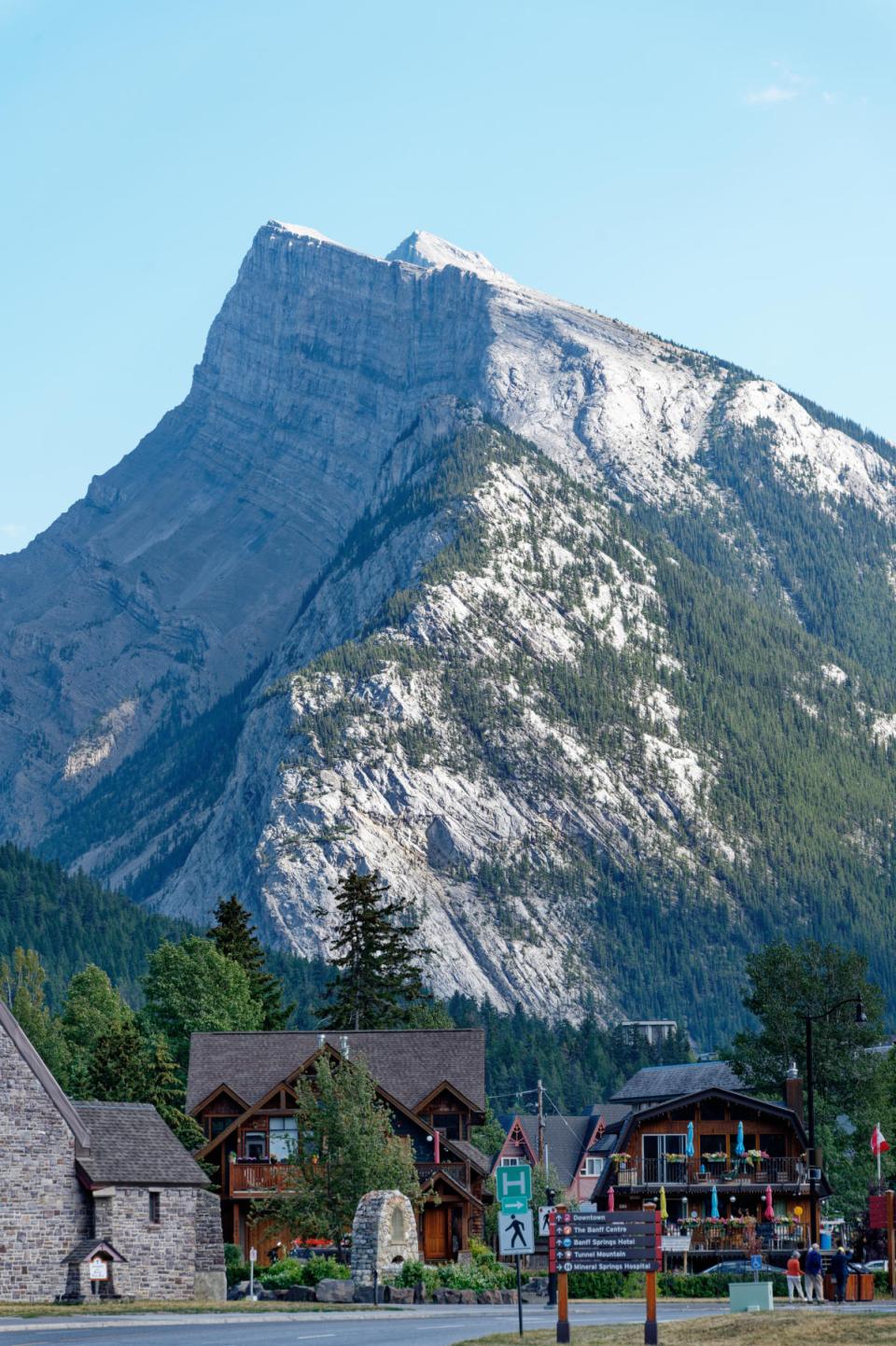
so I simply got a photo of the “ffnaB” sign and we turned back towards the town. There was still some great light on the mountainous backdrop to town buildings.

The chat with the car hire desk chappie was very brief as he was still dealing with the customer we’d seen earlier, so we just headed to the Maple Leaf restaurant – a recommendation from Geoff the guide – where we were eventually permitted to have a very nice lunch/dinner (delete as your culture dictates). They didn’t start serving food until 5pm, so we had to wait a while, but we bore this burdensome setback with heroic stoicism, a seat outside and a cocktail each.

After the meal we walked back to the hotel and indulged in further wedded bliss, with me writing this blog entry and Jane doing a bit of ironing from yesterday’s laundry, accompanied by Nice Cups Of Tea. Tomorrow we leave Banff for nearby Lake Louise, or at least we will if all goes well at the Avis desk; the journey there is short, which leaves time for some diversions on the way. I believe Jane has a plan for this. Come back tomorrow, and find out if I was right, eh?