Tag Archives: Tourism

Plane About in Ottawa

Sunday 18 September 2022 – The weather forecast for the day was rather wet and gloomy, and in any case we’d explored most of what was accessible on foot from the hotel, so we made a plan that said we’d take the hop-on-hop-off bus to view the further reaches of the city.  So, how was the weather?

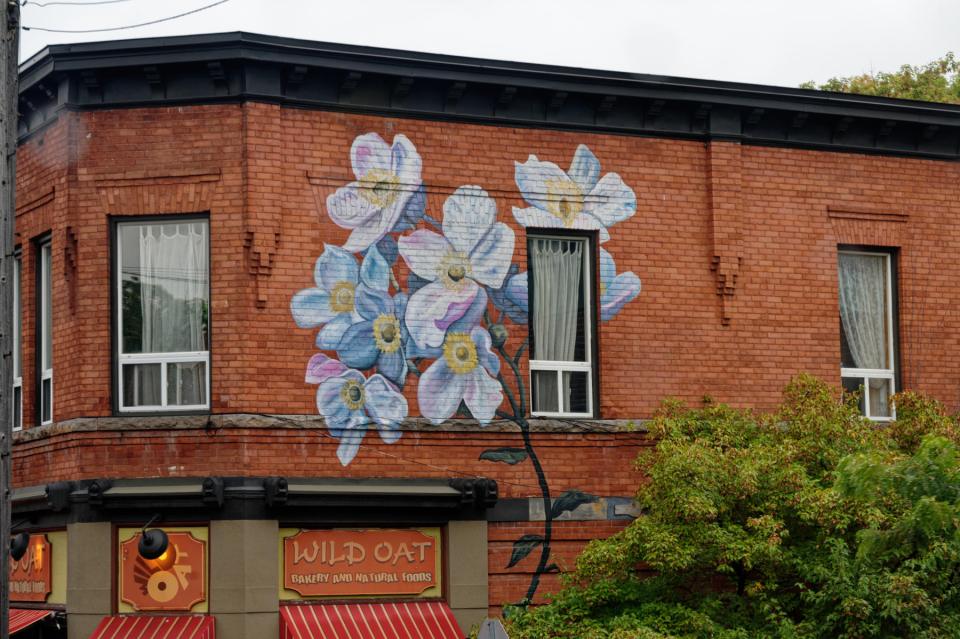
At this point in the day, it was drizzle rather than historic rain (and I wonder if anyone in Canada had thought about labelling this image “A Historic Reine” as a sort of bridge between English and French-speaking locals?).  What rain that there was made photography from the top deck of a (closed-top!) moving bus rather tricky.  We managed a couple of shots of passing street art

and decided that the only destination worth getting off the bus in the rain for, was the Aviation and Space Museum, which has a mind-boggling display of aircraft of all sorts,

as well as a much smaller area dedicated to satellites and other Space-related materials.

There follow a number of photos of aeroplanes, for which I make no apologies, as I’m passing interested in them, particularly historic ones; and there’s a decent joke towards the end, so it may be worth your while reading on.

We accidentally timed things right such that we were able to join a guided tour, which went round highlighting certain areas where planes were grouped.  Early Aviation had a section and featured this original Blériot XI, which was a huge commercial success for Louis Blériot after his pioneering flight across the channel.

World War I had a section, of course.  It contained a version of my favourite WWI aircraft, the Sopwith Camel (from reading Biggles books as a lad), modified to launch from a ship.

An intriguing section was dedicated to “Bush Planes”, a term we hadn’t come across before, and which means aircraft modified to meet the unique travel requirements of Canada’s wild northern regions (i.e. no runways and no airfields but lots of rivers and lakes). Below is a reproduction of one of the first attempts, with, next to it, the remnants of the original as eventually extracted from the lake it crashed into after an unsuccessful landing.

Also on display was a De Havilland Beaver, probably the most successful Bush Plane in Canada’s aviation history, here shown with the unprecedented volume of cargo one could fit into it and still be able to get airborne. One certainly managed to ferry us from Victoria to Farewell Harbour earlier in our trip, as you will remember because you were paying attention, weren’t you?
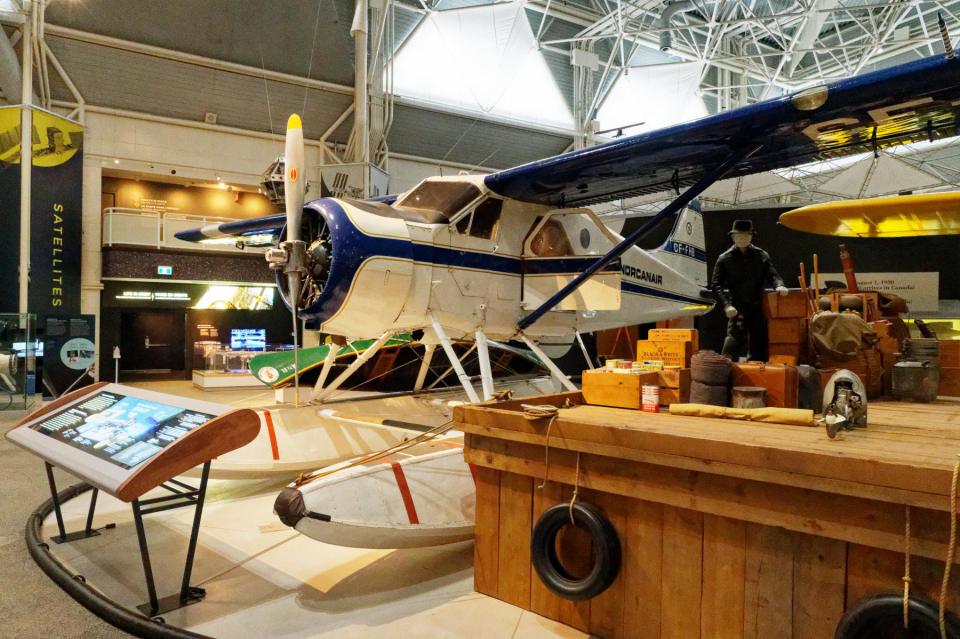
An interesting angle on Bush Planes is shown with this Junkers W-34, a plane to which one could fit floats, wheels or skis to help access a variety of terrains.  You can see a model of an airman taking a wheel off, presumably to leave the floats active.  To do this, he had to lift the plane somehow, and the exhibit shows that he had to chop down trees to make logs to use as a crane, rig up ropes to lift the plane and be able to change its undercarriage type.  He was alone, so he had to be pilot, navigator, mechanic, lumberjack and structural engineer, all rolled up into one.

Of course, aeroplanes were used to distribute mail, but in the severe winters, landing and taking off could pose a problem if the fuel lines froze. The solution was to have a hatch in the floor of the aircraft so the mail could be parachuted down.

There was, of course, a section dedicated to WWII aeroplanes.  One display had a Hurricane, a Spitfire (another plane I love) and their enemy – a German ME 109, which I’d never seen close to before.

The museum has a Lancaster, the first time I’ve ever been in the same room as one. It’s their biggest exhibit in the hangar, displayed with bomb bay doors open to show how the passing air would arm the bombs by spinning their propellers, before they were dropped.  This was OK provided all of them were dropped, but problems were inevitable if something prevented dropping the entire load of up to seven bombs, as landing with an armed bomb under the pane was bound to end in tears.

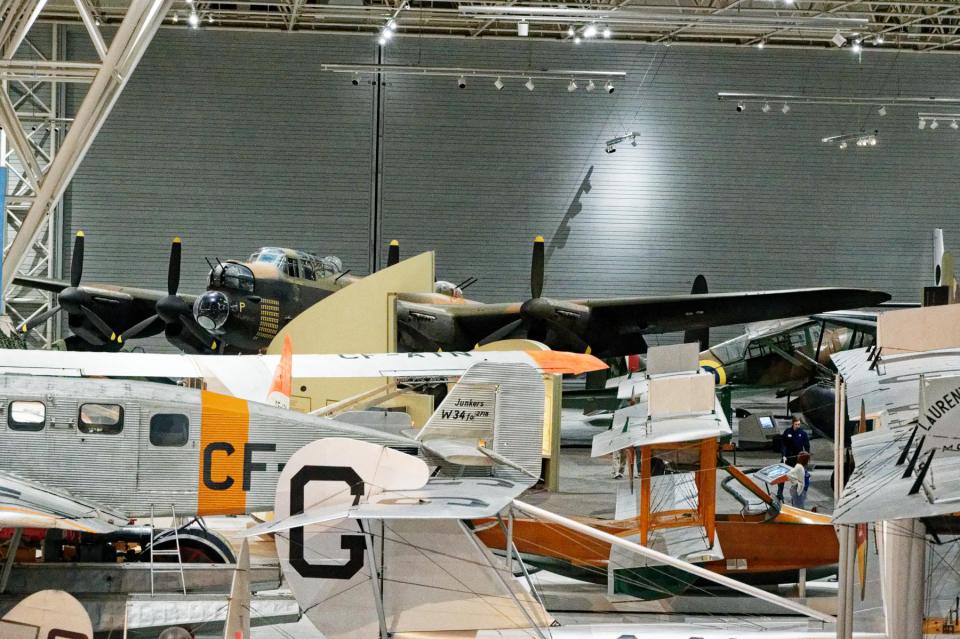
There were also several aircraft from the Cold War era, such as this Lockheed Martin F18 (foreground) and Avro Arrow (background).  The Arrow was far more advanced (Mach 2.5) than the F18 (Mach 1.8), but never made it into production and all examples destroyed save the portion on show here.

We learned that many aeroplanes used as trainers were painted a bright yellow.

This served several useful purposes: identifying aeroplanes to steer clear of if in operation; making it clear that they were not combat aircraft; and making it easy to find the pieces in the event of a crash.

There were several charming elements in the display, such as this helicopter with its rodent grin;

a rather poorly-placed warning over an aircraft’s gun

since if you were able to read it you were already in serious danger; and toy planes for the kids to whizz about on;

One exhibit was called an “ornithopter”, which I was very curious about, having had my head filled with images from sci-fi books and films such as “Dune”. It turned out to be “Snowbird” – the first successful human-powered aircraft – very light, and with an enormous wingspan.

And so passed an enjoyable 90 minutes at the museum.  But I can’t allow you to leave without the joke I promised.  In all of the aeroplane exhibitions I’ve seen before, the plane were all “ours”, i.e. British/Allied, rather than enemy.  By having at least one German plane on display, this museum allowed me to show you a picture of one of them Fokkers. (Decent joke??? Hah. Ed)

I suppose using the hop-on-hop-off bus to visit just one place in Ottawa wasn’t the most effective use of resources, but we really enjoyed the museum and did get to see some other places outside the immediate environs of Parliament Hill, albeit not very clearly.

We had to scamper rather back to the hotel, as it was raining heavily by that stage. But after a late lunch/early dinner the rain appeared to have abated, and we needed a reason to shake down the food (and gin).  So we went for a stroll along the banks of the Rideau Canal in the gathering evening.

We passed the Senate,
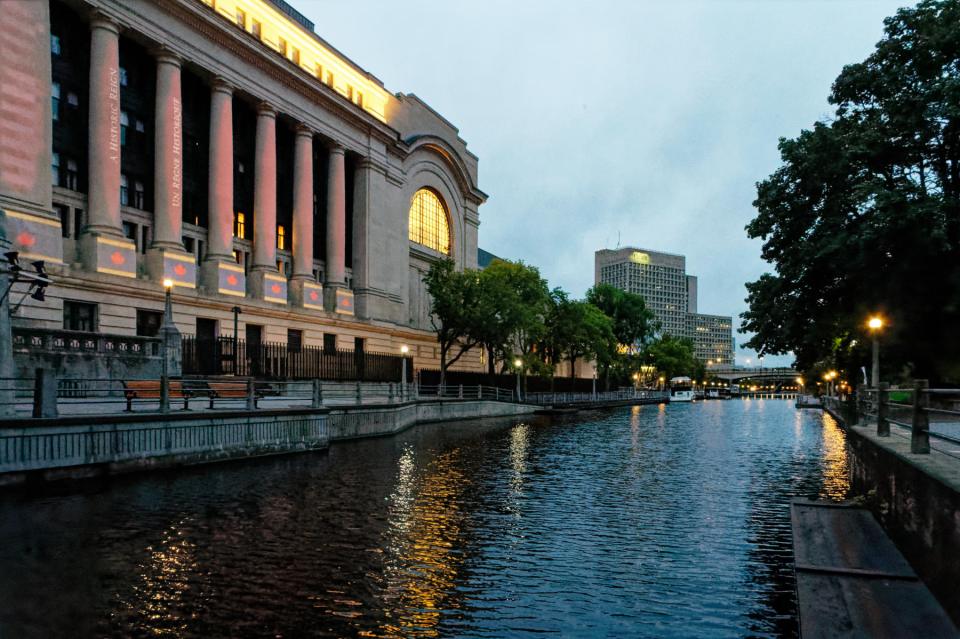
the Shaw Centre (what is it with Canada and GBS? Anyone?),

an odd-looking boat outside the Shaw Centre,

some bridges,

(the second of which we used to cross the canal and walk back on the other side), that boat again

(very strangely laden), and our final glimpse of the city and Parliament.

This pretty much ended our time in Ottawa.  Because of the overwhelming presence of government, it’s a slightly odd place, but one we found it very enjoyable to learn about and walk around.  Tomorrow we must leave, taking another Via Rail journey to Québec, where we have a Fabulous Country Tour awaiting us.  Let’s hope the weather is clement; please come back in a couple of days to find out.


Ottowa – Capital!

Saturday 17 September 2022 – As promised in my last entry, I have spared you my ramblings for a whole day, so here’s a catch-up of what we got up to yesterday.  The train trip from Toronto to Ottawa the day before was almost entirely unremarkable and quite pleasant.  We were on Via Rail, travelling business class, which is something I would recommend, as it saves a lot of queuing – queues to show your ticket, then queues to get on the platform are the lot of hoi polloi in the bilges.  We were wafted on to a carriage with comfortable seats, free drink and lunch, power for our computers and a reliable WiFi that lent some purpose to having the computers with us.  There were several stops en route, and we arrived in Ottawa some 30 minutes late, but we weren’t in a hurry.  A short taxi ride then got us to our hotel, (yet) another monumental Fairmont slab of masonry

the Château Laurier.

Today’s formal content was a walking tour of Ottawa, billed as free, but with the expectation set that tips were expected. At the appointed hour we met our guide, Craig

who has a real job of teaching history, but who started doing the walking tours 17 years ago and now has a company employing about 15 guides.  I’m glad we got the boss – he is knowledgeable, entertaining and very well organised; he shepherded a group of 17 people around for two and a half hours without boring or losing any of us and we thoroughly enjoyed it.

Ottawa is a strange place, for a number of reasons.  For a start, it’s the home of the government of Canada, and so there are numerous Parliament buildings on, unsurprisingly, Parliament Hill: centre block, with the Peace Tower;

West block, the House of Commons, home of the MPs; and East block, where the senators have their offices. Behind the centre block is the Parliamentary Library, of which more later.

In most of my photos of government buildings, I apologise for the presence of cranes and other signs of construction, but these are impossible to avoid, as The Construction (referred to by locals with implicit capital letters and normally through gritted teeth) is something that has been ongoing for a long time, in some senses for over a century. In 1916, a fire started in the central block, and some bright, erm, spark, thought to close the massive doors between it and the Library.  So the library was saved, but the rest burned down and has been rebuilt.  The Central Block is now being refurbished, so is unused – the Senate debates at Union Station – a mini replica of the original Penn Station in New York – down the way

and the Commons is in the West Block.

The West Block, by the way, has been completely rebuilt, brick by brick.  When The Construction started refurbishing it, the mortar was so fragile that the walls started to collapse as they were being sandblasted, so it was taken apart, and all the bricks individually cleaned, numbered and then used to rebuild.  So it is a modern building

with a copper roof which is still copper-coloured. Look across to the East Block

and you can see what 150 years of weathering does to a building.

The Canadian political system, with its two houses, is similar to the UK’s and is basically adversarial.  In that sense, Ottawa is split.  In a strictly geographical sense it is also split almost exactly in half.  The Parliament buildings are in the Upper Town, which, in the early days of the city, was the Posh Bit, designed and built by largely English and Scottish Protestants.  As such, streets like Spark Street, leading away from Parliament Hill, display architecture that would be familiar in London or Edinburgh

(although the buildings may state that they are “Bank of Nova Scotia” or similar, the government basically owns all of Spark Street, so all of the buildings are government buildings; any shops are leased from it). Government is way, way the most important part of Ottawa’s business, about 60% of the population work directly for the government or its agencies; high tech is second, with many of the big IT names having their Canadian HQ in the city; and tourism is third.

Crossing the Rideau Canal

takes you into Lower Town, where the buildings display a basically French architecture; many would seem at home in Paris.

The Lower Town is home to the Byward Market district, which is the entertainment centre of the city.  So there are profusions of cafés and restaurants, some of which are in very French-style courtyards.

So, why the split?  It was a direct consequence of the creation of the Rideau Canal, a 202km waterway connecting Ottawa to Lake Ontario, dug entirely by hand (no machinery at all) and opened in 1832 as a precaution in case of war with the USA who might then assert control over the Great Lakes and their rivers.  The labourers – 40,000 of them – were almost entirely French or Irish (hence Catholic), and made their homes on the Lower Town side of the canal route, hence the architectural – and indeed cultural – divide.

By the way, the relations with the USA remained cordial, so there was never a need for the Rideau Canal, which remains open these days for pleasure boating from April to October, when the locks are in operation, as seen here when a bunch of Rangers were making their way through by the hotel.

In Winter the canal freezes, of course, which creates the world’s largest skating rink – 7.8km long, and used not only for a bit of fun skating but also by people commuting to work in the winter. It, and Dow’s Lake which it leads to, is a UNESCO World Heritage site.

We saw a lot of other interesting things as we wandered around Ottawa, both on Craig’s tour and our independent ramblings later: protests by the Parliament;

the Centennial Flame, lit in 1967 to celebrate the 100th anniversary of the Canadian Confederation, with sides geographically dedicated to each of the provinces and territories;

statuary;

(above imaginatively called “Bear Catching Fish)

(The above is called “Our Shepherds”.  The accompanying description says “The playful blue colour and simple, symmetrical structure of the sculpture acts as an enticement to consider deeper meanings. Our Shepherds speaks of those who take power and those who are led, inviting viewers to question who are the shepherds and who are the sheep.” This is a load of pretentious bollocks in my view.)

(A representation of The Stanley Cup, the Canadian ice-hockey trophy)

(Maman, outside the Arts Museum and across the road from Notre Dame)

street art;

(a cute advert for a bicycle rental establishment)

(York Street Steps)

and the Changing of the Guard at the Tomb of the Unknown Warrior.

There are nice views over the Ottawa River.


(above: The Canadian Museum of History, designed by an indigenous architect deliberately to have no right angles, as these are deemed to trap spirits)

The Lower Town has a nice vibe about it

(although not everywhere is sweetness and light).

We couldn’t get into the Notre Dame Basilica

because it’s closed at weekends.  We couldn’t get into any Parliament buildings to gawp at the richness of the décor because of closure due to the death of Queen Elizabeth II – and the normal light show on the Parliament buildings had also been suspended, but there was at least a mark of respect,

and we couldn’t get into St. Brigid’s Church (spotted in the distance by Jane as having an interesting spire)

because the last rabble to occupy it have been evicted and the locks changed – see here for details.

The Library, behind Parliament, is indeed an impressive building.

Having been saved by the heroics of Michael MacCormac from the fire of 1916, the Library has been considerably refurbished and its very foundations improved by a complex (and probably expensive) underpinning operation. Walking on the path behind it gives the great views, shown above, over the Ottawa River.

In Sparks Street, the old Post Office building is another flashback to English Victorian architecture

with lions guarding the doorway which are supposed to be welcoming but actually look rather like a cross between Kenneth Williams and Frankie Howerd having seen something rather beneath them.

Nearby is a statue of Oscar Petersen, the virtuoso jazz pianist, who was actually from Montréal, so I’m not quite sure why Ottawa has been selected as its site, but there it is, with music playing quietly in the background.

As you can infer from some of the pictures above, we also wandered about as dark fell, and a couple of buildings looked quite good when lit: the Library;

a nearby pavilion;

the Peace Tower (you’ve seen already); and Notre Dame Basilica

which was hosting a wedding.

Our crepuscular perambulations ended another varied day.  It was excellent to get such a detailed historical perspective on the development of the city on the walking tour; it was a shame that some of the highlights were not accessible, but we still got a lot of pleasure from our ramblings.

The weather outlook for the morrow was, frankly, gloomy, so we thought we’d see how the day evolved, rather than make any detailed plans.  So please come back in due course to see what actually happened.


Falls Guys

Wednesday 14 September 2022 – Although it was interesting to wander around Toronto yesterday (and tomorrow promises to be even more interesting, but you’ll have to come back and find out, won’t you?) I suppose that a visit to Niagara Falls was the principal reason for coming here. Our itinerary was a full day; not just the Falls, but some other items as well. It was a long day and a good one.

(By the way, there is more than just the Falls in this post, in case you were feeling blasé about the Falls themselves.)

Our instructions were to meet “at the York Street entrance” to the hotel. Our attempt to find this from inside the hotel met with failure, so we exited by a different door and walked round to York Street, to find that the hotel entrance was not accessible, being behind boards advertising the wonders within. We wondered whether perhaps we should wait elsewhere, but there were a couple of other people standing there looking worried and clutching bits of paper and we established that they were on the same excursion as we were; and gradually a small mob of people gathered, each new arrival checking that, yes, this was the Niagara Falls trip before joining the increasing numbers on the pavement.

Eventually a coach turned up and we all surged towards it to be met by our guide, Sandro,

who checked people off as they got on. Initially, it seemed he was not quite in control, but as the day wore on it became quite clear that he was very experienced, to the point where (within limits) he felt able to make things up as he went along. It took a while for the last stragglers to find the bus, but soon we were off on the 90-minute drive to Niagara.

The Niagara River is well-known as running between two of the Great Lakes (Ontario and Erie, you’ll remember); but it’s not the only way that water gets from the one to the other, as there is a canal enabling ships to get between the lakes via a series of 7 locks (to address the drop of around 90m between Erie and Ontario). As we approached the falls, we passed the canal and Sandro pointed it out as we went by.

And then we were at the Falls. We didn’t immediately stop there, as Sandro got the driver to take us a bit upriver, past the old Hydro Electric Power Station building

(the Falls drives the largest production of hydroelectric power in North America) to what Sandro called the locks

but which were actually sluices, controlling the flow between the American and Canadian sides of the Falls in a mutually-agreed fashion. You can see, for example, that some of the sluice gates are open in the photo above. The sluices also reduce the overall volume of water going over the Falls as a way of controlling erosion. This erosion already means that the site of the Falls has moved 11km upstream over thousands of years; left unchecked, the falls would move one metre per year, but with the sluices this is reduced to just 3 centimetres.

I wasn’t quite sure what to expect from the area around the falls. My original mental image had them as being fairly isolated from civilisation, but a blog post from my brother, Chris, who had visited earlier and stayed at the Falls, gave me the impression that huge buildings loomed over everything, leaving barely room for the water to squeeze through. In the end, neither is the case. It’s not isolated, but neither did I feel overpowered by looming buildings.

There is a walkway beside the Falls, from which you get an increasing idea of the power and volume of them.

(This is the Horseshoe Falls – the Canadian side; there are other Falls on the US side also visible from the walkway –

the American Falls to the left and the Bridal Veil Falls to the right.)

Simply seeing the Falls is pretty dramatic, but one can join boats to go closer to them – Maid of the Mist from the US side (people in blue ponchos) and Hornblower from the Canadian side (people in red).

I made a video, which might help convey some of this, also.

The boat trip was to be our afternoon’s entertainment, but first we had lunch (with a view

and a desultory attempt to practise my Swedish with the other people on our table) in the welcome centre there, which is called Table Rock.

Then it was time for the boat. The organisation is pretty slick, getting crowds of people into an elevator down towards the river level, equipping them with the very important ponchos to protect from the worst of the forthcoming drenching, and into queues for the next boat.

The boats are, of course, pretty crowded

and it can be difficult to get a clear view of the Falls. At times that doesn’t matter, as approaching the Horseshoe Falls results in getting sprayed with a considerable amount of water

(it’s not a mist; more of a monsoon – I was very glad I hadn’t bothered to take my big camera with me, as it would probably not have withstood the treatment). However, one can get some decent shots.

(You can just make out people at the top of the Falls, to give an idea of scale.)

It’s quite a bracing experience!

After all of that excitement, we got (damply) back on the coach, exited past the other retail opportunities which have sprung up around the Falls

and headed towards the town of Niagara-on-the-Lake. Away from the commercialism of the Falls, the area of Niagara is a very pleasant place – a nice residential area, a golf course, other green spaces. Sandro took us via what he built up as “the largest church in the world”

(which is also the site of a fruit farm with a very distinguished name),

and a locally well-known floral clock

with flowers grown and provided by the students of the nearby botanical gardens. Behind the clock you can see a hint of the huge electricity generation and supply infrastructure which, powered by the Falls, supplies both Canada (2GW peak power) and the US (2.4GW).

Niagara-on-the-Lake is a very pretty town – also a National Historical site – with a remarkable Heritage District because of its remarkable, erm, heritage. It served as the first capital of the province of Upper Canada, the predecessor of Ontario; was razed during battles between America and Canada in 1812; and was then rebuilt. It is so pretty and so well-maintained that it’s almost too perfect, really; but it’s very photogenic.

It’s not devoid of modern influences

and has the oldest pharmacy in Canada.

The place even has a dedicated Christmas shop – Canada’s oldest year-round Christmas emporium, we learn. Nowhere’s perfect, I suppose.

The streets are laden with beautiful flowers

which are also maintained by the botanical garden students.

The town is at the heart of a wine district. Ontario wine region is actually the most productive of Canada’s wine regions, thanks to the Niagara Peninsula province. This was news to me; I was sufficiently ignorant that I didn’t realise that Canada produced any wine at all until today. So our next and final stop was at Niagara College Wine Visitor and Education Centre

where we were treated to a brief wine tasting session

with – gosh! – the opportunity to buy some of the produce.

(Jane was so impressed with the eiswein produced here that she bought a couple of bottles.)

And so ended a very full, varied and enjoyable day of relentless tourism. Tomorrow will be our last day in Toronto and we hope to set out to discover something about it that I had vaguely heard about but hadn’t realised was A Thing. To find out more, please join us again after tomorrow when (I hope) All Will Be Revealed.