Tag Archives: Scenery

Lanzarote Day 4 – Colora Tourer

Monday February 28 2022 – The day dawned with much more promising weather, although the yellow wind alert was still in force for the island (quite correctly – see later). So it was that after breakfast (including the usual very welcome couple of mugs of Earl Grey) we headed off to complete the major unticked tourist boxes for the south of the island – Caldera Colorada and the Timanfaya National Park bus tour (because you’re not allowed to walk in it).

The first part of the plan seemed to be going well when all of a sudden….

This was a temporary road block and we never quite worked out what was going on to cause it. After a few minutes the van backed away and we carried on on a completely clear road. Shortly afterwards, we parked near the Colorada crater and followed the path that led round it.

It’s quite near El Cuervo, which we walked into a couple of days ago, just a couple of kilometres as the raven* would fly if it weren’t for the bloody wind.

The bloody wind was practically non-stop gale force.  While it never actually blew us over, there were times it seemed near to doing so. Because of the geology (you can see from the lumps above), the northerly gale meant you were either struggling into it, or being blown along from behind, depending on which side of the hill you were.

(Parenthetical note – it’s interesting to look at the Terrain View of the area in Google Maps.  It gives a good insight into just how lumpy Lanzarote is. Colorada is marked top right and you can see Yaiza, where we’re staying, bottom left.)

As we started the loop round Colorada, we could see Cuervo in the distance.

As we walked along, the coloured part of the mountain, the south westerly slope, gradually came into view.

There were some people actually clambering up the side.

I’m not sure whether this is allowed, but there’s a sort of track leading up at an angle, so I suppose people do it regularly.  We decided against it and carried on until the full glory of the coloured slope was revealed.

The lump in the foreground is a massive rock, called a “Volcanic Bomb”, which gives you an idea of how it got there – not something to be standing under as it came out of the sky. The red volcano’s colour is caused by a richness of iron oxide in the cinders that poured out during its eruption – among the last of the Timanfaya eruptions in the 1730s.

As you can infer from the terrain map above, the area has no shortage of substantial hills, each evidence of volcanic activity and each having a different colour cast.

The photo above is of Montaña Ortiz (so tiz).  Almost unobserved in the foreground we spotted a pink geranium, just about holding its own against the wind.

One nearby volcano, Volcán de Las Nueces, provided a final striking image for the walk.

It’s a walk well worth doing; there are over a dozen information boards at strategic points around the volcano, giving insight into the geology at work and its effect on the landscape.

Our cobwebs having been thoroughly blown away, we set out to tick the other boxes – the Timanfaya Visitor Centre and the Timanfaya National Park itself.  The former is quite large and has a lot of information for those who are interested in the specifics of vulcanology, but somehow didn’t grab our attention, so we didn’t stay long. Had there been a coffee bar, we might have taken a breather, but there isn’t one.  There are toilets, though….

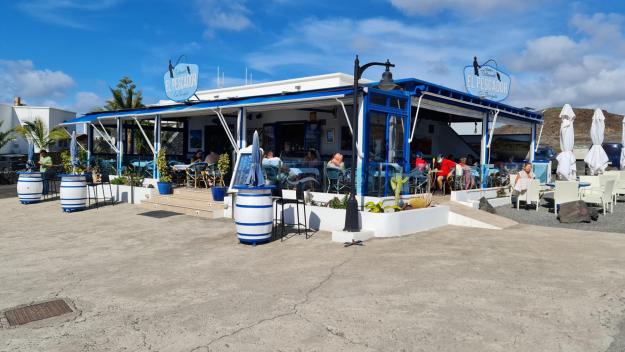
The day’s plan came severely unstuck some 4km down the road from the Visitor Centre, when it became apparent that the queue for the National Park was huge.  Traffic was backed up in the opposite direction for several hundred yards, so we decided that no bus trip was worth that amount of aggravation.  An early lunch seemed a good idea, and we had a recommendation of a specific restaurant – El Pescador in Playa Quemada. It turned out that getting there early (about half past midday) – without a booking – was a good idea as it soon got really quite busy.  We had a good lunch with a mixed fish grill, and we’re happy to add our vote for the place.

Jane suggested that we should try to start exploring more northerly parts of the island, so we headed off in that general direction. As we were going along she suggested that we should stop at a feature called Las Grietas, a crack in the side of Montaña Blanca, just past the town of Tias.  And so we did.  From the outside, it doesn’t look much.

But climb in, and it’s pretty dramatic.

A person can just about squeeze through, and it’s a little tough to climb in the loose gravelly surface, but thoroughly worth it, even though you get shoes full of the little stones.

(That was just one shoe’s worth.)

As we headed back to the car, we noticed a couple of young people seemingly camped out beside it.  When we got there, it turned out that they were a French couple who had no transport.  They couldn’t call a taxi because there was no mobile signal and they asked us if we could give them a lift to the airport. They were lucky – Jane’s French is very good, courtesy of the time she spent living in Paris, and so it seemed reasonably safe to help them out – the airport was only a couple of miles away.  So that was our Good Deed For The Day – they were very grateful.  We never established exactly how they managed to get themselves to Las Grietas, but we were glad to help them, anyway.

We resumed our original plan, which had been to see some of the northerly bits, with the possibility of visiting The Other salt factory, Salinas De Los Cocoteros.  En route, it became clear that we were heading into César Manrique country, as this installation on a roundabout showed.


View this post on Instagram


A post shared by Steve Walker (@spwalker2016)

We were by then close to the César Manrique Foundation, set up to allow people to visit the house that was his home from 1968 – 88, and also the setting for a gallery of some of his art – and at the moment still home to a celebration of the centenary of his birth in 1919. As you might expect, it’s a striking place, with a cactus garden outside it

and another of his wind-driven mobile art works by the entrance.


View this post on Instagram


A post shared by Steve Walker (@spwalker2016)


There are plenty of his artworks on display and the house itself is very unusual – Manrique exploited volcanic bubbles to create the lower floor

and the general atmosphere is very congenial.

Just by the house is a roundabout where Manrique was killed in a road accident in 1992.  There are two more of his wind-driven mobile artworks by and on the roundabout to mark the scene.

Our next stop was a feature nearby called the Stratified City (known in Spanish as Antigua rofera de Teseguite), which is a large set of rocks which have been created over the course of thousands of years by wind, sun, and rain. It’s quite a sight.

It’s also quite a site for idiots leaping about and taking selfies, but that’s just my age showing again.  I still don’t understand the thought process that says that a fabulously old geological feature can somehow be improved by having a gurning face in it. Anyway, we wandered off the main part and found a few quieter places for photos, and it’s quite an awesome place.

By this stage, the sun was nearly setting so we decided that Salinas De Los Cocoteros would have to wait for another day and we headed back to the hotel for a quiet evening.  We still have many, many tourist boxes to tick in the north of the island, and it looks like the weather tomorrow will be as nice as today’s – and a lot less windy.  So please check back in then and see how we got on, won’t you?

* El Cuervo is Spanish for raven…

Lanzarote, Day 2 – A Salt Course

Saturday February 26, 2022  – The hotel breakfast was the first opportunity we’d had for A Decent Cup Of Tea since 4am the previous day, so a couple of mugs of Twining’s finest Earl Grey were a welcome part of our breakfasts. We’ve brought a decent number of tea bags with us, and I think we’ll end up taking quite a few back with us, as the opportunities for cups of tea seem to be limited to breakfast time this week.

After breakfast and a short pause to work out whether the weather was going to be right for a day’s relentless tourism (it had rained pretty copiously overnight, it seemed), we decided to get out and get on with the gawping. This turned out to be the right decision, as it was a very good day, full of rewarding sights, or, as I think of them, photo opportunities.

Jane constructed a route based once again on the “Walking in Lanzarote” book, which, those of you who followed the link in yesterday’s effusion will know, suggests some driving tours as well as walks. Our first destination was El Golfo, which has a rugged coastline upon which waves regularly smash themselves, driven by a ceaseless and brisk wind.


View this post on Instagram


A post shared by Steve Walker (@spwalker2016)

A short walk along a coastal path brings you to a view over a green lagoon, the Charco de los Clicos) .

The green colour comes from particular types of algae which grow there.

The next stop was a place called Las Salinas, which – the clue is in the name – is the site of very extensive salt pans. Very extensive.

It’s difficult to do justice to the place through photos, but it’s striking sight.

Our next stop was to be a volcano called El Cuervo, but en route via Femés, which gave an opportunity to visualise how windy the place is:


View this post on Instagram


A post shared by Steve Walker (@spwalker2016)


we stopped to see a couple of interesting sights, such as a roundabout with huge camel statues on it.

This roundabout marks the start of an area called La Geria, which offers a striking insight into the local wine-growing, which is a significant part of Lanzarote’s industry.  Almost wherever we went, we could see the traditional near-circle walls constructed from lava rock.

Each circle surrounds a deep pit filled with lava gravel. A vine is planted in each circle. The walls offer protection from the north-easterly trade winds; and the gravel (because it’s volcanic and therefore somewhat porous) leads water into the soil to irrigate the vine. And you can see that the circles are extensive, stretching right up hillsides.  Interestingly, also on show was a more modern take on viniculture.

Straight walls are replacing the circles, and are more efficient because less wasteful of space, and also easier to harvest using mechanical aid.

Our route continued through a desolate, rocky landscape.

This is reminiscent of the lava fields we saw in Iceland; and, similarly, the only thing that can grow here appears to be a lichen.

Shortly thereafter we arrived at El Cuervo, a volcano which is worth a visit because you can actually walk into the crater.  It’s about a mile from the car park to the volcano, and you can walk around the whole of the outside of the volcano if you want.  But time was running short so we headed straight into the caldera,

which is quite impressive.

We made a note to visit a neighbouring volcano, called Caldera Colorada, because – again the clue is in the name – the rock is brightly coloured. However the light wasn’t going to be too favourable, hence it will be better to visit another day. However, we decided that we could make time to visit a wine museum, somewhat north of La Geria.

Exiting the La Geria area takes you through a village called Masdache, where the lava flow was of a different sort, pahoehoe lava, characterised by surface ripples created when molten lava flowed beneath the solidified outer crust. (The caldera at El Cuervo, by contrast, was built up from “spatter” – rocks thrown up during an eruption and settling back into a volcano-sized heap.)

And so it was that the El Grifo wine museum was our next stop.  El Grifo has been a site for wine making on Lanzarote since 1775 – it is the oldest working winery in the Canary Islands (and one of the ten oldest in Spain). The existence of the museum is down to our man César Manrique, who prevailed upon the owners to preserve old equipment and create the museum during modernisation.  It’s an interesting place to wander around.

There’s a cooperage display,

many different types of wine press

and I’m particularly pleased with this picture. It’s a corker!

(Yes, a machine for inserting corks, itself inserted into one of the old wine storage tanks.)

El Grifo also has quite a remarkable cactus garden.

Our final call en route back to the hotel was at the Monumento al Campesinos, a museum
dedicated to the island’s farming history,

and also the site of a substantial work by Manrique, the Monumento a la Fecundidads.

As well as the view (above) of the museum buildings, the Manrique work also gives a pleasingly zen view back towards the road.

With the light fading and the threat of rain in the air, we headed back to the hotel for a light bite or two and a gin or two.  Thus ended a surprisingly full day – very enjoyable and with a good overview of some of the key sights on the south of the island.  We haven’t worked out a full plan for tomorrow, so you’ll just have to check back and find out what we did, won’t you?

Lanzarote, Day 1 – an early start

Friday February 25 – And so the adventure begins – with an 0330 alarm for an 0430 taxi to Heathrow.  We can tell when we’re on holiday – it’s pretty much the only time we have to get up early.

The UK is well on the way to unlocking as the pandemic recedes – restrictions no longer legally required but left to personal discretion. So we were not too worried about falling foul of paperwork as we left the UK, but still felt a little in the dark about what would await us as we arrived in Lanzarote.  Jane had, as ever, done a masterful job of ensuring that we had completed all the things we thought we needed to do, but there was always a tiny lurking doubt in the corner of the mind that perhaps we might get an unwelcome surprise. So, clutching vaccination records and Spanish QR codes (backed up to Dropbox coz you never know), we stumbled out into the dark and into the taxi.

We actually arrived before the official start time for dropping off bags for our flight, but that didn’t seem to matter, and the bag drop and security parts of the process were swift and largely trouble-free, bar a poke at my laptop with an explosive detector swab. I didn’t see any instructions to wear a mask, but pretty much everybody was wearing one as they walked around. So we found ourselves a seat in what had by then become quite a busy terminal.

So busy, in fact that the queue for a coffee was sufficiently daunting that we didn’t bother.

The flight was uneventful and on time.  Mask wearing was mandated whilst not eating or drinking, but since I had a rental car to drive at the far end I couldn’t join in with the chap sitting next to me as he waded into a couple of G&Ts. The main concession to Covid on arrival was that disembarking was done in sections.  The first ten rows were called out through the front exit of the plane, then the last ten through the rear exit.  Finally the middle rows were called and we shuffled off onto the mystery bus tour that ended at the terminal building.

UK passports are still accepted at the electronic gates and after the passport gates were some desks set up to review Covid paperwork. Courtesy of Jane’s efficiency we had the right QR codes on paper and were waved through immediately, so in practically no time at all we were in the baggage hall, doing the carousel stare thing.  I took the time to pick up the keys to a rental car, the process for which took less time than the arrival of our cases.  My bag took so long to come through that I was actually beginning to fear the worst, but it finally made its appearance and so we went out to meet the Castaways rep, Eva, who escorted us to our motor, a tiny Fiat Hybrid – brand new, just 18km on the clock.  Tiny as it was, we could fit everything in and so we embarked on a tour of the car park trying to find the exit, which we managed on the second go round, with Jane getting reassurance from a nice chap that the exit was actually open.

I had brought a satnav with us which made the journey to our hotel, the Casona de Yaiza, pretty straightforward, and I discovered that I actually could still drive a car with a steering wheel on the wrong side and a manual gearbox, apparently without upsetting any of the other road users. I also discovered that I had got out of the habit of wearing a mask for short transactions indoors, and was politely reminded, when I refilled the car, that mask wearing indoors in Spain is still a legal requirement.

Because of our early start, our arrival at the hotel was quite early, too.  The reception wasn’t quite ready for us, but after a couple of minutes a nice lady called Chus (short, I think, for Maria Jesus) checked us in and explained a few things about the island – good places to go, places where you’re not allowed to go, that kind of thing – by which time it was lunchtime, for which I was frankly quite ready, having had only a bowl of cereal and two large sandwiches by this point. So we went into the restaurant, which is quite charming

where we were served by a lass called Dominica, who was equally charming.  The meal included a gazpacho based on papaya, which Jane pronounced to be delicious, and a fillet of a fish we eventually found out was called a pejerrey, a Peruvian Silverside (?) which was equally delicious.

Replete and tired, we had a short rest and then pottered round the hotel, which is as charming and quirky as the restaurant.

There are artistic touches all around, including some nice mosaic work

and plenty of succulents, some of them very substantial.

So this is to be our home for the next week as we discover the delights of Lanzarote – some walking, some driving, some appreciation of the art of César Manrique (who was to Lanzarote what Gaudi was to Barcelona) and some Nice Lunches beckon.

As the afternoon drew to a close, we thought we’d take a walk around, particularly taking up on a route mentioned in the book “Walking in Lanzarote”, one of the Sunflower books which we’ve valued so much over the years as a source of ideas for destinations and walks.  So, off we strolled, past some amazing gardens.

One house had converted its garden into a vineyard.

Also, we passed some open spaces covered with just the black laval soil (more like fine gravel, really), in some cases with people working on them, although we couldn’t see any plants or other evidence to explain what they were trying to achieve.

Some of these expanses of black soil had circular enclosures in them.  We can’t quite work out what’s going on, here – is it cultivation? Clearing for building?

The route description mentioned a flight of steps leading down to a roundabout which surrounded a Norfolk Pine.  We found some steps

but they clearly weren’t the right ones.  Heading back to the hotel, we eventually discovered what the route description had been talking about, but by that stage it was quite dark so a photo wasn’t possible.  However, since this is close to the hotel, rest assured that I will eventually and photographically take the necessary steps.

That’s it for today.  It’s been a long one and so rest and recovery is the order of the, well, night. Do check in again over the course of the next days to see how the week develops.