Monday February 20 2023 – After a 23-hour day yesterday and a late night to boot, one could reasonably expect to sleep the sleep of the just completely knackered. In the event, what happened is what always happens when I travel to the American continental mass – I find that I’m wide awake at 4am. I sort of managed to drift off for a bit but sleep patterns were further disrupted by: the weather – it was windy, with occasionally very vigorous gusts whistling through whatever it was was causing them to whistle; the wildlife, which woke early and started shrieking, in voices and at volumes unfamiliar to the British ear, with joy at the prospect of the coming day; and the airport, from which jets would fly over the hotel quite low at intervals (see later). At around 7am we gave up the unequal struggle of pretending we were still asleep and made ourselves some tea. Yes, we have brought some Twinings Earl Grey tea bags with us; whyever did you feel the need to ask?
The early morning gave us a little time to appreciate better the room we were in, which was really very substantial,
and had a decent view over towards Alajuela and San José. There were a lot of raptors out looking for their breakfasts
so we eventually went to have ours in the hotel restaurant, which shares the same view as we get from our room.
The hotel breakfast was perfectly fine without being outstanding in any way, and after it we found ourselves at leisure, with only the need to be ready to receive a hire car at 2pm on the formal schedule for the day. So we went for a walk. Obviously.
Until we arrived and were shown the map, we hadn’t appreciated the extent of the area in which the Xandari Hotel is set. It’s pretty considerable.
Jane had read the description in the hotel material of the trail that leads around the grounds and it told us various relevant facts: firstly, that there were some five waterfalls with vistas overlooking them; secondly, a walk to all the waterfalls would take over an hour; and thirdly that the route back from one of them was “arduous”. Whatever, it seemed a perfectly good idea to go exploring – the sun was shining, it wasn’t too hot and we needed to start to get back into the travelling habits. So, off we went.
The immediate environs of the hotel are nicely landscaped
The path leading to our room
and there are many sculptures and artistic touches as you walk around.
The use of mosaic tiles features heavily
and I reckon is more than a small nod in the direction of Gaudi, whose modernista work can be seen all over Barcelona.
As well as the sculptures, there were some lovely flashes of colour from flowers, some familiar, some less so.
After a while, we left the hotel area and headed into the wider “jungle” of its grounds. This is when it became apparent what they meant by “arduous”. Some of the going was quite up-and-down.
and there were some big trees around, too.
and some huge bamboo.
One particular bamboo grove was little short of spectacular and the noises it made as the wind blew through it were amazing.
We followed the trail down and down until we found the waterfalls. Owing to the somewhat eccentric nature of the numbering system, number 3 was the first we came across.
Further along the trail, numbers 1 and 2 were not that impressive, at least to us folk who have been fortunate enough to visit Iceland (the country, not the shop).
and number 5 was charming (and offered us some decorative seats so we could take a breather)
but the star of the show was number 4. Even an Icelander might grudgingly give this one a gruff nod.
Our walk was, as I say, quite up-and-downy
and it was also quite round-and-roundy
but we covered pretty much the whole of the hotel grounds, which was quite satisfactory, and a very pleasant way to start to get the feel of what the country had to offer.
Shortly after we got back to the hotel it was time to collect our hire car, which was brought to the hotel by a National Rental chap who didn’t speak English very well but introduced us to the SayHi app which helped us around some of the complexities of getting hold of what was to be our transport for the coming weeks.
after which a drink in the hotel bar seemed a decent logical step.
After some nachos and a couple of beers, we retreated to our room for a rest. Just before dinner, we got the opportunity to understand the reason that jets are so noisy near the hotel. They take off from the airport
and then turn to the left and fly directly over the hotel.
We had a decent dinner in the restaurant and then retired to our room for the rest of the evening. Tomorrow sees us embarking on the first drive of our time here, and it’s set to be a long one of about five hours as we head towards Ostional, on the west coast. It may be that there will be nothing to report tomorrow, but I guess you’ll have to check in, just in case something interesting happens, eh?
Wednesday 5 October 2022 – Sitting in the departure lounge at St. John’s airport, as I typed the headline, I felt a small spasm of sadness, because I’m about to describe the last day of our holiday in Alaska and Canada. Even though it’ll be nice to get home to our own shower, ease of laundry and some control over what we eat at breakfast, we shall be sad to come to the end of a two-month odyssey across North America, because it’s been such a great holiday. Yesterday’s wanderings were a positive contribution to the overall experience.
We started off attempting to remedy an omission from the day before; we’d passed Kilometre (or Mile) Zero of the Trans-Canada Trail without stopping to take account (and a picture) of the formal marker post that Jane had spotted on an internet search just beside the Rail Museum building. Our first stop, therefore, was to take a look at it.
Or, rather, take a look for it.
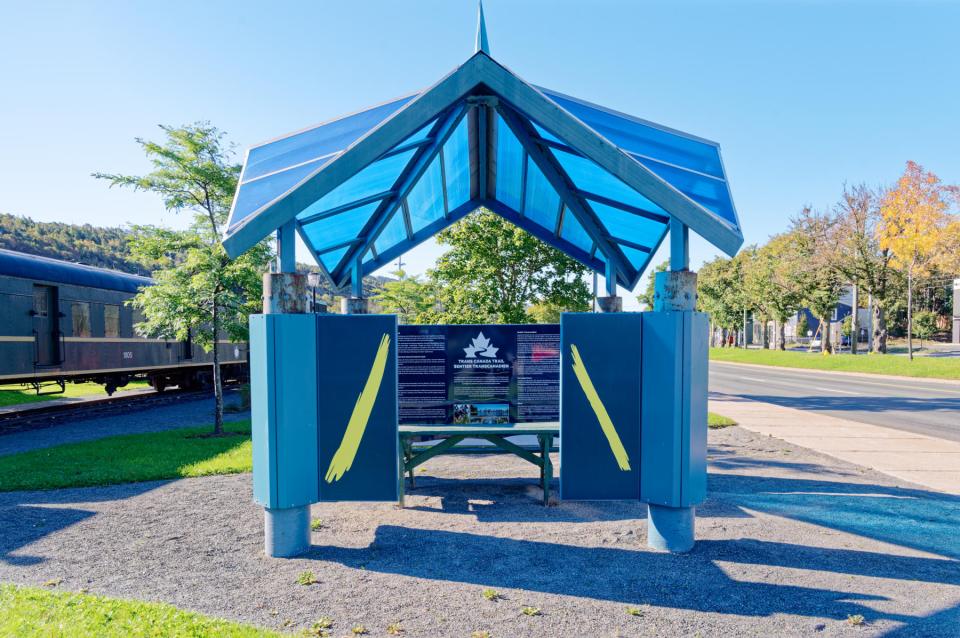
We could find no sign of the marker board that Jane had seen earlier photos of, even though we bumbled about aimlessly for a few minutes, which is our normal search strategy. We did, however, notice a gazebo set up over some noticeboards.
one of which noted that this was a memorial setup. Reading the information display gives the impression that this is now the formal beginning of the Trans-Canada Trail and the T’Railway we pottered a few steps along the day before,
We then addressed ourselves to the main task of the day – getting back to the top of Signal Hill where driver Basil had shown us our very first glimpse of St. John’s. This time, however, we would be under our own steam.
We passed a rather faded memural (a Steve Walker patented portmanteau neologism – not a typo) to the days when the railway was such a critical part of the history of St. John’s,
and then walked along Duckworth Street, which is one of the main downtown roads in the city. It has its share of the attractive Jelly Bean houses that make the place so individual – even the modern apartment blocks are things of beauty –
and, of course artwork. Above you see part of a long mural which depicts a lot of the traditional ways of life of St. John’s and Newfoundland including
men carrying fish around (cf ladies doing likewise yesterday). We assume this must be salted fish of some description. Duckworth Street is world famous in Newfoundland for being the home of The Duke of Duckworth, a British-style pub.
Tempting as the thought was, we didn’t stop in for a beer, but carried on, past the sort of sights which make St. John’s such an individual place
including an Air Force memorial and a Portuguese memorial (spot the azulejos – blue tiling).
Duckworth Street turns directly into Signal Hill Road, so one could just carry on walking. However, we wanted to follow a trail that took us through The Battery, the cluster of attractive houses we’d walked out to photograph the day before. Where Signal Hill Road carries straight on, Battery Road is a right-hand turn; it also leads past the Battery Cafe
which, I can report, serves damn’ fine coffee.
Battery road goes down a bit and then up quite a lot, giving progressively better views back over the town
as you reach The Battery
and continue up the hill
to the St. John’s Lookout.
At this point, we were at the foot of Gibbet Hill, beside attractively-named Deadman’s Pond. Gibbet Hill is the lump of rock behind the cottages we photographed from the other side of the harbour yesterday…
Apparently only one person was ever hanged on Gibbet Hill, but the name, erm, hung around nonetheless.
Passing Gibbet Hill took us back on to Signal Hill Road and we walked up to the Cabot Tower at the top, past George’s Pond.
Since the hill is pretty much the highest point hereabouts, it’s unsurprising that it gives a great view back over the town
but we were also interested to explore the tower and its history. Construction of the tower itself began in 1898 to commemorate the 400th anniversary of John Cabot’s discovery of Newfoundland, and also Queen Victoria’s Diamond Jubilee. John Cabot, by the way, was actually Giovanni Caboto, an Italian, and there’s a sister tower, of very different architecture, but with the same name and serving the same purpose, in Bristol, UK.
The St. John’s edition of the Tower has a slightly chequered history, in that the town was agin building it in the first place on account of the town having been burned to the ground a few years earlier and the banks going broke an’ that. But there it is, and there it was for its best-known part in the development of the world as we know it – the first successful receipt, on December 12th, 1901, of a radio transmission across the Atlantic Ocean, by Guglielmo Marconi (the origin of the signal, the letter “S” in Morse code, was Poldhu in Cornwall). Its prime use, though, was for flag signalling, it being in a good location for that purpose, visible for miles around in all directions.
We went into and up the tower, and a room at the top has signal flags neatly pigeon-holed all around it
as well as an installation to do with its role in radio telegraphy,
including a picture reconstructing how Marconi set up his receiving configuration. (We read that scientists at the time pooh-poohed his idea that transmission across the Atlantic was possible, but that’s because they didn’t realise that the radio waves would bounce off the ionosphere; I don’t know whether Marconi had realised this or not, actually).
As well as the various old-style cannons visible around the site
and the nearby Queen’s Battery
there’s a more modern one
which we found out about when it went bang. We were actually still quite a way away from the tower at this point but even so it was startlingly loud; heaven alone knows what it was like for the spectators. It is one of the various Noon Day Guns which seem to be popular hereabouts (as well as in Hong Kong).
From the top of the Tower, one can just about see Cape Spear,
the rather uninteresting-looking flat bit of land on the left of the photo above. It is the easternmost point of North America. Just so you know. Also, there’s one of those really helpful signposts telling you how far away you are from civilisation.
So, now you know that Poldhu is a mere 3,468 km away. Given that more civilised northerly and industrial parts of the UK, e.g. Liverpool, are even closer, it’s hardly surprising to learn that British fishing fleets started coming over to Newfoundland in the summers and ended up basically controlled the fishing industry here from about 1600 onwards, having seen off some upstart Portuguese (we were at war with them then).
The other planned component of the day’s walk was to visit a place called Quidi Vidi, recommended by both the mother of the whingeing, squirming brat and the ever-helpful Ian Burley. It’s pronounced Kiddy Viddy, by the way, which sounds to me more like a child’s entertainment. There’s a trail leading there from Signal Hill. It’s a decent trail, albeit a bit rocky and up-and-down in places
but basically very well-maintained in those places where it counts.
We caught sight of Quidi Vidi village fairly soon after starting on the trail
(you can just see the eponymous Quidi Vidi Lake to the left) and before long we were down in the village, at the Wharf end (where the lake debouches into the Atlantic).
It’s ridiculously pretty.
It also has attractions beyond the simply visual.
To be honest, we knew there was a brewery there – Ian B had told us – and so I had a plan which involved a certain amount of quaffing – and the place has a splendid bar and patio for those in need of fluid replacement therapy.
Having partaken of a couple of their offerings
(frankly, Day Boil doesn’t sound like a very pleasant brew, but Jane liked it; and their Iceberg lager is excellent), we walked on through the pretty village, past some rather attractive crocheted rock-cosies (reminiscent of what the natives do to trees in the island of Graciosa in the Azores);
past a couple of historic properties: Mallard Cottage, built in the early 1800s by the Irish-immigrant Mallard family;
and the Inn of Olde (sadly shut);
and what used to be a multi-denominational church.
Our route back to St. John’s took us by the banks of Quidi Vidi Lake on a decent trail, quite a lot of which is a boardwalk
past the St. John’s Rowing Club
and, past the lake, some very large and handsome properties on the outskirts of the town.
We ended up on George Street, which has a simply legendary density of bars and restaurants
(mainly bars, I think, with the occasional “gentleman’s club”), and past a final reminder of how attractive it can be to disguise the mundane with some nice artwork, in this case a map of all the other artwork, which I think is rather a neat idea.
And so, 12½ miles (20km) after we started, we arrived back at our hotel at the end of our day’s walking and our North American holiday. We’ve walked 214 miles (344km – actually not a lot over two months), ascended (and descended!) 4312 metres and enjoyed every minute of it. But we have to go home now – real life, our own washing machine and a defective septic tank await our attention in the UK, but we shall have the memories of all the places we’ve visited for a while and these blog pages for when the memories have dimmed.
For previous holidays, I’ve often penned a summary of our thoughts as a valedictory post. Canada is too vast and diverse, both geographically and culturally, to be able to do it justice, so I shan’t attempt one. A couple of things stand out, though: the helpfulness, politeness and friendliness of the people; the thoughtful approach that Canadians, both citizens and authorities, take to life around them; and the knowledge that we have but scraped the surface of a huge country during a single season – I couldn’t begin to tell you what anywhere here is like during winter, for example. You’ll just have to come and experience it for yourself.
Of course, this is not by any means our last major adventure. We have a real cracker coming up early next year, in February. I hope to be able to regale you with our exploits then and we hope you’d like to rejoin us to hear about them. For now, farewell!
Monday 3 and Tuesday 4 October 2022 – Jane and I had quite different journeys from Halifax to St. John’s, Newfoundland. (For the uninitiated and those who didn’t watch that particular episode of QI, Newfoundland is pronounced “NewfndLAND” – emphasis on the last syllable. Just so you know.) My journey was entirely unremarkable. Jane, sitting three rows behind me on a full flight, got the writhing, screaming toddler. However, she also got some useful intelligence from its mother about things to look out for in St. John’s.
The next oddity about the journey is that one travels half a time zone. Where Halifax is 4 hours behind the UK, St. John’s is 3½. The final oddity was our transport from airport to hotel.
Yes – another stretch limo. Once again, somewhat overkill for two people with standard amounts of luggage – but pleasant enough. Our driver was a chap with the unlikely name of Basil and what seemed at first an unlikely amount of Irish in his accent; it turns out that the ancestry of many people in Newfoundland is Irish from the original immigration, and significant bits of the accent have stuck.
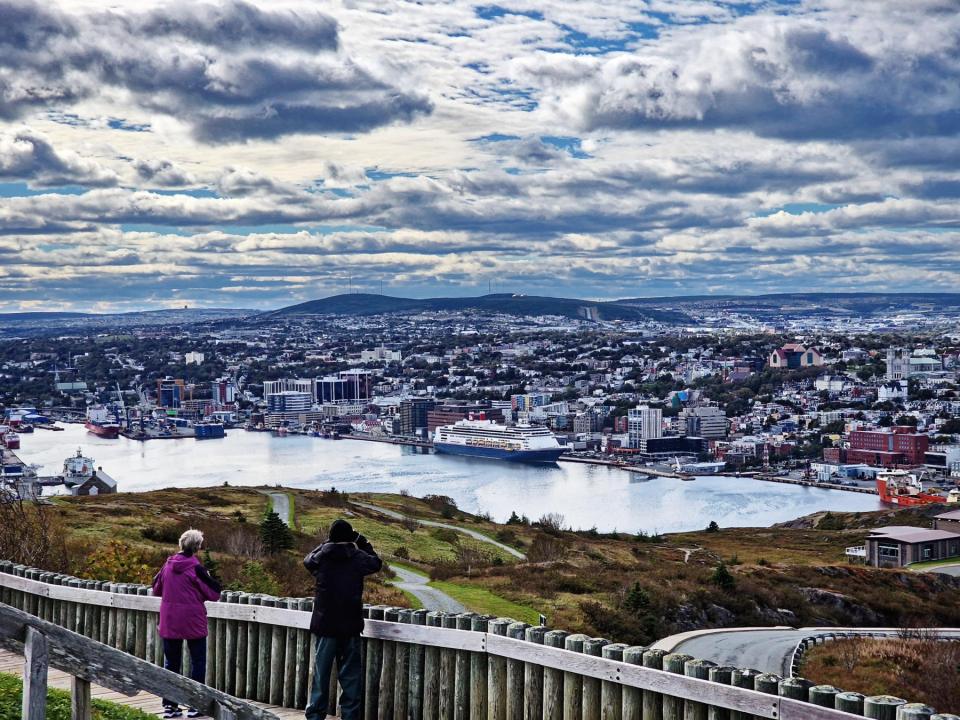
Basil was very helpful, possibly because of his good nature and possibly because he didn’t have anywhere else to be. He gave us the run around, but in a good way, taking us to the top of Signal Hill so we could get a view over the town
(note the cruise liner in the harbour; it’ll become relevant later) and then driving us around some of the main downtown streets pointing out interesting bits. Sadly, his limo was too big for the hotel forecourt, so he had to drop us off round the corner and we had to lug our bags up a small hill to the hotel reception, but that didn’t matter – he was charming, helpful and somewhat Irish and the limo journey was a pleasure.
We got a hotel room on the 10th floor, giving us a very pleasant outlook over bits of St. John’s.
This picture should give those of you who don’t know the place some idea of what was to come as we explored. Because, it being time for a late lunch/early dinner, we went for a walk. Obviously. Jane had had a recommendation for a restaurant called the Fish Exchange, and so we headed there and had a very nice meal indeed. After it, well fed up and agreeably drunk, we wandered the streets of St. John’s.
It is spellbindingly photogenic.
We wandered round, gawping in astonishment at pretty street after pretty street.
I’ll share more building photos later, as time was getting on as we wandered around and the light was fading. But as well as the houses, there was artwork,
(Jane asserted that this last is artwork; it looks more like a failed paint job to me.)
strange business names,
and cultural appropriation gone wrong.
There were interesting and imposing buildings
the last three above being the Anglican cathedral, the Law Courts and their antidote, the Appeal Courts.
It was a fascinating first sight of the place and we knew we had to come back in better light to explore further. Which we did, the following afternoon. However, before that, in the morning, we set out on another walk. Obviously. Jane had seen a couple of views of St. John’s online and was interested to try to capture our own version of them. One was a view over the town and the other was a particular view of an area called The Battery. Many of the houses in The Battery are obscured from view from the town itself by a rocky outcrop and we decided that we had to get across the harbour to the other side to get the right viewpoint.
To do this is not as straightforward as it might have been. You can’t, unfortunately, simply walk around the water to get to the other side; there’s rather a lot of shipyard, railway and river obstacles in the way. So the route you have to take looks like this.
The route we walked, we discovered, included a few steps of the 28,000 km Trans-Canada Trail, which I wrote briefly about in a previous post – the zero mile/kilometer point is just outside the Railway Coastal Museum
with its attendant train display.
From there we followed one Trans Canadian Trail option for a short distance along a riverside track – it’s thus called “T’Railway”, which is insufferably cute.
Leaving the trail to follow the road along the far side of the harbour, we passed some interesting sights as we went.
We passed a historic house being restored,
and a different view of one of those ships we saw earlier.
It’s called the Earl Grey, by the way. As we walked along, it became clear that the view was not, erm, clear. The south side of the harbour is basically occupied with shipping-related stuff – shipyards, customs areas, coastguard, fishing boat ports. Many of them are surrounded by chain fencing too high to get a decent view over. There are occasional gaps where one can see the town
and we gradually saw that we were on the right track for the view over The Battery, at least.
We pressed on, always trying to get to the waterside to catch a photo. On one occasion it meant going behind a film crew as they were trying to do a film shoot
and you can just see the director as he is about to point out to us that we’re about to be in his shot. We hastily moved on and – there it was!
The view of The Battery that we’d been after.
I love it when a plan comes together.
There’s actually a whole panorama across that view, which is a thing of beauty. I have a photo of it, stitched together from 10 images, and here is a video of what it looks like.
Having gone this far, we were nearly at an area called Fort Amherst, so we thought we might as well go and take a look at that. The original 1770s fort no longer exists, but it’s a pretty enough place and it has its own lighthouse.
As we were retracing our steps (there being no other way to get back to the hotel), we saw
the big cruise ship (Fred Olsen, Borealis, 706 cabins, 1300 guests, 660 staff) coming out. Since this bit of the harbour is called “The Narrows”, we thought it might be fun to watch it exit the harbour in case it crashed to see how it was done properly.
Nice work – you can just see the pilot boat heading in to collect the pilot after this smooth exit.
We headed back to the town, noting, in passing, the nearest we could get to the other view that Jane had seen
(that isn’t it, but we might get a go at it tomorrow);
That was the end of Part 1 of the day. Part 2, after a refreshing cup of tea at the hotel, involved us going for a walk. Obviously. We wanted to explore further the incredibly photogenic houses and other buildings in St. John’s, during daylight (and we had a wonderful sunny day in which to do so). So we did. And we took lots of photos. Here are a few.
The place is quite extraordinarily pretty, with each house being individually painted. There’s no planning regulation that we could discover, but an evident pride on the part of each householder in having a house that is (a) beautifully maintained and (b) a different colour from its neighbours.
The painted boards really are of wood
and very carefully painted by hand.
These houses are not altogether surprisingly known collectively as “Jelly Bean Row” although that does not refer to a single street – they are around every corner in the downtown area. As well as being attractively coloured, many of them have nice little styling details,
and if you look over the above photos of the houses, you can see that there’s a variety of styles – some plain, some with dormers, some new, some older. The whole area is just stunning and gets my current vote as the most photogenic area <Clarkson Mode ON> in the world <Clarkson Mode OFF>.
There are other nice things to see, too. There’s a Basilica
(sadly closed on a Tuesday), a Methodist Church,
a building that looks like a cross between a Flat Iron building and a windmill,
another religious-looking building whose purpose we couldn’t identify,
some fine detailing on the Appeal Court building
some statuary whose message is not quite obvious, but appears to involve ladies transporting fish
a handsome shopping street called Water Street
and a demonstration of how to use the visual character of a place to prettify an otherwise undistinguished object – the houses have become a symbol of the city itself.
I should say here that St. John’s is not all sweetness and light. Attractive as it is, as friendly as the natives are, there are some beggars on the streets, most frequently in the evenings; there is some graffiti (but not anything like as ubiquitous as in Montreal); and so there’s a bit of a rough air to the place around the downtown bars as the light fades.
All in all it was a superb day – lovely sunshine, successful execution of a photo plan, wonderful scenery and delightful surroundings. What more can one ask for?
Well, let’s see what tomorrow will bring. Possibly even more striking and attractive scenery, if our luck holds. Check in later and find out!