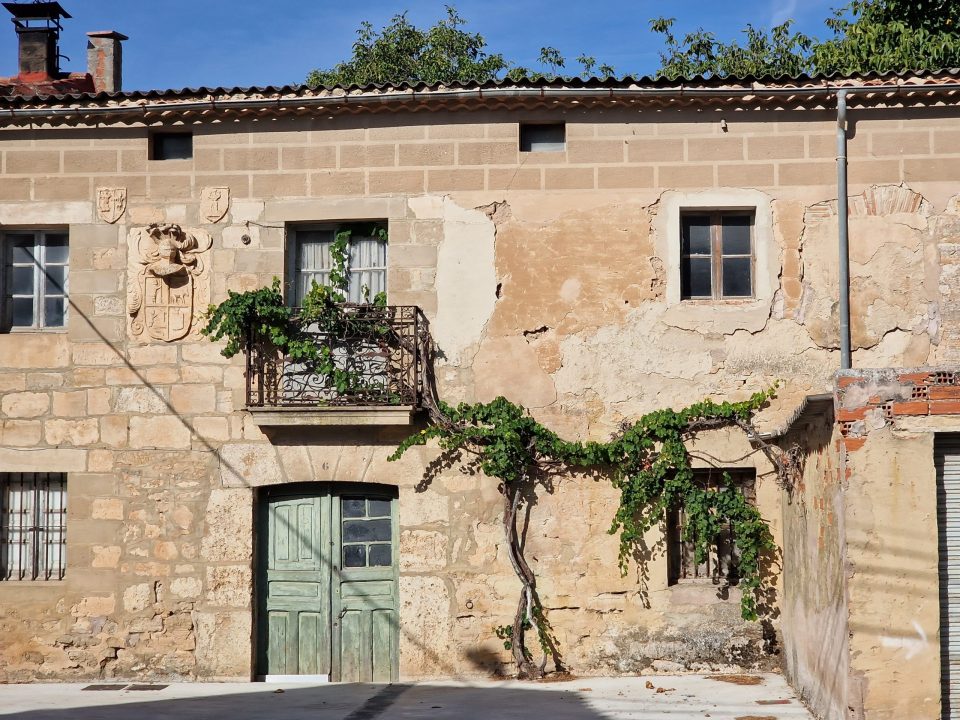
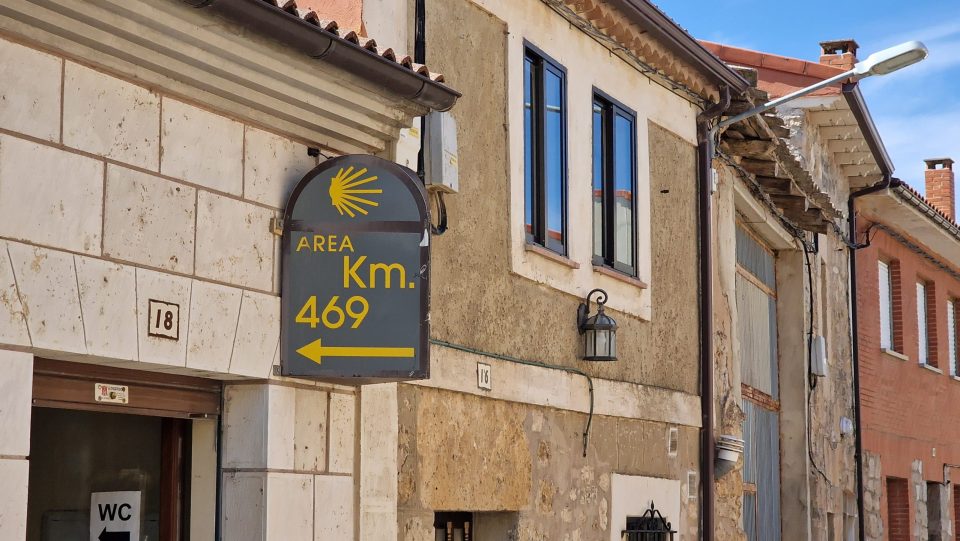
Tuesday 5 September 5 2023 – The observant among you will have noticed a missing day in the reporting. This is the consequence of a trip down a Rocky road (see later) which left me unable to report on yesterday, Day 18. Fortunately, Day 19 has been a bit short of notable content, so I can describe both days in a single post.
You can bypass the commentary by watching the Relives, if you’d like:
- Day 18: Boadilla del Camino to Carrión de las Condes
- Day 19: Carrión de las Condes to Calzadilla de la Cueza
So: yesterday.
The weather forecast was not one to inspire great joy at the prospect of walking 26km. Neither was looking out of the window at the driving rain at 7am. In Accuweather’s view of the world, the rain was due to ease after 8am, so we took a decision to delay our start in the hope that this would be the case, despite facing one of the longer walks in our Camino schedule. In the end, at 0845 we decided we shouldn’t delay any further, so we bade farewell to Eduardo, who had looked after us and everyone else with a charm that added greatly to the enjoyment of our stay in Boadilla.

As it happened, the rain ceased exactly as we left the hotel, which made our decision to walk in sandals and socks seem less like lunacy. The town’s water tower wasn’t impressed, it seemed, though.

Wot? No Umbrella?
Eduardo it was who told us what yesterday’s mystery object

had been. It was a dovecote, as were the other buildings surrounding it. We saw more as we left Boadilla.


These doves serve as a natural insecticide and fertiliser, hence the number of dovecotes.
Our path showed clearly the evidence of how much rain there had been.

The rain had thus far held off, which made our socks-and-sandals decision seem not too insane after all, even if some special effort was occasionally necessary to try to keep the feet dry.

There was even a little weak sunshine.

Our luck didn’t hold, though, and it started to rain as we joined the Canal de Castilla which took us towards Frómista, our first town and coffee stop. It seems that one can actually catch a boat from a boat stop to get along the canal,


but, even more so than the buses which run past our house into Woking, it’s not a frequent service.


There were a few things to see along the canal path: batboxes

carefully labelled so that any passing bird wouldn’t get the wrong idea about moving in;

infrastructure for using water abstracted from the canal for irrigation;

and, at Frómista, a lock.

This was quite a substantial affair,


though, looking at it in detail, it’s difficult to see how it could possibly be operational any more.
My main interest at this point was coffee; I’d been promised a Frómista coffee stop.


Jane’s main interest, however, can be seen in the background of the first of these pictures. Frómista features a beautifully restored Romanesque church, San Martin de Tours.


Inside, there is a model of how the church looked before the restoration started,

and there are some beautifully-carved details, both restored


and recreated.

After spending some time looking around the church we carried on our journey towards Carrión de las Condes, crossing the motorway


and embarking on a straight path beside the road.

You can probably see where we’re going, here. The rain had left the path dificult to navigate with dry feet, particularly if wearing socks and sandals.

In the end we abandoned the path and actually walked along the road; the traffic was very light and the surface was a lot less problematical to walk along.
There’s a decision point after a while; one can continue slogging along beside the road or one can take a path that follows a river. We decided on the latter, which led us through a town engagingly called Población de Campos


which has an enormous church.

The Camino then turns on to a path that goes bolt-straight for about four kilometres alongside quite a sophisticated irrigation system for the fields it borders.

There was a scent in the air which led us to believe that this path had recently been resurfaced. It was certainly easier to walk along than the roadside path. As we walked along, the rain, which had been light but persistent for the last while or so, started to come down quite heavily. So we were glad, at the end of this path, to find that the place for a planned lunch stop, El Chiringuito De Villovieco, was open, so we could sit and watch the rain for a while.
The place featured a (rather squalid, but reasonably functional) kitchen and we ordered some food, Jane had a chicken salad sandwich which was OK, but my pizza was a very bizarre affair. You’ll be glad that I don’t post photos of food, because it was an extraordinary combination of ingredients. I ate some of them and the place served gin, so all was not lost.
The rain eased back to light-but-persistent after a while and so we started out again, only to find that the nice surface we’d enjoyed was no longer available.

Walking along this in socks and sandals merely resulted in wet and muddy socks, but, to my surprise this really wasn’t a problem – OK my feet were a bit wet (all right, sodden), and somewhat heavier than I’d been used to. What was a problem was the slipperiness of the mud, so when we had an opportunity to get back to the road we took it, past a couple of things that clearly had stories to tell, even if we couldn’t fathom them.


So we rejoined the straight path beside the road, which actually wasn’t too bad at this point; and it had even stopped raining.

It seemed to be appropriate only for vehicles if they had a very good ground clearance.

It led past a town called Villalcazar de Silgar, where we’d planned a final coffee stop to refuel for the last 5km or so into Carrión. This village also has a colossal church,


so big that it has double porticos.

Sadly, both of them were closed, so we didn’t get a chance to see what it was like inside – a real pity, I feel sure. Having had our coffee (me) and smoothie (Jane), we walked past the village’s pilgrim statue

and rejoined our path which eventually became a dual carriageway just outside Carrión,

which seemed to be organising a “guess the monument” competition.

The town is quite a substantial one, and features an inordinate number of religious buildings, many of which are too big to photograph adequately. We found our way to our hostal, feeling not too drained, despite having walked a distance which we had found very tiring when we covered it into Burgos. Improved fitness and an extra coffee stop might be posible explanations; but it’s good to know that we can cover the distances without too much trouble.
Having settled in, we went for a walk. Obviously. It was somewhat curtailed by having to avoid moaning Minnie, who was out and about. It led us to explore a tapas bar, Bar España, which is where the wheels came off the day. In the bar was a Aussie lady (shortly to become a naturalised Brit) called Rocky, whom I had briefly chatted with back in Boadilla, when she bought all the pilgrims in the hotel bar a drink. Of course I had to return the compliment, didn’t I? And, somehow, one drink didn’t seem quite enough, and so we had another.
And another.
And so on until it was time to try to get some sleep. This is why I didn’t write up the day. It’s All Her Fault.
And so on to today.
After yesterday’s long kilometrage – 27.2, taking us up to 370.6, or 230 miles – today was light; just 17km, taking us to Calzadilla de la Cueza. “Calzada” means “road” in English; “Calzadila” translates to “shoe” and “Cueza” to “cook”, according to Google. So our destination is the cook’s shoe. Furthermore, the 17km is along an almost entirely straight and flat path. My expectations were thus set that, photographically speaking, the pickings would be slim. They were, it has to be said, largely met.
The forecast was for sunny weather, which meant that we had to apply sunblock for the first time in several days; the expected temperature was in the mid-to-high twenties, which is perfectly fine for walking in.
The route out crosses a major bridge

called, logically enough, Puente Mayor, past one of the principal religious buildings in Carrión, the Monasterio De San Zoilo

which is now the basis for a very posh hotel and which has a very fine portico on its side.

Soon, you leave the road for the Camino path

which is substantially bolt-straight and dead level for the next 15km. There are highlights:
Excitement – a bend!

More excitement: an Abbey!

(still exciting, even though you can’t really see it). And then, sarcasm apart, something of real interest.

The next 12km are actually walked on an original Roman road, some 2,000 years old and untouched except for being surfaced with gravel. It’s a real causeway, built up from the surrounding land.

and, again, pretty much bolt-straight, in the finest tradition of Roman roads, for the 12km. Someone got out a fag packet once and, using the back of it, calculated that underpinning the surface is 100,000 tons of rock and stones. Given that the surrounding land is wetland, and devoid of stones, ths means that all of that rockery had to be brought in from elsewhere – a staggering logistical exercise. I suppose that having a slave-based labour infrastructure helps, but it’s still an amazing piece of work.
It is dead straight.
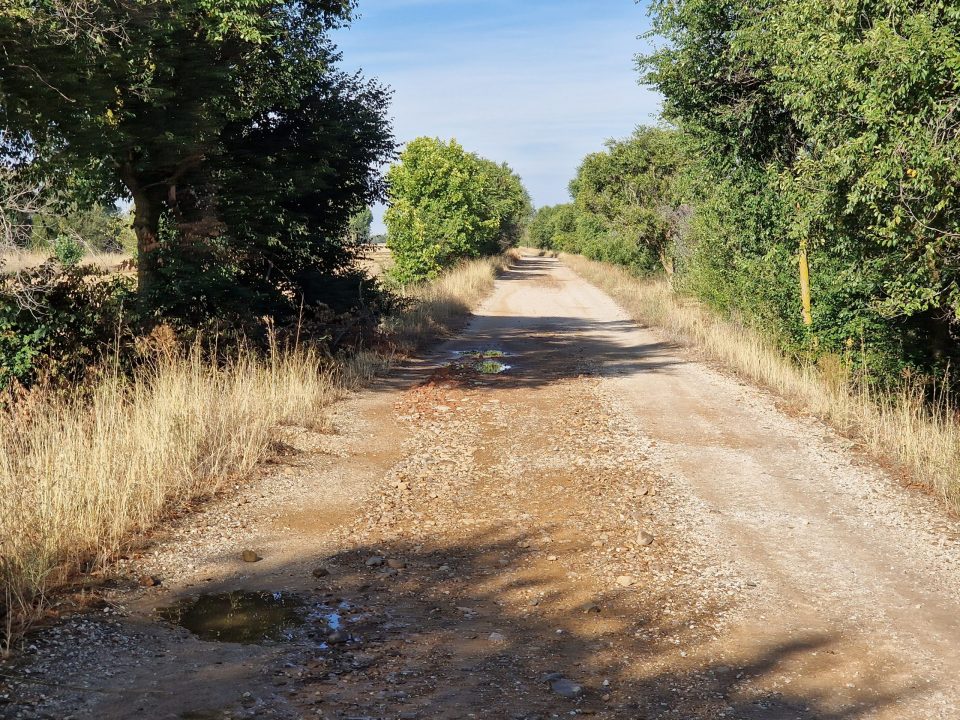
The surrounding countryside is flat.

Very flat.

But walking along the path is not boring, even though there’s not a lot of variety in the scenery. Simply making progress is quite satisfying, and one is out in nature which is accepted as being a Good Thing. There were a few things that leavened the routine of quiet walking: we were passed by a couple of guys on monowheels;

there are a couple of resting places

and a food truck;

and, eventually, a hill!

You need to be within a kilometre or so of Calzadilla before you notice any signs of habitation

and then

all of a sudden

there you are.

We found our accommodation, Hostal Camino Real, and Rocky almost simultaneously and there was quite a lot of comedy going on as we tried to check in while simultaneously explaining to the staff that Rocky wanted to put a drink behind the bar for us, a concept that I’m not sure exists in Spain. The net of it was that we had one more drink with Rocky, who then had the strength of character to move on before the whole thing degenerated. It very nearly did; the lad serving us didn’t understand the concept of a gin and tonic and seemed about to fill a sizeable glass with just gin before we managed to stop his pouring and diverted the excess into a second glass. Oh, how we laughed!
It was good to chat with Rocky again, and with luck we’ll meet her later on in our Camino, but who knows? That serendipity is one of the things that marks walking the Camino out from other long excursions.
Today’s stats – Relive counted 18.4km passing us by, which might be a little high. But it’s what I’ve been using so far. That takes us to 389km – 241 miles plus a few yards. One of the official figures for the length of the Camino Frances is 780km. This means that we expect to hit the halfway point tomorrow. However, there are many different assessments of the overall length, so don’t get too carried away, OK?
Tomorrow we head for Sahagún, about 23km away, with prospects for decent weather again, which makes a nice change. I’ll report on that when I can, at which point I hope I will once again have your company, dear reader.