Tag Archives: Tourism

Windy Peg

Sunday 25 September 2022 – We might have done with Montréal, but Montréal (and fate) had not done with us. As I mentioned in my last entry, the itinerary we’re following has evolved over the course of three years and, as a result, has produced some wrinkles. The order of cities was one; the timing of this morning was another. We had grown rather alarmed at the prospect of an 0530 pickup at the hotel – particularly when we saw that the flight that this was to take us to was not at 0800 as originally specified, but 0855. So we had a bit of a back-and-forth with Discover Holidays, who are in charge of local details, and they agreed that an 0630 pickup was OK. 0630 is not good, but it’s a whole lot better than 0530.

0530, however, was, of course, the time we had to set the alarm for. Having done so, and heaved ourselves up to face the rigours of the day, a text arrived at 0553 from those nice people at Air Canada, telling us that our flight was delayed until 1045, “due to a technical problem with the aircraft”, and would be departing from Gate A9.

Hah.

It was too late to change the timing of the pickup, so we got ourselves ready and checked out before 0630. Unsurprisingly, we were alone in the hotel lobby, apart from the receptionist and a chap in a cap. Equally unsurprisingly, it turned out that he was our driver, André (an Italian-Canadian ex-truck driver with a New York accent), and he took us out to the car.

Perhaps a bit OTT for two people and two suitcases to go to the airport, but, hey,

it perks the day up a bit. So did the sunrise.

Our hopes that perhaps fate was making up for the mix-up with the early start were at first slightly lowered when the Air Canada machinery wouldn’t take our checked-in bags and then dashed when we headed for security.

You’ll remember (of course) that we were heading for an A gate, and you can just make an A out in the distance. When we got near it, though,

we saw that there was a huddled mass of humanity between us and it. This was Montréal, we thought, having the last laugh. Actually, it was only about a 35-minute queue and then we were free! Noticeboards were still talking about our flight leaving at 0855 from gate A1, but we smiled, knowing that Air Canada had given us the skinny of the new gate and time. So we sat at Gate A9, not worrying at all about our almost total isolation because We Knew The Score.

At about 40 minutes before the scheduled departure, though, we began to worry that We Didn’t After All Know The Score, so we hurried off to Gate A1, where AC371 (yes, our flight) was still showing as departing. A lady at an adjacent Air Canada desk saw us and the uncertainty we were radiating and shouted out that the flight was no longer going from Gate 1, but was just about to board at Gate 15. So nice of Air Canada to contribute to our exercise regime.

The rest of the journey was fine, involving as it did a decent but not excessive amount of gin and Pringles. It was a little bumpy towards the landing

due to a not insignificant wind. We arrived in Winnipeg (for that was the correct destination) at around midday; by the time we arrived at the carousel our bags had just appeared and we had just a short (but slightly puzzling) walk to our airport hotel, the sumptuously named Lakeview Signature by Wyndham (which is not sumptuous at all, and has a view only of the airfield, but otherwise appears to be perfectly workmanlike). Our room was ready, and the organisers of this next segment of our holiday were obviously on the ball, as there was a board in the hotel lobby telling us where we had to be and when for the introductions and briefing.

So. Why are we in Winnipeg, a westward step in our otherwise eastward progress, significant enough to warrant a change in time zone?? You’ll find out if you keep reading these pages.

In the meantime, we had some hours to kill, and Jane had spotted that Winnipeg airport is home to the Royal Aviation Museum of Western Canada. This seemed to be only a couple of minutes’ walk away, but the hotel reception virtually insisted that we take the hotel shuttle bus. I think this was to make the driver feel part of the team, because it was a ridiculously short drive. We were greeted by a charming lady called Hedie and welcomed to the museum.

Which was not huge, but really interesting.

Assembled here is a collection of those things that are significant in Canada’s aviation history, particularly in the development of the bush plane. For example, the first purpose-built example, the Fairchild AC71

had great capabilities for all those things that bush planes needed to do (e.g. land on and take off from water). It suffered a little from the fact that the pilot’s ability to see forwards was very limited because the cockpit was set so far back, so it never entered commercial production.

The museum also gave me a chance to show you another one of them Fokkers, in this case a Super Universal.

There are many curiosities on display: an example of a sesquiplane, something I’d never heard of before – a plane with one and a half wings;

a nuclear bomb, which I’m glad the organisers rendered inert before displaying;

a replica of the Avro Canada VZ-9 Avrocar, a top secret US Air Force funded attempt to create a supersonic fighter capable of vertical take off and landing (it was underpowered, unstable and cancelled, having never got more than a metre into the air);

the Froebe Helicopter, designed in 1937, built from salvaged truck parts and featuring design points that are still in use on today’s helicopters,

but underpowered and hence also not able to rise higher than one metre from the ground; the Vedette, the first attempt at a boat that could fly;

and – my favourite – the Canadair CL-84 Dynavert.

As soon as I saw this beast I thought “Bell Boeing Osprey” (for those of you not familiar with it, here’s a picture of one I took at Farnborough Air Show some years ago)

FIA 2012 - Bell Boeing Osprey

and, indeed, the Dynavert was a predecessor – well ahead of its time, having first flown in 1965, a quarter of a century before the Osprey (though it never found a buyer so was cancelled in 1974).

I particularly like the little helicopter rotors on the tail.

There were many other, more serious, exhibits as well, but I found these the most engaging and we spent a happy hour at the museum in one of those lovely bits of serendipity that contribute so much to life’s pleasure.

Rather than attempt to call up the hotel’s shuttle bus for a return journey, we dared the walk back unaided – the hotel is just under the control tower, so it wasn’t exactly a major expedition. So we stepped out – into an astonishing wind – and fought our way home against it. Apparently it’s been windy here all month.

And this brings you bang up to date. The sunset here is as interesting as the sunrise this morning back in Montreal

and we have about 90 minutes to wait until we get our briefing on the next few days. All we know is that we have to be up, packed, checked out and breakfasted in time to leave the hotel at 0700 tomorrow. So there’s no chance I will report back today about what we learned at the briefing and what we’re up to over the coming days – you’ll have to come back tomorrow to find out more. See you then!

The Nelson Column

Saturday 24 September 2022 – As expected, Jane had formulated A Plan for the day – a walk in the Old Town, followed by a stroll beside a canal which led to the Old Port.  Accordingly, we hopped the Metro to Champ-de-Mars (because we’re seasoned users of the public transport now, you see), and attempted to follow a self-guided walking tour that Jane had found on the interweb. This part of the day, overall, was not a success, partly because the route given by the website was either not very good or incoherent (possibly both) and partly because Montreal Old Town is, well, not really very interesting.  Perhaps it would have been more rewarding if we’d been able to organise a guide to regale us with fascinating historical and contextual nuggets, but, as it was, we didn’t find much to wow us.

There are some prominent buildings there, such as the Bon Secours market building, with its distinctive silver-coloured dome, which I assume is a tin roof with big ideas.

It looks like the sort of building that should house something monumental or religious, but actually inside it is a modernish market, with boutiquey shops.  Even the tourist tat is done quite nicely.

Other major buildings of interest, such as the Town Hall and the Basilica of Notre Dame, are shrouded in scaffolding and other paraphernalia of reconstruction, which renders them less easy on the eye.  Next door to the market building is the Notre Dame de Bon-Secours Chapel,

inside which, we were delighted to find, was a chamber trio playing at the far end – rehearsing for a concert, we guessed.

The chapel dates from 1771; it was a popular place of worship for sailors coming to port from the St Lawrence river and it became widely known as the sailors’ chapel. It has a lovely interior

with replicas of ships hanging from the ceiling as a reminder of this heritage.

And, er, that’s it for the Old Town, really.  We wandered about the rest of the area trying, and, we eventually realised, failing, to follow the self-guided tour.  It had one lighter moment when I spotted an illusion that the figure on top of the chapel was trying to operate a punt,

but beyond the Wheel and the Clock Tower (with the geodesic dome of the Montreal Biosphere museum, designed by Buckmaster Fuller for the US pavilion at the 1967 Expo, visible in the distance)

we couldn’t find anything particularly to detain us beyond this general kind of street scene

It was at this point that we found out that the “Galleon” by the Wheel was a kids’ adventure park.

Having exhausted what we could see of the entertainment possibilities here, we decided to go for Part 2 of The Plan – the Canal.  To do this, we hopped the Metro again, to Place Saint Henri, and then walked down to the Lachine Canal, which connects Lake Saint-Louis to the Old Port, our target for the walk.  The canal gets its name from the French word for China (la Chine). The European explorers sought to find a route from New France to the Western Sea, and from there to China and hence, optimistically, the region where the canal was built was named Lachine.

Jane had read that the canal had been the subject of some gentrification (not unusual for waterside locations with an industrial history).  Initially, there wasn’t much evidence of this, but before too long we saw the unmistakeable signs of what would once have been a warehouse or similar.

This turned out to be Merchants Manufacturing, a mill which has a reasonably chequered history, including being expanded to be the second largest cotton factory in the country.  Further investigation showed that it was now a very substantial and not unattractive apartment complex.

The canal then displayed signs that we were approaching another nexus of civilisation

and then we found ourselves at Atwater Market, which is quite substantial and was quite busy.

Just as Jean Talon’s market had introduced us to aubergines and cauliflowers of unfamiliar colours, this one showed that squash can come in a variety of colours

as well as the more common orange of the pumpkin.

Every year I’m astonished by the ubiquity of pumpkins in this season.  Surely you can only eat or carve so many?  What happens to all the rest?

As we went back to the canal, we passed a “flowerbed” which actually contained only edible plants – a nice touch.

We passed another suburb which had a canal-side chess den

and seemed to be preparing for some kind of local festival.

Evidence of the industrial past increased as we neared the city.

We passed one of the hydraulically-operated locks

which, I was pleased to note, was being kept clear of leaves and other debris by the lock-keeping staff,

something which I wish could happen in the UK, where the appearance of many otherwise charming locks is spoiled by accumulated crud, both natural and man-made.

We also discovered that the canal path was part of the Trans-Canada Trail, the scope of which is absolutely vast – 

28,000km in total, meandering all over the vastness of Canada’s interior.  To give this some context, the circumference of the earth is just 40,000km.

Further evidence of previous industrialisation mounted as we carried on.

as well as of the gentrification process which is making this walk so much more pleasant.

There is a clear cycle path which is sometimes separate from and sometimes on the same ground as the walking path, thus requiring vigilance on the part of pedestrians wanting to cross the path e.g. to take photos.

The landscape clearly shows what a massively industrial area this once was.

Looking left, we could see the part of the city where our hotel is – you can just spot the dome of its next-door neighbour Basilica among the tower blocks.

There’s a boat converted into a spa

and a clearer view of Habitat 67, a project designed by Israeli-Canadian architect Moshe Safdie and built for Expo 67, a World’s Fair held here from April to October 1967.  It comprises 354 identical prefabricated concrete forms, arranged in various combinations and divided into three pyramids (I’ve only shown two here because there was a stack of containers in the way of the third).

Safdie’s goal for the project to be affordable housing largely failed: demand for the building’s units has made them more expensive than originally envisioned.  Good old market forces, eh?

And then, there we were, in the Old Port

which gives some views over the city

and even makes the Old Town look reasonably attractive.

By this stage, it was nearly 3 o’clock, and so we decided that an early (for us) lunch was the order of the day.  There’s a square in the Old Town, Place Jacques Cartier, which features several restaurants, so we headed there, and Jane suggested we try Jardin Nelson, a restaurant on the ground floor and courtyard of the erstwhile Nelson Hotel – all of which, I suppose, take the name from the version of Nelson’s Column which stands at the top end of the square.

This turned out to be an inspired choice, as we were led to a table in the flower- and greenery-bedecked courtyard

which allowed us to hear the really very good jazz trio who were performing

without being overwhelmed by their volume.  We had an excellent poké bowl lunch and then tottered back to our hotel, once again via the good services of the Metro.

And that was it for Montréal, really – a city whose undoubtedly charming scenes just fail to overcome the downside of the scruffiness, graffiti and quotient of beggars and derelicts of the place. It occurs to me that we visited these eastern cities in the wrong order, largely as a consequence of our itinerary evolving over the space of three years, getting modified every time the trip was rescheduled.  Our route (you’ll remember, because you’ve been paying attention) has been from Ottawa to Québec City to Montréal.  I think a better (and more logical) route would be Ottawa – Montréal – Québec City, where the charm of the final destination might erase the less-than-distinguished memories from its predecessor.

Tomorrow sees an interruption to our eastward peregrination, as we head back to Winnipeg as part of ticking an important tourist box.  It involves an early start. To find out more, please join us over the next few days.  See ya later!

Hallelujah!

Thursday 22 September 2022 – The only thing we had to do today was to get ourselves from Québec to Montréal; all else would be (a) bunce and (b) unplanned.  It involved a rather early start, since our train departed at 0810; however, we were business class, obvs, and would thus get breakfast on the train, which gave us back a little time.  Québec Station’s main entrance is rather grander in appearance than the windswept construction site that houses the taxi rank of unhappy memory from our arrival.

Nonetheless, if you look closely, you can see that the whole place is suffering from not having been well looked after recently. It’s sadly in need of a lick of paint; also, the coffee machine in the business class lounge wasn’t able to dispense actual coffee.  However, we were only there for about five minutes before it was time to board the train, so our souls didn’t suffer too badly.  Our carriage was similar to the one in which we travelled to Ottawa – indeed, we had the same seat allocation.  It also meant that our baggage travelled with us (so often the case in life) and there was room in the overhead locker for all our bits including my ludicrously heavy backpack.

The journey was unremarkable and quite short – enough to serve us a palatable breakfast and some coffee – and so we arrived in Montréal before midday.  Jane had done her research and so we knew that Montréal has an underground city similar to, although not so tightly networked as, that of Toronto; Montréal’s is called RÉSO and it looked like we could get from the station to our hotel, the Fairmont Queen Elizabeth, using its network. So it proved.  Of course, arriving that early meant that our room wasn’t ready and we spurned the chance to spend an extra 100 dollars a night (minimum) on getting an upgraded room that was available.

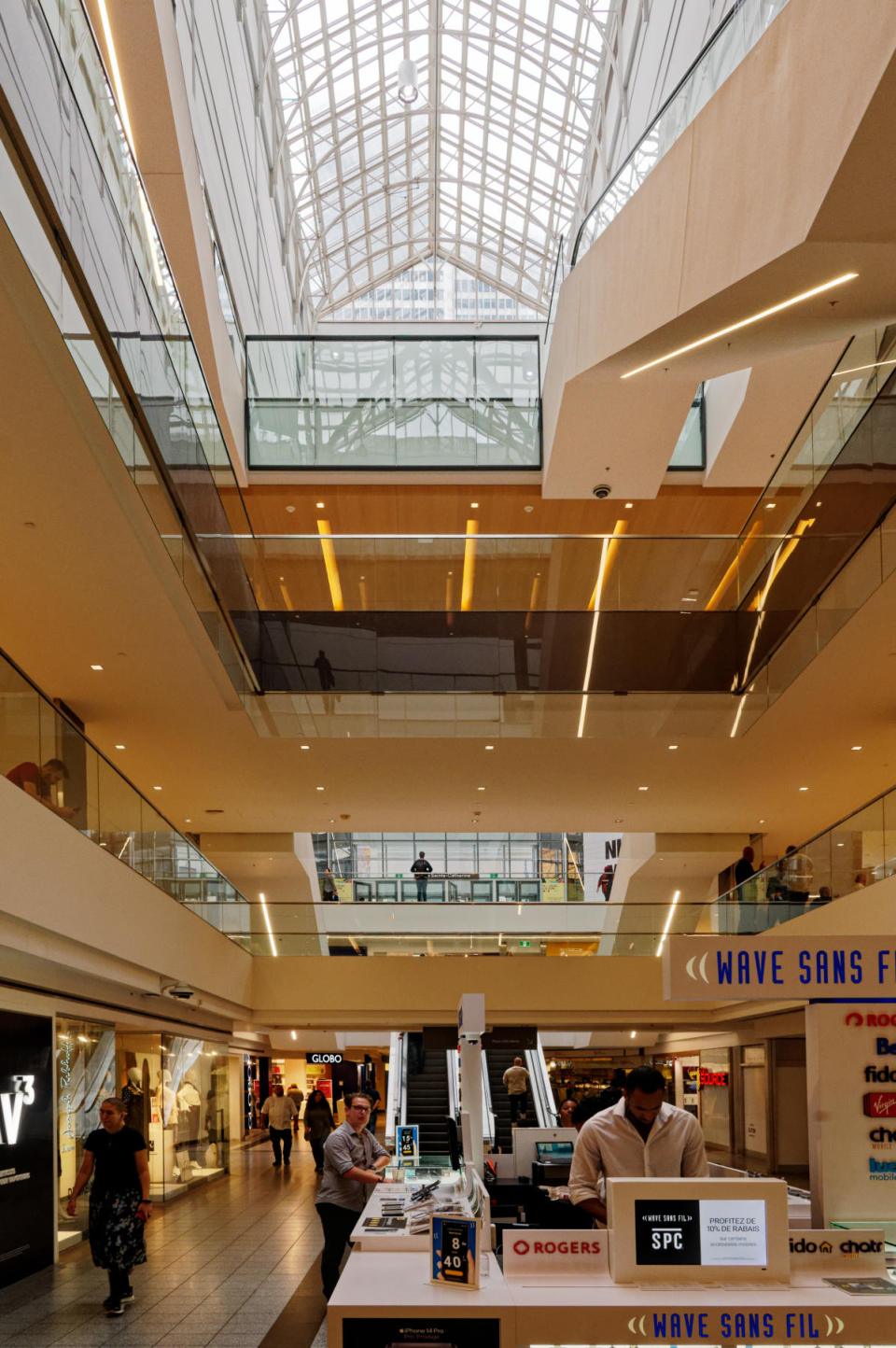
The weather outlook was for heavy showers so we decided to use the time until our room became available to go back into the RÉSO and explore a bit, on the basis that this carried the minimum risk of getting soaked. Back underground we went, and found, to no real surprise, that it was very similar to Toronto’s PATH: corridors and walkways;

eateries in profusion;

occasional glimpses of the outside world;

shops and shopping centres;

some interesting architecture;

and some quirky touches.

These two escalators were unusual in that they were both working.  In many other cases, one of the escalators was not.  This seems so systematic across the bits of the city we’ve passed through that I can only assume it’s because of routine maintenance in preparation for the forthcoming winter, rather than the kind of tight-fisted neglect which leaves so many UK escalators nonfunctional.

Having found ourselves in the Eaton Centre, a temple to consumerism that was of no interest to us, we realised that we were quite close to the city’s Christ Church cathedral, so we popped in for a look.

There’s a nice almost-cloister round the back, too.

We decided to walk back towards the hotel – not one of Fairmont’s more sumptuous establishments –

and mooch around near it until we were alerted that our room was available.  Our friend Ian Burley, whose Canadian recommendations have been very helpful as we work our way across the country, describes the area around the hotel as “charmless”.  He’s right; but that doesn’t mean it’s uninteresting.  Opposite the hotel, for example, is the newly installed 30m diameter steel Ring at the entrance to downtown’s Place Ville Marie

(sorry about the C2 crap in the way of a decent image); and next door to the hotel is the huge Basilica of Mary Queen of the World,

so we popped in there, too.  It’s rather different from Christ Church….

…one can easily tell which is the Protestant and which is the Catholic church.  Outside, this cathedral is architecturally complex in a similar manner to that of Sainte Anne de Beaupré.

Whilst walking around, we also saw this extraordinary building.

which looks like a bastion but is actually the Gare Windsor,

formerly the city’s Canadian Pacific Railway (CPR) station, and which served as the headquarters of CPR from 1889 to 1996.  It’s now mainly office space, and has a wonderful atrium.

We walked out into the courtyard outside, and spotted what we thought was our first piece of street art (something that’s very big in Montréal).  Actually it wasn’t really; this was the Place des Canadiens who are

Montréal’s hockey team.  There’s a kind of Hall of Fame by this big billboard.

Our room was by this time available, so we put our bags into it and then almost immediately headed out to see another of Ian’s recommendations and something that Jane particularly wanted to see –

the Leonard Cohen mural.  I should point out that this takes up 13 storeys on the side of a 21-storey building. I have used image manipulation to straighten the photo above.  To give you an idea of the context, this is how it looked:

The route we walked there took us through streets that weren’t all that pleasant, with many homeless and/or otherwise troubled people in evidence, and there was a powerful whiff of weed almost everywhere.  We walked back a slightly different route, which was less oppressive and in doing so spotted our first piece of real street art,

a mural so big that it was not possible to fit it all into a single image, but I’ve done my best here.  The general area around our hotel is pretty much a business district and so one wouldn’t expect it to have lots of charm. There are one or two odds and bits of interest

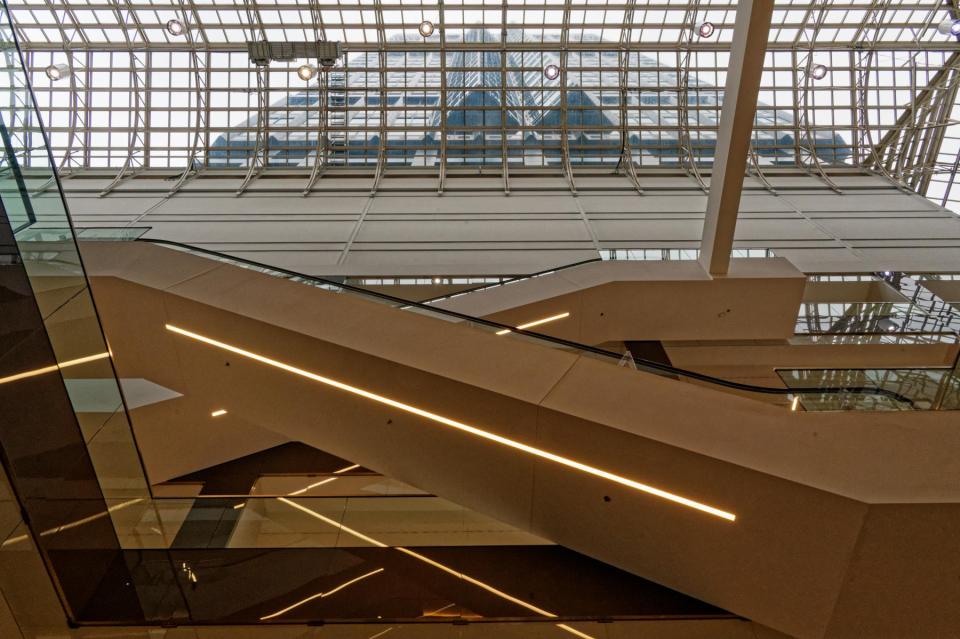
although I haven’t a clue what any of them are about; and there’s some interesting modern architecture, which I’ve attempted to convey in an arty shot here.

Many of the tall modern buildings hereabouts are quite interestingly architected, with modern takes on art deco and so forth, so it’s not without interest.

It was nice to have a chance to explore a little of the area in preparation for two days of currently unplanned wanderings.  Apart from anything else, it made us realise that we would need to get equipped with ticket for the metro in order to get to the areas we want to explore – it would take too long to walk. I’m sure that by the time we get to tomorrow, Jane will have worked out what we should be getting up to, and I bet it involves looking for street art among other things.  You’ll have to stay in touch with these pages to find out, won’t you? I hope you think this is a reasonable idea.