Tag Archives: Scenery

Can we bear the suspense?

Wednesday 28 September 2022 – The mood, as we got into the bus to go to the buggy to spend another day searching for polar bears, was a little muted; everyone was, I think, disappointed that the previous day’s searching, whilst it had shown us some wildlife, had been unsuccessful in its main objective.  Joe took us along a road where there was a possibility of seeing bears – indeed, there was a bear guard in evidence.

We passed the graveyard, which is really quite extensive (and the norm is three feet down rather than six feet, due to the permafrost)

and a site where there is extensive quarrying for stone to support the improvements being implemented to the railway leading to Churchill.
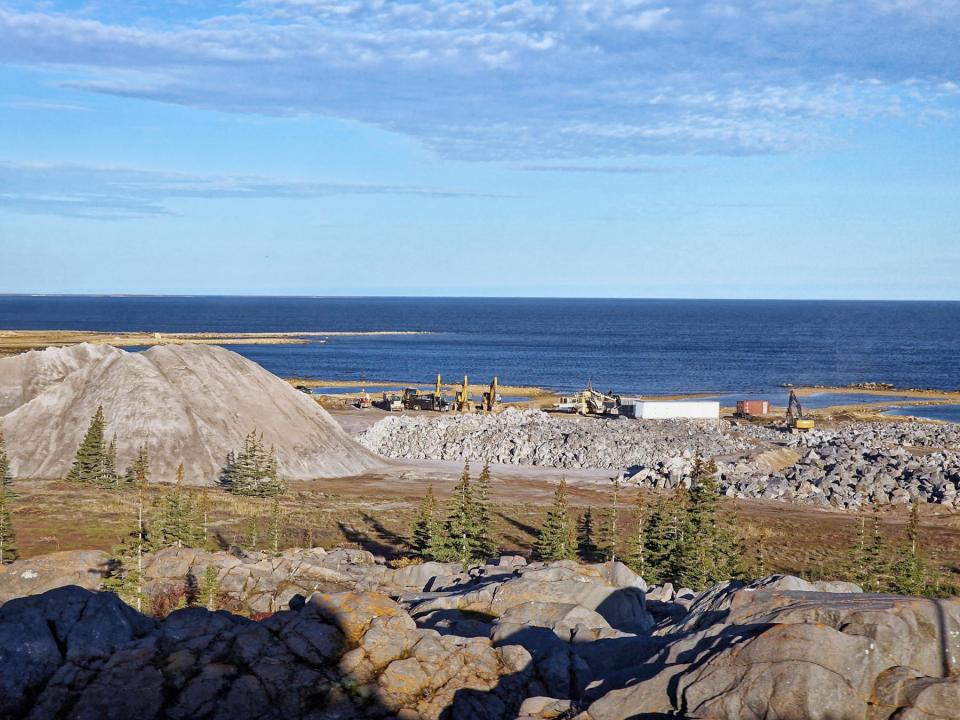
(The railway is one of only two ways to reach Churchill, the other being by air.  It currently takes 18 hours to reach the town by rail from where the road ends, at Thompson, 400k to the south, and the target is to halve that time, which requires a lot of current improvement and then maintenance work on the tracks.  The quarries in Churchill will be active for a while yet.)

All we got, though, was the by now customary opportunity for the more emotional among us to shriek with excitement at seeing some passing Belugas.

As we got to the buggy dock, one of our group, Theo, suggested that we exit the bus facing backwards, to leave the previous day’s bad luck on the bus.  For some strange reason, we all did this.

The buggy route, which of course is constrained by the network of available trails, was pretty much exactly as the day before – 26 miles in total.

I had got my gimbal working, so was able to record some better footage to give an idea of just how not smooth progress is.

However, the day perked up a bit when, just after 10am, one of the eagle-eyed people on the bus spotted a bear!

As you can see, it was quite a way away – my eyesight is not very good (it took Jane a few minutes of patient explanation to enable me to actually locate the bear in the surrounding landscape) and I am utterly impressed that Bob and Jason and Mark are quite so expert at seeing wildlife.  Zooming in, this is what I got out of the above.

Well, it’s identifiably a polar bear, at least.  It was doing what polar bears in the West Hudson Bay bear population do at this time of year, which is, well, not much, really.  The good times for them start when the ice freezes in Hudson Bay and they can get out on to it to catch and eat seals.  Unlike Grizzlies, which can subsist on berries and other such foods, polar bears really need the skin and blubber of seals to fatten up; they convert over 80% of such fat to their own adipose tissue.  Until the seals can be hunted, the bears are basically fasting.  Of course they’ll gorge on anything they can find, such as a Beluga carcass on the beach or some such, but basically they’re just waiting around for the freeze – and being careful not to expend too much energy.  So this bear did really not very much for quite a while.  On the other side of the buggy, we could just about make out a bald eagle, perched on a rock,

and there were some shore birds (Lesser Yellowlegs it seems) to keep us amused

whilst we waited to see what the bear did.  There was excitement when it stood up and walked a few paces

but then it lay down in the vegetation and basically disappeared from view.

We moved on, hoping to find more bears.  We passed the Frontiers North Lodge, by now expanded from yesterday and almost ready to receive guests

and we noted that the Tundra Swans had got a couple of other birds trying to get in on their act.

But, apart from a distant dot on some distant rocks which Bob declared to be a sleeping bear, that was it for the rest of the day on the buggy.  We got back to the dock just after 4pm having bagged just the one bear.  It was a lovely sunny day and the temperature was quite high – nearly 20°C, so there was some, erm, very scenic scenery. Jane caught this nice example of fall colours in the landscape.

At the buggy dock, Joe was on hand to take us back to town, on a route which took us past the rocket base that was once such an important part of Churchill’s military role.

It’s disused now, and the ugliest building – the concrete blast bunker – has, of course, been the recipient of a mural to try to pretty it up a bit.

As he drove us on a roundabout route towards the town, Joe actually spotted more bear!

At first, we thought it was a mother and a cub, but it turned out that there were actually two cubs with their mother, who seemingly just wanted a bit of peace and quiet but had to keep rounding up her boisterous cubs.

We watched them for a while and I recorded some video.

They’re quite a way away, but at least the bear quotient was rising.  Jason pointed out that visible on the other side of the bus was an arctic hare.

It’s a shame it didn’t move to give us a better look, but it was just resting in the shade – why would a sensible hare move under those circumstances?

The mother and cubs disappeared and Joe took the bus along a road which we hoped would take us a bit nearer.  I’m not sure he succeeded in that; but all of a sudden we saw yet another bear, quite a bit closer than the previous encounters.

The experts on the bus eventually came to the conclusion that this was a lone male, and he, like the others, was basically just mooching about.

I got some video of him, as well.

So by the time we got back to the hotel we were a much happier band of bear seekers. We were late for our appointed dinner slot, but since we were basically the only tour in town, I don’t think we inconvenienced people too much.  Had this been later in the season, with multiple tour groups going through the town, we would have had to have limited our time watching the bears, which would have been a shame.

After dinner, Jane went to a reportedly enjoyable presentation at the Parks Office (which, you’ll know because you’ve been paying attention, is housed in the Railway Station)

whilst I toiled away sorting through the vast number of substantially identical photos of bears in various places and combinations to decide what to include in this entry.  I hope you’ve enjoyed seeing and reading about the fruits of my labours and the group’s success in achieving the main objective of our visit to Churchill.

Our time here is almost over.  We have greatly enjoyed it, despite the initial disappointment of yesterday’s fruitless quest.  Things here are workmanlike rather than luxurious, but the hotel was comfortable, the food was good, hearty and well served, and the people we’ve met have been delightful.  There’s a real sense of community here, which has been a pleasure to see in action.

There are a couple of excursions organised for tomorrow before we leave Churchill to get back on our eastward journey and I will, of course write about them here.  Please keep in touch with these pages to see our final activities in this engaging place.


Tundra: birds are Go!

Tuesday 27 September 2022 – The plan for the day was simple – get out on a Tundra Buggy and find polar bears. So, bright-eyed, bushy-tailed and breakfasted, we got on the bus and Joe took us for a half-hour drive to the Buggy Dock

where number 15 was to be our chariot for the day.

We were a small group, so there was plenty of room to spread out in a nice warm cabin.

Our driver was “Buggy Bob”, a man of great experience in driving these great big things across terrain which is tricky, but not impossible; we would go along old tracks originally created by the military in the 1940s and not deviate from them in order to minimise disturbance to the local wildlife. This is Buggy Bob.

I reckon he looks a lot like Sean Connery in The Hunt For Red October, but Jane disagrees.

Anyhoo…

The ride in these great beasts is not the smoothest, as it’s over very rough terrain, including places where water has covered the trail.

I want to give you some idea of how ungentle the ride is, but unfortunately “buggy” also applied to the software for my stabilising gimbal which I use with my mobile phone. I couldn’t get the two to co-operate and so this is the best I could do under the circumstances. I will try to get you a better impression during tomorrow’s ride.

We covered about 25 miles in 6 hours, so progress is barely above walking pace. But it’s a good way of seeing the wildlife without the risk of attack from a disconcerted bear, and it’s warm (the temperature outside was about 4°C and the brisk wind was once again of the lazy variety, so it gets my vote).

The scenery is at times quite striking, with fall colours becoming more and more established.

We passed near the accommodation buggies of a tundra lodge offered by another tour company

and were near the Churchill River when an excited cry went up as someone spotted what might have been a Beluga Whale swimming along. So we stopped for a closer look. Many people were delighted to have seen these Belugas, but frankly I found it difficult to be greatly moved, as this was the scene.

The Belugas are the white flecks towards the middle of the picture. Even zoomed in, they don’t, to me, present a scene to get excited about.

There were apparently some Eider ducks to be seen, too.

If you zoom in, they are the little black dots just above where the waves are breaking.

There was more excitement as we saw bear footprints – an adult and a cub, apparently.

The next excitement was the sighting of a bald eagle.

Yes, there it is.

But then it flew away.

Jason, one of the tour leaders reckoned he saw a beaver.

It turned out to be a muskrat.

We passed a site where Frontiers North are establishing their own residential lodge in the midst of all this tundra.

This will be fully commissioned and operational within a couple of days to receive the first guests of this year’s Bear Season (basically October and November).

There was even more excitement as we saw a Tundra Swan – the second largest bird in North America behind the Trumpeter Swan, Mark tells us. In the end, we saw it was a family of two adults and four cygnets, who took one look at us and moved away, slowly and with dignity.

Mark diverted us for a while with an explanation of why these Spruce trees have grown the way they have – clumped together, bushy at the base and scraggy at the top.

The weather is the driver of this. Ice particles driven by the wind strip the upper branches back; snow covers the ground to a depth of two feet on average and stops this happening for the lower branches. The short growing season and the snow also prevents the normal conifer reproduction method of dropping cones with seeds in them. Instead, the branches grow round and back down to the ground and “sucker” new growth before themselves dying back. Apparently beneath the little “skirt” of branches the temperature can be up to 10°C warmer, helping the trees establish an underground network for spreading through the permafrost and providing a congenial microenvironment for small creatures.

We saw some snow geese. They heard us coming and flew away.

Later, we came across an unusual sight, which was a single snow goose, just wandering around seeking food.

Then someone saw a Ptarmigan.

Bob confirmed it as a Willow Ptarmigan. Excitement mounted as we saw there were several,

all with the distinctive cute feathery leggings.

The scenery continued to be striking at times.

In the photo above, you can see that the path leads in to water, and so we relied on Bob’s skill and experience to get us through safely.

And then it was 4pm and we were back at the Buggy Dock.

This was an opportunity for a group photo (to be published when I can get my hands on it). Notably, there was an armed Bear Guard on duty (shown here chatting to Bob) whilst we were outside the Buggy.

I can’t imagine why, because there weren’t any fucking bears anywhere around. To prove this, Joe took us on a drive round the back roads in the bus, past various locations such as the “golf balls”,

that once housed radar tracking technology for the rockets that were tested hereabouts, and the shipwreck,

the rotting remains of a ship called the Ithaca which ran into trouble in the 1950s when ice crushed the rudder into the propeller and has been abandoned there ever since.

But no bears.

I took a couple more pictures of the town of Churchill as we headed back to the hotel, which add to its strong identity as a frontier town.

But no bears.

And that was it for the day, for me at least. After dinner, Jane went to a talk given by a trapper, but I stayed behind to deal with the recalcitrant gimbal and to see what photographs could be rescued from a day which had, apart from the bird life, featured a bear minimum of activity. We go out in the buggy again tomorrow, with our fingers firmly crossed for the polar opposite of today’s searching. I hope you will come back to find out how we got on.

The Nelson Column

Saturday 24 September 2022 – As expected, Jane had formulated A Plan for the day – a walk in the Old Town, followed by a stroll beside a canal which led to the Old Port.  Accordingly, we hopped the Metro to Champ-de-Mars (because we’re seasoned users of the public transport now, you see), and attempted to follow a self-guided walking tour that Jane had found on the interweb. This part of the day, overall, was not a success, partly because the route given by the website was either not very good or incoherent (possibly both) and partly because Montreal Old Town is, well, not really very interesting.  Perhaps it would have been more rewarding if we’d been able to organise a guide to regale us with fascinating historical and contextual nuggets, but, as it was, we didn’t find much to wow us.

There are some prominent buildings there, such as the Bon Secours market building, with its distinctive silver-coloured dome, which I assume is a tin roof with big ideas.

It looks like the sort of building that should house something monumental or religious, but actually inside it is a modernish market, with boutiquey shops.  Even the tourist tat is done quite nicely.

Other major buildings of interest, such as the Town Hall and the Basilica of Notre Dame, are shrouded in scaffolding and other paraphernalia of reconstruction, which renders them less easy on the eye.  Next door to the market building is the Notre Dame de Bon-Secours Chapel,

inside which, we were delighted to find, was a chamber trio playing at the far end – rehearsing for a concert, we guessed.

The chapel dates from 1771; it was a popular place of worship for sailors coming to port from the St Lawrence river and it became widely known as the sailors’ chapel. It has a lovely interior

with replicas of ships hanging from the ceiling as a reminder of this heritage.

And, er, that’s it for the Old Town, really.  We wandered about the rest of the area trying, and, we eventually realised, failing, to follow the self-guided tour.  It had one lighter moment when I spotted an illusion that the figure on top of the chapel was trying to operate a punt,

but beyond the Wheel and the Clock Tower (with the geodesic dome of the Montreal Biosphere museum, designed by Buckmaster Fuller for the US pavilion at the 1967 Expo, visible in the distance)

we couldn’t find anything particularly to detain us beyond this general kind of street scene

It was at this point that we found out that the “Galleon” by the Wheel was a kids’ adventure park.

Having exhausted what we could see of the entertainment possibilities here, we decided to go for Part 2 of The Plan – the Canal.  To do this, we hopped the Metro again, to Place Saint Henri, and then walked down to the Lachine Canal, which connects Lake Saint-Louis to the Old Port, our target for the walk.  The canal gets its name from the French word for China (la Chine). The European explorers sought to find a route from New France to the Western Sea, and from there to China and hence, optimistically, the region where the canal was built was named Lachine.

Jane had read that the canal had been the subject of some gentrification (not unusual for waterside locations with an industrial history).  Initially, there wasn’t much evidence of this, but before too long we saw the unmistakeable signs of what would once have been a warehouse or similar.

This turned out to be Merchants Manufacturing, a mill which has a reasonably chequered history, including being expanded to be the second largest cotton factory in the country.  Further investigation showed that it was now a very substantial and not unattractive apartment complex.

The canal then displayed signs that we were approaching another nexus of civilisation

and then we found ourselves at Atwater Market, which is quite substantial and was quite busy.

Just as Jean Talon’s market had introduced us to aubergines and cauliflowers of unfamiliar colours, this one showed that squash can come in a variety of colours

as well as the more common orange of the pumpkin.

Every year I’m astonished by the ubiquity of pumpkins in this season.  Surely you can only eat or carve so many?  What happens to all the rest?

As we went back to the canal, we passed a “flowerbed” which actually contained only edible plants – a nice touch.

We passed another suburb which had a canal-side chess den

and seemed to be preparing for some kind of local festival.

Evidence of the industrial past increased as we neared the city.

We passed one of the hydraulically-operated locks

which, I was pleased to note, was being kept clear of leaves and other debris by the lock-keeping staff,

something which I wish could happen in the UK, where the appearance of many otherwise charming locks is spoiled by accumulated crud, both natural and man-made.

We also discovered that the canal path was part of the Trans-Canada Trail, the scope of which is absolutely vast – 

28,000km in total, meandering all over the vastness of Canada’s interior.  To give this some context, the circumference of the earth is just 40,000km.

Further evidence of previous industrialisation mounted as we carried on.

as well as of the gentrification process which is making this walk so much more pleasant.

There is a clear cycle path which is sometimes separate from and sometimes on the same ground as the walking path, thus requiring vigilance on the part of pedestrians wanting to cross the path e.g. to take photos.

The landscape clearly shows what a massively industrial area this once was.

Looking left, we could see the part of the city where our hotel is – you can just spot the dome of its next-door neighbour Basilica among the tower blocks.

There’s a boat converted into a spa

and a clearer view of Habitat 67, a project designed by Israeli-Canadian architect Moshe Safdie and built for Expo 67, a World’s Fair held here from April to October 1967.  It comprises 354 identical prefabricated concrete forms, arranged in various combinations and divided into three pyramids (I’ve only shown two here because there was a stack of containers in the way of the third).

Safdie’s goal for the project to be affordable housing largely failed: demand for the building’s units has made them more expensive than originally envisioned.  Good old market forces, eh?

And then, there we were, in the Old Port

which gives some views over the city

and even makes the Old Town look reasonably attractive.

By this stage, it was nearly 3 o’clock, and so we decided that an early (for us) lunch was the order of the day.  There’s a square in the Old Town, Place Jacques Cartier, which features several restaurants, so we headed there, and Jane suggested we try Jardin Nelson, a restaurant on the ground floor and courtyard of the erstwhile Nelson Hotel – all of which, I suppose, take the name from the version of Nelson’s Column which stands at the top end of the square.

This turned out to be an inspired choice, as we were led to a table in the flower- and greenery-bedecked courtyard

which allowed us to hear the really very good jazz trio who were performing

without being overwhelmed by their volume.  We had an excellent poké bowl lunch and then tottered back to our hotel, once again via the good services of the Metro.

And that was it for Montréal, really – a city whose undoubtedly charming scenes just fail to overcome the downside of the scruffiness, graffiti and quotient of beggars and derelicts of the place. It occurs to me that we visited these eastern cities in the wrong order, largely as a consequence of our itinerary evolving over the space of three years, getting modified every time the trip was rescheduled.  Our route (you’ll remember, because you’ve been paying attention) has been from Ottawa to Québec City to Montréal.  I think a better (and more logical) route would be Ottawa – Montréal – Québec City, where the charm of the final destination might erase the less-than-distinguished memories from its predecessor.

Tomorrow sees an interruption to our eastward peregrination, as we head back to Winnipeg as part of ticking an important tourist box.  It involves an early start. To find out more, please join us over the next few days.  See ya later!