Tag Archives: Cityscape

Crossing a qulture qhasm

Monday September 19 2022 – The day started and ended with something warm and familiar – a Nice Cup Of Tea (Twinings Earl Grey, courtesy of St. Lawrence Market in Toronto). In between those comforting landmarks, there was a distinct culture shift as we headed to Québec City.

The Via Rail experience was broadly similar to that of our journey into Ottawa:  masks were required at all times in station and train, unless actually eating or drinking (even between sips of a drink, according to the stern-sounding MC shortly after we set off); food and drink were served at our comfortable seats; power and WiFi were available throughout the journey; and we arrived about half an hour late.  The differences were subtle, though marked:  the ham and omelette served for breakfast were both very odd creations; the WiFi worked for some websites (including, fortunately, this one) but not others (including my banking app, so I couldn’t check on whether the Ottawa hotel had really given us free internet access); and our suitcases were checked in, rather than accompanying us in the carriage. Oh, and the weather wasn’t all that brilliant, either, but then we were on a train, so didn’t really mind.

On the journey, Jane saw more churches with what looked like silver spires

(reminiscent of Notre Dame in Ottawa). The explanation will be forthcoming tomorrow, by the way, so please continue to pay attention.

But then we arrived in Québec city, and it was obvious that we had qrossed a qultural qhasm: we might as well have been in Paris.  The atmospheric change affected the passengers, whose previous orderly behaviour descended into an amorphous mob grabbing at their luggage as it came off the baggage car; initial signs directing passengers to taxis evaporated, leaving those in need of transport baffled as to where to go; a young lady at an “information” desk couldn’t be arsed to do more than hold up a piece of paper with a taxi phone number on it; and the taxi rank (once we discovered it, indicated by a scruffy and not very prominent sign attached crookedly to a lamppost hidden behind a construction site) was devoid of taxis. After all the orderly, North American and well-organised travels of the last six weeks, it was a distinctly European experience.

Eventually, taxis started appearing and the ragged queue that had rather grudgingly formed with a puzzled expression on its collective face, started being transported to its destinations. The sophistication of the local taxi network was laid bare as our taxi driver stopped at one point to shout at another taxi that he should go to the station as it was “plein” (full), and reinforced as he explained that he’d prefer us to pay cash – the first time we had actually had to use Canadian banknotes in a month and a half. Oh, how we chuckled!

The Parisian feel continued as we arrived at our hotel (yet another Fairmonster, the Chateau Frontenac)

whose front yard was littered with vehicles (Gawd alone knows how our taxi driver got out). Once inside, we had a choice of what might or might not have been three separate queues, any of which might or might not have led to a point where we might or might not have been able to check in, amid scenes of fairly voluble and rather unco-ordinated discussions going on all around us.  We took the only course of action one can under these circumstances, which is to stand separately in two of the least unpromising-looking queues, ready to spring to the other in case it was a more effective choice.  In the end, and completely by accident, I won.  I saw a couple of people apparently jump all of the available queues and decided that I should follow this very Parisian example; it turned out that they’d found the Fairmont Loyalty Card queue and since I have an Accor membership I was able to find someone prepared to help us.

Once that had happened, everything proceeded a lot more smoothly.  We got a nice room (rather reminiscent of Jane’s Parisian garret apartment of 30 years ago) on the seventh floor, and the last Parisian snook cocked at us was that we were charged by a hotel room service jobsworth for some milk for the cup of tea we were really in need of by this stage. This is our eighth Fairmont; none of the previous seven have cavilled at simply – and freely – helping out a couple of Brits in pitiful need of tea. But we were now in logical Paris, so not only were we charged for a glass of milk, but, of course, there was a delivery cost added to the bill.

Anyhoo….

It was late afternoon by this stage and so we decided to go for a walk. Obviously.  We (broadly) followed a recommendation from Ian Burley (you’ll remember – of course! – that we met him as we walked around Menorca a year ago) for a stroll around parts of the city.  The walk started on the terrace outside the hotel

which also gives an opportunity to see quite what a monster the hotel is.  The terrace is a pleasant boardwalk in a nice environment

with the occasional surprise, like this toboggan run (winters only, of course)

and, at the end, a really quite substantial set of steps up to Quebec’s Citadel.

Our route took us across the Plains of Abraham (no, not that one, actually; more likely a Scottish fisherman who came here early in the 17th century) which were the scene of a battle between perfidious Albion and those diabolical Frenchies in 1759 as the two nations struggled for control of an extremely important strategic location.  Then we went past the National Assembly building

(very imposing, and much more pleasant on the eye than the government buildings opposite),

and one of the historic gates into the city (St. Louis Gate).

It was almost impossible for me to shake off the feeling of being in Paris.  On one side of the street you could find a charming row of houses and brasseries,

and, directly opposite, great brutalist slabs of masonry;

inexplicable bits of statuary;

attempts to disguise, with a mural

a ghastly block of modern masonry;

and some really charming buildings.

We ended up walking along the Rue St. Jean, sadly by now in the dark, as it looks like it would be really interesting to see in the daylight, past the building site outside the cathedral and back towards the hotel. Québec is clearly going to be an interesting place to look around

despite the appalling solecism of having a Christmas Shop.

This was one of the giveaways that we were not, actually, in Paris; the other was that walking along Rue St. Jean was accompanied by the smells emanating from innumerable popcorn and ice-cream parlours – an ineluctable part of being anywhere near retail establishments in North America.

All in all, it was a pleasant and interesting introduction to somewhere which clearly has a great deal of historical interest to accompany its undoubted charm.  We will hardly scratch the surface in our forthcoming two days here, but it’ll be nice to aim for some degree of insight.

Tomorrow, we are promised, on our itinerary, “A Fabulous Country Tour” and, by the weather forecast, wind and rain.  Who knows how it will go?  Answer: you will, but only if you check back in to these pages to find out.


Ottowa – Capital!

Saturday 17 September 2022 – As promised in my last entry, I have spared you my ramblings for a whole day, so here’s a catch-up of what we got up to yesterday.  The train trip from Toronto to Ottawa the day before was almost entirely unremarkable and quite pleasant.  We were on Via Rail, travelling business class, which is something I would recommend, as it saves a lot of queuing – queues to show your ticket, then queues to get on the platform are the lot of hoi polloi in the bilges.  We were wafted on to a carriage with comfortable seats, free drink and lunch, power for our computers and a reliable WiFi that lent some purpose to having the computers with us.  There were several stops en route, and we arrived in Ottawa some 30 minutes late, but we weren’t in a hurry.  A short taxi ride then got us to our hotel, (yet) another monumental Fairmont slab of masonry

the Château Laurier.

Today’s formal content was a walking tour of Ottawa, billed as free, but with the expectation set that tips were expected. At the appointed hour we met our guide, Craig

who has a real job of teaching history, but who started doing the walking tours 17 years ago and now has a company employing about 15 guides.  I’m glad we got the boss – he is knowledgeable, entertaining and very well organised; he shepherded a group of 17 people around for two and a half hours without boring or losing any of us and we thoroughly enjoyed it.

Ottawa is a strange place, for a number of reasons.  For a start, it’s the home of the government of Canada, and so there are numerous Parliament buildings on, unsurprisingly, Parliament Hill: centre block, with the Peace Tower;

West block, the House of Commons, home of the MPs; and East block, where the senators have their offices. Behind the centre block is the Parliamentary Library, of which more later.

In most of my photos of government buildings, I apologise for the presence of cranes and other signs of construction, but these are impossible to avoid, as The Construction (referred to by locals with implicit capital letters and normally through gritted teeth) is something that has been ongoing for a long time, in some senses for over a century. In 1916, a fire started in the central block, and some bright, erm, spark, thought to close the massive doors between it and the Library.  So the library was saved, but the rest burned down and has been rebuilt.  The Central Block is now being refurbished, so is unused – the Senate debates at Union Station – a mini replica of the original Penn Station in New York – down the way

and the Commons is in the West Block.

The West Block, by the way, has been completely rebuilt, brick by brick.  When The Construction started refurbishing it, the mortar was so fragile that the walls started to collapse as they were being sandblasted, so it was taken apart, and all the bricks individually cleaned, numbered and then used to rebuild.  So it is a modern building

with a copper roof which is still copper-coloured. Look across to the East Block

and you can see what 150 years of weathering does to a building.

The Canadian political system, with its two houses, is similar to the UK’s and is basically adversarial.  In that sense, Ottawa is split.  In a strictly geographical sense it is also split almost exactly in half.  The Parliament buildings are in the Upper Town, which, in the early days of the city, was the Posh Bit, designed and built by largely English and Scottish Protestants.  As such, streets like Spark Street, leading away from Parliament Hill, display architecture that would be familiar in London or Edinburgh

(although the buildings may state that they are “Bank of Nova Scotia” or similar, the government basically owns all of Spark Street, so all of the buildings are government buildings; any shops are leased from it). Government is way, way the most important part of Ottawa’s business, about 60% of the population work directly for the government or its agencies; high tech is second, with many of the big IT names having their Canadian HQ in the city; and tourism is third.

Crossing the Rideau Canal

takes you into Lower Town, where the buildings display a basically French architecture; many would seem at home in Paris.

The Lower Town is home to the Byward Market district, which is the entertainment centre of the city.  So there are profusions of cafés and restaurants, some of which are in very French-style courtyards.

So, why the split?  It was a direct consequence of the creation of the Rideau Canal, a 202km waterway connecting Ottawa to Lake Ontario, dug entirely by hand (no machinery at all) and opened in 1832 as a precaution in case of war with the USA who might then assert control over the Great Lakes and their rivers.  The labourers – 40,000 of them – were almost entirely French or Irish (hence Catholic), and made their homes on the Lower Town side of the canal route, hence the architectural – and indeed cultural – divide.

By the way, the relations with the USA remained cordial, so there was never a need for the Rideau Canal, which remains open these days for pleasure boating from April to October, when the locks are in operation, as seen here when a bunch of Rangers were making their way through by the hotel.

In Winter the canal freezes, of course, which creates the world’s largest skating rink – 7.8km long, and used not only for a bit of fun skating but also by people commuting to work in the winter. It, and Dow’s Lake which it leads to, is a UNESCO World Heritage site.

We saw a lot of other interesting things as we wandered around Ottawa, both on Craig’s tour and our independent ramblings later: protests by the Parliament;

the Centennial Flame, lit in 1967 to celebrate the 100th anniversary of the Canadian Confederation, with sides geographically dedicated to each of the provinces and territories;

statuary;

(above imaginatively called “Bear Catching Fish)

(The above is called “Our Shepherds”.  The accompanying description says “The playful blue colour and simple, symmetrical structure of the sculpture acts as an enticement to consider deeper meanings. Our Shepherds speaks of those who take power and those who are led, inviting viewers to question who are the shepherds and who are the sheep.” This is a load of pretentious bollocks in my view.)

(A representation of The Stanley Cup, the Canadian ice-hockey trophy)

(Maman, outside the Arts Museum and across the road from Notre Dame)

street art;

(a cute advert for a bicycle rental establishment)

(York Street Steps)

and the Changing of the Guard at the Tomb of the Unknown Warrior.

There are nice views over the Ottawa River.


(above: The Canadian Museum of History, designed by an indigenous architect deliberately to have no right angles, as these are deemed to trap spirits)

The Lower Town has a nice vibe about it

(although not everywhere is sweetness and light).

We couldn’t get into the Notre Dame Basilica

because it’s closed at weekends.  We couldn’t get into any Parliament buildings to gawp at the richness of the décor because of closure due to the death of Queen Elizabeth II – and the normal light show on the Parliament buildings had also been suspended, but there was at least a mark of respect,

and we couldn’t get into St. Brigid’s Church (spotted in the distance by Jane as having an interesting spire)

because the last rabble to occupy it have been evicted and the locks changed – see here for details.

The Library, behind Parliament, is indeed an impressive building.

Having been saved by the heroics of Michael MacCormac from the fire of 1916, the Library has been considerably refurbished and its very foundations improved by a complex (and probably expensive) underpinning operation. Walking on the path behind it gives the great views, shown above, over the Ottawa River.

In Sparks Street, the old Post Office building is another flashback to English Victorian architecture

with lions guarding the doorway which are supposed to be welcoming but actually look rather like a cross between Kenneth Williams and Frankie Howerd having seen something rather beneath them.

Nearby is a statue of Oscar Petersen, the virtuoso jazz pianist, who was actually from Montréal, so I’m not quite sure why Ottawa has been selected as its site, but there it is, with music playing quietly in the background.

As you can infer from some of the pictures above, we also wandered about as dark fell, and a couple of buildings looked quite good when lit: the Library;

a nearby pavilion;

the Peace Tower (you’ve seen already); and Notre Dame Basilica

which was hosting a wedding.

Our crepuscular perambulations ended another varied day.  It was excellent to get such a detailed historical perspective on the development of the city on the walking tour; it was a shame that some of the highlights were not accessible, but we still got a lot of pleasure from our ramblings.

The weather outlook for the morrow was, frankly, gloomy, so we thought we’d see how the day evolved, rather than make any detailed plans.  So please come back in due course to see what actually happened.


Going Underground

Thursday 15 September 2022 – In my last post I said I would tell you about our exploration of something that I’d vaguely heard about Toronto. And I will. I promise.

First, however, we had to attempt a photo of the building next to our hotel – the Royal Bank Plaza, which has gold-plated windows.  No, really. Unsurprisingly, there are many photos of this building online, such as this one, But no; we had to have our own.  So, it being a lovely sunny day, and after consultation with the Photographers Ephemeris to check sunshine angles, we hastened out to Bay Street.  This was the result (after a lot of processing to correct converging verticals):

Once again, this (which I think is not bad) was achieved with my mobile phone, as my Nikon’s lens couldn’t capture the whole building in one gestalt.  I could have gone back to the hotel room to fetch my wide-angle lens but (a) the sun would have been wrong by the time I got back and (b) we had urgent business – the day’s project – to attend to.

So, what do you do when walking about Toronto on a beautiful sunny day?  Of course – you go underground.  This is what I’ve been mysteriously referring to heretofore.

Underground……

As you walk around Toronto, you see a lot of grilles in the sidewalks pavements: some small;

and some much larger.

Occasionally, you catch warm air coming out of them, or spot lights of various colours underneath.  This all started to make sense when Sandro, our guide from yesterday, mentioned “the Underground City” – a way of getting between buildings comfortably despite the -30 or -40°C temperatures regularly experienced here in winter.  It’s called PATH, a series of underground tunnels linking building basements and, as we discovered, it’s A Thing – really, Quite. A. Thing – the largest underground shopping complex in the world.  29 kilometres of underground walkways connecting over 70 buildings and incorporating everything that citizens need without them having to go above ground – shops, eateries, medical facilities – as well as the basic businesses it connects (each of whom – banks, department stores etc, is responsible for their own basements, as it were).

It started in 1900, when the Eaton’s department store constructed a tunnel underneath James Street, allowing shoppers to walk between the Eaton’s main store at Yonge and Queen streets and the Eaton’s Annex located behind the (then) City Hall.  It expanded under city planner Matthew Lawson – clearly a man of vision – in the 1960s. Toronto’s downtown sidewalks were overcrowded, and new office towers were removing the much-needed small businesses from the streets. Lawson convinced several important developers to construct underground malls, pledging that they would eventually be linked. What a salesman he must have been.

Anyway, this was something we simply had to explore.

You can get to PATH from our hotel, which we did (actualy the second tunnel ever created as part of what then became PATH); and then immediately got lost, since we had no clues as to compass or street directions.  We (Jane) eventually sorted it out, with some assistance from a nice young man wearing a Security uniform and ad hoc access to the internet courtesy of passing WiFi  hotspots.

It’s extraordinary.

Having got underground to Union Station’s Great Hall

we plunged into the underworld

and blundered about whilst we sorted ourselves out.  From there, we wandered this network of shops,

corridors,

and hallways.

(this last, showing a host of ATMs in a pretty much deserted hallway, reminds me that this was quiet because the sun was shining; during the winter, I bet it’s much busier.)
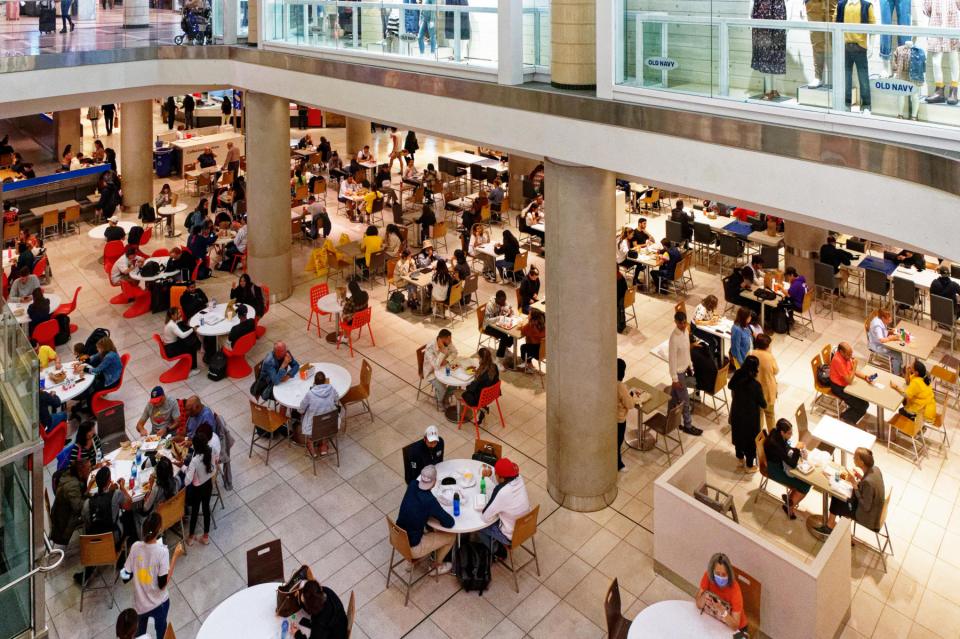
It’s quite interesting to note, as you move from the domain of one building to the next, that the colours and other look-and-feel cues change at the “border”.

There are massive food halls,

dental and medical facilities, including this pop-up Covid vaccination centre,

special messages among the digital advertising billboards,

fleeting glimpses of the outside world,

and occasional insights into the phenomenal amount of work that went into creating PATH and which needs to go into maintaining it.

After covering a couple of miles of this, we eventually emerged, blinking, into

….Overground….

the upper domain of street level.

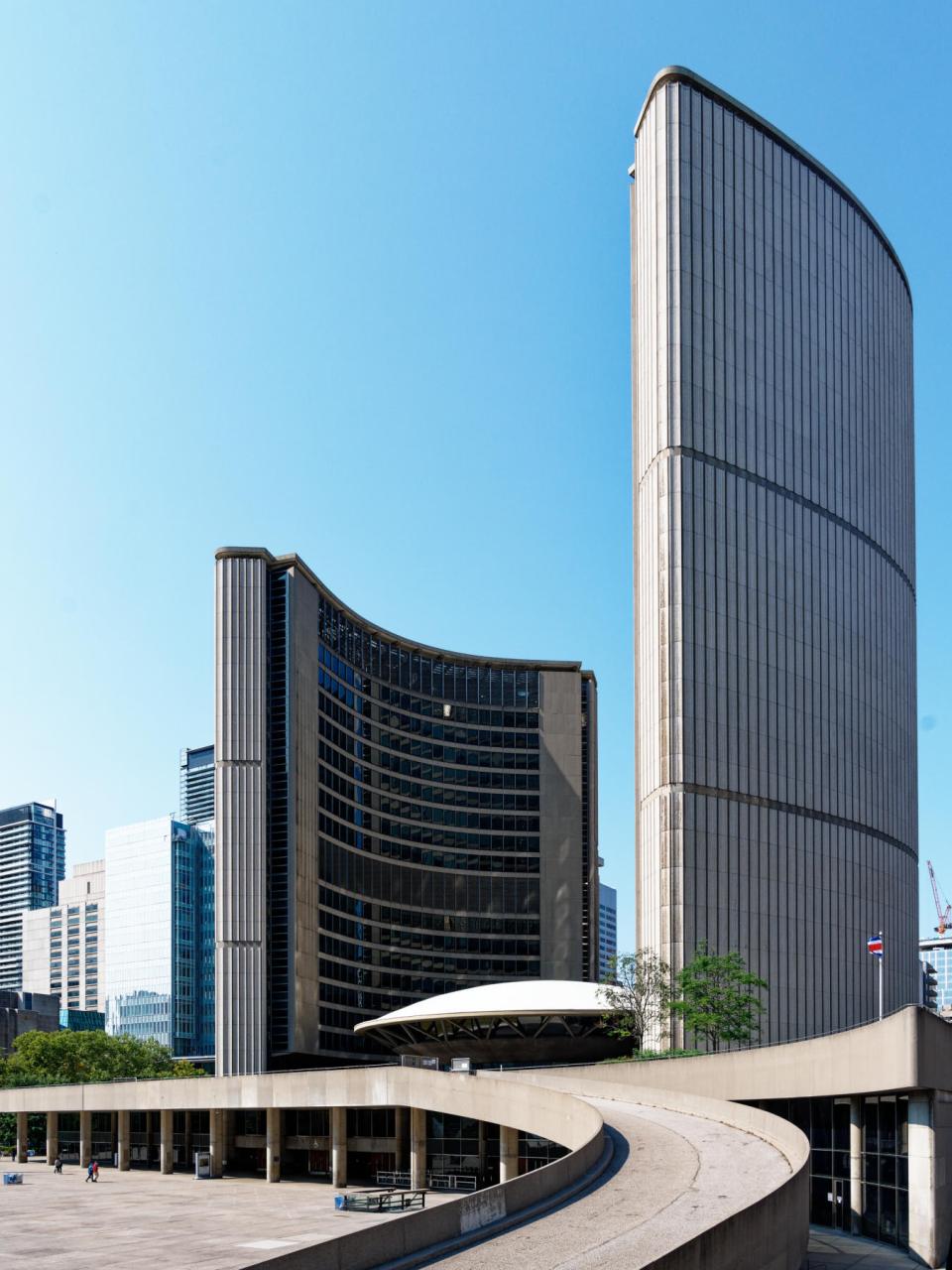
We were near the Old City Hall

and its modern replacement,

the setting of which gave plenty of scope for more photographic angles.

We were on Bay Street, which effectively leads back to our hotel, so we walked towards it, and, on the left, spotted another Architectural Thing – Brookfield Place, which is a sufficiently massive building that you can hardly comprehend it from the street, but which houses a lovely atrium, the Allen Lambert Galleria.

The Overground part of the day finished with a visit to one of Toronto’s defining landmarks, the CN Tower, for dinner. It’s about a 10-minute walk from our hotel, and we used our (Jane’s) new-found confidence in navigating PATH to get there without going outdoors – via the Skyway.

As we arrived, we had to pause for the obligatory ridiculous picture up this 553-metre tower, once the tallest free-standing building in the world until the Burj Khalifa in Dubai sprang up.

There’s a security check and an efficient queuing system, which favours People Like Us (i.e. with restaurant reservations – you can just pay to go up to gawk if you want) and then you’re whisked up to the revolving restaurant in just about a minute, in an elevator with a glass door and a (rather scuffed) glass floor.

We had a nice dinner, with courteous service from our waiter, Juan, and (because they didn’t give us window seats) I made a bit of a nuisance of myself squeezing past tables to take photos of the views of the city and the islands as we slowly revolved past them.

(The Rogers Arena had its roof open today)

Whilst we were eating, the sun set and, after dinner, we went down a level to the observation deck, where hoi polloi had been gawping at the view and taking selfies, to look at the city by night,

and also to mark the forty three years since Jane’s last visit.  This is her original photo.

Note that the landmark in her photo, the white Bank of Montreal building, has rather more surrounding masonry now than it used to. (We do have a night time shot, but it hardly makes any sense, hence not included here.)

We then joined the 10-minute queue for the elevators back down to ground level and headed back to the hotel for a final drink in the…

….Wobbling Free

Library Bar, which is a very classy place in which to have a martini.

And that was it for the day. And for Toronto, really, since tomorrow we leave for Ottawa after an absorbing, varied and enjoyable three days here.  If all goes well, we’ll take the train and have an entirely unremarkable day, in which case I’ll be back to report on Ottawa in a couple of days’ time.  I hope you’ll join me then as we continue our eastward journey.